
Table of Contents
Table of Contents
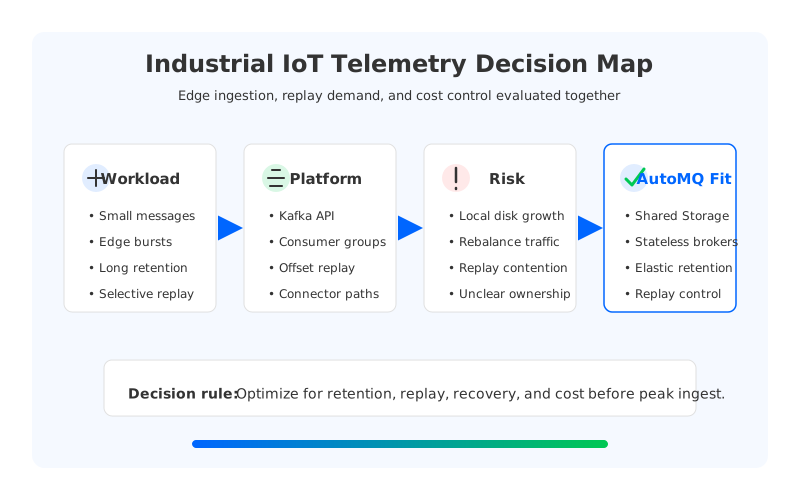
Industrial IoT telemetry looks simple until the first real incident asks the platform to do three hard things at the same time. The factory floor keeps producing sensor readings, the edge gateway reconnects after unstable network windows, and the analytics team asks to replay last week's data because a vibration model changed. A Kafka-compatible streaming layer is often the natural place to absorb that pressure, but the hard question is not whether Kafka can ingest telemetry. The harder question is whether the operating model can survive ingestion bursts, replay windows, and cloud cost scrutiny without turning every maintenance event into a capacity project.
That is why searches for industrial iot telemetry kafka usually come from teams that already understand streaming. They are not looking for a beginner explanation of topics and partitions. They are deciding how to connect machines, gateways, historians, alerting services, lakehouse pipelines, and machine learning consumers without building a platform that becomes expensive precisely when it becomes useful.
1Why teams search for industrial iot telemetry kafka
Industrial telemetry has a different shape from web events. A plant telemetry stream correlates with assets, shifts, maintenance windows, edge connectivity, and control-loop sensitivity. The platform must tolerate small messages at high frequency, out-of-order arrival after edge buffering, and selective replay when a downstream model, dashboard, or regulatory query needs historical context.
The search phrase often hides several production questions:
- Can the edge layer publish reliably when connectivity is intermittent, and can the cloud layer absorb catch-up bursts without destabilizing consumers?
- Can the platform retain enough telemetry for root-cause analysis and model retraining without forcing all retained bytes onto broker-local disks?
- Can operations teams isolate real-time monitoring from heavy replay jobs so that a data science backfill does not interfere with plant-floor alerting?
- Can security and governance teams keep plant, tenant, and region boundaries visible while still giving engineers a Kafka-compatible API?
These questions point to architecture more than syntax. MQTT, OPC UA, historians, and edge gateways may handle local collection and protocol translation, while Kafka provides durable fan-out, ordering within partitions, consumer group coordination, and replay through offsets. The useful design boundary is where local control ends, where durable streaming begins, and how replay is paid for.
2The production constraint behind the problem
A typical industrial telemetry path starts at machines and sensors, passes through edge gateways, and lands in a regional or cloud streaming layer. From there, consumers split into alerting, dashboards, lakehouse ingestion, anomaly detection, and audit pipelines. The expensive part is not the first steady-state write. It appears when the same data must be copied, retained, rebalanced, and read again by consumers with different priorities.
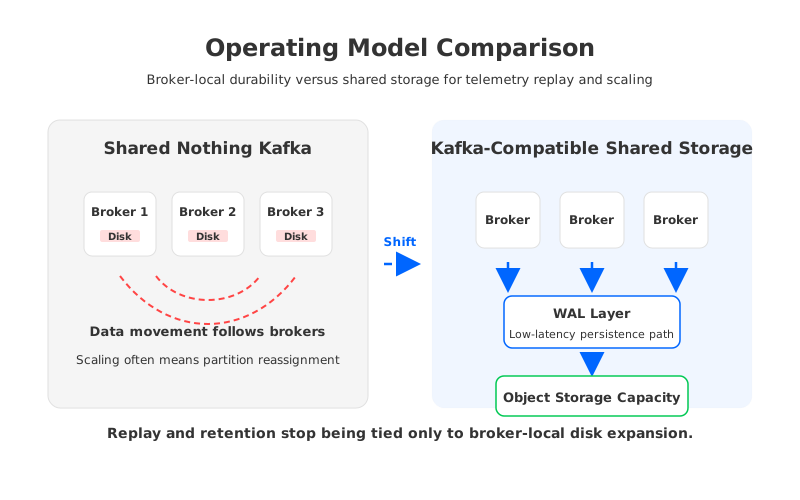
Traditional Kafka is strong at the log abstraction, but its original storage model binds durable data to broker-local disks. That design makes sense in many environments. The operational tension shows up when telemetry growth requires more storage, more partitions, or more retention than the current broker fleet was sized to handle. Adding brokers increases compute even when the real need is capacity. Reassigning partitions moves data across the network. Recovery after broker failure can involve substantial replication traffic. Replay jobs can compete with hot-path reads and writes.
For industrial IoT, those behaviors map directly to business friction. A plant expansion may add thousands of sensors before the central platform team can redesign the cluster. A quality investigation may replay high-frequency telemetry for a narrow time window, but the cluster experiences it as a large catch-up read. A cloud finance review may find storage, inter-zone traffic, and over-provisioned brokers growing faster than production throughput.
The architectural smell is easy to recognize: the team scales compute because it needs storage, moves data because it added compute, and pays network cost because durable replicas must keep broker-local disks synchronized. Kafka did not create the industrial telemetry problem. It exposes whether the platform's storage and compute boundaries match the workload.
3Architecture options and trade-offs
The first option is to keep a conventional Kafka cluster and tune it carefully. This can be the right answer when retention windows are short, replay is rare, operations expertise is strong, and the workload is predictable. The team should still treat disk utilization, partition count, consumer lag, and broker replacement time as first-class design inputs instead of post-deployment metrics.
The second option is Kafka with tiered storage. Tiered storage can reduce pressure on broker-local disks by moving older log segments to remote storage. It is especially useful when the hot set is small and historical reads are occasional. The trade-off is that brokers still own hot data and coordination, and the team must understand how tiering affects fetch latency, operational tooling, and failure recovery. Tiered storage is a storage extension, not a full change in the broker operating model.
The third option is a Kafka-compatible streaming platform built around shared storage. Brokers stay closer to stateless compute nodes, while durable stream data lives in shared object storage with a write-ahead layer for low-latency persistence. The design goal is to scale compute and storage independently, reduce broker-local data movement, and make recovery less dependent on copying large partitions between disks.
These options are not interchangeable, so the evaluation should be explicit:
| Decision area | Conventional Kafka | Kafka with tiered storage | Kafka-compatible shared storage |
|---|---|---|---|
| Edge catch-up bursts | Handles bursts when brokers and disks are pre-sized | Helps if older data is remote, but hot-path pressure remains | Adds compute without tying every change to local data ownership |
| Long retention | Usually increases broker disk footprint | Moves older segments to remote storage | Treats object storage as the primary durable capacity layer |
| Replay isolation | Requires careful fetch throttling and capacity planning | Improves historical capacity, with tiering behavior to validate | Separates replay economics from broker-local disk expansion |
| Failure recovery | Depends on replicas and broker-local data movement | Similar hot-path concerns, with remote historical data | Recovery focuses more on compute replacement and metadata correctness |
| Migration risk | Lowest if already deployed and understood | Moderate, depending on version and operational maturity | Depends on Kafka compatibility, tooling, and rollback planning |
The table is not a universal ranking. A plant historian feeding one daily batch job has different requirements from a global manufacturer running predictive maintenance and real-time anomaly detection across regions. The point is to make each architectural assumption visible before the first outage or backfill makes it visible for you.
4Evaluation checklist for platform teams
The right checklist starts with workload behavior, not vendor features. For each telemetry domain, define the expected write rate, message size distribution, partitioning key, ordering requirement, retention window, replay frequency, and maximum acceptable lag for safety-adjacent analytics. Then identify which consumers are real-time and which are opportunistic.
Governance belongs in the same conversation. Industrial data often carries plant, asset, supplier, and region context. A platform that hides these boundaries inside ad hoc topic names will leak complexity into access control, lineage, and incident response. Topic naming, ACL strategy, schema ownership, and consumer group ownership should be designed before volume makes cleanup expensive.
Use this practical scorecard when comparing Kafka-compatible platforms:
- Protocol compatibility: Existing Kafka clients, producers, consumers, Connect workers, and observability tools should keep working unless a migration plan explicitly accepts code changes.
- Backpressure behavior: Edge gateways need a known policy for local buffering, retry, deduplication, and catch-up. The cloud streaming layer needs quotas and isolation so delayed edge traffic does not starve real-time consumers.
- Replay economics: Retained telemetry is valuable only if the team can afford to read it again. Evaluate how the platform serves catch-up reads and whether replay forces broker expansion.
- Storage and compute elasticity: Sensor growth and retention growth should not always require the same scaling action. If every storage change adds compute, over-provisioning becomes normal.
- Failure recovery: Broker replacement, zone failure, metadata recovery, and consumer offset recovery should be tested as procedures, not described as intentions.
- Security boundaries: Encryption, private networking, identity integration, ACLs, and regional deployment control must match the plant and enterprise risk model.
- Operational ownership: Decide who owns schema evolution, connector failures, consumer lag, cluster scaling, and cloud cost alerts. The architecture is incomplete until these ownership lines are clear.
This scorecard prevents a common mistake: treating ingestion throughput as the main benchmark. Throughput matters, but an industrial telemetry platform spends much of its life handling unevenness: small messages, high-priority consumers, retained history, and replay jobs that should be uneventful.
5How AutoMQ changes the operating model
Once the evaluation reaches independent storage and compute scaling, AutoMQ becomes relevant as a Kafka-compatible cloud-native streaming platform built around Shared Storage. Its design keeps Kafka protocol compatibility while moving durable storage away from broker-local disks and into object storage, with a WAL layer for low-latency writes. The platform discussion shifts from "how many brokers do we need for this much disk?" to "how much compute do we need for current traffic, and how much object storage do we need for retention?"
That shift matters for industrial IoT because telemetry has asymmetric needs. The hot path may require stable low-latency ingestion and alerting, while the cold path may require long retention and occasional replay. In a broker-local model, those needs collide on the same fleet. In a shared-storage model, retained data capacity can grow with object storage, while brokers focus on serving current traffic and coordinated reads. This does not remove the need for capacity planning, but it changes what the team plans.
AutoMQ's stateless broker model is also relevant to recovery and scaling. When brokers are less tied to local durable data, adding or replacing compute can avoid heavy partition movement. For telemetry teams, that reduces the operational penalty of growth spurts, maintenance windows, and node replacement.
Cost control is the other reason shared storage deserves a serious look. Industrial telemetry retention tends to expand after the first real investigation proves its value. Teams start with operational dashboards, then add predictive maintenance, warranty analytics, fleet benchmarking, and data lake ingestion. If every new use case increases broker disk and replication pressure, the platform begins to tax innovation.
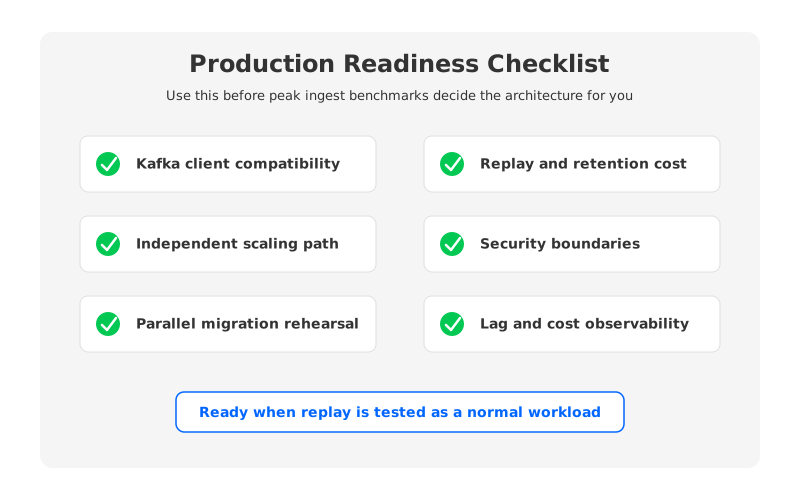
The product fit should still be evaluated with the same discipline as any platform decision. Validate Kafka API compatibility against your actual clients, run replay tests using representative telemetry, test consumer group offset behavior, measure lag under edge catch-up, and confirm deployment boundaries for your cloud account, VPC, IAM, and observability stack.
6A migration pattern that avoids drama
Most industrial teams should not migrate telemetry by replacing the ingestion layer in one step. The safer pattern is parallel validation. Keep the existing Kafka or streaming path as the production source, mirror a representative subset of topics into the new platform, and run shadow consumers for alerting, dashboards, and replay. The goal is to prove that offsets, ordering assumptions, schemas, lag behavior, and operational alerts still make sense.
A useful migration rehearsal has four phases. First, inventory producers and consumers by criticality. Second, choose a telemetry domain with meaningful volume but limited blast radius. Third, run dual reads and compare lag, missing records, duplicate handling, and replay behavior across a known time range. Fourth, define rollback before producer cutover.
The same pattern applies to lakehouse and analytics consumers. If telemetry is also landing in Apache Iceberg, Snowflake, Apache Doris, or another analytical system, validate the connector path independently from the broker migration. Connector failures can look like broker problems when ownership is blurry.
7Cost control is an architecture practice
Industrial IoT cost control is often framed as a pricing exercise, but the larger lever is architecture. Cloud prices matter, and they should be checked against current provider pages before procurement decisions. Still, most surprise costs come from shape mismatch: replicated data crossing zones, brokers sized for storage instead of traffic, and historical reads competing with hot-path operations.
A platform team can control that risk with a small set of operating rules. Put retention into classes instead of one default. Separate real-time and replay consumers by quotas and alerting. Track cost per telemetry domain so one plant expansion does not hide inside a regional bill. Test edge catch-up as a normal workload, not a failure mode.
The deeper rule is simpler: do not let storage, compute, and network cost become invisible side effects of a Kafka deployment. Industrial telemetry becomes strategic when teams can afford to keep it, replay it, and connect it to new consumers. The streaming layer should make that possible without asking operations to manually rebalance the business every time the factory changes.
If you are evaluating a Kafka-compatible architecture for industrial IoT telemetry, start with your replay and retention model before you benchmark peak ingest. AutoMQ's shared-storage design is worth testing when broker-local storage, partition movement, or cross-zone traffic have become part of the operating tax. Review the AutoMQ architecture overview and run a replay-focused proof of concept with your own telemetry shape.
8References
- Apache Kafka documentation: https://kafka.apache.org/documentation/
- Apache Kafka consumer configuration reference: https://kafka.apache.org/documentation/#consumerconfigs
- AutoMQ Shared Storage architecture overview: https://docs.automq.com/automq/architecture/overview?utm_source=blog&utm_medium=reference&utm_campaign=rpb-0184-industrial-iot-telemetry
- AutoMQ S3Stream shared streaming storage overview: https://docs.automq.com/automq/architecture/s3stream-shared-streaming-storage/overview?utm_source=blog&utm_medium=reference&utm_campaign=rpb-0184-industrial-iot-telemetry
- AutoMQ Kafka compatibility documentation: https://docs.automq.com/automq/what-is-automq/compatibility-with-apache-kafka?utm_source=blog&utm_medium=reference&utm_campaign=rpb-0184-industrial-iot-telemetry
- AutoMQ inter-zone traffic overview: https://docs.automq.com/automq/eliminate-inter-zone-traffics/overview?utm_source=blog&utm_medium=reference&utm_campaign=rpb-0184-industrial-iot-telemetry
- AWS overview of Internet of Things services: https://docs.aws.amazon.com/whitepapers/latest/aws-overview/internet-of-things-services.html
9FAQ
9.1Is Kafka a good fit for industrial IoT telemetry?
Kafka is a good fit when telemetry must be durably ingested, consumed by multiple systems, and replayed by offset. It is less useful as a direct replacement for every edge protocol or plant-floor control path. Most architectures use edge gateways and local protocols near machines, then use Kafka or a Kafka-compatible platform as the durable regional or cloud streaming layer.
9.2How should teams partition industrial telemetry topics?
Partitioning should reflect ordering and load distribution. Common keys include asset ID, production line, gateway ID, or a composite key that preserves ordering where it matters. The wrong key can create hot partitions, so teams should test with realistic sensor frequency and plant distribution before standardizing topic templates.
9.3What makes replay expensive in industrial telemetry systems?
Replay becomes expensive when retained data sits on broker-local disks, when catch-up reads compete with real-time consumers, or when historical reads trigger extra network and storage pressure. The cost is not only cloud spend. Replay can also consume operational attention if it requires manual throttling, broker expansion, or emergency rebalancing.
9.4Where does AutoMQ fit in an IoT streaming architecture?
AutoMQ fits where teams want Kafka compatibility but need a cloud-native operating model for storage, replay, and elasticity. It does not replace edge gateways or industrial protocols. It sits at the durable streaming layer, where telemetry is retained, consumed by multiple applications, and replayed for analytics, machine learning, and incident investigation.


