
Table of Contents
Table of Contents
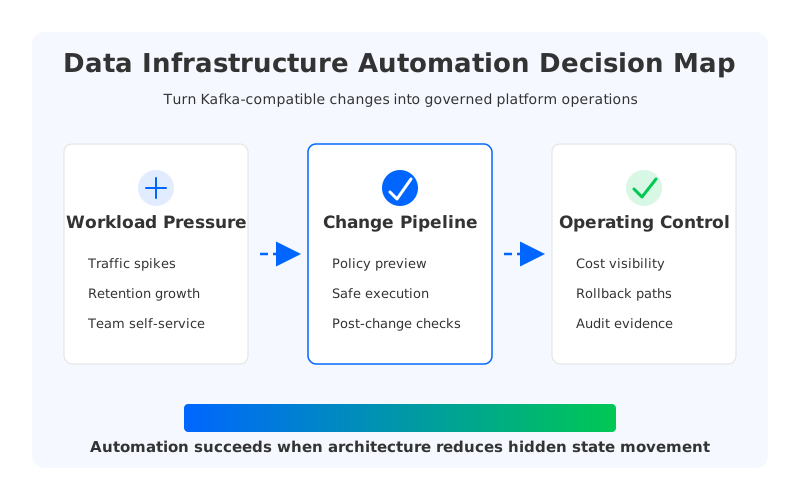
Teams do not search for data infrastructure automation kafka because they want another workflow engine. They search for it when ordinary platform changes start to feel like production events. A topic expansion touches partitions, quotas, ACLs, schemas, dashboards, alerts, consumer lag, and sometimes a spreadsheet predicting disk pressure.
Kafka often exposes this operational tax first. It sits between product teams and databases, mobile events and analytics, fraud detection and payment flows. When it is stable, everyone forgets it is there. When it needs a change, the organization rediscovers how many applications have encoded assumptions about brokers, partitions, offsets, credentials, and latency.
The real question is not whether Kafka operations can be automated. They can. The harder question is whether the infrastructure beneath the automation gives the pipeline a clean, bounded change surface. If every capacity change also implies data movement, client risk, replica catch-up, and cloud networking side effects, the pipeline becomes a wrapper around a fragile manual process.
1Why teams search for data infrastructure automation kafka
The search usually begins after a platform team has automated the obvious tasks. Topic creation moves from tickets to Terraform or an internal portal. ACL requests become pull requests. Dashboards and alerts come from templates. A developer can request a new environment without a long operations thread.
Then the backlog shifts. The team is no longer blocked by missing scripts; it is blocked by the cost and risk profile of the changes themselves. Capacity increases still require careful broker selection. Partition changes still affect load distribution. Broker replacement still has to account for local replicas, network traffic, and cloud billing effects that application teams rarely see.
That is why mature platform teams treat event streaming automation as a pipeline, not a script collection. A pipeline has policy gates, preview, execution, verification, rollback, and ownership boundaries. It records the reason for change and the result, then separates safe self-service from changes that need senior operator judgment.
For Kafka-compatible platforms, the useful automation boundary usually includes:
- Application-facing resources. Topics, quotas, ACLs, credentials, schemas, and connector definitions should be declarative, reviewable, and recoverable from source control.
- Capacity and placement. Broker count, compute shape, storage capacity, availability-zone layout, and scaling policy should be observable before and after the change.
- Data movement and recovery. Reassignments, replica catch-up, offset continuity, mirror flows, and rollback paths should be explicit parts of the plan.
- Cost and governance. Cross-zone traffic, object storage, instance hours, endpoint choices, audit trails, and retention policy should be visible to FinOps and security teams.
This is where many automation programs stall. The developer interface looks clean, but the cluster still behaves like a set of stateful machines that must be nursed through each change.
2The production constraint behind the problem
Traditional Kafka was designed around brokers that own local storage. That model is battle-tested: producers write to partitions, partitions are replicated across brokers, consumers track offsets, and the cluster keeps enough copies to survive failures. The operational cost appears when this design meets cloud infrastructure and continuous self-service.
Local broker storage makes infrastructure change stateful by default. If a broker is removed, replaced, resized, or rebalanced, the platform has to account for data that lives on that broker. If a workload grows, the platform must decide whether the bottleneck is CPU, network, disk throughput, disk capacity, partition distribution, or several at once.
Apache Kafka has improved the operational model over time. KRaft removes the dependency on ZooKeeper, Tiered Storage moves older log segments to remote storage, Kafka Connect standardizes integration runtimes, and MirrorMaker 2 supports replication between clusters. These are important building blocks, but they do not automatically make every infrastructure change small. In many environments, the hot path is still tied to broker-local state and the operator still has to reason about where data sits during the change.
That difference matters for automation because pipelines are only as reliable as their failure modes. A good pipeline can validate syntax, apply policy, and call APIs. It cannot magically make a stateful data movement safe if the architecture requires large amounts of data to move before the infrastructure change is complete.
3Architecture options and trade-offs
Most platform teams arrive at one of three operating models. The first is self-managed Kafka with stronger internal tooling. This gives maximum control and often fits teams with deep Kafka expertise, but the organization owns the runbooks, cost model, upgrade path, scaling discipline, and incident response. Automation helps, yet the platform team still carries the operational semantics of traditional Kafka.
The second model is a managed Kafka service. This reduces part of the operations burden and can fit teams that value procurement, support, and cloud integration. The trade-off is that the automation boundary often becomes the service API. If the service still exposes stateful scaling delays, partition balancing limits, quota constraints, or network charges, the internal pipeline can hide some complexity but not remove it.
The third model is a Kafka-compatible streaming platform that changes the storage architecture. Instead of treating each broker as the durable home for log data, the platform separates compute from durable storage. That changes the automation question. Scaling brokers becomes closer to changing compute capacity, while durability is handled by a Shared Storage architecture rather than broker-local replica movement.
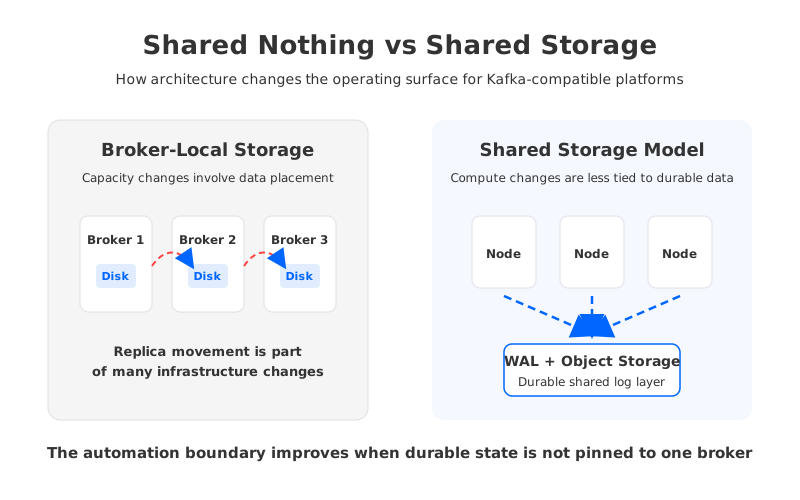
Shared Storage architecture still has trade-offs. Object storage has different latency and request behavior than local disks, so the write path needs a careful WAL design. Metadata, controller behavior, client compatibility, observability, and failure recovery still matter. The narrow point is this: when durable state is not bound to a specific broker, many infrastructure changes become easier to describe, preview, execute, and roll back.
4Evaluation checklist for platform teams
An automation program should start with a neutral scorecard before a product conversation. The scorecard separates developer experience from operational reality. A portal that creates topics quickly is useful, but it is not enough if the platform cannot scale, recover, and explain cost under load.
| Evaluation area | What to verify | Why it matters for change pipelines |
|---|---|---|
| Kafka compatibility | Client protocols, transactions, consumer groups, offsets, ACL behavior, and tooling compatibility | Automation should not force application rewrites or special client branches. |
| Change preview | Planned broker, topic, quota, connector, and policy changes can be reviewed before execution | Platform teams need a visible blast-radius estimate, not opaque button clicks. |
| Scaling model | Compute, storage, and network capacity can be adjusted independently where possible | Coupled scaling turns routine capacity changes into data movement projects. |
| Cost visibility | Instance hours, storage, cross-zone traffic, endpoint charges, and retention impact are observable | FinOps cannot govern what the platform cannot attribute. |
| Recovery boundary | Failure domains, rollback path, offset continuity, and cluster restore process are tested | A pipeline is incomplete when it can apply changes but not recover from them. |
| Governance | RBAC, audit logs, policy checks, approval workflow, and environment boundaries are enforced | Self-service needs guardrails that security teams can inspect. |
| Observability | Lag, throughput, request latency, controller health, connector health, and storage behavior are monitored | Automation needs feedback loops after every change. |
The table avoids vague claims like "fully automated" and asks how a real change behaves. Can the team add capacity without moving large amounts of data? Can it prove consumer-group offset continuity? Can it show why a cloud bill changed after retention changed?
This is also the right moment to define team boundaries. Application teams should request topics, credentials, quotas, and connector deployments through governed interfaces. Platform teams should own cluster topology, version policy, SLOs, recovery design, and cost architecture. Security and FinOps should have policy and cost visibility without becoming Kafka operators.
5How AutoMQ changes the operating model
If the scorecard points to architecture as the bottleneck, a Kafka-compatible shared-storage platform becomes worth evaluating. AutoMQ fits this category: it keeps Kafka protocol compatibility while using a Shared Storage architecture designed for cloud object storage. Durable log data is not owned permanently by a specific broker-local disk, and storage durability is backed by object storage with a WAL layer on the write path.
The operational effect is what matters for automation. When compute and storage are separated, a pipeline can reason about capacity changes with fewer hidden data-placement side effects. Adding or replacing brokers is less entangled with moving durable log segments between machines. Storage growth follows retention and object storage policy rather than broker disk size. Cross-availability-zone traffic can also be reduced by avoiding traditional replica traffic patterns that move full copies between zones.
For platform teams, this changes the internal product they expose to developers. The self-service layer can focus on topics, access, throughput policy, environments, and observability. The cluster layer can focus on SLOs, capacity envelopes, storage policy, and failure recovery. That separation is what makes change pipelines less surprising.
AutoMQ still needs the same disciplined evaluation as any production platform. Teams should test client behavior, transaction semantics, consumer group operations, connector compatibility, monitoring integrations, upgrade workflow, and rollback scenarios. They should also confirm deployment boundaries, network isolation, IAM, and audit expectations.
The practical advantage is that the architecture gives automation a smaller stateful core to manage. Instead of building ever more elaborate scripts around broker-local data, the platform team can move more change logic into declarative policy and verification.
6A reference pipeline for event platform changes
A useful event-platform pipeline has six stages. The order matters because each stage narrows risk before the next one starts. Skipping straight from pull request to apply may work for topic metadata, but it is too loose for capacity, connectivity, or recovery changes.
- Describe intent. The requester declares the resource, environment, owner, expected traffic, retention, compliance tag, and rollback expectation. The goal is to capture why the change exists, not only what API call should be made.
- Validate policy. The pipeline checks naming, quota boundaries, data classification, region rules, retention limits, connector allowlists, and required approvals.
- Preview impact. The platform estimates affected topics, consumers, connectors, capacity, network paths, and expected cost drivers. For high-risk changes, this stage should produce an operator-readable plan.
- Apply with guardrails. The pipeline applies changes through provider APIs, Terraform, Kubernetes controllers, or platform APIs while preserving an audit trail.
- Verify behavior. The system checks throughput, error rates, consumer lag, connector status, storage behavior, and alert state after the change.
- Record and learn. The final stage writes the result back to the change record so the next review can compare expected and actual impact.
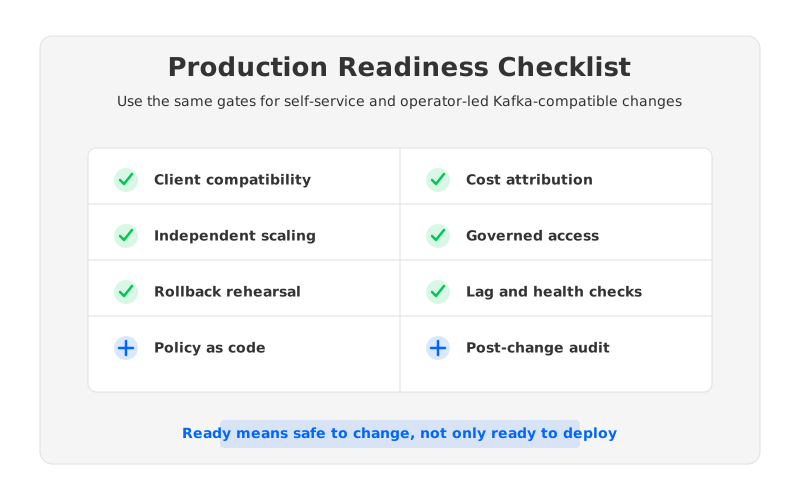
This pipeline works best when the platform distinguishes low-risk and high-risk operations. Creating a topic with approved defaults should be fast. Changing replication, storage policy, region placement, or connectivity deserves stronger review. Expanding compute in a shared-storage design may be routine, while cross-region migration still needs explicit recovery planning.
The value of the pipeline is not speed alone. It turns Kafka operations into an internal product with consistent semantics. Developers get predictable interfaces. Operators get fewer surprise pages. FinOps gets traceability. Security gets policy evidence. Leadership gets a platform that can scale without every change becoming a meeting.
7Migration and readiness scorecard
Before changing the event platform architecture, run a readiness scorecard against one real workload. Pick a service with steady traffic, real consumers, observable cost, and a team willing to participate. Avoid both the easiest toy workload and the most critical payment path as the first test.
The scorecard should answer five questions:
- Can existing clients connect without code changes? Include producers, consumers, admin tooling, schema tooling, and any framework-managed clients.
- Can operational state be preserved? Consumer offsets, topic configuration, ACLs, quotas, and connector state need explicit handling.
- Can the team compare cost before and after? Include compute, storage, network, endpoint, retention, and operational labor assumptions.
- Can rollback be rehearsed? A migration is not ready when rollback is only a diagram.
- Can the platform absorb normal change after migration? Test topic creation, quota updates, scaling, alerting, and access rotation, not only initial data movement.
This scorecard prevents a common mistake: treating migration as the finish line. Migration is useful only if the day-two operating model improves. The goal is not to move Kafka somewhere else; it is to make event-platform changes safer, clearer, and easier to govern.
If your team is building change pipelines for Kafka-compatible infrastructure and wants to evaluate a shared-storage operating model, review the AutoMQ architecture and deployment guidance here: Explore AutoMQ for cloud-native Kafka operations.
8References
- Apache Kafka Documentation: Consumers
- Apache Kafka Documentation: Kafka Connect
- Apache Kafka Documentation: KRaft
- Apache Kafka Documentation: Tiered Storage
- AWS: Amazon S3 pricing
- AWS: Access Amazon S3 through AWS PrivateLink
- AutoMQ Architecture Overview
- AutoMQ and Apache Kafka Compatibility
- AutoMQ Cross-AZ Traffic Cost Guidance
9FAQ
9.1What does data infrastructure automation kafka mean in practice?
It means applying platform-engineering discipline to Kafka-compatible infrastructure changes: declarative configuration, policy checks, preview, controlled execution, verification, rollback, and audit trails. The important part is not the tool name. The important part is whether the pipeline can safely manage topics, access, capacity, connectors, cost, and recovery.
9.2Is Terraform enough for Kafka infrastructure automation?
Terraform is useful for declarative resources and reviewable change history, but it is not the whole operating model. Kafka platform teams still need runtime verification, consumer-lag checks, connector health checks, rollback plans, and cost feedback after changes are applied. Terraform can be one stage in a broader pipeline.
9.3Why does storage architecture affect automation?
Automation becomes harder when every infrastructure change is coupled to broker-local durable data. If scaling, broker replacement, or recovery requires large data movement between machines, the pipeline has to manage more risk. Shared storage can reduce that coupling, which makes many capacity changes easier to describe and verify.
9.4How should teams evaluate Kafka-compatible platforms for self-service?
Start with compatibility, governance, scaling behavior, cost visibility, recovery boundaries, observability, and migration risk. Do not evaluate only the developer portal. A good self-service experience depends on the production behavior underneath it.
9.5Where should AutoMQ enter the evaluation?
AutoMQ should be evaluated after the team has defined the operating model it wants. If the main bottleneck is broker-local state, coupled compute and storage, or cross-zone replica traffic, AutoMQ's Kafka-compatible shared storage architecture is relevant to test with a real workload.


