
Table of Contents
Table of Contents
Teams do not search for confluent alternatives because Kafka stopped mattering. They search because Kafka matters enough that the platform decision has become an infrastructure decision, not a tool comparison. Once streaming carries payment events, telemetry, fraud signals, inventory updates, or AI feature pipelines, the question changes from "Which service can run Kafka for us?" to "Which operating model gives us the right control over cost, risk, and data boundaries?"
That distinction matters because Confluent is a capable and widely adopted Kafka platform. For many organizations, its managed service, ecosystem, and governance tooling are a good fit. The search for an alternative usually starts when a team has a sharper constraint: cloud spend that scales faster than traffic, deployment boundaries that must stay inside a customer-controlled VPC, migration requirements that cannot tolerate client rewrites, or a platform team that wants Kafka semantics without inheriting the full operational shape of broker-owned disks.
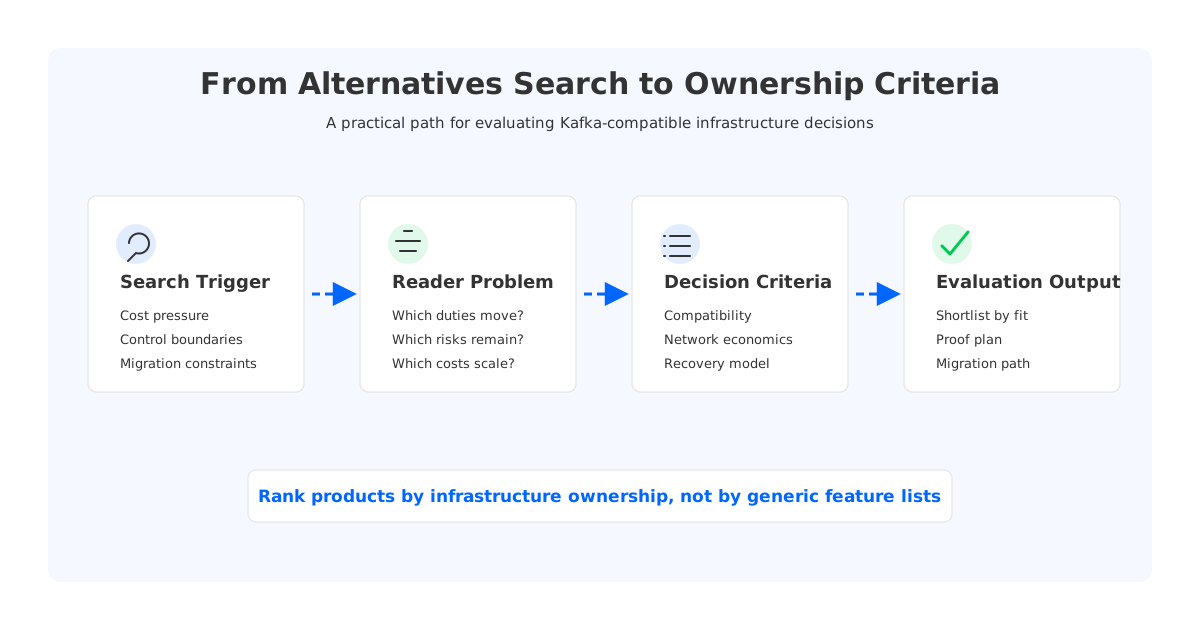
The useful way to evaluate alternatives is not to build a ranking table. Ranking tables tend to flatten the hard parts into checkmarks. A production Kafka platform is a set of ownership decisions: who owns the data plane, where durability lives, how network traffic is charged, and how much of your Kafka estate survives migration. The right answer depends less on brand preference and more on which responsibilities your team wants to keep, delegate, or redesign.
1Why Teams Search for Confluent Alternatives
The first trigger is often cost, but cost is rarely a single line item. Kafka spend is a product of compute, retained storage, replication traffic, read fanout, support model, and operational labor. A team comparing managed Kafka services may begin with a public price page, then discover that the real bill is shaped by workload behavior: how many bytes are written, how often they are read, how long data is retained, and how much traffic crosses availability zones or private network boundaries.
The second trigger is control. Some organizations want a fully managed service where the provider owns most operational decisions. Others want the data plane in their own account for security, procurement, latency, or compliance reasons. Neither model is inherently superior. The point is fit. If platform ownership is part of your internal control framework, the deployment boundary becomes as important as throughput or retention.
The third trigger is architecture. Traditional Kafka was designed around brokers that own local log storage. That model is understandable: local disks are fast, the replication protocol is well understood, and the operational model has been refined for years. In cloud environments, the same model can create a mismatch. Brokers become both compute units and storage owners, so scaling compute often drags data movement with it. Multi-AZ durability can also mean broker-to-broker replication across billable network paths.
Those triggers lead to a more concrete question: what kind of alternative are you actually evaluating?
- A managed Kafka service reduces operational work while keeping familiar Kafka mechanics. This can fit teams that want a provider-operated cluster and are comfortable with the service boundary.
- A Kafka-compatible engine keeps client-facing Kafka semantics but changes internal implementation choices. This can fit teams that want a different storage or scaling model without rewriting applications.
- A self-managed Kafka distribution maximizes direct control, but the team keeps responsibility for sizing, upgrades, balancing, recovery, and cost tuning.
- A broader streaming platform may add governance, connectors, processing, or observability around Kafka. This can be valuable, but it should not hide the infrastructure trade-offs underneath.
If those categories are mixed together, the evaluation becomes noisy. A vendor with excellent governance features may not solve a storage-cost problem. A lean Kafka-compatible engine may not replace a full enterprise platform. A self-managed deployment may reduce subscription spend while increasing operational burden. The shortlist should start with the ownership problem, then map products to that problem.
2The Architecture Criteria Behind the Shortlist
The most important architectural question is where durable log data lives. In a broker-owned model, brokers write to attached storage and coordinate replication between broker replicas. In a shared-storage model, brokers act more like stateless compute nodes while durable data lives in a shared storage layer, often object storage plus a write-ahead log path for low-latency writes. This one decision affects scaling, recovery, network traffic, and operational blast radius.
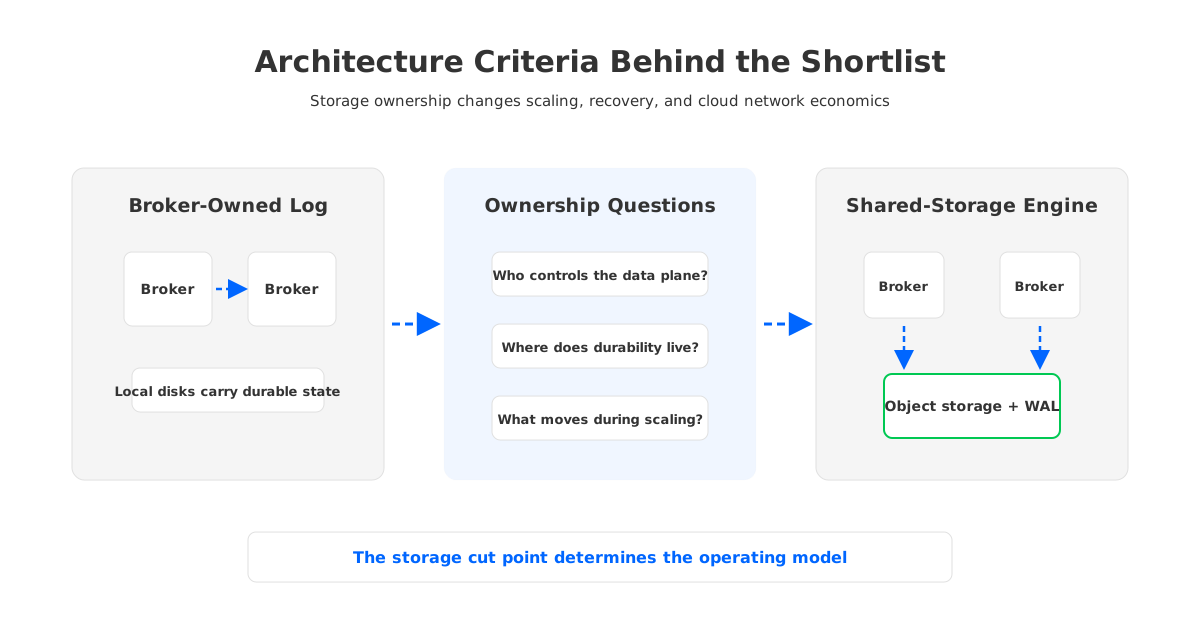
Apache Kafka itself now includes tiered storage, which moves older log segments to remote storage while local disks still serve the hot write and read path. That is a useful capability, especially for long retention. But tiered storage and diskless shared storage solve different problems. Tiered storage reduces pressure from retained historical data. Diskless shared storage changes broker ownership of the log so compute and storage can scale on different axes.
For platform teams, that distinction should turn into specific evaluation checks:
| Criterion | What to Ask | Why It Matters |
|---|---|---|
| Kafka compatibility | Which protocol, client, transaction, consumer group, and admin API behaviors are preserved? | Compatibility determines how much application and tooling change the migration creates. |
| Storage ownership | Do brokers own durable data, or is durability moved to shared storage? | This affects scaling speed, rebalancing, recovery, and how much state is tied to each broker. |
| Network economics | Which writes, replicas, reads, and private connections cross billable boundaries? | Cloud Kafka cost is often driven by data movement, not only instance size. |
| Deployment boundary | Does the data plane run in the vendor account, customer account, or customer VPC? | Security, compliance, procurement, and data residency requirements often depend on this line. |
| Operational failure mode | What happens when a broker, zone, controller, or storage dependency fails? | The failure story matters more than a steady-state architecture diagram. |
| Migration path | Can existing clients, topics, ACLs, offsets, and connectors move with limited disruption? | A technically strong alternative can still fail if migration risk is too high. |
This table is not a feature checklist. It keeps the architecture discussion honest. A platform can score well on managed operations while still leaving your cost model exposed to traffic fanout. Another platform can score well on storage redesign while requiring more ownership of governance and surrounding services. You want those trade-offs visible before procurement turns them into a contract.
3Cost Ownership Is More Than Subscription Price
For Kafka workloads, cost follows bytes. Subscription pricing, instance hours, storage retention, and support tiers matter, but the infrastructure bill is usually pushed around by write throughput, read fanout, and replication topology. AWS documentation, for example, treats many data transfer paths as billable, including traffic between availability zones in common configurations. If your Kafka architecture creates cross-AZ replication or heavy cross-AZ reads, those bytes are part of the platform economics.
This is why "managed versus self-managed" is not enough. A managed service can save engineering time and still produce a cost curve that is hard to explain to finance. A self-managed cluster can expose every knob while requiring constant capacity planning. A shared-storage Kafka-compatible architecture can reduce some broker-to-broker replication patterns, but the evaluation still has to include object storage requests, WAL design, cache hit rate, read behavior, and operational support.
A practical cost review should separate four layers:
- Platform fee: the commercial price paid to the provider or vendor.
- Compute and storage infrastructure: instances, disks, object storage, and retained data.
- Network movement: cross-AZ, cross-region, NAT, PrivateLink, and egress paths.
- Operational labor: upgrade work, scaling work, incident response, capacity planning, and migration support.
The fourth layer is easy to undercount because it rarely appears as a Kafka invoice. It appears as weekend upgrades, slow rebalances, oversized clusters kept around for peak traffic, and SRE time spent explaining why a storage-heavy broker cannot be removed yet. A credible alternative evaluation should include those costs without pretending they can be converted into a perfect universal formula.
4Migration Risk Decides Whether the Architecture Is Usable
A Confluent alternative can be attractive on paper and still be a poor choice if migration breaks the operating model around Kafka. Most production Kafka estates are not only producers and consumers. They include schema governance, ACLs, service accounts, stream processors, connectors, monitoring dashboards, topic conventions, retention policies, consumer offsets, and recovery runbooks. The more of that estate you preserve, the less political and technical risk the migration carries.
That is why Kafka compatibility has to be tested at the behavior level, not the marketing level. Apache Kafka compatibility should include the wire protocol, client libraries, consumer group behavior, offset commits, transactions where used, admin APIs, topic configuration semantics, security controls, and integration with the surrounding ecosystem. If a workload depends on Kafka Streams, Connect, exactly-once processing, or strict ordering guarantees, those behaviors deserve targeted proof before a broader migration.
The migration question is not "Can this platform ingest Kafka records?" The question is "Can our existing Kafka estate continue to behave the way production systems expect?"
The second migration risk is reversibility. Teams often focus on cutover but pay less attention to rollback. A serious plan defines how data is replicated, how offsets are handled, how clients are moved, how long dual-running lasts, and what condition would trigger a rollback. The alternative that looks more expensive during migration may be the lower-risk option if it preserves offsets, gives clean visibility into lag, and avoids application rewrites.
Procurement teams should care about this as much as engineers do. Migration risk becomes schedule risk, schedule risk becomes contract pressure, and contract pressure weakens negotiation. The technical proof of concept should produce artifacts that finance and leadership can understand: workload coverage, known gaps, cutover steps, rollback path, and expected ownership after the move.
5How AutoMQ Fits the Evaluation
Once the evaluation is framed around ownership, AutoMQ belongs in a specific category: a Kafka-compatible, cloud-native streaming engine that keeps Kafka-facing semantics while changing the storage architecture underneath. AutoMQ is not positioned as a replacement for every service surrounding Kafka. It is most relevant when the core problem is the infrastructure shape of Kafka itself: broker-owned disks, slow data movement during scaling, duplicated storage cost, and network traffic created by replication topology.
AutoMQ uses a shared-storage architecture in which brokers are designed as stateless compute nodes and durable data is stored on object storage, with WAL options for the write path. Its documentation describes native compatibility with Apache Kafka by preserving the Kafka compute layer and replacing the storage layer. For teams evaluating alternatives, that means the right proof points are not generic feature claims. The proof points are client compatibility, topic behavior, operational recovery, cost model, and whether the deployment boundary matches the organization's control requirements.
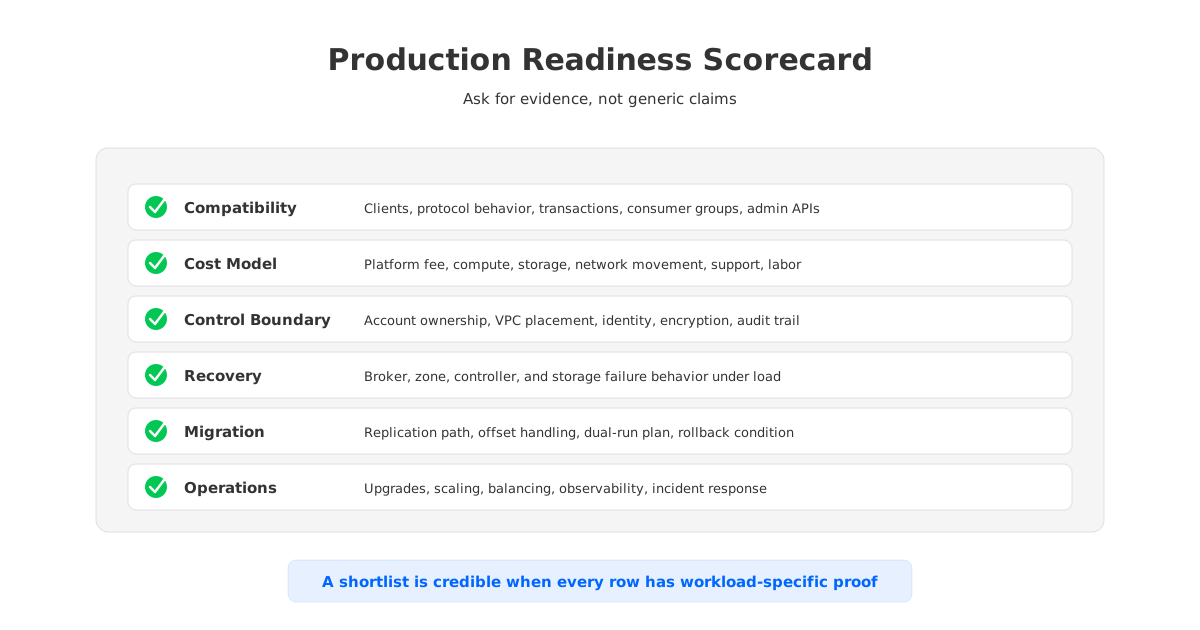
The architecture is especially relevant in three situations. First, if the team wants Kafka compatibility but does not want compute scaling to require large broker-local data movement. Second, if cloud networking cost is a recurring issue and the team wants to reduce broker-to-broker replication traffic patterns rather than tune around them forever. Third, if the organization prefers a BYOC or software deployment model where the data plane remains in the customer's cloud environment.
That does not remove the need for validation. A serious AutoMQ evaluation should still run the target clients, benchmark realistic write and read patterns, test failover, check observability integration, and compare cost under the workload's own retention and fanout assumptions. The strongest reason to evaluate AutoMQ is not that it appears on an alternatives list. It is that the architecture attacks a different layer of the problem.
6A Practical Evaluation Worksheet
The cleanest next step is to turn the search into a worksheet. Give each candidate the same workload profile, the same security requirements, and the same migration constraints. Then ask the same questions in the same order.
| Area | Evidence to Collect |
|---|---|
| Workload fit | Peak and average write throughput, read fanout, retained data, partition count, latency budget, and growth pattern. |
| Compatibility | Client versions, required APIs, transactions, consumer groups, Connect, Streams, ACLs, and admin workflows. |
| Cost model | Subscription fee, compute, storage, object storage, data transfer, private connectivity, support, and engineering time. |
| Control boundary | Account ownership, VPC placement, encryption, identity integration, audit requirements, and data residency. |
| Operations | Upgrade process, scaling behavior, balancing, controller failure, zone failure, storage failure, and observability. |
| Migration | Replication path, offset handling, dual-run plan, rollback condition, and ownership after cutover. |
This worksheet prevents a common failure mode: comparing a full managed platform, a Kafka-compatible engine, and a self-managed cluster as if they were the same kind of purchase. They are not. They allocate responsibility differently. Your decision should make that allocation explicit.
If your current search began with a simple phrase like confluent alternatives, the more useful endpoint is a sharper infrastructure question: which platform gives your team the right balance of Kafka compatibility, cloud cost control, deployment ownership, and operational risk? For teams that want to test whether a shared-storage Kafka architecture changes that balance, run your own workload through the AutoMQ pricing calculator and compare the result against your current Kafka bill and migration constraints.
7References
- Apache Kafka documentation: Tiered Storage
- Apache Kafka documentation: KRaft
- AWS documentation: Data transfer charges
- Confluent Cloud documentation: Overview
- AutoMQ documentation: Kafka compatibility
- AutoMQ Diskless Engine
- AutoMQ BYOC architecture
8FAQ
8.1What is the most important criterion when comparing Confluent alternatives?
Start with ownership. Decide whether your main issue is managed-service coverage, infrastructure cost, data-plane control, migration risk, or operational complexity. Those are different problems, and they lead to different shortlists.
8.2Is a Kafka-compatible platform the same as Apache Kafka?
No. Kafka-compatible platforms aim to preserve Kafka-facing behavior such as protocol compatibility and client semantics, but they may change internal architecture. That can be valuable, but it should be validated against the APIs, clients, transactions, connectors, and operational workflows your estate uses.
8.3Does tiered storage make diskless Kafka unnecessary?
Not by itself. Kafka tiered storage helps move older log data to remote storage, which is useful for retention. Diskless shared storage changes the broker's relationship to durable data, so it affects scaling, recovery, and replication economics in a different way.
8.4When should AutoMQ be on the shortlist?
AutoMQ is worth evaluating when you want Kafka compatibility, customer-controlled deployment options, and an architecture that separates broker compute from durable storage. It is especially relevant when broker-local data movement, cross-AZ replication traffic, or slow scaling loops are central pain points.
8.5How should a team validate cost claims?
Use your own workload profile: write throughput, read fanout, retained data, partition count, latency budget, deployment topology, and cloud region. Then compare platform fees, compute, storage, network movement, and operational labor under the same assumptions.


