
Table of Contents
Table of Contents
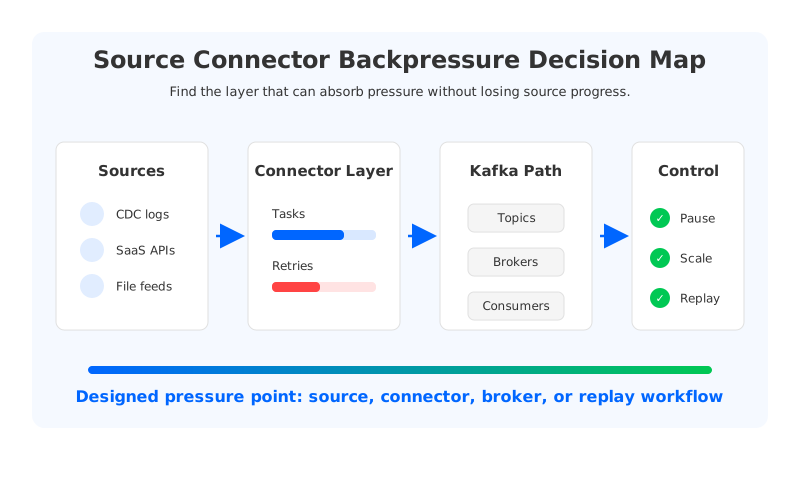
Teams search for source connector backpressure kafka after a pipeline starts pushing back. A CDC connector falls behind. A SaaS connector fleet wakes up at the top of the hour. A schema change forces retries, the retry queue grows, and broker I/O becomes the shared bottleneck for systems that used to look independent. The symptom is connector lag, but the deeper problem is that ingestion pressure has no clean boundary.
That is why connector-heavy platforms need a pressure-control model, not another tuning checklist copied from a single incident. Kafka Connect, producer configuration, consumer lag, topic design, and broker storage all participate in the same feedback loop. Backpressure is a safety signal. The useful question is where pressure should be absorbed, how much the platform can buffer, and what happens when the buffer is no longer enough.
1Why source connectors create a different kind of pressure
A regular producer usually has one owner, one deployment path, and one application backlog. Source connectors are different. They turn external systems into Kafka producers, but they do not fully control those systems. A database emits a transaction log at application pace. A SaaS API may apply rate limits, pagination behavior, and retry windows. The connector sits between two independent clocks, then Kafka becomes the place where mismatched clocks become visible.
The first design mistake is treating source connectors as ordinary producer clients. They do use Kafka producer settings, and those settings matter, but source-heavy ingestion has more failure surfaces:
- The upstream source may not be safely slowed down. A database log, for example, can keep growing while the connector waits for Kafka to accept records.
- The connector runtime has its own task assignment, offset storage, retry, and dead-letter behavior. A broker issue can turn into a connector rebalance issue before the operator sees the original cause.
- The target topic is often shared by downstream jobs with service-level expectations. Slowing ingestion may protect Kafka while starving fraud detection, inventory, or analytics consumers.
- The operational owner is split across integration, platform, source-system, and security teams.
Those boundaries are the reason source connector backpressure becomes political as well as technical. When a connector falls behind, every team can point to a different metric and be partly right: broker disk, task retries, database log retention, or stale downstream data. A good architecture gives all of them a shared control plane for the same pressure signal.
2The constraint hidden inside Shared Nothing architecture
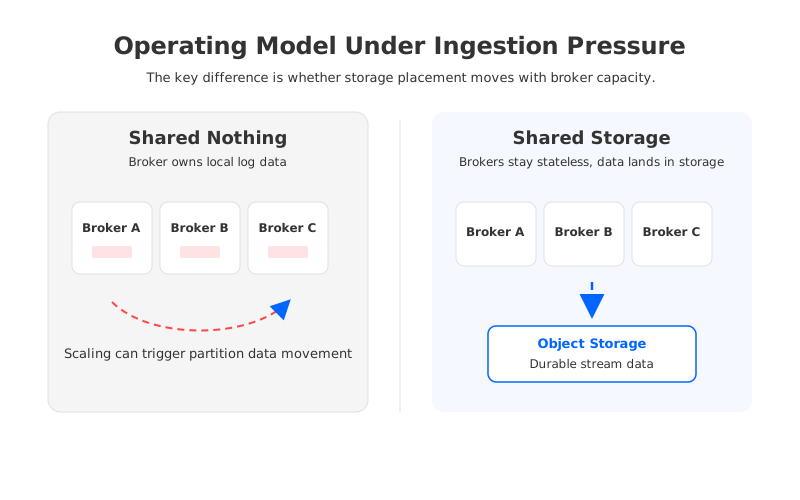
Apache Kafka's classic Shared Nothing architecture is strong because each broker owns local partitions and can serve high-throughput append workloads with predictable locality. The same property becomes a constraint when ingestion pressure arrives unevenly. A hot connector does not write "to the cluster" in an abstract sense. Its records land on leaders for specific partitions, on brokers with specific local disks, through network paths that also serve replication and reads.
That local ownership shapes the pressure curve. If broker-local storage fills or saturates I/O, adding more brokers does not automatically move historical data away from overloaded nodes. Partition reassignment can help, but it introduces more data movement at the exact time the platform is already under stress. Tiered Storage changes the retention economics for older data, yet recent writes still pass through broker-local hot paths. Source connectors care about the write path first, because their failure mode is usually "I cannot commit source progress until Kafka accepts enough data."
The platform decision is therefore less about one connector setting and more about where the system keeps slack capacity. Traditional Kafka clusters often reserve slack in broker count, local disk, replication bandwidth, and manual operational windows. That model works, but capacity is provisioned for spikes while connector traffic arrives in bursts that are hard to schedule.
| Pressure point | What operators see | Why it matters for source-heavy ingestion |
|---|---|---|
| Connector task backlog | Source offsets advance slowly or stop | Upstream retention windows can become the recovery limit |
| Broker write path | Higher produce latency or throttling | Connector retries amplify pressure when Kafka is already busy |
| Partition locality | A subset of brokers carries most hot partitions | Cluster capacity looks available while specific nodes are saturated |
| Rebalance and reassignment | Longer operational windows | Fixing skew can add data movement during the incident |
| Governance controls | Credentials, schemas, and topic policy drift | A pressure event can become a data quality or access-control event |
This table is not a product comparison. It is a reminder that source connector backpressure is a systems problem. Connector settings decide how pressure enters the platform. Broker architecture decides how pressure is absorbed. Governance decides whether the team can slow or reroute ingestion without creating a second incident.
3Failure handling starts before the broker rejects writes
Backpressure discussions often jump to buffer sizes, retries, and linger.ms. Those settings are useful only after the team has decided what failure means. A connector that reads from a replayable log can pause more safely than a connector reading from an API with short retention or strict rate windows. A connector that writes idempotent records keyed by primary key has different recovery behavior than one that emits append-only facts. A connector that owns source offsets in Kafka Connect must be evaluated together with the Kafka cluster that stores those offsets.
Kafka Connect gives teams a framework for moving data between Kafka and external systems, but it does not remove architectural choices. Source connectors still need topic design, schema governance, retry policy, dead-letter handling, and source offset recovery. Kafka itself gives operators producer and consumer configuration knobs, plus partitioning and retention controls. The problem is using them in isolation.
For a source-heavy platform, the pressure plan should answer these questions in order:
- What is the maximum safe pause time for each source before recovery becomes expensive or impossible?
- Which topics can accept delayed records, and which downstream consumers treat freshness as a correctness requirement?
- Where are rejected, malformed, or schema-incompatible records stored, and who owns replay?
- How does the team distinguish upstream slowness, connector runtime pressure, broker pressure, and downstream read pressure?
- During migration or scaling, how are source offsets, consumer group positions, and rollback paths protected?
The order matters. If the maximum safe pause time is short, broker elasticity and write-path isolation matter more than elegant retry settings. If replay ownership is unclear, any backpressure event can turn into a long manual reconciliation exercise.
4A neutral evaluation checklist for platform teams
Architects evaluating Kafka-compatible infrastructure for connector-heavy workloads should start with the operating model, then map features into that model. This keeps the discussion grounded and prevents a familiar failure mode: one team buys a faster broker while migration, governance, and connector operations stay unchanged.
The checklist below is the one I would use before changing a production ingestion platform.
| Dimension | Question to ask | Strong signal |
|---|---|---|
| Kafka compatibility | Can existing clients, connectors, serializers, ACLs, and operational tools keep working? | The migration plan avoids application rewrites and preserves Kafka semantics. |
| Write-path elasticity | Can the platform add ingestion capacity without large local data movement? | Scaling changes compute capacity more than storage placement. |
| Storage pressure | Does retention growth compete with active writes on broker-local disks? | Hot ingestion and long retention have separate failure domains. |
| Network cost and topology | Does replication or connector traffic cross Availability Zone boundaries unnecessarily? | Placement and routing policies are explicit, not accidental. |
| Governance | Are schemas, credentials, topic policy, and connector ownership visible in one workflow? | Operators can slow, stop, or replay a connector without bypassing policy. |
| Recovery | Can the team recover source offsets and consumer positions after migration or failover? | Rollback is documented before the cutover starts. |
| Observability | Can metrics separate source, connector, broker, and consumer pressure? | Alerts point to a control action, not only to a symptom. |
One practical scoring method is to classify each connector as elastic, bounded, or fragile. Elastic sources can pause and replay with minimal business impact. Bounded sources can pause only within a known retention window. Fragile sources lose data, violate contracts, or trigger manual repair when ingestion is delayed. Once sources are classified, Kafka capacity planning becomes less abstract: fragile sources deserve isolation and tighter alerting, while elastic sources can share capacity and absorb more deliberate throttling.
Backpressure is useful only when the system has somewhere safe to put it. If every layer passes pressure to the next layer without ownership, Kafka becomes the place where organizational ambiguity is stored.
5How AutoMQ changes the operating model
After the evaluation framework is clear, the architecture question becomes sharper. If connector pressure is hard because broker-local storage, data movement, and compute capacity are tied together, then a Kafka-compatible system that separates compute from storage changes the operator's options. AutoMQ is a Kafka-compatible cloud-native streaming platform built around Shared Storage architecture, where brokers are stateless and stream data is stored in object storage through S3Stream and WAL storage.
This does not make connector design disappear. Source offsets, schema compatibility, dead-letter policy, and upstream retention still need engineering discipline. The difference is where the platform absorbs pressure. In AutoMQ's model, long-term data is not trapped on broker-local disks, and broker replacement or scaling is less coupled to moving partition data. WAL storage handles persistence before data is uploaded to object storage, so adding compute capacity, isolating hot traffic, and recovering from broker failure are less entangled with local disk ownership.
For source-heavy pipelines, this matters in four places. Independent compute and storage scaling reduces local disk reserves for rare ingestion peaks. Stateless brokers make replacement and scaling less dependent on copying historical partition data. Object-storage-backed durability gives retention growth a different profile from broker-local disks. AutoMQ BYOC keeps the control plane and data plane inside the customer's cloud account and VPC, which matters when connector credentials, private endpoints, and source systems must stay within defined network boundaries.
AutoMQ's Managed Connector capability is relevant for teams that want Kafka Connect operations under the same governance model as the Kafka-compatible data plane. The point is that pressure control improves when connector lifecycle, network placement, topic policy, and broker capacity are operated together. When those concerns live in separate scripts and consoles, the first incident becomes the integration test.
6Migration planning is part of pressure control
A source-heavy migration is riskier than a stateless application migration because source offsets and consumer group positions carry business meaning. If a connector writes duplicates, loses ordering for a key, or commits the wrong source position, the damage may appear downstream hours later. Migration tooling belongs in the same backpressure framework.
For Kafka-compatible moves, the migration plan should preserve three things: byte-level data expectations, source-side progress, and consumer-side progress. AutoMQ's Kafka Linking documentation describes migration from Apache Kafka or other Kafka distributions without application changes, including topic synchronization and consumer group progress synchronization. Teams should still run their own cutover rehearsal, because connector behavior depends on source type, serialization, idempotency, and downstream tolerance for duplicate or late records.
The safest migration pattern is boring in a good way. Start with non-fragile sources, mirror traffic, compare topic counts, offsets, lag, schema errors, and consumer behavior, then promote only after the rollback path is clear. Fragile sources need tighter observation windows and explicit owners for source, connector, broker, and consumer metrics. The purpose is to avoid discovering during cutover that the person who understands source offsets is on another team.
7Production readiness checklist
The final readiness review should be short enough for an incident review and specific enough to guide engineering work. If a team cannot answer these items, the pipeline is not ready for source-heavy pressure.
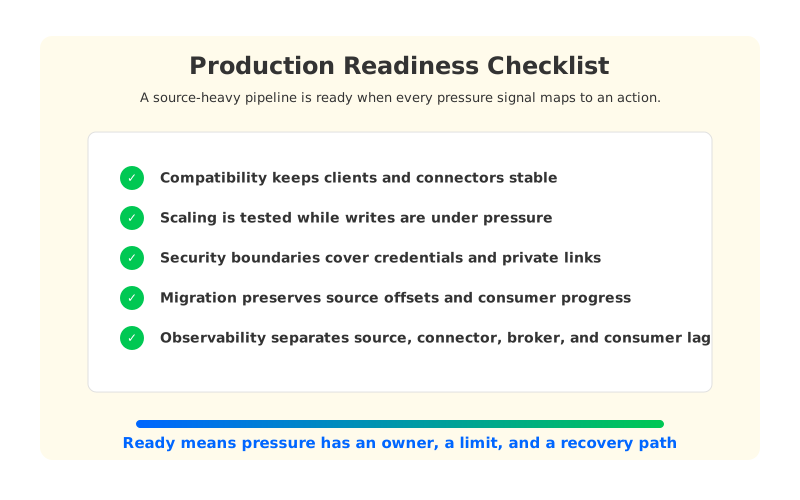
Use this checklist as a scoring tool:
- Fragile sources have a maximum pause time, owner, retry policy, and replay path.
- Metrics separate upstream lag, connector task lag, broker produce latency, and downstream consumer lag.
- Hot ingestion topics have partitioning, retention, and quota decisions that match source recovery windows.
- Schema failures and malformed records have a destination, alert, and replay owner.
- Scaling has been tested under write pressure, not only during idle windows.
- Migration rehearsals include source offsets, consumer group positions, rollback, and duplicate handling.
- Network boundaries are documented before connector credentials are deployed.
The core lesson is simple enough to remember during a 2 a.m. incident: source connector backpressure should terminate at a designed control point. If it terminates in a local disk filling up, a connector task bouncing between workers, or a database log retention alarm, the architecture made the decision for you.
If your team is evaluating Kafka-compatible infrastructure for connector-heavy ingestion, review AutoMQ's architecture and migration model with your own connector pressure map beside it. The fastest next step is to try AutoMQ in your cloud environment through AutoMQ Cloud and validate the sources that create the most operational risk.
8References
- Apache Kafka documentation for producer, consumer, topic, broker, and Kafka Connect concepts.
- Confluent Kafka Connect overview for source and sink connector terminology.
- AWS Availability Zones documentation and Amazon S3 storage classes for cloud topology and object storage context.
- AutoMQ architecture overview and S3Stream overview for Shared Storage architecture and WAL storage.
- AutoMQ Managed Connector overview and Kafka Linking overview for connector operations and migration planning.
9FAQ
9.1What is source connector backpressure in Kafka?
Source connector backpressure happens when a connector cannot write to Kafka at the pace required by the upstream source. Causes include Kafka produce latency, connector task pressure, retries, schema failures, upstream rate limits, and downstream policies.
9.2Is backpressure always bad?
No. Backpressure is a control signal. It becomes dangerous when the platform has no safe place to absorb it, no owner for the control action, or no recovery plan for the source offsets that continue to advance outside Kafka.
9.3Which Kafka settings should teams tune first?
Start with the source's maximum safe pause time, topic design, connector retry policy, and observability boundaries. Producer batching and retry settings should follow the recovery model instead of replacing it.
9.4How does Shared Storage architecture help connector-heavy workloads?
Shared Storage architecture separates broker compute from durable storage. For connector-heavy workloads, this can reduce the operational coupling between ingestion spikes, local disk pressure, broker replacement, and partition data movement.
9.5When should AutoMQ enter the evaluation?
AutoMQ is relevant when a team wants Kafka-compatible APIs but needs a different operating model for elasticity, storage growth, migration, and cloud network boundaries. Evaluate it after mapping connector pressure, source recovery windows, governance requirements, and rollback paths.


