
Table of Contents
Table of Contents
Teams search for integration platform chargeback kafka when the streaming platform has stopped looking like one shared cluster and started looking like a bill nobody can explain. One team adds a database CDC pipeline. Another adds a warehouse sink. A third asks for longer replay. None of those changes feels dramatic alone, but together they create storage, network, compute, support, and governance costs that land on the platform budget.
The hard part is not building a spreadsheet. The hard part is deciding what the spreadsheet should measure. Kafka can expose topic throughput, consumer lag, broker metrics, connector task state, and retention settings. Cloud bills can expose compute, object storage, block storage, data transfer, load balancers, private connectivity, logging, and monitoring. Chargeback only works when those signals map to the teams that create the demand and to the platform decisions that shape the cost.
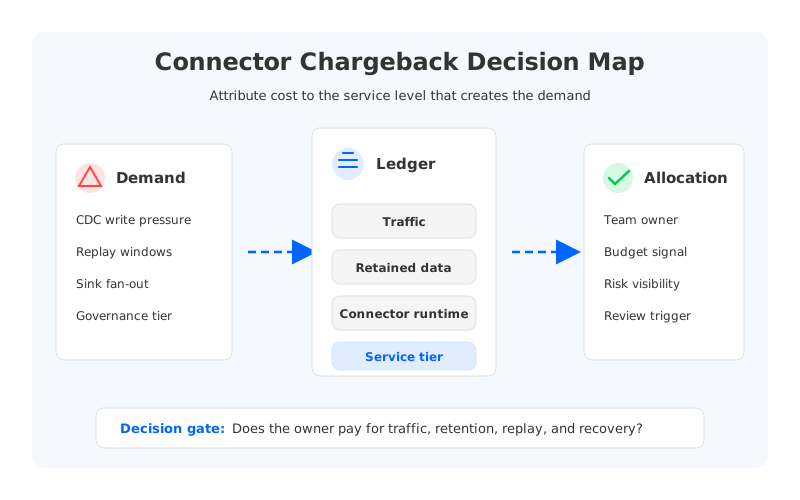
A connector-heavy estate needs a chargeback model that is architectural, not merely financial. If the cost model ignores replay, retention, zone placement, and failure recovery, it will reward the teams that create hidden risk and punish the teams that happen to run visible workloads.
1Why teams search for integration platform chargeback kafka
Connector platforms grow through convenience. Kafka Connect gives teams a standard way to run source and sink connectors, and the Kafka API gives application teams a familiar log abstraction for movement between databases, services, lakehouses, warehouses, search indexes, and stream processors. That standardization is useful. It also means every new integration consumes shared platform resources through the same surface, even when the underlying demand is very different.
A low-volume sink connector that reads from a compacted topic is not the same platform tenant as a CDC source that writes continuously, keeps long retention for replay, and triggers downstream fan-out. A payment enrichment pipeline is not the same tenant as a marketing export that can pause overnight. A team that needs seven days of replay is making a storage decision, not only a topic configuration request. Chargeback brings those differences into the architecture conversation before they become a dispute during budget review.
The search phrase also reflects an ownership problem. Integration teams often own connector configuration, platform teams own Kafka operations, application teams own producers and consumers, and finance teams own the final allocation. When those groups use different definitions of cost, the platform ends up with weak incentives. Long retention, high partition counts, and duplicate sink paths can each be rational for the requester and expensive for the shared estate.
Good chargeback does not try to make every integration team become a Kafka operator. It makes the consequences of architectural choices visible enough that teams can choose deliberately. The model should tell a requester why a long replay window costs more than a short one, why cross-zone consumers matter, why idle connector tasks still consume operational capacity, and why a migration or backfill can require a temporary budget envelope.
2The operational constraint behind connector-heavy platforms
The simplest chargeback model counts bytes in and bytes out. That is a useful starting point, but connector-heavy platforms create costs that are not linear with daily ingest. A CDC connector may write modest steady-state traffic after its initial snapshot, yet require a long retention window because downstream repair depends on replay. A sink connector may read the same topic repeatedly across environments. A governance workflow may require audit logs, schema history, encryption, private networking, and operational review that never appears in topic throughput.
Traditional Kafka adds another layer to this problem because storage and compute are tied together at the broker. In the classic Shared Nothing model, each broker owns local log segments for the partitions assigned to it. Replication protects availability by maintaining additional copies across brokers. That architecture has served the Kafka ecosystem well, but its cost shape becomes harder to allocate when many connector teams share the same cluster.
Several cost drivers become entangled:
- Retention becomes disk planning. A longer replay window can require more broker-local storage, larger instances, or more brokers, even when active compute demand is unchanged.
- Backfill becomes cluster pressure. Initial snapshots, replays, and catch-up reads compete with live ingestion and can trigger capacity requests that look temporary but affect shared operations.
- Replication becomes network behavior. Broker placement, replica traffic, and client locality can turn an integration decision into cross-zone data movement.
- Failure recovery becomes a billing event. Broker replacement, partition movement, and consumer catch-up can consume network and compute resources that are hard to attribute after the incident.
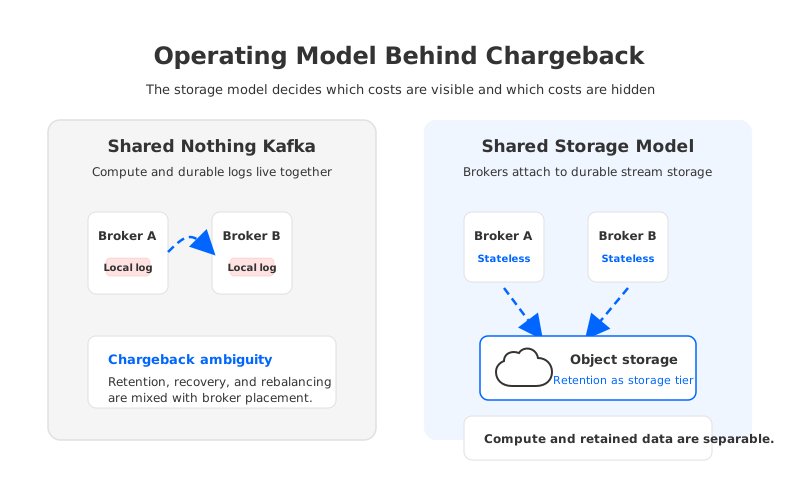
This is why chargeback has to be designed with operations in mind. A platform team that allocates cost by connector count will undercharge high-retention workloads and overcharge small operational connectors. A platform team that allocates only by ingress will miss fan-out and replay. A platform team that allocates only by cloud invoice line item will struggle to explain why a team with small business traffic created a large recovery burden.
3Failure handling, schema, and replay trade-offs
Connector platforms are expensive because they are useful during failure. If every downstream system were always healthy, retention could be short and replay could be rare. Production integration work is different. Warehouses throttle, search clusters rebuild indexes, database maintenance changes source availability, schema changes land at the wrong time, and consumers fall behind because the system they call is slow.
Kafka gives teams a durable log and independent consumer groups, which makes recovery possible without returning to the original source for every repair. Kafka Connect gives source and sink connectors a shared runtime. Those capabilities are the reason Kafka appears in integration platforms, but they do not decide the chargeback model by themselves. The platform still has to price the recovery capabilities that tenants consume.
A practical chargeback model should separate normal traffic from resilience demand. Normal traffic includes producer writes, consumer reads, connector task compute, and routine monitoring. Resilience demand includes retained bytes, replay reads, duplicate sink runs, schema history, backfill windows, and capacity reserved for incident recovery. That distinction matters because the second category is often where hidden cost lives.
Consider a team that asks for longer retention because its downstream sink can take days to recover after a data quality issue. Charging only for daily write volume hides the real request. The team is reserving a repair window inside the platform, and that window should be visible to the owner who benefits from it.
The same logic applies to schema. CDC and connector streams carry interpretation, not only bytes. If a connector platform preserves topic data but loses the schema history needed to decode older records, replay is technically available and practically broken. Chargeback should include governance work such as schema compatibility review, subject naming, schema registry operations, and audit evidence because those controls reduce the risk of expensive recovery work later.
4Evaluation checklist for platform teams
Chargeback becomes defensible when the model is tied to a clear evaluation checklist. The checklist should be understandable to finance stakeholders, but detailed enough that platform engineers can trace every allocation back to a technical driver. It should also avoid a trap: measuring only what is easy to meter. A connector that is simple to meter can still be expensive to operate.
Use the following framework before rolling out chargeback for a connector-heavy Kafka estate:
| Dimension | What to measure | Why it belongs in chargeback |
|---|---|---|
| Traffic | Producer bytes, consumer bytes, connector reads, connector writes | Captures normal platform usage and fan-out. |
| Retention | Stored bytes by topic, replay window, compaction requirements | Makes recovery windows visible to the teams that request them. |
| Elasticity | Snapshot load, backfill duration, catch-up read demand | Separates steady-state usage from temporary integration events. |
| Locality | Client zone, broker zone, private networking path, sink placement | Prevents network cost from disappearing into the shared platform line item. |
| Governance | ACLs, encryption, schema policy, audit, approval workflow | Allocates the operational work required for regulated integrations. |
| Recovery | Restore drills, replay tests, connector restart evidence, rollback paths | Prices resilience as a deliberate service level, not a free side effect. |
The table should not become a tax form for engineers. It should become the service catalog behind the platform. A team requesting a new connector can choose a standard retention tier, a replay tier, a governance tier, and a migration tier. The platform team can then explain cost in terms of service levels instead of arguing over raw cloud bill fragments.
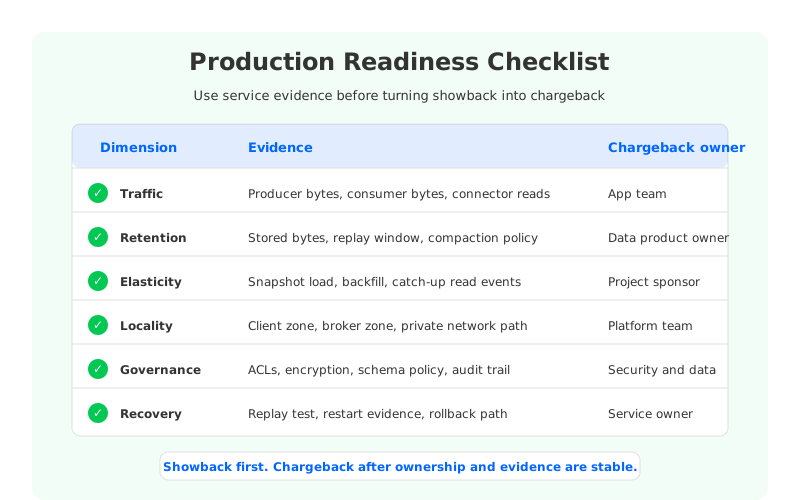
A useful scorecard also keeps migration risk in view. Many estates already run Apache Kafka, Kafka Connect, MirrorMaker, custom wrappers, or third-party integration platforms. Chargeback can expose an expensive architecture, but replacing it without preserving connector compatibility, offsets, ACLs, topic configuration, and observability creates a different kind of cost.
5How AutoMQ changes the operating model
Once the evaluation framework is in place, the architecture question becomes sharper: which platform design makes chargeback easier to explain and control? If storage, compute, replay, and recovery remain tied to broker-local disks, the model must allocate costs that are side effects of placement. If durable stream storage is separated from broker compute, platform teams can separate active traffic from retained data and recovery behavior.
AutoMQ is a Kafka-compatible cloud-native streaming platform built around Shared Storage architecture. It keeps compatibility with Kafka clients and tools while moving durable stream storage into an object-storage-backed design. Brokers become more stateless, and platform teams can scale compute and storage along different axes instead of treating every retention or replay decision as a broker sizing problem.
That shift matters for chargeback because it changes what the platform has to attribute:
- Retention can be treated as a storage service level. Teams that need longer replay windows can be charged for retained data without forcing broker-local disk expansion to dominate the conversation.
- Connector bursts can be isolated from long-term storage ownership. Snapshot load and backfill traffic still require compute and network capacity, but they do not have to imply permanent broker storage placement.
- Broker replacement has a smaller data-movement story. When brokers are not the long-term owners of unique durable data, failure recovery and scale events are less likely to become large partition-copying exercises.
- Cloud boundaries become easier to reason about. BYOC and private deployment options let teams align platform ownership with customer cloud accounts, VPCs, IAM, and compliance requirements.
AutoMQ does not remove the need for a chargeback model. It makes the model closer to the real service boundaries: active compute, retained stream data, connector operations, governance, and recovery. That is a better fit for integration estates where different tenants create very different combinations of traffic, retention, replay, and compliance demand.
The neutral evaluation still matters. A small connector estate with short retention and stable traffic may not need an architecture change. A large multi-tenant platform with CDC, lakehouse sinks, private networking, strict audit requirements, and repeated backfills has a different cost shape. For that second pattern, Shared Storage and stateless brokers can reduce the number of hidden costs the chargeback model has to explain after the fact.
6A practical chargeback rollout model
The first version of chargeback should be narrow enough to survive production. Start with showback before invoice-backed chargeback. Showback explains usage, service tier, and estimated allocation without moving budget immediately, which exposes missing tags, ambiguous ownership, orphaned topics, and connector tasks nobody wants to claim.
After showback, define a small set of units. A connector-heavy Kafka platform usually needs units for write traffic, read traffic, retained data, connector runtime, governance tier, and migration or backfill events. Each unit should have an owner, a measurement source, and a dispute path. If a team cannot see how behavior changes allocation, the model will be treated as arbitrary.
The rollout should also define exceptions. Some connectors are platform utilities rather than tenant integrations. Some topics exist for security, audit, or internal reliability. Some migration windows should be approved as project cost rather than pushed into a recurring team allocation.
The strongest programs connect architecture review to cost review. When a team asks for a new connector, the platform review should ask the same questions the cost model later enforces: retention window, fan-out, replay requirement, schema policy, data sensitivity, private networking, sink ownership, and migration plan. The report then reflects the approved design rather than surprising teams at quarter end.
If your connector platform is large enough that teams are debating who should pay for replay, retention, and backfill capacity, the next step is to evaluate the storage and operations model, not only the line items. AutoMQ's Shared Storage architecture overview is a useful starting point: https://docs.automq.com/automq/architecture/overview?utm_source=blog&utm_medium=cta&utm_campaign=integration-platform-chargeback-kafka
7References
- Apache Kafka documentation: https://kafka.apache.org/documentation/
- Apache Kafka Connect documentation: https://kafka.apache.org/documentation/#connect
- AutoMQ architecture overview: https://docs.automq.com/automq/architecture/overview.md
- AutoMQ compatibility with Apache Kafka: https://docs.automq.com/automq/what-is-automq/compatibility-with-apache-kafka.md
- AutoMQ managed Kafka Connect overview: https://docs.automq.com/automq-cloud/kafka-connect/overview.md
8FAQ
8.1What is integration platform chargeback for Kafka?
It is a method for allocating the cost of shared Kafka and Kafka-compatible integration infrastructure to the teams or products that create the demand. In connector-heavy estates, this includes more than ingress and egress. Retention, replay, connector runtime, governance work, private networking, observability, and recovery drills all affect the cost of the shared platform.
8.2Should chargeback be based on connector count?
Connector count is usually too blunt. Two connectors can have completely different traffic, retention, replay, and governance profiles. Connector count can be a supporting signal for runtime operations, but the core model should allocate cost based on measurable workload drivers and service levels.
8.3How does Kafka Connect affect chargeback?
Kafka Connect standardizes connector deployment and operation, which makes shared integration platforms easier to manage. It also centralizes cost. Platform teams need to allocate connector worker capacity, source and sink traffic, task monitoring, plugin management, restart operations, and the Kafka topics that connectors create or consume.
8.4Where does AutoMQ fit in the decision?
AutoMQ fits when the main cost and operations problem comes from broker-local storage, long replay windows, elastic connector demand, and cloud data movement. Its Kafka-compatible Shared Storage architecture lets teams reason about retained data and broker compute separately, which can make chargeback cleaner for large connector-heavy estates.
8.5How should a team start without creating a finance-heavy process?
Start with showback. Produce a monthly report that maps topics, connectors, retained data, traffic, and service tiers to owners. Use the first reports to fix tagging and ownership. Move to budget chargeback after the engineering and finance teams agree that the model reflects how the platform actually works.


