
Table of Contents
Table of Contents
Teams usually search for integration test kafka cluster after a local mock has already failed them. A producer uses idempotence, a consumer depends on committed offsets, a connector needs to preserve schema behavior, or a deployment pipeline must prove that a service can survive a rolling restart without losing its place in a topic. At that point, a single in-memory broker is no longer a test environment. It is a convenient lie.
The hard part is not deciding whether Kafka should be tested with Kafka. The hard part is deciding how much production shape the test cluster needs before the cost, operational load, and governance work start to look like another production estate. Make staging identical to production and platform teams inherit the same broker sizing, disk planning, replication traffic, access controls, monitoring, and upgrade choreography. Keep it tiny and temporary and application teams eventually find the missing behavior in production.
An integration test Kafka cluster sits in that uncomfortable middle. It must be realistic enough to catch protocol, ordering, offset, transaction, and connector mistakes, but elastic enough that idle environments do not carry production-like cost. The architecture choice matters because Kafka's behavior is not only an API. It is a combination of client protocol, metadata, storage, replication, failure recovery, and operational contracts.
1Why Teams Search for integration test kafka cluster
The search intent is more specific than "how do I run Kafka in tests?" A developer can start a broker in Docker. A CI pipeline can run a short-lived container. A platform team can offer a shared development namespace. Those choices work until the test objective depends on behavior that local setups flatten away.
The common trigger is a boundary between application correctness and infrastructure correctness. A payment service may need to prove that a producer retries safely when acknowledgments are delayed. A data platform may need to validate consumer group rebalances during a blue-green deploy. A CDC pipeline may need to run Kafka Connect tasks against realistic topic counts and offset histories. A regulated team may need every test topic, principal, and ACL to be auditable because test data still contains sensitive business signals.
Those requirements pull the cluster away from toy mode:
- Protocol realism. Tests need real Kafka clients, broker metadata, consumer groups, offsets, idempotent producers, and sometimes transactions. A fake queue cannot reproduce the failure surface of these features.
- Operational realism. Teams need to rehearse topic creation, quota changes, broker restarts, credential rotation, and observability paths before those actions touch production.
- Cost and governance realism. A test cluster may sit idle for most of the day, then absorb heavy CI bursts. Shared clusters also need naming rules, retention limits, ACLs, network boundaries, and deletion policies.
This is why the phrase "integration test Kafka cluster" hides a platform decision. The real question is how to expose enough Kafka surface area to catch integration bugs without copying the entire production cost structure.
2The Production Constraint Behind the Problem
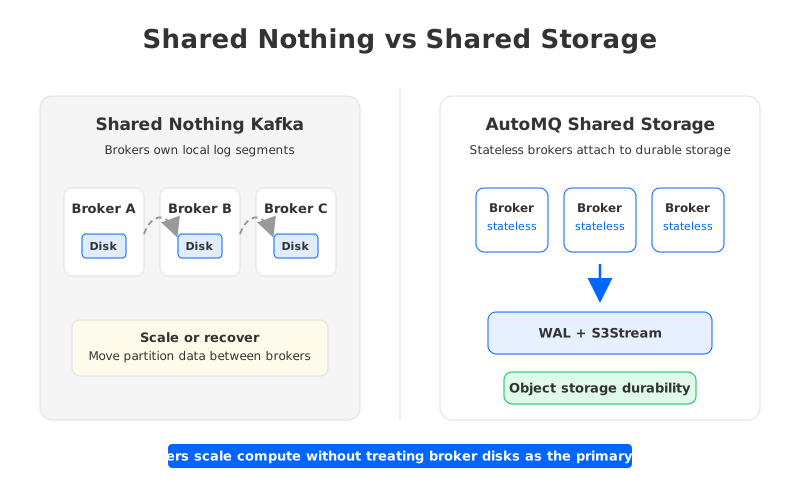
Traditional Apache Kafka was designed around brokers that own local log segments. Each broker is both compute and storage: it accepts requests, serves reads, persists partition data, replicates that data to other brokers, and participates in cluster metadata decisions. That shared-nothing model is robust, but it ties test-environment cost to the same resources that make production reliable.
Replication is the first cost amplifier. A production-like test cluster often uses multiple brokers across availability zones so that it can exercise leader election and failure handling. Once replicas are spread across zones, the cluster starts moving data between zones as part of normal replication and catch-up behavior. Cloud providers also charge for many forms of inter-zone and inter-region data transfer, so instance price alone can hide the network line item.
Storage is the second amplifier. Kafka retention is local to broker disks unless an architecture moves historical data elsewhere. Test teams often set retention higher than they admit because failed test runs need evidence: input events, output topics, poison messages, replay windows, and connector offsets. Local disks then have to be sized for the worst combination of topic count, replication factor, retention, and backlog.
Elasticity is the third amplifier. Kafka can scale, but in a shared-nothing architecture, scaling involves more than adding brokers. Partitions must move, replicas must catch up, leadership may shift, and operators need to watch the rebalance. For integration tests, every environment refresh can become a small operations project.
KRaft removed the ZooKeeper dependency from Kafka metadata management, but it does not remove the broker-local storage model. Kafka's documentation treats consumer groups, offsets, transactions, and Connect as first-class distributed-system features rather than queue behavior. A useful integration environment has to respect those semantics.
The constraint becomes clearer when you map requirements to the resources they consume. Multi-broker failover needs broker count, replica placement, and leader movement. Consumer group realism needs offset retention, rebalance behavior, and lag visibility. Connector validation needs workers, plugins, task state, and external-system access. Replay after failed tests needs durable retention. Every useful test feature pulls the cluster closer to production, and avoiding that pull by under-testing only moves the cost into incidents, rollbacks, and late debugging.
3Architecture Options and Trade-offs
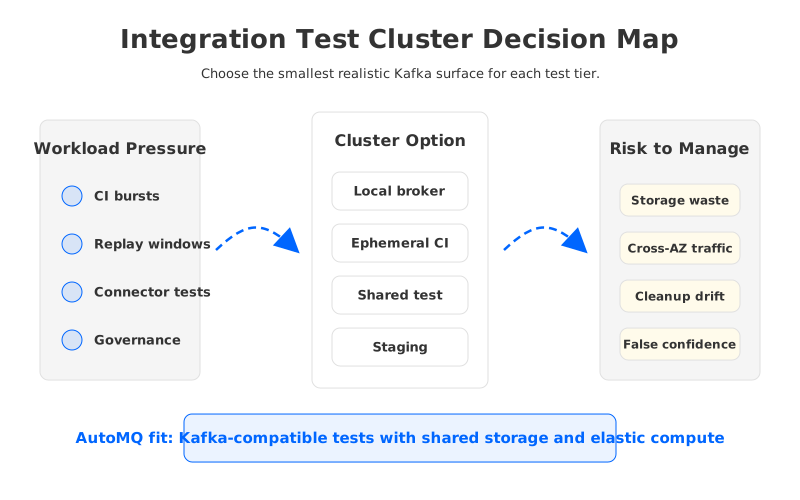
There are four common patterns for integration test Kafka clusters. None is universally correct. The right answer depends on what the test must prove, how many teams share the platform, and how quickly the environment needs to appear and disappear.
A local single-broker cluster is good for developer feedback loops. It catches serialization mistakes, basic producer and consumer wiring, topic naming errors, and simple offset handling. It does not prove broker failover, multi-AZ behavior, partition reassignment, real access boundaries, or connector operations.
An ephemeral CI cluster improves isolation. Each pipeline can create a fresh cluster, run tests, and destroy the environment. This pattern keeps test data contained, but startup time and cleanup discipline become part of the developer experience.
A shared non-production cluster centralizes governance. Platform teams can enforce ACLs, quotas, topic policies, retention defaults, metrics, and support procedures once. The trade-off is contention, stale topics, and cleanup work.
A production-shaped staging cluster gives the strongest operational signal. It is the right place to test failover drills, migration rehearsals, network policy, observability, and upgrades. It is also the most expensive pattern to leave idle.
The mistake is forcing all tests into one pattern. A mature platform exposes a ladder: local for fast feedback, ephemeral clusters for pipeline isolation, a governed shared cluster for cross-service integration, and a production-shaped environment for operational rehearsals. The architecture should make it practical to move up and down that ladder without rewriting clients.
4Evaluation Checklist for Platform Teams
Before choosing infrastructure, define what the integration cluster must prove. This keeps the decision away from brand preference and closer to test value.
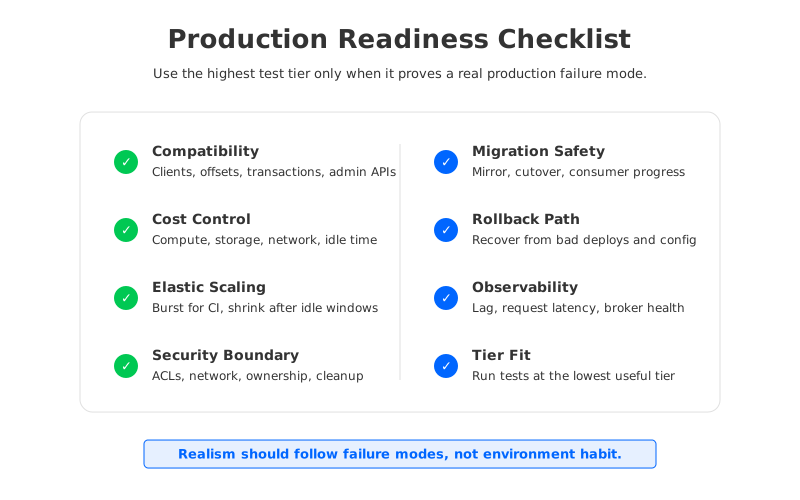
Start with compatibility. Kafka clients do not only send and receive bytes; they depend on broker APIs, topic metadata, group coordination, offset commits, transactions, authentication, authorization, and error behavior. A cluster that is "Kafka-like" at the happy path but diverges under retries can produce false confidence. If production workloads use Kafka Connect, include connector workers and plugin lifecycle in the test scope.
Cost is the next filter because integration environments are bursty. Ask how the cluster behaves when CI traffic drops to zero, when a branch build creates many topics, when retention needs to be extended for debugging, and when a team runs a load-heavy contract test. Instance price alone is a weak signal if broker replication and cross-zone movement dominate the bill.
Governance deserves the same attention as throughput. Test clusters often become dumping grounds because nobody wants to slow developers down. Once multiple teams share the cluster, you need topic naming conventions, retention caps, ACL templates, owner tags, data classification rules, and deletion automation.
Recovery and rollback complete the checklist. Integration tests should prove that the platform can recover from broken deploys, bad connector configs, schema mistakes, runaway producers, and lost consumers. That requires observability around broker health, client errors, lag, request latency, partition movement, and storage growth.
Use a small scorecard rather than a vague architecture debate:
| Decision area | What to verify | Failure signal |
|---|---|---|
| Client compatibility | Existing clients, transactions, and admin tooling work unchanged | Test-only configs or client forks |
| Elasticity | Cluster grows for CI bursts and shrinks after idle periods | Capacity is permanently sized for peak windows |
| Storage model | Retention and replay do not force large broker disks | Debugging requires disk expansion or topic deletion |
| Governance | ACLs, quotas, retention, naming, and ownership are automated | Cleanup relies on chat reminders |
| Observability | Metrics and logs show broker, topic, client, and connector symptoms | Failures are visible only inside CI logs |
The strongest architecture lets different test tiers share the same client contract. Developers should be able to start local, move to ephemeral, then validate against a governed cluster without learning a different messaging system at each step.
5How AutoMQ Changes the Operating Model
If the root problem is broker-local storage, the architectural question becomes direct: can the platform keep Kafka protocol behavior while removing the need for every test cluster to reserve production-like disks and replication capacity? AutoMQ is a Kafka-compatible, cloud-native streaming platform built around Shared Storage architecture. It keeps the Kafka API and client semantics while moving the storage responsibility away from broker-local disks and into object-storage-backed stream storage with a write-ahead log layer.
That separation changes the integration-test cost model. Brokers become more stateless because durable stream data is not trapped on a specific broker's local disk. Compute can scale for test bursts, then shrink when the pipeline is idle. Storage can retain enough data for replay and debugging without forcing every environment to carry large broker volumes.
AutoMQ also changes failure recovery. In traditional Kafka, replacing or scaling brokers can trigger partition reassignment and replica catch-up work that moves data between brokers. In a shared-storage design, brokers attach to the same durable storage layer, which reduces the amount of broker-to-broker data movement needed for common scaling and recovery operations.
For integration tests, the practical benefits show up in workflows:
- CI environments can be sized around expected request load instead of worst-case retained data.
- Shared non-production clusters can keep realistic retention for debugging without making broker disks the limiting resource.
- Platform teams can test client compatibility, consumer groups, ACLs, metrics, and topic operations through Kafka-compatible interfaces.
- Multi-AZ environments can be designed with stronger control over broker data movement and cross-zone traffic.
- BYOC and software deployment models give teams clearer boundaries for cloud accounts, VPCs, Kubernetes clusters, and compliance controls.
There is still engineering work to do. An integration test cluster needs lifecycle automation, test-data policy, observability, and ownership no matter which platform runs it. Shared storage removes a specific source of friction: the assumption that realistic Kafka tests must reserve realistic production storage and broker-local replication capacity all the time.
The adoption path can be incremental. Keep fast local tests for developer loops. Add ephemeral Kafka-compatible clusters for CI jobs that need real protocol behavior. Use a governed shared AutoMQ cluster when multiple services need common integration infrastructure. Reserve production-shaped staging for migration rehearsals, failover drills, and release gates.
6A Readiness Model You Can Apply
The fastest way to improve an integration test Kafka cluster is to classify tests by the behavior they must prove. Start by deleting ambiguity.
Use four tiers:
- Developer loop. Single broker, local or containerized, short retention, no production governance.
- Pipeline isolation. Ephemeral cluster per branch, test suite, or release candidate.
- Shared integration. Governed non-production cluster with ACLs, quotas, topic policies, metrics, and connector workers.
- Operational rehearsal. Production-shaped cluster used for migration, failover, upgrade, disaster-recovery, and capacity validation.
Once the tiers are named, every team can answer the same question: what would this test fail to catch if it ran one tier lower? If the answer is "nothing important," move it down. If the answer is "we would miss rebalances, ACLs, connector state, or recovery behavior," keep it at the higher tier and make the cost visible.
The best integration test Kafka cluster is not the one that most closely resembles production. It is the one that exposes production-relevant failure modes at the lowest sustainable cost. When broker-local storage makes that balance hard, a Kafka-compatible shared-storage architecture gives platform teams another lever: keep the semantics that matter, but stop treating every test environment as a miniature production storage estate.
If your team is redesigning non-production Kafka environments, review AutoMQ's architecture and deployment options in the AutoMQ documentation, or talk with AutoMQ about sizing a Kafka-compatible integration test cluster for your CI and platform requirements.
7References
- Apache Kafka Documentation
- Apache Kafka Connect Documentation
- AutoMQ: Compatibility with Apache Kafka
- AutoMQ: Architecture Overview
- AutoMQ: S3Stream Shared Streaming Storage
- AutoMQ: Eliminate Inter-Zone Traffic
- AWS: Amazon S3 Interface Endpoints and PrivateLink
- AWS EC2 On-Demand Pricing
8FAQ
8.1Should every integration test use a real Kafka cluster?
No. Local and mocked tests still have value when they validate serialization, basic producer and consumer wiring, or application logic around message handling. A real Kafka-compatible cluster is needed when the test depends on broker semantics such as consumer group coordination, offsets, transactions, ACLs, failover, connector workers, or operational behavior.
8.2What is the minimum useful integration test Kafka cluster?
The minimum useful cluster is the smallest environment that can reproduce the behavior under test. For many teams, that means a single broker for developer loops and an ephemeral multi-broker cluster for CI tests that need rebalances, topic operations, or recovery behavior. Production-shaped staging should be reserved for tests that need production-like failure and governance boundaries.
8.3How can platform teams control Kafka test cluster cost?
Separate test tiers, set retention defaults, automate topic cleanup, enforce ownership tags, and avoid sizing every environment for peak traffic. Architectures that separate compute and storage can also help because retained data and burst compute no longer have to scale together in the same broker-local disk footprint.
8.4Does Kafka compatibility matter for test clusters?
Yes. Integration tests are supposed to reveal issues before production. If the test environment changes client behavior, hides broker errors, or omits APIs used in production, it can create false confidence. Compatibility matters most for teams using advanced producer settings, consumer group behavior, transactions, Kafka Connect, ACLs, and existing admin tooling.
8.5When should AutoMQ be considered for integration testing?
Consider AutoMQ when Kafka compatibility matters but production-like broker storage cost does not fit the test environment. It is especially relevant for teams that need elastic CI clusters, governed shared non-production clusters, realistic retention for debugging, or cloud-account boundaries through BYOC or software deployments.


