
Table of Contents
Table of Contents
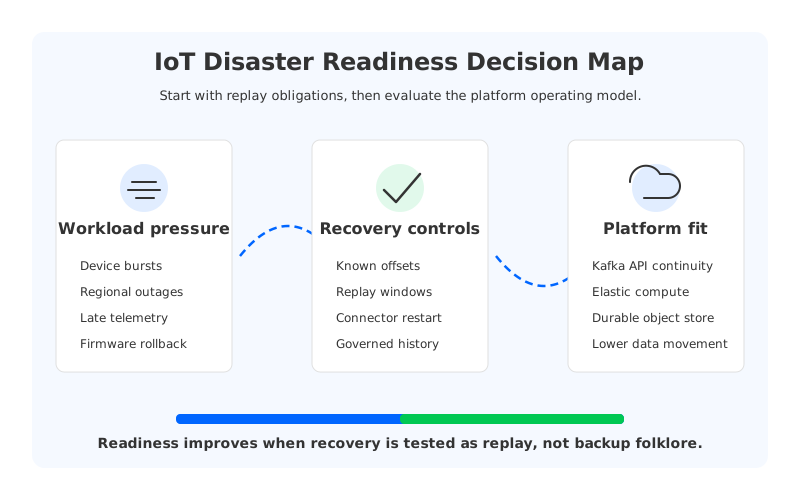
Most IoT disaster plans begin with the wrong question. Teams ask whether the Kafka cluster is backed up, whether another region can receive traffic, or whether a replication tool is running. Those questions matter, but they miss the operational pressure that makes IoT failures different: when devices reconnect, gateways retry, and downstream systems need repair, the platform must replay event history without turning recovery into a second outage.
That is why searches for iot disaster readiness kafka usually come from teams that already know Kafka is useful. They are asking whether their event backbone can survive regional disruption, bad firmware, schema mistakes, connector failures, and delayed telemetry while keeping enough history to rebuild state. In IoT, the disaster is rarely one broken component. It is the backlog, replay, duplicate handling, and governance work that follows.
Kafka gives IoT platforms a strong foundation because events are retained in ordered partitions, consumers track offsets, and different consumer groups can progress independently. That model is why telemetry ingestion, device state updates, command acknowledgements, audit trails, and stream processors often converge on Kafka-compatible infrastructure. The trap is assuming that Kafka semantics alone make the recovery plan complete. Semantics define what applications can do; the storage and operating model determine whether the platform can do it under stress.
1Why IoT disaster readiness is a replay problem
An IoT outage changes the shape of traffic. During normal operation, devices produce small records at predictable intervals, gateways batch data, and consumers follow near the head of the log. During recovery, the same platform may receive delayed events, reconnect storms, duplicate publishes, connector restarts, and backfills from edge stores. The workload stops looking like a clean streaming pipeline and starts looking like a dispute over time: which event is authoritative, which state should be rebuilt, and how far back can each system safely read?
Kafka is well suited to that dispute because offsets make progress explicit. A consumer group can resume from committed offsets, a repair job can read from an earlier point, and a stream processor can rebuild local state when its checkpoint and input topics are still consistent. But those capabilities depend on a clear replay contract. If retention is too short, the history is gone. If partition keys are inconsistent, replay breaks ordering assumptions. If downstream writes are not idempotent, a recovery job can corrupt the system it is trying to repair.
For IoT teams, the replay contract usually spans four data classes:
- Telemetry history. Sensor readings, gateway events, logs, and status updates need enough retention for late arrival, diagnostics, and downstream rebuilds.
- Device state changes. Provisioning, firmware version, configuration, and command status events need stronger ordering and duplicate handling.
- Operational evidence. Security, access, and maintenance events need governance metadata because replay can expose sensitive patterns.
- Integration outputs. Connector topics and sink pipelines need restart rules so a database, warehouse, or alerting system can recover without guessing offsets.
These are not separate disaster recovery features. They are the same Kafka log viewed by different teams with different recovery obligations. A platform that treats retention as passive storage will miss the risk. During an incident, retained data becomes active traffic again.
2The production constraint behind the problem
Traditional Kafka uses a shared-nothing architecture. Each broker owns local log segments for the partitions assigned to it, and replication protects those logs across brokers. This design has served many production systems well, but it creates a tight coupling between recovery and broker-local storage. When a broker fails, a cluster expands, partitions move, or a team rebalances traffic, the platform has to account for where local data lives and how replicas catch up.
That coupling becomes uncomfortable in IoT because capacity requirements are uneven. A device fleet may be quiet overnight and then surge after power restoration, road congestion, weather, cellular recovery, or delayed smart-meter reads. In each case, the disaster plan needs elastic ingestion and safe replay at the same time.
The storage model also shapes the cost model. Broker-local storage means retained bytes, replica bytes, and broker sizing move together. Longer retention can require larger disks, more careful rebalance planning, and more capacity held for recovery scenarios that may happen rarely but must work when they do. Cross-zone replication, network placement, and consumer fanout can add additional cost pressure. The exact bill depends on cloud, region, instance type, network topology, and retention policy, so it should be modeled from the provider's published pricing rather than guessed from averages.
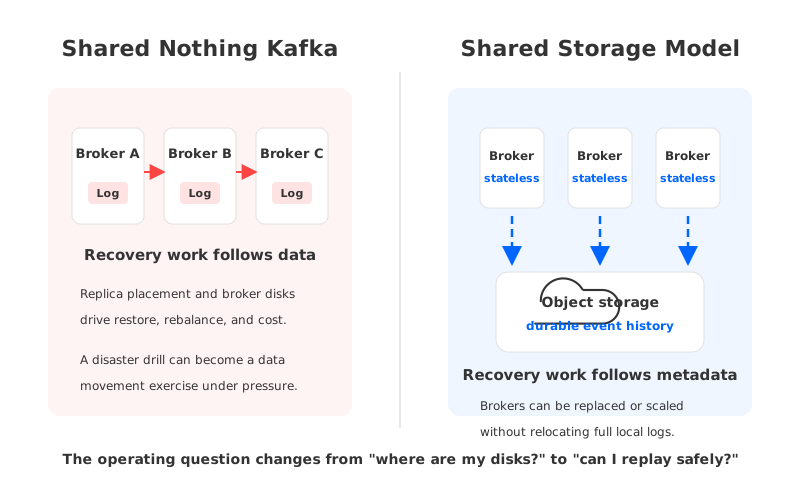
Tiered storage can reduce some pressure by moving older Kafka segments to remote storage, and it can be a sensible fit when the team wants to extend retention without changing the core operating model. It does not erase the need to test cold reads, metadata behavior, consumer lag, compaction, and failure recovery. A platform may retain old data, but the recovery question is whether applications can replay that data predictably while producers and tailing consumers continue to run.
3Architecture options and trade-offs
An IoT Kafka architecture should be evaluated by failure behavior, not by a feature checklist. A single-region Kafka cluster with well-tested backups may be acceptable for noncritical telemetry. A multi-zone Kafka deployment may be the right baseline for operational streams that need high availability inside one cloud region. Cross-region replication may be required when regional failure is inside the recovery target. A cloud-native shared-storage design becomes interesting when broker-local data movement is the part of the plan that creates the most operational risk.
The decision is easier when the team separates application semantics from platform mechanics:
| Question | Why it matters for IoT disaster readiness |
|---|---|
| What is the replay window for each topic? | Firmware rollback, delayed device uploads, and state repair may need different history lengths. |
| Which consumers can replay safely? | Idempotency, ordering, and offset reset behavior determine whether recovery creates duplicates. |
| How does the platform behave during broker loss? | Recovery should not depend on manual data movement under incident pressure. |
| Where does retained data live? | Broker disks, remote tiers, and object storage have different cost, latency, and operational profiles. |
| Who is allowed to trigger replay? | Replay can expose sensitive device behavior and can overload downstream systems. |
| How is success observed? | Consumer lag alone is not enough; teams need storage, cache, connector, and application signals. |
There is no universal winner across those rows. A small fleet with short retention may prefer operational simplicity. A regulated energy platform may care more about governance evidence and controlled replay. A mobility platform may need region-aware ingestion, strict ordering by device, and a recovery path that does not turn every rebalance into a storage project.
The useful architecture review starts with the workload, then maps the platform around it. Define the recovery target in engineering terms: how much history must remain replayable, how quickly a backfill must complete, which topics can be compacted, which applications tolerate duplicates, which downstream systems need write fencing, and which region or account owns the data. Without that contract, platform comparisons become a debate over labels.
4Evaluation checklist for platform teams
The strongest IoT disaster readiness reviews make the recovery path explicit before an incident and then rehearse it with real clients, real topics, and realistic traffic shape. A tabletop exercise can find ownership gaps, but it cannot prove that consumers resume correctly or that a connector restart does not flood a sink.
Use this checklist as a practical gate before increasing IoT reliance on Kafka-compatible infrastructure:
- Compatibility gate. Test the actual producers, long-running consumers, Kafka Connect tasks, stream processors, authentication methods, ACLs, serializers, transactions if used, and monitoring tools. Do not treat protocol compatibility as proven until the risky applications have run against the target.
- Replay gate. Pick representative topics and replay from known offsets while normal traffic continues. Measure catch-up duration, duplicate handling, tailing consumer impact, and downstream write behavior.
- Retention gate. Model retention by topic class. Telemetry, audit, state, and connector topics should not inherit the same retention policy by accident.
- Cost gate. Separate compute, broker storage, object storage, network transfer, read fanout, cross-zone paths, and operator time. A disaster plan that is affordable only when no one replays data is not a plan.
- Governance gate. Attach owner, data class, schema policy, replay approval path, and incident contact to important topics. Recovery should not rely on someone remembering who owns a device stream.
- Migration gate. Validate how data, offsets, schemas, ACLs, clients, and rollback work before moving production traffic. A migration that cannot be reversed should be treated as a high-risk application change.
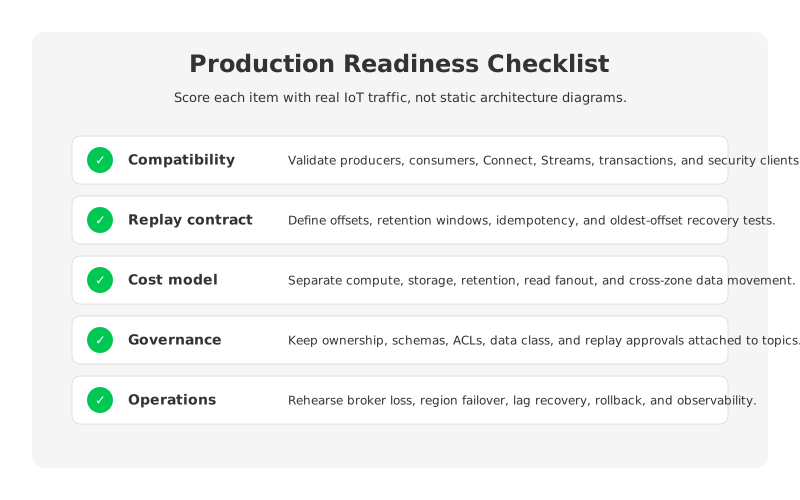
This checklist is platform-neutral. Apply it to self-managed Kafka, managed services, Kafka-compatible systems, and hybrid designs. Disaster readiness is a set of observable behaviors, not a vendor label.
5How AutoMQ changes the operating model
Once the evaluation reaches broker-local data movement, AutoMQ becomes relevant as a Kafka-compatible cloud-native streaming platform built around Shared Storage architecture. The design keeps the Kafka protocol and ecosystem surface familiar to applications while replacing Kafka's broker-local log storage layer with S3Stream, WAL storage, cache, and S3-compatible object storage. In practical terms, brokers handle protocol processing, partition leadership, caching, scheduling, and request routing, while durable data is organized in shared object storage rather than being permanently bound to a specific broker's local disk.
That distinction matters for IoT disaster readiness because many recovery tasks become less coupled to local log ownership. If compute and storage scale independently, adding or replacing brokers is less likely to require large partition-log relocation. If retained history lives in object storage, longer replay windows can be reviewed as a storage and read-path design rather than as a direct increase in every broker's local disk burden. WAL still matters: it is the write durability and recovery buffer before data is uploaded and organized in object storage, and different WAL choices have different latency and deployment implications.
AutoMQ should not be evaluated as a magic disaster recovery switch. The same gates still apply: client compatibility, offset behavior, connector restart, retention policy, security review, observability, and rollback. What changes is the platform mechanic underneath those gates. For workloads where IoT recovery is constrained by broker replacement, scaling, partition reassignment, cross-zone data movement, or long replay economics, a shared-storage operating model gives platform teams a different set of trade-offs to test.
Deployment boundaries also matter. AutoMQ BYOC and AutoMQ Software align with teams that need the streaming platform to run in their own cloud account, VPC, or private environment. That does not remove the need for IAM, private networking, encryption, telemetry, and support-access reviews. It does make the data path, control path, and operational responsibility easier to discuss separately.
6A practical readiness scorecard
The final readiness conversation should produce a scorecard, not a slide that says the platform is resilient. A useful scorecard names the failure, expected behavior, owner, proof, and residual risk. For example, "region outage" is too vague. "Ingest from region A stops, devices reconnect through region B, command acknowledgements replay from the last committed offset, and the state store rebuild completes without duplicate device commands" is testable.
The scorecard can be compact:
| Readiness dimension | Pass condition |
|---|---|
| Device reconnect storm | Producers retry without unbounded broker pressure or uncontrolled duplicate side effects. |
| Oldest-offset replay | A recovery consumer can read the oldest required offset while live ingestion continues. |
| Connector restart | Source and sink connectors resume with documented offset and write semantics. |
| Broker replacement | The platform recovers capacity without manual local-log relocation as the main task. |
| Governance | Topic ownership, data class, schema policy, and replay approval are visible before incident time. |
| Rollback | Clients and data paths can return to the previous state with defined data-loss and duplicate bounds. |
This is where architecture becomes measurable. If a platform passes the scorecard, the team has evidence. If it fails, the failure is useful because it names the work: shorten the replay target, change partitioning, increase retention, isolate replay traffic, adjust connector semantics, or revisit the storage model.
Back at the original search query, iot disaster readiness kafka is not answered by a replication diagram alone. It is answered by a replayable event history that operators can trust during the worst traffic shape of the year. If broker-local storage, cross-zone data movement, or slow recovery drills are the constraints you keep finding, use a shared-storage evaluation as the next test, not as a slogan. A concrete starting point is to review the AutoMQ architecture overview and run the scorecard against one representative IoT workload.
7References
- Apache Kafka documentation: Consumers and consumer groups
- Apache Kafka documentation: Kafka Connect
- Apache Kafka documentation: Replication and high availability design
- AWS documentation: Amazon S3 storage classes
- AutoMQ documentation: Architecture overview
- AutoMQ documentation: Compatibility with Apache Kafka
- AutoMQ documentation: S3Stream shared streaming storage
- AutoMQ documentation: Eliminate inter-zone traffic overview
8FAQ
8.1Is Kafka a good fit for IoT disaster recovery?
Kafka is a strong fit when IoT systems need ordered event history, independent consumer progress, replay, and integration with stream processing or connectors. It is not a complete disaster recovery plan by itself. Teams still need retention policies, idempotent downstream writes, offset recovery tests, governance, observability, and a platform operating model that can handle recovery traffic.
8.2How long should IoT Kafka topics retain data?
Retention should be set by use case rather than copied across all topics. Telemetry may need enough history for delayed arrival and diagnostics, device state topics may need compaction plus replay windows, and audit topics may need governance-driven retention. The right answer depends on recovery objectives, data sensitivity, downstream rebuild time, and cost.
8.3What should an IoT Kafka replay test include?
A useful replay test reads from known old offsets while live ingestion continues. It should measure consumer catch-up time, producer latency impact, tailing consumer behavior, connector restart behavior, duplicate handling, downstream write safety, and observability coverage. Testing replay without live traffic misses the pressure that appears during incidents.
8.4Where does AutoMQ fit in an IoT disaster readiness architecture?
AutoMQ is worth evaluating when a team wants Kafka compatibility but needs a different operating model for storage, scaling, broker replacement, and replay economics. Its Shared Storage architecture uses S3-compatible object storage as the durable data layer, with WAL and cache components supporting the Kafka-facing path. The proof should still be a workload-specific recovery drill.


