
Table of Contents
Table of Contents
An IoT team usually discovers the edge problem in the least convenient place: not during the whiteboard session, but during a backhaul outage, a ship-to-shore handoff, a factory network maintenance window, or a cellular dead zone between telemetry bursts. The application is still producing events. Operators still expect alarms, dashboards, and downstream models to make sense. Yet the network path to the cloud is no longer a steady pipe.
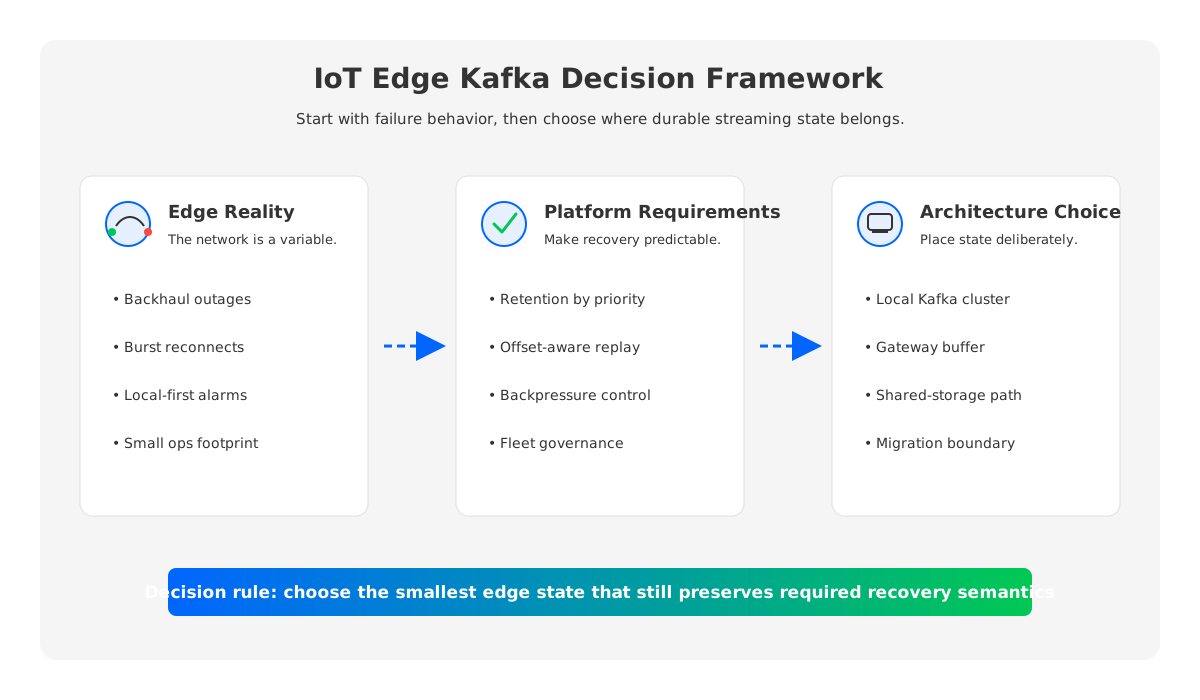
That is why searches for iot streaming edge kafka are rarely about whether Apache Kafka can ingest device telemetry. Kafka already gives teams a durable log, producer and consumer APIs, partitioned ordering, offsets, and consumer groups. The harder question is where Kafka should live, how much state should be placed at the edge, and how the platform should behave when the edge is connected only part of the time.
Edge streaming is not a smaller version of a central data platform. It is a different failure model. Links fail asymmetrically, bandwidth comes back in bursts, sites may run with limited staff, and local compute must decide what to keep, compress, replay, or drop. A production architecture has to treat intermittent connectivity as a normal state, not an exception path.
1Why IoT Streaming Edge Kafka Is a Different Problem
The attraction of Kafka at the edge is straightforward. Many platform teams already use Kafka-compatible applications, connectors, stream processors, and operational practices in the cloud or data center. Reusing that interface at factories, energy sites, logistics hubs, retail locations, and industrial gateways can reduce application rewrite work. Producers write events. Consumers read by offset. Downstream services can replay historical data when a model or analytic pipeline changes.
The pressure comes from the gap between Kafka's elegant logical model and the physical constraints of remote sites. A central Kafka cluster is usually deployed with stable networking, managed storage, planned capacity, and a team that can respond quickly. An edge site may have a small server, constrained disk, limited network windows, and long periods where local services must operate without cloud coordination.
For IoT workloads, the most important design questions are operational:
- Which events must be acted on locally before they reach the cloud?
- How much local retention is needed when backhaul is unavailable?
- What happens to ordering when devices reconnect in batches?
- Which data should be compacted, filtered, or aggregated before upload?
- How are offsets, schemas, ACLs, and observability handled across many sites?
Those questions determine whether the edge should run a full Kafka cluster, a local buffer that later exports to Kafka, or a hybrid model that keeps Kafka-compatible semantics for applications while moving durable storage and control-plane complexity away from the site.
2The Production Constraints Behind Intermittent Networks
Intermittent connectivity is more than packet loss. It changes how the streaming system accounts for time. A producer may continue generating records while the cloud is unreachable. A local consumer may process alerts immediately while an analytics consumer in the cloud sees the same records minutes or hours later. During recovery, a backlog can arrive faster than normal steady-state traffic, creating a second failure mode: the system survives the outage but overloads during catch-up.
Kafka gives useful primitives for this situation. Offsets let consumers resume from a known position. Consumer groups let work be divided among instances. Transactions and committed offsets can help applications coordinate processing when they are used carefully. Kafka's design documentation also emphasizes the log as a durable abstraction that supports replay rather than one-time message delivery.
At the edge, the risk is not that these primitives disappear. The risk is that local infrastructure cannot carry the state safely enough. Broker-local disks become the operational center of gravity. If an edge broker fails, the data on that broker has to be recovered or replicated. If retention is undersized, telemetry may be deleted before the WAN returns. If every site uses a bespoke buffer and export path, central teams inherit a fleet of small streaming systems that behave differently.
Cloud edge services recognize the same constraint. AWS IoT Greengrass Stream Manager, for example, supports local stream handling for high-volume device data and explicitly works in environments with intermittent or limited connectivity. That design pattern is a useful signal even for teams that standardize on Kafka: a production edge architecture needs local policy for retention, priority, bandwidth, and export behavior, not only a broker endpoint.
3Three Architecture Patterns Teams Usually Compare
Most IoT streaming edge Kafka discussions converge on three patterns. None is universally right; each moves state, operational complexity, and failure recovery to a different place.
The first pattern is a full Kafka cluster at each edge site. It preserves familiar APIs and can support local consumers, local replay, and disconnected operation. It also puts broker state, replication, disk sizing, upgrades, and monitoring at every site. This can work for large industrial locations with reliable local infrastructure. It becomes harder when a company has hundreds or thousands of small sites.
The second pattern is an edge buffer or gateway that exports to a central Kafka cluster. This keeps the edge footprint smaller and lets the core Kafka platform remain centralized. It is often a good fit when local applications only need buffering, filtering, or lightweight rules. The tradeoff is semantic translation. The gateway must decide how to map local queues, priorities, and retries into Kafka topics, keys, timestamps, and offsets.
The third pattern is a Kafka-compatible architecture that separates compute from durable storage. In this model, brokers serve Kafka APIs but data is not permanently tied to broker-local disks. Shared storage reduces the amount of state bound to each broker and can make scaling, replacement, and recovery less dependent on local data movement. The pattern is especially relevant when the "edge" is a regional edge zone, cloud-adjacent factory environment, or controlled customer VPC rather than a tiny embedded device.
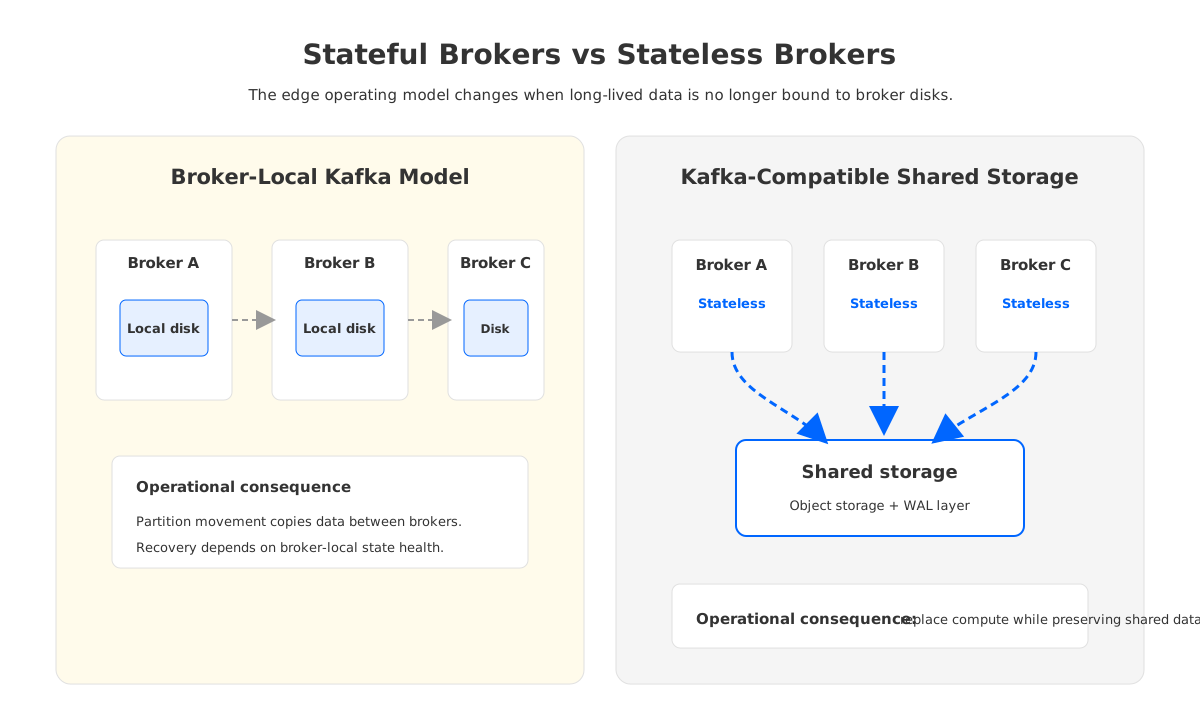
The important distinction is not "edge versus cloud." It is how much durable state you are willing to operate at the edge. Stateful local Kafka gives strong local autonomy but higher fleet burden. Gateway buffering reduces fleet burden but may weaken Kafka semantics. Shared-storage Kafka-compatible systems reduce broker-local state, but they still need a deployment boundary with enough connectivity and storage access to make the model useful.
4Evaluation Checklist for Platform Teams
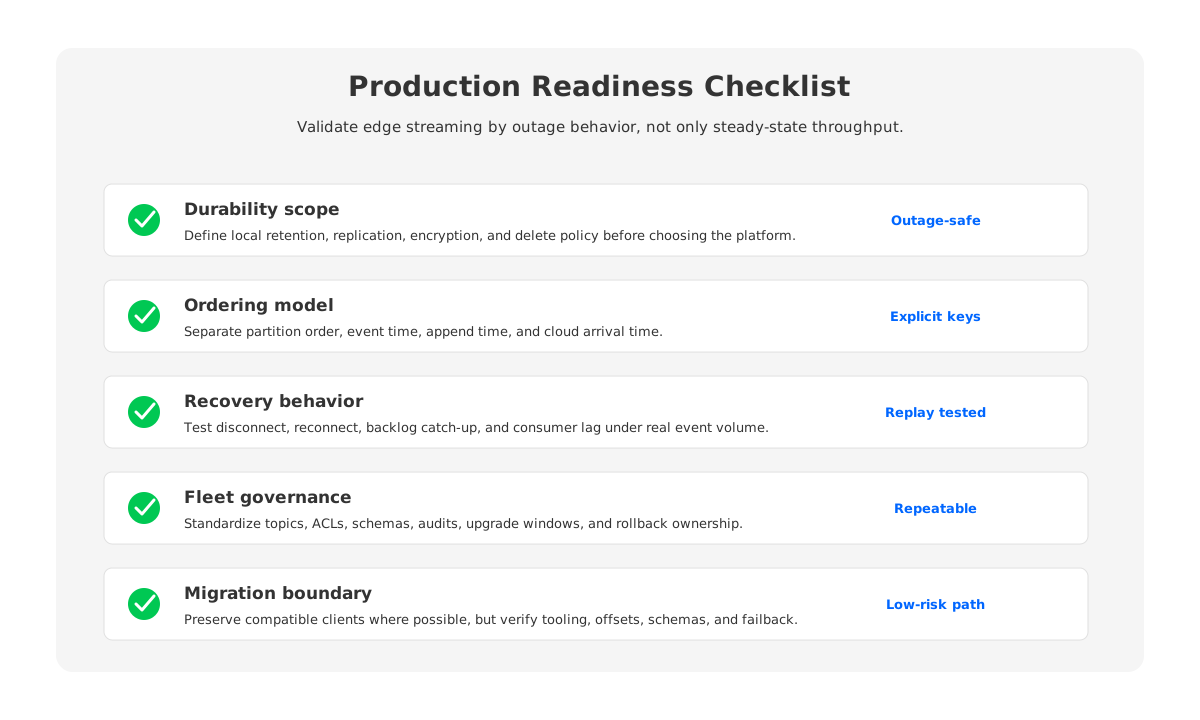
The cleanest way to evaluate an IoT streaming architecture is to test it against failure and recovery scenarios before comparing product features. A platform that looks reasonable at steady state can fail under backlog replay, schema drift, or disk pressure.
Start with durability scope. Decide whether the edge must guarantee local durability while disconnected, or whether it only needs to preserve data until a cloud export succeeds. This choice drives disk sizing, replication, encryption, and operational runbooks. A safety-critical manufacturing line and a retail foot-traffic counter should not share the same retention assumptions.
Next, define the ordering model. Kafka ordering is per partition, not global. That works well when keys map naturally to devices, assets, or production lines. It becomes tricky when devices reconnect late or gateway software batches records by network availability rather than event time. Teams should be explicit about the difference between event timestamp, broker append time, and cloud arrival time.
Then examine recovery behavior. A useful test is to disconnect a site, continue producing events, reconnect it, and measure whether local consumers, cloud consumers, and monitoring systems all behave predictably. The architecture should make it clear which component owns backpressure, which component prioritizes urgent streams, and which metrics show that catch-up is healthy.
Finally, look at governance. Edge streaming can multiply topics, credentials, schema versions, and deployment variants. If every site becomes a unique Kafka environment, the central platform team will spend more time reconciling configuration than improving the product. A production design needs repeatable policy for naming, schema evolution, ACLs, audit logs, and upgrade windows.
5Operational Controls That Matter During Catch-Up
The most revealing edge test is not "can the site buffer for a while?" It is "what happens in the first hour after the link returns?" During catch-up, the platform has to move old telemetry, current telemetry, control-plane traffic, and operator-facing alerts through the same constrained path. If every backlog is treated equally, high-value streams can be delayed behind routine measurements that were already stale when the connection came back.
That is why production teams usually add policy before adding capacity. Some streams need strict preservation. Others can be compacted by key, aggregated over a window, or dropped after a retention threshold. Kafka topics and keys are part of that policy because they decide how ordering, retention, compaction, and consumer lag are observed. A generic edge queue may hide those choices until export time; a Kafka-compatible edge or aggregation layer makes them visible earlier.
Observability should be designed around the same recovery story. The platform needs site-local indicators for disk pressure, buffer age, producer errors, and consumer lag, plus central indicators for delayed arrival, replay rate, and failed exports. A dashboard that only shows broker health is not enough. A healthy broker can still be carrying a backlog that makes downstream AI features or operational analytics stale.
Migration planning also belongs in this control layer. If an organization already has Kafka clients in factories or gateways, replacing every producer and consumer is usually the riskiest part of the program. A safer path is to preserve the Kafka interface where it is already embedded, verify compatibility topic by topic, and change the infrastructure boundary in stages: gateway buffer, regional aggregation, central replay, then long-term storage and analytics.
6Where AutoMQ Changes the Operating Model
After that neutral evaluation, shared-storage Kafka-compatible systems become easier to place. AutoMQ is one option in this category: it keeps Kafka API compatibility while using a shared-storage architecture in which brokers are designed to be stateless and data is offloaded to object storage with a write-ahead log layer.
That does not mean every sensor gateway should run AutoMQ, or that shared storage removes the need for local edge buffering. Tiny gateways and harshly disconnected sites still need local persistence policies close to the device. The more relevant fit is the layer where platform teams want Kafka-compatible ingestion and replay without binding long-lived data to broker disks: regional aggregation points, industrial edge clusters with object storage access, cloud-adjacent edge zones, and customer-controlled VPC deployments.
In a traditional broker-local model, scaling or replacing brokers often implies partition reassignment and data movement. That is uncomfortable in edge-adjacent environments because recovery windows are constrained and network capacity may be shared with operational traffic. In a shared-storage model, the broker is less like a permanent data owner and more like compute serving the Kafka protocol. For platform teams, the practical benefit is a different failure-recovery and scaling conversation: replace compute, preserve shared data, and reduce the amount of broker-local state that has to be nursed back to health.
AutoMQ's documentation describes this storage-compute separation, WAL storage choices, Kafka compatibility, and migration via Kafka Linking. Those capabilities matter most when the team wants to keep Kafka applications and tooling while changing the infrastructure economics and operations behind the API. They are not a substitute for edge design discipline. They are a way to avoid carrying a central Kafka cluster's broker-local storage assumptions into every edge-adjacent deployment.
7A Decision Table for IoT Edge Kafka Architecture
The decision usually becomes clearer when the site profile is separated from the application interface.
| Scenario | Prefer This Pattern | Why It Fits |
|---|---|---|
| Small devices or gateways with long offline windows | Local stream buffer exporting to Kafka | Keeps footprint small and lets local policy handle retention, priority, and reconnect behavior. |
| Large site that needs local replay and local consumers | Site-local Kafka or Kafka-compatible cluster | Preserves Kafka semantics close to operations, with enough infrastructure to run it responsibly. |
| Regional edge aggregation or cloud-adjacent industrial platform | Kafka-compatible shared-storage architecture | Reduces broker-local state while keeping Kafka APIs for applications and downstream pipelines. |
| Existing Kafka estate moving toward cloud-native operations | Migration path with compatibility checks | Lets teams preserve clients, topics, and operational knowledge while changing the storage model. |
The table is intentionally not a product selector. It is a boundary selector. Decide first where durable state belongs, how disconnected operation should behave, and which parts of Kafka compatibility are required by applications. Only then compare implementations.
8References
- Apache Kafka documentation
- Apache Kafka design documentation
- Apache Kafka tiered storage documentation
- AWS IoT Greengrass Stream Manager documentation
- AutoMQ shared storage architecture
- AutoMQ WAL storage documentation
- AutoMQ migration overview
9FAQ
9.1Should every IoT edge site run Kafka locally?
No. Local Kafka is most useful when the site needs local replay, local stream processing, and enough infrastructure to operate brokers safely. Smaller sites often need a durable edge buffer that exports to a central Kafka-compatible platform.
9.2How should teams handle intermittent connectivity with Kafka?
Treat disconnection as a normal operating state. Define local retention, priority, bandwidth, backpressure, and replay policies. Then test outage and catch-up behavior with real event volume rather than only testing steady-state ingestion.
9.3Does Kafka guarantee ordering for late-arriving IoT events?
Kafka preserves order within a partition append log. IoT systems still need to model event time separately from arrival time because devices may reconnect late, gateways may batch data, and cloud consumers may see records after local consumers have already acted on them.
9.4Where does shared storage help in edge-adjacent Kafka deployments?
Shared storage helps when broker-local disks become the operational bottleneck for scaling, replacement, recovery, or retention. It is most relevant for regional edge or cloud-adjacent deployments where object storage access is available and Kafka API compatibility remains important.
9.5Is AutoMQ a replacement for edge buffering?
Not in every site profile. AutoMQ is better understood as a Kafka-compatible, shared-storage streaming platform for the aggregation or platform layer. Device gateways and severely disconnected sites may still need local buffers before data reaches that layer.


