
Table of Contents
Table of Contents
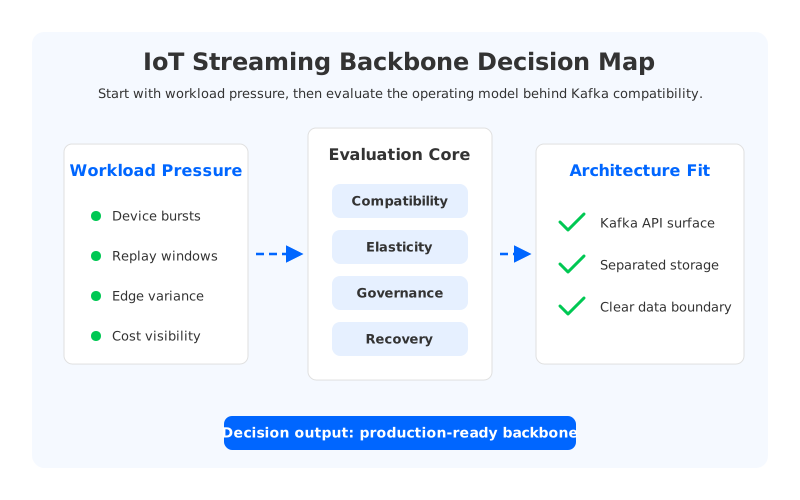
Teams usually search for iot streaming backbone kafka after the first ingestion design has already proved useful. Device events are landing, dashboards are live, and downstream teams now want the same stream for anomaly detection, predictive maintenance, fleet analytics, audit storage, and product telemetry. The platform question changes from "Can Kafka receive these events?" to "Can this backbone keep absorbing irregular device traffic without turning every growth step into a storage, networking, or governance project?"
That change matters because IoT telemetry is rarely a clean, evenly distributed stream. Devices reconnect after network outages, gateways flush buffered events, firmware updates alter payload shape, and downstream consumers ask for replays at the worst possible time. The backbone has to preserve Kafka's familiar producer, topic, consumer group, and connector model while making capacity, retention, recovery, and cloud cost understandable to more than one team.
1Why teams search for iot streaming backbone kafka
IoT systems expose a specific weakness in many streaming platforms: the ingest path and the operating model are judged by different clocks. Producers care about accepting device events now. Data engineering cares about making those events usable across warehouses, lakehouses, stream processors, and operational services. SRE cares about what happens when the broker fleet, network path, storage layer, or consumer estate falls behind.
Kafka is attractive because it gives these teams a shared abstraction. It supports durable logs, ordered partitions, consumer groups, offsets, Kafka Connect integrations, and stream processing ecosystems. That surface area is the reason Kafka often becomes the backbone instead of a narrow ingestion queue. A temperature reading, equipment state change, charging event, alarm, location update, or edge gateway heartbeat can be written once and consumed many times.
The harder part is not the first topic. It is the accumulation of topics with different owners and failure modes:
- Bursty sources: Device fleets often move in waves. A reconnection storm or scheduled poll can look like a traffic spike even when the long-term average is calm.
- Replay-heavy consumers: Analytics, model training, incident investigation, and backfills can turn retained telemetry into active read load.
- Uneven payloads: Some topics carry tiny heartbeats, while others carry rich event envelopes with headers, diagnostics, and schema evolution pressure.
- Regional constraints: Factories, utilities, vehicles, retail locations, and smart buildings may have placement, sovereignty, or private networking requirements.
- Long operational tails: Devices can remain in service for years, so the backbone has to support old producers, later consumers, and controlled migration paths at the same time.
A platform team that treats all of this as "Kafka throughput" will miss the real decision. The backbone is a contract across application teams, data teams, security reviewers, FinOps, and operators. The technology choice should therefore be evaluated as an operating model, not only as a broker benchmark.
2The integration constraint behind the pipeline
The integration layer is where IoT backbones become politically and technically important. Device teams usually do not want to learn every downstream destination. Analytics teams do not want to negotiate with every firmware release. Security teams do not want uncontrolled point-to-point data movement between factories, cloud accounts, and SaaS systems. Kafka creates a useful boundary because producers publish events into topics and downstream systems consume from that durable stream.
Kafka Connect is often the practical bridge at this boundary. Source connectors bring data from databases, object stores, message brokers, or edge aggregation systems into Kafka. Sink connectors move validated telemetry into warehouses, lakehouses, search systems, observability tools, and operational stores. The value of the connector layer is not only reuse; it is also governance. A connector gives the platform team a place to enforce credentials, observe failures, control delivery semantics, and standardize how data leaves the backbone.
That does not make connectors a free abstraction. High-volume telemetry can overload a sink, expose schema drift, or create retry storms if error handling is vague. A connector that works for a calm dashboard feed may behave differently during a replay window. The platform has to decide which failures should block the stream, which records should go to a dead-letter path, and which topics require a stricter schema contract before any sink is allowed to consume them.
The same logic applies to stream processing. A Flink job, Kafka Streams application, or custom consumer can enrich device telemetry, detect anomalies, aggregate by fleet, and join events with reference data. Those jobs usually depend on predictable offset behavior and replayable history. Once stream processing becomes part of the backbone, retention is no longer only a storage policy. It becomes the recovery window for downstream state.
3Where traditional Kafka operations feel the pressure
Traditional Kafka is a shared-nothing system. Brokers own partitions, serve client traffic, and store durable log segments on broker-local disks. This model is proven and widely understood, but it binds several capacity questions together. More retention means more broker storage. More partitions can mean more metadata and balancing work. More consumers can mean more fetch traffic. Broker failure or scaling can require data movement between brokers, which competes with production traffic.
For steady workloads, that coupling may be acceptable. IoT telemetry makes it more visible because the stream has both a hot edge and a long tail. Hot ingest needs low producer latency and enough broker headroom. The long tail needs retained data for replay, investigation, compliance, and model training. When both are tied to the same broker fleet, the team can end up buying capacity for the worst overlap of active writes, historical reads, replication, and recovery.
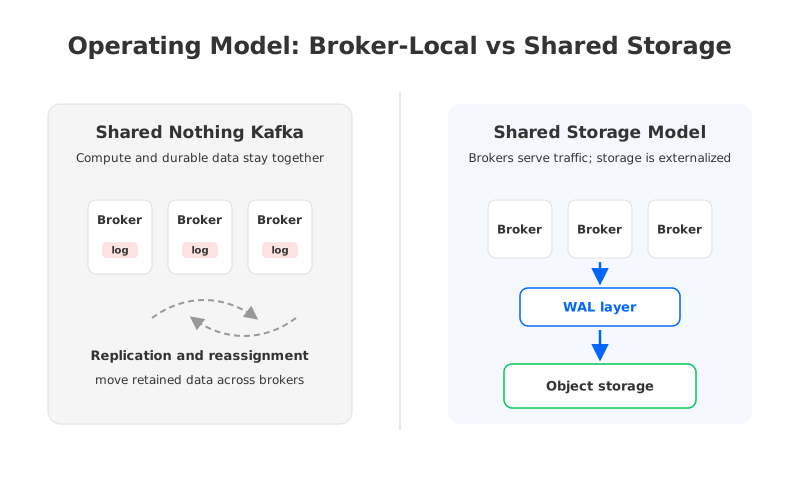
This is where cloud economics enter the architecture discussion. Cloud services separate compute, storage, request, and network cost into different meters. A Kafka backbone that moves replicated data across availability zones, stores large retained logs on block devices, and expands brokers for storage headroom can make the bill hard to explain. The issue is not that Kafka is expensive by definition. The issue is that broker-local storage can hide the reason one cost line moves with another.
Tiered storage changes part of that picture by moving older log segments to remote storage. It can be a useful fit when the main problem is long retention for cold reads. It does not automatically make the brokers stateless, and it does not remove every operational dependency on local broker resources. For an IoT backbone, the distinction matters: offloading older segments helps retention economics, while removing durable data from broker identity changes scaling and recovery mechanics more deeply.
4Connector, schema, replay, and processing trade-offs
The most productive architecture review starts with workload classes rather than product names. A building telemetry stream, industrial equipment stream, and consumer device stream may all use Kafka, but they should not share the same assumptions about retention, replay, ordering, privacy, or downstream sinks. If the platform does not name those classes, every debate becomes generic.
Use a decision table that forces each team to show evidence:
| Decision area | What to validate | Why it matters for IoT telemetry |
|---|---|---|
| Compatibility | Producer libraries, consumer groups, offsets, transactions where needed, Kafka Connect, schema registry, and admin tooling | Device and data teams need continuity for working integrations when the backbone changes |
| Cost model | Broker compute, storage, object storage, network transfer, private connectivity, connector runtime, and observability | FinOps needs to know which workload behavior drives which cost line |
| Elasticity | Scale-out, scale-in, partition movement, hot partitions, replay pressure, and recovery drills | Device waves punish platforms that can add capacity only after moving too much retained data |
| Governance | IAM, ACLs, encryption, private networking, audit logs, data residency, and telemetry collection boundaries | IoT events often contain operational, location, or customer-sensitive context |
| Migration | Topic inventory, consumer group handling, offset continuity, dual-run windows, producer switch order, and rollback | A streaming backbone migration has to be reversible enough for application owners to trust it |
| Operations | Broker metrics, connector lag, processing lag, request failures, storage growth, and incident runbooks | The team has to diagnose whether pressure comes from producers, consumers, storage, or recovery |
The table looks simple, but it changes the conversation. A platform that passes a producer throughput test but cannot explain consumer replay cost is not ready. A managed service that hides every storage and network detail may reduce routine work while making governance harder. A self-managed cluster may give full control while asking the team to own every failure drill. There is no universal answer; there is only a better match between workload pressure and operating model.
5How AutoMQ changes the operating model
Once the evaluation separates Kafka compatibility from broker-local storage assumptions, shared storage becomes a serious architecture category. AutoMQ fits this category as a Kafka-compatible cloud-native streaming platform that keeps the Kafka protocol and ecosystem surface while moving durable stream storage into object storage through a Shared Storage architecture. The point is not to make Kafka disappear. The point is to preserve the Kafka contract while changing what brokers are responsible for.
In AutoMQ, brokers are designed to be stateless relative to durable stream data, and the storage layer is backed by object storage with a WAL path for write durability. That changes the operational questions. Scaling compute capacity no longer has to mean that retained stream data is redistributed as part of the same action. Retention becomes a storage policy against object storage rather than a direct broker disk sizing exercise. Recovery focuses more on service ownership, metadata, cache behavior, and client-visible continuity than on rebuilding large broker-local replicas.
For IoT backbones, that shift is useful in several common scenarios. A fleet reconnect wave can be handled as an elasticity and ingress problem rather than a reason to permanently oversize every broker for storage. A replay-heavy analytics job can be evaluated against object-storage-backed history and cache behavior instead of only local disk pressure. A governance review can inspect the deployment boundary, object storage bucket, WAL configuration, IAM scope, network path, and telemetry path more explicitly.
AutoMQ BYOC is relevant when the data plane must run inside the customer's cloud account and network boundary. AutoMQ Software is relevant when a team wants a Kafka-compatible shared-storage model in its own controlled environment. In both cases, the responsible evaluation is still workload-specific. The right proof is not a generic hello-world cluster; it is a production-shaped test with real payload classes, connector behavior, replay windows, security controls, and rollback steps.
The migration path also deserves sober treatment. Kafka-compatible APIs reduce application change, but production migration is still coordination work. Topic batches, consumer groups, schema compatibility, connector cutover, producer switch order, mirror or linking behavior, and rollback criteria should be documented before the first high-value topic moves. A better storage architecture reduces a class of operational coupling; it does not remove the need for disciplined change management.
6A practical readiness sequence
Start with a workload register. For each topic family, capture owner, event type, expected peak pattern, retention, consumer groups, downstream sinks, schema contract, privacy class, and recovery objective. This register turns architecture debate into a shared source of truth. Without it, the loudest dashboard usually wins.
Then run a baseline window that includes normal traffic and at least one controlled stress event. The stress event can be a replay, a connector sink slowdown, a broker replacement, a consumer group restart, or a device batch flush in a test environment. The goal is not to create drama. The goal is to learn which part of the backbone saturates first and whether the team can explain it from metrics and logs.
Next, compare operating models against the same evidence. Do not let each vendor or internal team define its own success criteria. Use the same payloads, topic layout, consumer groups, connector sinks, network boundary, retention policy, and observability requirements. A platform that looks strong only under its preferred test shape may still fail the shape your IoT system actually produces.
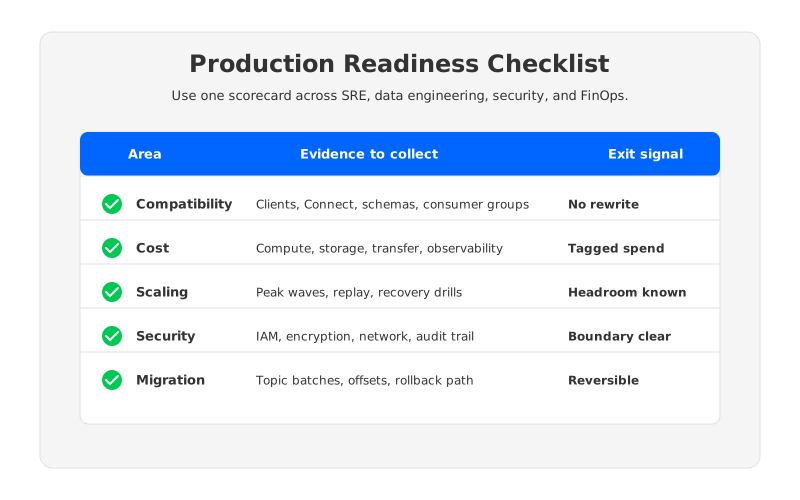
Before production, write the rollback plan in operational language. Which producers switch back? Which consumers must pause? How are offsets validated? Which connector sinks can tolerate duplicate delivery? Which dashboard tells the incident commander that the backbone is healthy enough to continue? These questions are unglamorous, but they decide whether migration risk is real or theoretical.
If your IoT streaming backbone keeps pointing to the same coupling between retained data, broker capacity, recovery movement, and cloud cost, evaluate whether a Kafka-compatible shared-storage model changes the trade-off for your workload. You can review AutoMQ's cloud-native Kafka architecture and start a workload-shaped evaluation here: Explore AutoMQ for Kafka-compatible streaming.
7References
- Apache Kafka Documentation
- Apache Kafka Connect Documentation
- Apache Kafka Consumer Configuration
- Apache Kafka Message Delivery Semantics
- AWS Availability Zones documentation
- Amazon S3 User Guide
- AutoMQ compatibility with Apache Kafka
- AutoMQ architecture overview
8FAQ
8.1Is Kafka a good fit for an IoT streaming backbone?
Kafka is a strong fit when the backbone needs durable event streams, ordered partitions, consumer groups, replayable history, connector integrations, and stream processing. The main design work is not choosing Kafka as an API; it is choosing an operating model that can handle bursty device traffic, retention, replay, governance, and recovery without constant manual intervention.
8.2What is the biggest architecture risk in high-volume IoT telemetry?
The biggest risk is treating average ingest throughput as the whole problem. IoT workloads often fail at the overlap between producer bursts, consumer replay, connector backpressure, retained data growth, and recovery movement. A useful architecture review tests those overlaps directly.
8.3How should teams evaluate Kafka-compatible platforms for IoT telemetry?
Use a workload-based scorecard. Validate client compatibility, connector behavior, schema handling, cost visibility, scaling mechanics, security boundaries, observability, migration steps, and rollback. Run the same production-shaped workload against each option instead of relying on generic benchmark claims.
8.4Where does shared storage help?
Shared storage helps when broker-local durable data is the source of scaling, recovery, or retention friction. By separating compute capacity from durable stream storage, a Kafka-compatible shared-storage platform can make capacity changes and long retention easier to reason about. Teams still need to test write durability, cache behavior, replay performance, and operational tooling against their own workload.


