
Table of Contents
Table of Contents
Teams usually search for kafka access control workflow after the first permission model has already become hard to explain. A few service accounts were created by hand. Some ACLs came from Terraform. A platform portal may exist for topic requests, while emergency access still happens through tickets and chat approvals. Nobody set out to build a risky system, but Kafka access control becomes risky when the workflow is split across ownership metadata, identity systems, topic lifecycle, networking, schema policy, and audit evidence.
The practical problem is not whether Apache Kafka supports authorization. Kafka has a mature authorization model built around principals, resources, operations, and ACLs. The harder question is whether an organization can let application teams request Kafka access without turning the platform team into a permanent manual review queue or, worse, normalizing broad permissions because narrow approvals take too long.
Self-service makes this tension visible. Developers want to create producers and consumers, request access to topics, test replay workflows, and ship applications without waiting days for platform tickets. Security wants least privilege. SREs want blast-radius control. Data governance wants ownership and auditability. Finance wants to understand whether a new consumer group, retention exception, or cross-domain stream creates infrastructure cost. A useful Kafka access control workflow has to serve all of those groups without pretending they have the same risk model.
1Why Kafka Access Control Becomes a Platform Workflow
Access control looks like a security feature from a distance. In production, it is a platform contract. A permission request often implies a topic owner, a data classification, a service identity, a network path, a quota, an observability surface, and a lifecycle rule. If those fields are not captured at request time, the platform will reconstruct them later during an incident, audit, or migration.
Kafka's own abstractions encourage broad reuse. A topic can serve multiple applications. A consumer group can replay old records. A connector can move data into warehouses, search systems, operational databases, or AI pipelines. That flexibility is the reason Kafka became shared infrastructure, but it also means a single ACL can cross team, environment, and data-domain boundaries.
A self-service workflow should therefore separate three decisions that are often mixed together:
- Who is asking? The request should identify the application, owning team, service account, environment, on-call contact, and lifecycle owner.
- What data boundary is involved? The request should classify the topic, schema domain, role, retention expectation, and whether access crosses domains or environments.
- What operation is being granted? Read, write, describe, create, alter, delete, and admin permissions have different blast radii and should not share the same approval path.
The workflow starts to fail when those questions are answered outside the system of record. A ticket comment may explain why a service received access, but a Kafka cluster cannot query that comment during drift detection. A security review may approve an exception, but a Terraform module cannot enforce the expiration unless the exception is encoded as policy. Self-service does not remove review; it forces review to become structured enough for automation.
2The Governance Pressure Behind Shared Streaming Platforms
Traditional Kafka operations add another layer of pressure because access requests are rarely isolated from capacity. A new producer may increase write throughput, a new consumer may increase broker fetch load, and a replay workflow may turn retained data into a peak-hour traffic event. When brokers own local persistent storage, the platform team often evaluates access and infrastructure together because a read permission can still affect disk, cache, network, and partition load.
This is where a simple ACL workflow becomes an operating model discussion. A platform can approve access by policy, but it still has to absorb the consequences of that access. If every larger domain rollout requires more brokers, more broker-local storage, or more cross-AZ replication traffic, access control becomes the front door to cost and reliability risk. The approval screen may ask "can this service read this topic?" while the SRE is really asking "can the cluster survive the replay this service plans to run next Friday?"
The same coupling appears in shared clusters. Teams often choose shared Kafka clusters because they reduce operational duplication and make governance central. Over time, the shared cluster becomes a negotiation space. Security wants narrow ACLs and strict topic ownership. Application teams want fewer delays. The platform team wants standard templates. Data teams want discoverable streams. Finance wants chargeback. The ACL object is the smallest visible artifact, but the workflow around it has to carry the real contract.
That contract should be explicit. A mature Kafka access control workflow does not approve individual ACLs in isolation; it evaluates the intended data relationship. Producer access to a payment event topic is different from consumer access to a product catalog topic. Temporary backfill access is different from steady-state application consumption. A connector sink with credentials to an external system is different from an internal service reading its own domain events.
3Contracts, Ownership, Access, and Audit Trade-offs
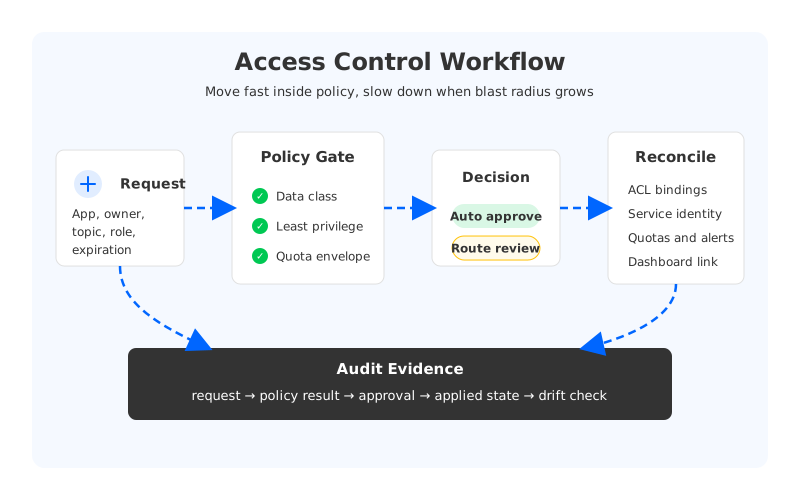
The cleanest way to design the workflow is to treat access as a lifecycle object, not a one-time grant. A request is created, classified, approved, reconciled into Kafka, observed, reviewed, and eventually renewed or removed. Each stage should leave evidence that another system can inspect later.
| Workflow stage | What the platform should capture | Why it matters |
|---|---|---|
| Intake | Application, owner, environment, topic, operation, business reason | Prevents orphaned permissions and unclear support paths |
| Policy check | Naming, data class, domain boundary, quota, network path | Turns informal review into repeatable rules |
| Approval | Required approver by risk tier, expiration, exception reason | Keeps high-risk access visible without blocking routine access |
| Reconciliation | ACLs, service identity, secret delivery, quota, dashboard registration | Keeps requested state and cluster state aligned |
| Audit | Request, policy result, applied ACL, drift result, renewal status | Gives security and incident teams a traceable record |
The table is intentionally operational. Many teams start with the Kafka command line, an infrastructure-as-code repository, or a portal form. Those tools can all work, but only if they preserve the same lifecycle. The workflow needs one place where the desired state is understandable: who can do what, on which resource, for what purpose, under which policy, until when.
Least privilege also needs practical boundaries. Wildcard topic permissions may be acceptable for a tightly controlled platform automation principal, but they should be rare for application services. Read access may be low-risk for public reference data and high-risk for regulated customer events. Write access may look narrow while still letting a service poison downstream consumers if schema governance is weak. Access control and data contract governance are separate mechanisms, but a self-service platform has to evaluate them together.
The useful test is whether an auditor, an on-call SRE, and the application owner would all give the same answer to the question: "Why does this principal have this permission?"
If the answer depends on tribal memory, the workflow is not ready for broad self-service. If the answer comes from request metadata, policy output, Git history, and cluster state, the platform can scale routine approvals without losing control.
4An Evaluation Checklist for Platform Teams
A good Kafka access control workflow is conservative about risk and aggressive about removing repetitive work. Routine, low-risk access should be fast because it follows templates. High-risk access should be slower because it changes blast radius, compliance posture, or cost. The mistake is to make every request manual or every request automatic.
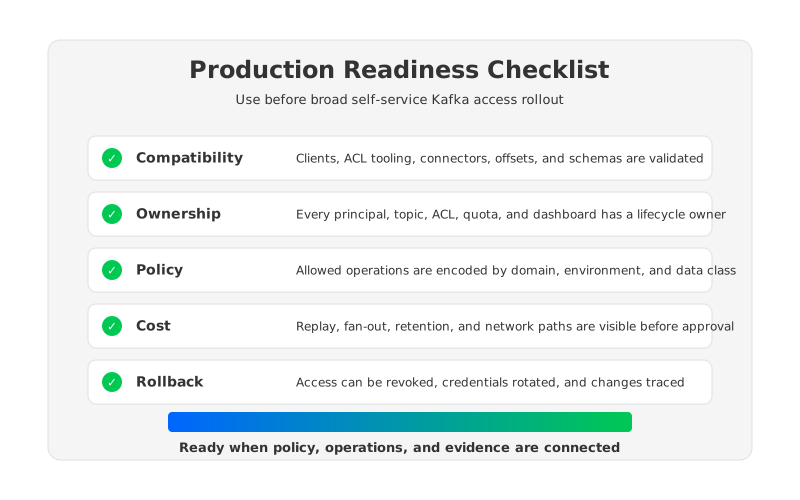
Use this checklist before exposing access requests through a service catalog, internal developer portal, Terraform module, or GitOps workflow:
- Compatibility: Do your Kafka clients, admin tools, ACL management paths, consumer groups, connectors, and schema workflows behave the same way in the proposed platform?
- Ownership: Does every topic, principal, ACL binding, quota, and dashboard have a team owner and lifecycle policy?
- Policy expression: Can the platform encode allowed operations by environment, domain, data class, and resource pattern rather than relying on reviewer memory?
- Cost awareness: Does the workflow distinguish a small steady-state consumer from a replay-heavy consumer, connector, or fan-out workload?
- Rollback: Can the platform revoke access, rotate credentials, roll back a bad permission change, and preserve evidence of the action?
- Observability: Can application teams see their own access-related failures while platform teams see authorization errors, drift, quota pressure, and anomalous traffic?
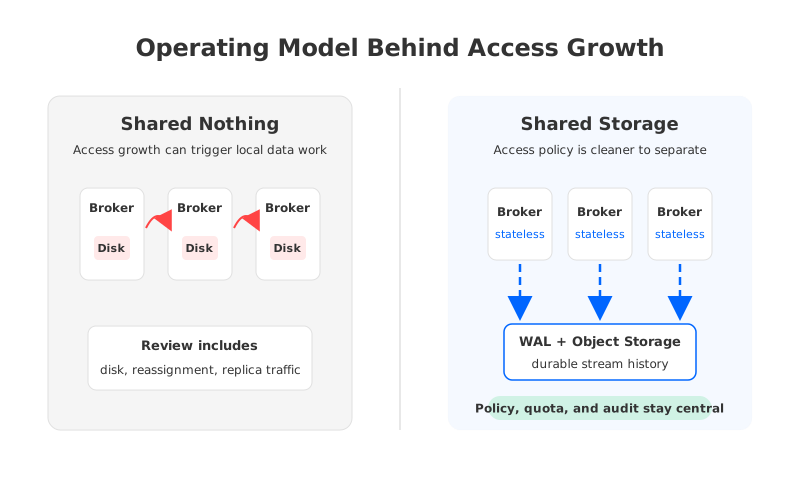
The architecture underneath the workflow matters because it determines which requests create operational drag. In a Shared Nothing Kafka architecture, brokers own local log storage and replication keeps partition replicas available. That design is proven, but it means access-driven workload growth can translate into broker sizing, storage forecasting, reassignment, and cross-zone traffic review. Tiered Storage can help by moving older log segments to remote storage, but it does not make brokers stateless; hot data, leader placement, and broker-local operational concerns still remain part of the review.
A self-service access workflow should expose that difference honestly. If a platform can approve a new consumer but cannot predict whether replay will stress broker-local storage or network paths, the workflow should include a gate. If a platform can separate routine ACL reconciliation from capacity planning, the workflow can be faster. The point is not to block developers with infrastructure details. The point is to avoid granting access in a way that hides the cost and reliability consequences from everyone.
5How AutoMQ Changes the Operating Model
Once the evaluation framework is clear, a different architecture category becomes relevant: Kafka-compatible streaming with Shared Storage architecture. AutoMQ fits this category by preserving Kafka API compatibility while moving durable stream storage away from broker-local disks and into an object-storage-backed design with WAL storage. Brokers become more stateless because durable data is not tied to a broker's local disk.
That changes the access-control discussion in a specific way. AutoMQ does not remove the need for ACL design, ownership metadata, service identities, or audit review. Those controls remain essential. What changes is the infrastructure consequence behind many access-driven changes. When storage and compute can scale more independently, a platform team can evaluate a new producer, consumer, or replay workflow with a cleaner separation between access policy and broker-local data movement.
For platform teams building self-service applications, the practical effects are concrete. The workflow can focus more on policy, ownership, data classification, and quota envelopes instead of treating every access expansion as a potential storage migration. Stateless brokers make broker replacement and compute scaling less dependent on moving persistent log data between local disks. Object storage changes the retention conversation because retained history is not sized primarily through broker-local disks. AutoMQ's documented goal of reducing cross-AZ traffic also gives teams another cost and topology dimension to evaluate for multi-AZ workloads.
Deployment boundaries matter for governance as much as architecture. AutoMQ BYOC is relevant when teams want lifecycle assistance while keeping runtime resources in the customer's cloud environment. AutoMQ Software is relevant when the platform must run in a customer-controlled private environment. In both cases, the workflow still needs IAM review, network policy, encryption policy, audit evidence, and operational authorization. The value is that the platform can evaluate those controls inside a clearer customer-controlled boundary.
6A Production Workflow Pattern
The access workflow should be built as a decision pipeline. Start with a narrow request model: topic, role, operation, environment, data class, owner, quota, traffic shape, and expiration. Then classify risk. Read access to an internal low-sensitivity topic may be template-approved. Write access to a shared business event topic may need schema owner approval. Admin operations, wildcard permissions, destructive actions, and cross-domain access should require explicit review.
After approval, automation should reconcile the full package, not only the ACL. That package includes the service identity, secret delivery or certificate binding, Kafka ACLs, quotas, dashboard registration, alert routing, and ownership metadata. The audit record should link the request, policy decision, approver, applied state, and drift result. When a team leaves, an application is retired, or a topic is migrated, the same lifecycle object should drive cleanup.
This workflow also helps migration planning. Access metadata shows which principals read or write each topic, which services need cutover testing, and which wildcard grants need redesign before production traffic moves.
The closing principle is simple: Kafka access control is not only an authorization setting. It is the point where application intent meets platform responsibility. A self-service workflow succeeds when developers can move quickly inside policy, and the platform team can still explain cost, security, ownership, and recovery when something goes wrong.
If your team is evaluating self-service Kafka access control and the operating model behind it, map one real application workflow from request to audit evidence. Then test whether your current architecture makes access expansion, replay, and scaling predictable. To evaluate the same workflow on a Kafka-compatible Shared Storage architecture, start an AutoMQ BYOC review.
7References
- Apache Kafka Documentation: Security and authorization
- Apache Kafka Documentation: Operations and access control lists
- Apache Kafka Documentation: Tiered Storage
- Apache Kafka KIP-405: Kafka Tiered Storage
- AutoMQ Architecture Overview
- AutoMQ Compatibility with Apache Kafka
- AutoMQ WAL Storage
- AutoMQ BYOC Environment Overview
- AWS PrivateLink Pricing
- AWS Data Transfer Pricing
8FAQ
8.1What is a Kafka access control workflow?
A Kafka access control workflow is the process for requesting, approving, applying, reviewing, and removing permissions for Kafka resources. It usually includes service identity, topic ownership, ACLs, quotas, audit evidence, and lifecycle metadata.
8.2Are Kafka ACLs enough for self-service access?
No. Kafka ACLs express authorization rules, but self-service also needs ownership, policy checks, approval routing, secret delivery, observability, cost awareness, and cleanup. ACLs are the enforcement artifact, not the full workflow.
8.3Which Kafka permissions should require manual approval?
Manual approval is usually appropriate for wildcard permissions, admin operations, destructive actions, cross-domain access, production write access to shared topics, retention exceptions, and temporary backfill access that may create unusual traffic.
8.4How does architecture affect Kafka access control?
Architecture affects the operational consequence of access. In broker-local storage designs, new producers, consumers, and replay workflows can create storage, network, and reassignment pressure. Shared Storage architecture can separate more of the access policy decision from broker-local data movement.
8.5Where does AutoMQ fit in Kafka access control workflow design?
AutoMQ fits when a team wants Kafka compatibility, customer-controlled deployment boundaries, and a Shared Storage operating model. It does not replace access governance, but it can make the infrastructure side of self-service access easier to reason about.


