
Table of Contents
Table of Contents
If you're running Apache Kafka in production, you've probably had that conversation — the one where someone pulls up the cloud bill and asks why a messaging system costs more than the databases it feeds. Kafka's architecture was designed for on-premise data centers where cross-rack replication was essentially free. In the cloud, every byte replicated across availability zones shows up as a line item, and the economics of three-way replication on EBS volumes start to look very different.
The good news: the Kafka ecosystem has never had more options. The bad news: choosing between them requires understanding architectural trade-offs that marketing pages tend to gloss over. In this comparison, I evaluate nine Kafka-compatible streaming platforms across seven dimensions — from cost efficiency and protocol compatibility to a dimension most comparisons ignore: metadata independence and its impact on SLA. Whether you're evaluating a Kafka alternative for a greenfield project or planning a migration from self-hosted Apache Kafka, this guide aims to give you the technical depth to make an informed decision.
1Methodology
This comparison draws on publicly available documentation, architecture whitepapers, pricing calculators, and benchmark reports published by each vendor. Where possible, I cross-referenced claims against community discussions, third-party benchmarks, and the KafScale comparison page which provided a useful starting framework.
Each platform is scored on a 1–10 scale across seven dimensions. These scores reflect my assessment based on the evidence available — reasonable people may weight dimensions differently based on their workload requirements. The scoring criteria:
- Cost Efficiency: Total cost of ownership for a representative workload (100 GB/day ingestion, 7-day retention). Includes compute, storage, network, and license fees.
- Kafka Protocol Compatibility: Breadth of Kafka API support — transactions, compacted topics, consumer groups, Connect, Streams.
- Operational Simplicity: How much operational burden falls on the user. Fully managed scores higher; complex multi-component architectures score lower.
- Scalability / Elasticity: Speed of scaling, auto-scaling capabilities, and whether scaling requires data rebalancing.
- Latency Performance: End-to-end P99 latency for produce-consume cycles under typical workloads.
- Openness: Licensing model, source availability, and freedom from vendor lock-in.
- Metadata Independence: How much the data path depends on external metadata services, and the SLA impact when metadata services degrade.
1.1Products Evaluated
| Product | Type | Language | Primary Storage |
|---|---|---|---|
| AutoMQ | Kafka fork, diskless | Java (Kafka codebase) | S3 + pluggable WAL |
| Confluent Cloud | Fully managed SaaS | Java (Kafka) | Managed infrastructure |
| WarpStream | Kafka-protocol, S3-native | Go (rewrite) | S3 only |
| Redpanda | Kafka-compatible rewrite | C++ | Local disk + S3 tiering |
| Amazon MSK | Managed Kafka | Java (Kafka) | EBS / managed storage |
| Aiven Diskless Kafka | Kafka with KIP-1150 | Java (Kafka) | S3 (diskless topics) |
| StreamNative Ursa | Lakehouse-native streaming | Java | Object storage (Iceberg/Delta) |
| Bufstream | S3-native, Iceberg-first | Go | S3 + PostgreSQL metadata |
| Apache Kafka | Self-hosted original | Java/Scala | Local disk |
2Comparison Overview
The chart below visualizes how each platform scores across all seven dimensions. Higher bars indicate stronger capability.
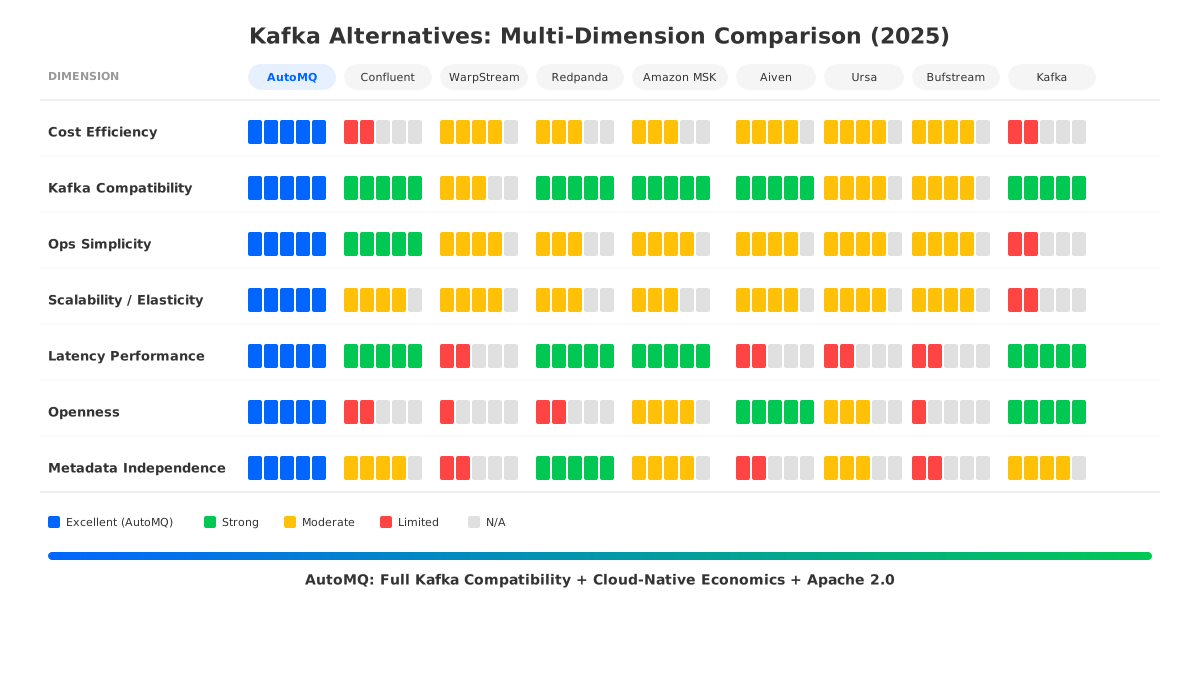
A few patterns jump out immediately. Platforms built on object storage (AutoMQ, WarpStream, Aiven Diskless, Ursa, Bufstream) cluster toward the high end on cost efficiency but diverge sharply on latency — the WAL architecture makes a decisive difference here. Traditional disk-based platforms (Apache Kafka, Redpanda) excel at latency but carry higher operational and cost burdens. Managed services (Confluent Cloud, Amazon MSK) trade cost for convenience. And on metadata independence, the architectural choices create real SLA implications that deserve more attention than they typically receive.
3Detailed Comparison by Dimension
3.1Architecture and Storage Model
The fundamental architectural divide in the Kafka ecosystem is between shared-nothing (traditional) and shared-storage (cloud-native) designs. This choice cascades into nearly every other dimension.
Shared-nothing platforms — Apache Kafka, Redpanda, and Amazon MSK — store data on local disks attached to broker instances. Each partition's data is replicated to multiple brokers across availability zones for durability. This delivers excellent latency (data is always local) but creates tight coupling between compute and storage. Scaling means moving data, and moving data takes time.
Shared-storage platforms take a different approach. AutoMQ, WarpStream, Bufstream, and Aiven Diskless Kafka all use S3 (or compatible object storage) as the primary data store, making brokers stateless or near-stateless. The key differentiator among them is how they handle the write path:
- AutoMQ uses a pluggable WAL (Write-Ahead Log) layer that sits between brokers and S3. The WAL accepts writes with low-latency acknowledgment, then batches and flushes data to S3 asynchronously. The WAL backend is configurable — S3 WAL (~500ms latency, zero additional infrastructure), EBS WAL (sub-10ms P99), or NFS WAL (e.g., AWS EFS/FSx). This "one architecture for both high-latency and low-latency workloads" design is architecturally distinctive: the same cluster can serve latency-sensitive and cost-optimized workloads by choosing the appropriate WAL backend.
- WarpStream writes directly to S3 with no local WAL, resulting in higher latency (~400–600ms P99). Their "Lightning Topics" use S3 Express One Zone for lower latency but sacrifice ordering guarantees and transaction support.
- Aiven Diskless Kafka (KIP-1150) reroutes Kafka's replication pathway from broker disks to object storage. It uses a leaderless architecture with a coordinator service (PostgreSQL-based) for batch metadata management.
- Bufstream stores data in S3 with PostgreSQL or Spanner as the metadata backend, targeting Iceberg-first data lakehouse workflows.
StreamNative Ursa takes a lakehouse-native approach — it stores data directly in open table formats (Iceberg, Delta Lake) on object storage, using a leaderless architecture with Oxia as its metadata/index manager. This eliminates the need for separate ETL pipelines to move streaming data into the lakehouse.
Confluent Cloud abstracts the architecture entirely as a managed service. Under the hood, it runs Apache Kafka with KRaft mode on managed infrastructure, with options ranging from Basic single-zone clusters to Enterprise multi-zone deployments. Their Freight Clusters (announced in 2024) explore a WarpStream-like S3-native model for cost-sensitive workloads.
| Platform | Storage Model | Broker State | Write Path |
|---|---|---|---|
| AutoMQ | S3 + pluggable WAL | Stateless | WAL → S3 (async batch) |
| Confluent Cloud | Managed (abstracted) | Managed | Standard Kafka |
| WarpStream | S3 only | Stateless | Direct to S3 |
| Redpanda | Local SSD + S3 tiering | Stateful | Local disk (Raft) |
| Amazon MSK | EBS volumes | Stateful | Local disk (ISR) |
| Aiven Diskless | S3 (diskless topics) | Near-stateless | Object storage (leaderless) |
| StreamNative Ursa | Object storage (Iceberg/Delta) | Stateless | Object storage (leaderless) |
| Bufstream | S3 + PostgreSQL | Stateless | S3 (batched) |
| Apache Kafka | Local disk | Stateful | Local disk (ISR) |
The storage model choice is not about which is "better" — it's about which trade-offs align with your workload. If you need sub-10ms latency and can afford the operational overhead, shared-nothing still delivers. If cost efficiency and elasticity matter more than single-digit millisecond latency, shared-storage architectures offer a fundamentally different cost curve.
3.2Kafka Protocol Compatibility
Compatibility is not binary — it's a spectrum. "Kafka-compatible" can mean anything from "supports Produce and Fetch APIs" to "passes all 2,000+ official Apache Kafka test cases."
| Feature | AutoMQ | Confluent | WarpStream | Redpanda | MSK | Aiven Diskless | Ursa | Bufstream | Kafka |
|---|---|---|---|---|---|---|---|---|---|
| Core Produce/Consume | ✓ | ✓ | ✓ | ✓ | ✓ | ✓ | ✓ | ✓ | ✓ |
| Consumer Groups | ✓ | ✓ | ✓ | ✓ | ✓ | ✓ | ✓ | ✓ | ✓ |
| Transactions (EOS) | ✓ | ✓ | ✗ | ✓ | ✓ | ✗ | ✗ | ✓ | ✓ |
| Compacted Topics | ✓ | ✓ | ✗ | ✓ | ✓ | ✗ | ✗ | ✗ | ✓ |
| Kafka Connect | ✓ | ✓ (managed) | External | ✗ (partial) | ✓ (MSK Connect) | ✓ | External | External | ✓ |
| Kafka Streams | ✓ | ✓ | ✓ | ✓ | ✓ | ✓ | ✓ | ✓ | ✓ |
| Strimzi Operator | ✓ | N/A | ✗ | ✗ | N/A | ✓ | ✗ | ✗ | ✓ |
Platforms built on the actual Apache Kafka codebase — AutoMQ, Amazon MSK, Aiven Diskless, and Confluent Cloud — inherit full protocol compatibility almost by definition. AutoMQ's approach is particularly notable here: because it reuses the Kafka Java codebase and only replaces the storage engine, it passes all official Kafka test cases and supports every Kafka feature natively, including transactions, compacted topics, and the queueing model. This is not emulation — it's the same code.
Redpanda, as a C++ rewrite, achieves high compatibility but occasionally diverges on edge cases, particularly around Kafka Connect plugins that depend on JVM internals. WarpStream and Bufstream, both Go rewrites, support core APIs but lack transactions and compacted topics — features that many production workloads depend on. StreamNative Ursa, coming from the Pulsar ecosystem, offers Kafka protocol compatibility for core operations but is still building out full feature parity.
The practical implication: if you're running Kafka Connect pipelines, Flink jobs with exactly-once semantics, or applications that rely on compacted topics for CDC, your options narrow significantly. AutoMQ, Confluent Cloud, Amazon MSK, and Apache Kafka are the safest choices for full compatibility.
3.3Cost Efficiency
Cost is where the architectural differences become most tangible. The three biggest cost drivers in traditional Kafka deployments are cross-AZ replication traffic, EBS storage for multiple replicas, and over-provisioned compute for headroom.
Here's an estimated monthly cost comparison for a representative workload: 100 GB/day ingestion, 7-day retention, 3-node equivalent cluster in AWS us-east-1.
| Platform | Estimated Monthly Cost | Key Cost Drivers |
|---|---|---|
| Apache Kafka (self-hosted) | ~$400 | EBS volumes × 3 replicas + ZK/KRaft compute + cross-AZ traffic |
| Redpanda | ~$300 | EBS volumes + compute (no ZK, but still stateful) |
| Amazon MSK (Provisioned) | ~$250–350 | Instance hours + EBS + cross-AZ traffic + MSK premium |
| AutoMQ | ~$150 | S3 storage + compute + optional WAL volume (~$1–50/mo) |
| WarpStream | ~$150 + fees | S3 + agents + control plane fees (charged on uncompressed data) |
| Confluent Cloud | ~$200–400+ | Throughput fees + partition fees + network fees (varies by cluster type) |
| Aiven Diskless | ~$120–180 | S3 + compute (no cross-AZ replication) |
| StreamNative Ursa | ~$100–150 | Object storage + ETU-based throughput pricing |
| Bufstream | ~$120 + license | S3 + compute + usage-based license fee |
These estimates vary significantly by region, instance type, and workload pattern. S3-native platforms generally win on storage costs but may incur higher API costs at very high throughput. The key insight is structural: platforms that eliminate cross-AZ replication and multi-replica storage have a fundamentally lower cost floor.
AutoMQ's cost advantage comes from three architectural decisions: zero cross-AZ replication (S3 handles multi-AZ durability natively), single-copy storage on S3 ($0.023/GB vs $0.08–0.10/GB for EBS), and stateless brokers that can run on smaller instances without over-provisioning. At higher throughput levels (200+ MiB/s), the savings amplify — AutoMQ reports up to 77% cost reduction compared to self-hosted Kafka for a 200 MiB/s write, 3x fanout, 72h retention workload.
Confluent Cloud's pricing model deserves special attention. Beyond base throughput charges, it includes per-partition fees ($0.0015/partition-hour), tiered data transfer fees, and PrivateLink surcharges. For high-partition workloads, these compounding fees can push costs well above the estimates above.
WarpStream's pricing has a subtlety worth noting: charges are based on uncompressed (logical) data volume. With typical compression ratios of 2–5x, actual bills can be significantly higher than initial estimates based on compressed data volumes.
3.4Scalability and Elasticity
Scaling a streaming platform has two dimensions: how fast you can add capacity, and whether adding capacity requires moving data.
| Platform | Scale-Up Speed | Data Rebalancing Required? | Auto-Scaling |
|---|---|---|---|
| AutoMQ | Seconds | No (metadata-only partition reassignment) | Yes (HPA, Karpenter, Spot) |
| Confluent Cloud | Minutes | Managed (abstracted) | Yes (eCKU auto-scaling) |
| WarpStream | Seconds | No (stateless agents) | Yes (HPA) |
| Redpanda | Hours | Yes (data must move between brokers) | Limited |
| Amazon MSK | Minutes–Hours | Yes (Standard); ~5 min (Express) | Limited (Express improves this) |
| Aiven Diskless | Minutes | No (for diskless topics) | Limited |
| StreamNative Ursa | Seconds | No (leaderless, stateless) | Yes (ETU-based) |
| Bufstream | Minutes | No (stateless) | Yes (HPA) |
| Apache Kafka | Hours | Yes (partition reassignment is data-intensive) | No |
The stateless broker architectures (AutoMQ, WarpStream, Ursa, Bufstream) have a structural advantage here. When brokers don't own data, adding or removing a broker is a metadata operation — it takes seconds regardless of data volume. AutoMQ specifically highlights that a 100 TB partition moves as fast as a 1 MB partition because partition reassignment only updates metadata pointers.
Amazon MSK Express brokers (launched in 2024) represent AWS's attempt to close this gap. They offer 20x faster scaling compared to standard MSK brokers (~5 minutes vs 20–40 minutes) and unlimited pay-as-you-go storage. It's a significant improvement, though still not as elastic as truly stateless architectures.
Confluent Cloud's elastic CKU (eCKU) model auto-scales compute based on demand, which works well for variable workloads. The scaling is managed and abstracted — you don't control the mechanics, but you also don't have to think about them.
For Kafka and Redpanda, scaling remains a manual, data-intensive operation. Adding a broker means rebalancing partitions, which involves copying data across the network. For large clusters, this can take hours and impact performance during the rebalance.
3.5Operational Complexity
Operational complexity is the hidden cost that doesn't show up on the invoice. It's the 3 AM pages, the week-long rebalancing operations, and the team of Kafka specialists you need to keep the lights on.
Fully managed services (Confluent Cloud, Amazon MSK) score highest here by design — they absorb the operational burden. But "managed" doesn't mean "zero ops." MSK customers still deal with AWS-initiated maintenance windows that can trigger unexpected broker restarts and latency spikes. Confluent Cloud abstracts more but at a higher price point.
AutoMQ's BYOC (Bring Your Own Cloud) model occupies an interesting middle ground. The data plane runs in your cloud account (you own the data and infrastructure), while AutoMQ manages the control plane. Stateless brokers mean that common operational nightmares — broker failures, rolling upgrades, partition rebalancing — become non-events. A broker restart is just a pod restart; there's no data to recover, no leader election storm, no rebalancing cascade.
Self-hosted Apache Kafka sits at the other end of the spectrum. Running Kafka well requires deep expertise in JVM tuning, partition management, ZooKeeper/KRaft operations, monitoring, and capacity planning. Most organizations underestimate this cost.
| Platform | Deployment Model | Key Operational Concerns |
|---|---|---|
| AutoMQ | BYOC / Self-managed | Minimal — stateless brokers, managed control plane |
| Confluent Cloud | Fully managed SaaS | Minimal — but limited control over infrastructure |
| WarpStream | BYOC (agents in your VPC) | Low — stateless agents, but metadata in Confluent's cloud |
| Redpanda | Self-hosted / BYOC | Moderate — stateful brokers, Raft-based replication |
| Amazon MSK | Managed on AWS | Low-Moderate — managed but AWS maintenance windows |
| Aiven Diskless | Managed / BYOC | Low-Moderate — managed service with diskless option |
| StreamNative Ursa | BYOC | Low — leaderless, managed control plane |
| Bufstream | Self-hosted | Moderate — requires PostgreSQL/Spanner for metadata |
| Apache Kafka | Self-hosted | High — ZK/KRaft, replication, rebalancing, JVM tuning |
3.6Latency and Performance
Latency is where the "diskless Kafka" platforms diverge most dramatically. Writing to S3 is inherently slower than writing to a local SSD — the question is how each platform addresses this.
| Platform | Typical P99 Latency | How It's Achieved |
|---|---|---|
| Apache Kafka | < 10ms | Local disk writes, ISR replication |
| Redpanda | < 10ms | Local SSD, C++ optimized I/O path |
| AutoMQ (EBS/NFS WAL) | < 10ms | WAL on low-latency shared storage → async S3 flush |
| AutoMQ (S3 WAL) | ~500ms | Direct S3 writes (no additional infrastructure) |
| Amazon MSK | < 10ms | Standard Kafka on managed EBS |
| Confluent Cloud | < 10ms | Managed Kafka infrastructure |
| WarpStream | ~400–600ms | Direct S3 writes (no WAL) |
| Aiven Diskless | ~200–500ms | Object storage writes (leaderless) |
| StreamNative Ursa | ~200–500ms | Object storage writes (leaderless) |
| Bufstream | ~260ms median, ~500ms P99 | S3 writes with batching |
AutoMQ's WAL architecture is the key differentiator among S3-native platforms. With an EBS or NFS WAL, producers receive acknowledgment as soon as data is written to the WAL — a low-latency, durable shared storage layer. Data is then asynchronously batched and flushed to S3. This achieves sub-10ms P99 latency while still storing all data on S3 for long-term retention. With the S3 WAL (default, zero additional infrastructure), latency rises to ~500ms — comparable to WarpStream — but the cost is lower since no additional storage is needed.
For tailing reads (real-time consumers), AutoMQ serves data from an in-memory hot data cache on the broker, delivering the same low latency as traditional Kafka. Catch-up reads (consumers that are behind) fetch from S3, which isolates cold reads from hot reads and prevents backfilling consumers from impacting real-time performance.
WarpStream's "Lightning Topics" attempt to address the latency gap by using S3 Express One Zone, but this comes with trade-offs: S3 Express One Zone costs ~8x more than standard S3, and Lightning Topics do not support ordering guarantees, transactions, or idempotent producers.
The bottom line: if your workload requires sub-100ms latency, your realistic options are Apache Kafka, Redpanda, AutoMQ (with EBS/NFS WAL), Amazon MSK, or Confluent Cloud. For ETL pipelines, log aggregation, and analytics ingestion where hundreds of milliseconds are acceptable, the S3-native platforms offer dramatically lower costs.
3.7Metadata Dependency and SLA Impact
This is the dimension most comparisons overlook, and it's arguably the most important for production reliability. Every streaming platform needs metadata management — the question is whether the metadata service sits in the data path, and what happens when it degrades.
The platforms fall into three categories based on their metadata architecture:
Metadata decoupled from data path (highest independence):
- AutoMQ reuses Kafka's native KRaft as its metadata layer — a mature, battle-tested consensus protocol. Critically, the message write path does not pass through the metadata service. Producers write to the WAL, which is flushed to S3. Metadata (partition assignments, consumer offsets) is managed separately by KRaft. If the KRaft controllers experience a transient failure, in-flight produce and consume operations continue uninterrupted. This architectural separation means metadata availability does not directly determine data plane SLA.
- Redpanda uses an internal Raft-based metadata system with no external dependencies. Metadata is co-located with brokers, which simplifies operations but means metadata and data compete for the same resources.
- Apache Kafka (with KRaft) similarly embeds metadata management in the cluster. ZooKeeper-based deployments had a separate metadata dependency, but KRaft mode eliminates this.
Metadata managed by cloud provider (moderate independence):
- Confluent Cloud and Amazon MSK run managed KRaft (or previously ZooKeeper) infrastructure. The cloud provider guarantees metadata availability as part of the service SLA. You don't manage it, but you also can't control it — and AWS-initiated maintenance on MSK can trigger unexpected metadata disruptions.
Metadata in the critical data path (lowest independence):
- WarpStream depends on a centralized Cloud Metadata Store hosted outside your environment (operated by WarpStream/Confluent). Every read and write operation must consult this metadata service. If the metadata coordinator fails, all read/write operations are disrupted. WarpStream acknowledged this risk by introducing a "Ripcord" fallback mode, but Ripcord itself does not support idempotent producers, transactions, message ordering, or consumer operations — consumers are completely unavailable until the control plane recovers.
- Aiven Diskless Kafka uses a leaderless architecture with an Aiven-managed PostgreSQL database as the Coordinator for batch metadata. The read/write path is coupled to this coordinator, meaning coordinator availability directly impacts data plane SLA.
- Bufstream similarly depends on PostgreSQL or Spanner for metadata management, with the metadata service in the data path.
- StreamNative Ursa uses Oxia as its metadata/index manager. While designed for scalability, it represents an additional external dependency in the data path.
| Platform | Metadata System | In Data Path? | SLA Impact of Metadata Failure |
|---|---|---|---|
| AutoMQ | KRaft (embedded) | No | Data plane continues; metadata ops paused |
| Redpanda | Internal Raft | Partially | Broker-level impact, no external dependency |
| Apache Kafka | KRaft / ZooKeeper | Partially | Controller failover; brief disruption |
| Confluent Cloud | Managed KRaft | Managed | Provider SLA covers metadata |
| Amazon MSK | Managed KRaft | Managed | Provider SLA covers metadata |
| WarpStream | Cloud Metadata Store | Yes | All reads/writes disrupted |
| Aiven Diskless | PostgreSQL Coordinator | Yes | Batch operations disrupted |
| Bufstream | PostgreSQL / Spanner | Yes | All operations disrupted |
| StreamNative Ursa | Oxia | Yes | Operations disrupted |
Why does this matter? In a production environment, metadata services can degrade for many reasons — network partitions, cloud provider incidents, configuration errors, or simple overload. Platforms where metadata failure means data plane failure have a fundamentally different reliability profile than platforms where the two are decoupled. When evaluating SLAs, ask not just "what's the uptime guarantee?" but "what happens to my producers and consumers when the metadata service has a bad day?"
3.8Licensing and Openness
Licensing determines your long-term flexibility. It affects whether you can self-host, fork, contribute, or build managed services on top of the platform.
| Platform | License | Source Available? | Self-Hostable? | Vendor Lock-in Risk |
|---|---|---|---|---|
| AutoMQ | Apache 2.0 | Yes (open source) | Yes | Low |
| Apache Kafka | Apache 2.0 | Yes (open source) | Yes | Low |
| Aiven Diskless | Apache 2.0 (KIP-1150) | Yes (upstream Kafka) | Yes | Low |
| Redpanda | BSL 1.1 | Source available | Yes (with restrictions) | Moderate |
| Amazon MSK | Apache Kafka (managed) | N/A (managed service) | N/A | Moderate (AWS-specific) |
| Confluent Cloud | Proprietary (managed) | Partial (Community) | N/A | High |
| StreamNative Ursa | Proprietary | No | BYOC only | Moderate-High |
| WarpStream | Proprietary | No | BYOC only | High (Confluent-owned) |
| Bufstream | Proprietary | No | Self-hosted (licensed) | High |
AutoMQ and Apache Kafka stand out as the only full-featured, Apache 2.0 licensed options. AutoMQ's open-source status under Apache 2.0 means you can use, modify, and redistribute it freely — including building managed services on top of it. This is a meaningful differentiator for organizations that need to avoid vendor dependency.
Aiven's Diskless Kafka (KIP-1150) is being developed as an upstream Apache Kafka contribution, which means it would inherit Kafka's Apache 2.0 license. This is a strong move for the open-source ecosystem, though the feature is still maturing.
Redpanda's BSL 1.1 license is source-available but restricts competitive use — you cannot offer Redpanda as a competing managed service. The license converts to Apache 2.0 after four years, but that's a long time in infrastructure.
WarpStream's acquisition by Confluent in September 2024 introduced additional vendor lock-in concerns. As a proprietary, closed-source platform now owned by a major Kafka vendor, the long-term strategic direction is tied to Confluent's roadmap.
3.9Ecosystem and Integrations
A streaming platform doesn't exist in isolation. Its value multiplies with the breadth of its integration ecosystem.
| Capability | AutoMQ | Confluent | WarpStream | Redpanda | MSK | Aiven | Ursa | Bufstream | Kafka |
|---|---|---|---|---|---|---|---|---|---|
| Kafka Connect | ✓ Native | ✓ Managed | External | Partial | ✓ MSK Connect | ✓ | External | External | ✓ |
| Schema Registry | External | ✓ Built-in | External | ✓ Built-in | ✓ Glue SR | External | External | ✓ Built-in | External |
| Stream Processing | Flink, Streams | Flink (managed) | Flink | Flink | Flink, Streams | Flink | Flink | Flink | Flink, Streams |
| Iceberg Integration | ✓ Table Topics | ✓ Tableflow | ✓ Tableflow | ✓ Iceberg Topics | ✓ (via Flink) | ✓ | ✓ Native | ✓ Native | Via ETL |
| Kubernetes Native | ✓ Operator, HPA | N/A (SaaS) | BYOC agents | ✓ Operator | N/A (managed) | ✓ | BYOC | Helm chart | ✓ Strimzi |
| Multi-Cloud | 5 clouds + S3-compat | 3 clouds | 3 clouds (limited regions) | Self-hosted anywhere | AWS only | 3 clouds | 3 clouds | Self-hosted | Self-hosted |
Confluent Cloud has the most mature ecosystem, with managed Schema Registry, managed Flink, Kafka Connect with 200+ connectors, and Tableflow for Iceberg integration. If ecosystem breadth is your primary concern and budget is secondary, Confluent is hard to beat.
AutoMQ's ecosystem strength comes from its Kafka codebase compatibility — every Kafka client library, every Connect connector, every Streams application works without modification. Its Table Topics feature provides zero-ETL Kafka-to-Iceberg integration, and its Managed Connectors service offers 300+ pre-built connectors. Multi-cloud support spans five cloud platforms (AWS, GCP, Azure, Alibaba Cloud, OCI) plus any S3-compatible storage for on-premises deployments.
StreamNative Ursa's lakehouse-native approach is distinctive — data is stored directly in Iceberg or Delta Lake format, with native integration into Databricks Unity Catalog, Snowflake Open Catalog, and AWS S3 Tables. If your primary use case is feeding data into a lakehouse, Ursa eliminates the ETL step entirely.
Amazon MSK benefits from deep AWS integration — IAM authentication, VPC networking, CloudWatch monitoring, MSK Connect, and Glue Schema Registry. For AWS-native shops, this integration reduces friction significantly.
4Head-to-Head Summaries
AutoMQ — The strongest all-around option for organizations that want Kafka's full feature set with cloud-native economics. 100% Kafka compatibility (it is Kafka under the hood), sub-10ms latency with WAL, Apache 2.0 open source, and proven at extreme scale (13 trillion messages/day at JD.com). The pluggable WAL architecture uniquely serves both latency-sensitive and cost-optimized workloads. Best for: Kafka migration, latency-sensitive workloads on S3, multi-cloud deployments.
Confluent Cloud — The most feature-rich managed Kafka service, with the broadest ecosystem of managed integrations. Ideal for organizations that prioritize convenience and ecosystem over cost optimization. The pricing model can be complex, with multiple compounding fee dimensions. Best for: teams that want a fully managed experience and can absorb the premium.
WarpStream — A cost-effective option for latency-tolerant workloads (logs, observability). Zero local disk, stateless agents. The Confluent acquisition raises long-term vendor lock-in questions, and the metadata dependency creates SLA concerns. Lacks transactions and compacted topics. Best for: BYOC logging and observability pipelines where 400ms+ latency is acceptable.
Redpanda — Excellent single-node performance thanks to C++ and thread-per-core architecture. Strong Kafka compatibility. But it inherits the same shared-nothing scaling challenges as Kafka — stateful brokers, hours-long rebalancing, cross-AZ replication costs. BSL license restricts competitive use. Best for: low-latency workloads where raw performance matters more than cost or elasticity.
Amazon MSK — The path of least resistance for AWS-native organizations. Deep AWS integration, managed operations, and Express brokers improve the scaling story. But it inherits Kafka's fundamental cost structure (cross-AZ replication, EBS storage) and adds an instance premium. Best for: AWS shops that want managed Kafka without changing their architecture.
Aiven Diskless Kafka (KIP-1150) — A promising approach that brings diskless topics to upstream Apache Kafka. The open-source commitment (contributing to Kafka itself) is commendable. Still maturing — diskless topics don't yet support transactions or compacted topics, and the leaderless architecture introduces coordinator dependency. Best for: organizations betting on upstream Kafka's evolution and willing to accept current limitations.
StreamNative Ursa — The most innovative approach for lakehouse-centric architectures. Storing data directly in Iceberg/Delta format eliminates ETL entirely. The leaderless architecture delivers strong cost efficiency. Kafka compatibility is still evolving, and the platform is newer than alternatives. Best for: organizations building around a data lakehouse where streaming is a data ingestion layer.
Bufstream — A niche player targeting Protobuf-heavy, Iceberg-first data lakehouse workflows. Strong on data governance (built-in schema validation) but limited Kafka feature support (no compacted topics). Proprietary license. Best for: data lakehouse teams using Protobuf and Iceberg extensively.
Apache Kafka — The original, the standard, the reference implementation. Full feature set, Apache 2.0, massive community. But self-hosting Kafka at scale is a significant operational investment, and the shared-nothing architecture means you're paying cloud prices for a data-center-era design. Best for: organizations with deep Kafka expertise and specific requirements that managed services can't meet.
5Who Should Choose What?
The right choice depends on your workload characteristics, team capabilities, and strategic priorities. Here's a decision framework:
| If your priority is... | Consider | Why |
|---|---|---|
| Full Kafka compatibility + lowest cost | AutoMQ | 100% Kafka codebase, S3 storage, zero cross-AZ fees, Apache 2.0 |
| Sub-10ms latency + S3 economics | AutoMQ (with EBS/NFS WAL) | Only S3-native platform that achieves sub-10ms P99 |
| Fully managed, maximum ecosystem | Confluent Cloud | Broadest managed integrations, but highest cost |
| AWS-native, minimal change | Amazon MSK (Express) | Deep AWS integration, managed operations |
| Lowest possible cost, latency-tolerant | StreamNative Ursa, WarpStream | S3-only, no WAL overhead, but 200ms+ latency |
| Raw single-node performance | Redpanda | C++ optimized, but stateful and BSL licensed |
| Lakehouse-first architecture | StreamNative Ursa, Bufstream | Native Iceberg/Delta storage, zero ETL |
| Open source, no vendor lock-in | AutoMQ, Apache Kafka | Apache 2.0, full source, self-hostable |
| Kafka migration with zero downtime | AutoMQ (via AutoMQ Linking) | Built-in migration tool with 100% Flink state retention |
| Multi-cloud consistency | AutoMQ | 5 cloud platforms + S3-compatible on-premises |
6Conclusion
The Kafka ecosystem in 2026 looks fundamentally different from even two years ago. The emergence of S3-native architectures has broken the assumption that low-latency streaming requires expensive local storage and multi-replica replication. But the new generation of platforms is not monolithic — they make very different trade-offs on latency, compatibility, metadata architecture, and openness.
If I had to distill this comparison into one insight, it would be this: the metadata architecture matters more than most teams realize. A platform that couples its metadata service to the data path has a fundamentally different failure mode than one that decouples them. When you're evaluating SLAs and designing for production reliability, understanding where the metadata sits — and what happens when it's unavailable — should be near the top of your checklist.
For organizations looking for the broadest combination of Kafka compatibility, cost efficiency, low latency, and open-source freedom, AutoMQ occupies a unique position in the landscape. Its approach of keeping the proven Kafka codebase while replacing only the storage engine delivers the best of both worlds — the maturity and ecosystem of Kafka with the economics of cloud-native storage. But every platform on this list has legitimate strengths, and the right choice ultimately depends on which trade-offs align with your specific workload, team, and strategic direction.
The streaming infrastructure market is moving fast. Whichever platform you choose today, make sure the licensing and architecture give you the flexibility to adapt as the landscape continues to evolve.


