
Table of Contents
Table of Contents
Kafka alternatives usually enter the conversation after Kafka has already done its job well. The platform became the default event backbone, more teams adopted it, retention grew, and suddenly the monthly infrastructure review has a Kafka line item that will not stay quiet. The same thing happens in operations reviews: a broker replacement takes longer than expected, a rebalance needs careful throttling, or a scaling request turns into a storage movement project.
That is the practical starting point for evaluating a Kafka alternative. Most teams are not rejecting Apache Kafka because producers, consumers, topics, partitions, offsets, and consumer groups stopped making sense. They are asking whether the operating model still fits a cloud environment where compute, storage, network, and SRE time all show up as separate costs.
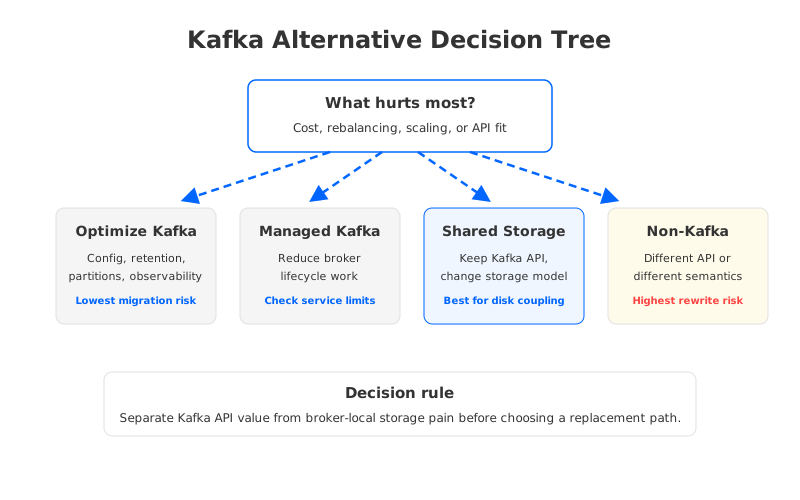
The important split is between leaving Kafka semantics and leaving Kafka's broker-local storage model. Those are not the same decision. Many production teams want to keep the Kafka API, Kafka Connect jobs, Kafka Streams applications, schema workflows, monitoring habits, and operational vocabulary. What they want to change is the architecture that makes broker count, local disk, replication, retention, and rebalancing feel welded together.
1The real reason teams search for Kafka alternatives
Kafka pain rarely appears as one clean failure. It shows up as a pattern: the cluster is reliable enough that no one wants to touch it, but expensive enough that everyone asks about it. Platform teams add brokers before peak events, keep extra disk headroom for retention and replicas, watch cross-zone traffic, and schedule reassignments around business hours. The result is a platform that works, but extracts a tax from every growth plan.
Traditional Kafka follows a Shared Nothing architecture. Each Broker owns local log segments, and replication keeps copies on other Brokers. That design is understandable and battle-tested, but it means storage ownership is part of broker identity. When traffic grows, retained data grows, or a node must be replaced, operators often need to think about where partition data lives and how much movement the cluster can tolerate.
The pain usually falls into five categories:
- Broker and storage cost: Compute, block storage, local disks, replicas, idle headroom, and network traffic grow together. A workload with high retention or high fanout can become costly even when application traffic looks stable.
- Rebalancing delays: Adding capacity or replacing brokers can trigger partition reassignment, replica catch-up, and throttling decisions. The operation may be safe, but it is rarely invisible.
- Scaling limits: Kafka can scale, but scaling a stateful broker fleet is different from adding stateless compute. Operators must account for partition placement, disk usage, leadership distribution, and client impact.
- Operational overhead: Upgrades, certificates, quotas, ACLs, topic hygiene, hot partitions, controller health, and incident response require Kafka-specific expertise.
- Migration risk: Kafka is often embedded deep inside application contracts. A replacement that breaks client behavior, offset semantics, Connect jobs, or observability can cost more than the infrastructure it saves.
These problems are related because Kafka is both a protocol surface and a storage system. A better kafka alternative has to say which side it changes. Replacing the API is a larger application project. Replacing the storage and operations model can be an infrastructure project, provided compatibility is real.
2When optimizing Kafka is still enough
Some teams should not replace Kafka yet. If the cluster is small, growth is predictable, the team has Kafka expertise, and the main issues are configuration hygiene, better observability, or a few overloaded topics, optimization is usually the responsible first move. A well-run Kafka deployment can serve production workloads for a long time, especially when retention is modest and the team understands partition strategy.
The optimization path usually means tightening the basics. Clean up unused topics, review retention policies, right-size partitions, improve producer batching, watch consumer lag, tune quotas, and automate common operations. If the biggest complaint is that the cluster has been neglected, a replacement project may only move the neglect to another platform.
Optimization becomes less convincing when the root cause is architectural. If every scaling event requires storage movement, if retained data forces broker disks to grow faster than compute, or if cloud network charges make replication expensive, tuning can reduce symptoms without changing the underlying curve. That is where the evaluation should widen from "how do we run Kafka better?" to "which Kafka alternative changes the cost and operations model?"
3Managed Kafka helps, but inspect what it actually removes
Managed Kafka is often the first alternative teams consider, and for good reason. A managed service can reduce provisioning work, patching burden, baseline monitoring, and some failure handling. It can also give engineering managers a cleaner responsibility boundary: the platform team consumes a service instead of owning every broker-level task.
The tradeoff is that managed packaging does not automatically remove broker-local storage mechanics. A provider can operate a stateful Kafka fleet for you, but the service may still price or scale around brokers, partitions, storage, traffic, and quotas. It may also introduce data residency, private networking, version availability, and support-boundary questions. The key question is not whether the service is managed; it is which pain the service removes and which pain it turns into a bill, quota, or ticket.
| Decision trigger | Kafka tuning | Managed Kafka | Non-Kafka streaming | Kafka-compatible shared storage |
|---|---|---|---|---|
| Need fewer day-to-day broker tasks | Partial | Strong | Varies | Strong, depending on deployment model |
| Need to keep Kafka clients and tools | Strong | Strong | Often weak | Strong |
| Need to reduce local-disk coupling | Weak | Depends on provider architecture | Strong, but API changes | Strong |
| Need customer-account data control | Strong | Varies | Varies | Strong in BYOC or software models |
| Need a low-risk migration path | Strong | Medium to strong | Usually weaker | Strong when compatibility is validated |
The table is not a vendor ranking. It is a pressure test. If the dominant pain is "we do not want to patch brokers," managed Kafka may be enough. If the pain is "we cannot keep coupling storage growth to broker operations," the evaluation needs to look below the service wrapper and into the architecture.
4Map pain to architecture before comparing products
Generic apache kafka alternatives lists tend to mix categories: managed Kafka services, Kafka-compatible engines, cloud event brokers, distributed logs, stream processing systems, and pub/sub services. That can be useful for discovery, but it is a poor way to make a production decision. The better starting point is to map the pain to the architectural cause.
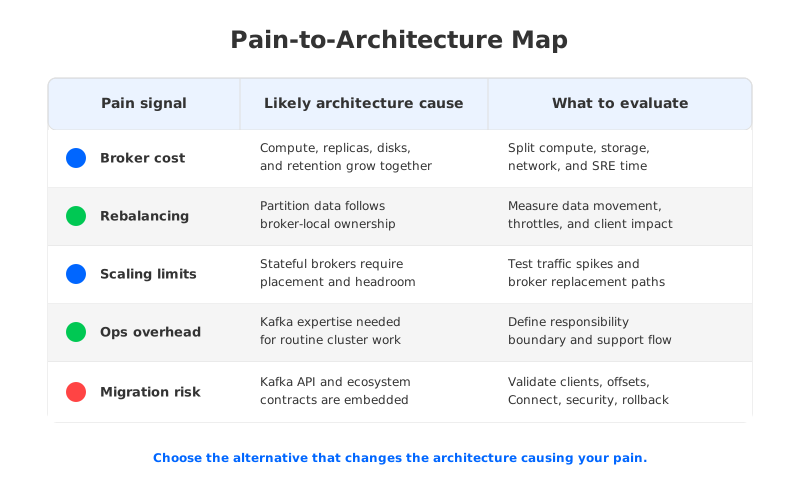
Cost pain, for example, can come from over-provisioned brokers, replicated storage, cross-zone replication, long retention, read fanout, or operational labor. Scaling pain can come from partition count, leader imbalance, local disk movement, client metadata churn, or quotas. Migration risk can come from protocol gaps, offset behavior, connector dependencies, security assumptions, and observability differences.
Once the causes are separated, the shortlist becomes clearer:
- Stay on Kafka and optimize when the problem is mostly operational maturity, not architecture. This path preserves the most compatibility and has the least migration risk.
- Move to managed Kafka when broker lifecycle work is the main burden and the service boundary fits your data, network, compliance, and cost model.
- Move to a non-Kafka streaming system when the application architecture can accept different APIs, different semantics, and a larger rewrite in exchange for a different platform model.
- Move to Kafka-compatible shared storage when the team wants to keep Kafka semantics but reduce the coupling between brokers and durable data.
This is where many evaluations get more interesting. The team may not be searching for a different event model. They may be searching for a cloud native kafka alternative that keeps Kafka's application contract while changing the infrastructure contract underneath it.
5Why Kafka-compatible shared storage changes the discussion
In traditional Kafka, durable log data is tied to brokers through local storage and replicated across the cluster. Tiered Storage can move older segments to remote storage, but brokers still keep local storage responsibilities for the active log and the operational model still includes stateful broker ownership. That helps some retention-heavy workloads, but it does not fully turn brokers into replaceable compute.
A Kafka-compatible Shared Storage architecture changes the premise. Brokers keep the Kafka protocol surface, request processing, leadership, caching, and scheduling responsibilities, while durable data is placed in shared object storage or S3-compatible object storage. In that model, the broker is less of a permanent data owner and more of a compute node serving a shared durable log.
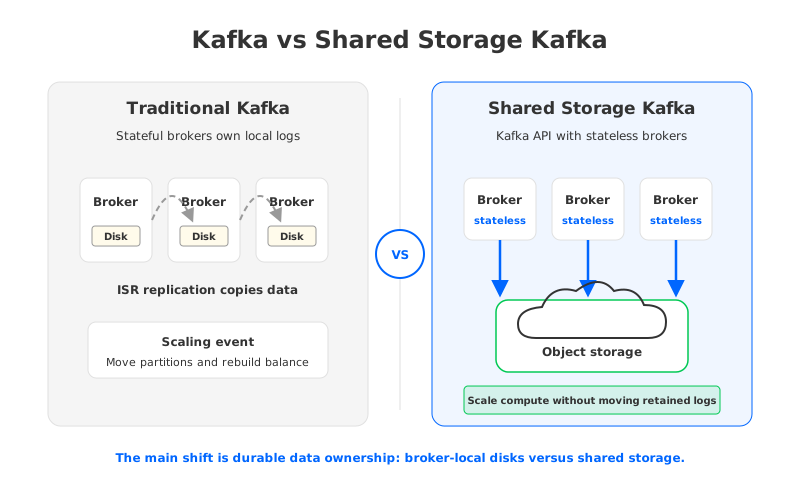
This matters because several painful Kafka operations are storage ownership problems in disguise. Broker replacement becomes easier when long-term durable data is not trapped on the failed broker. Scaling becomes less data-heavy when adding compute does not require moving large retained logs to additional local disks. Rebalancing can focus more on leadership, metadata, and traffic distribution rather than copying storage ownership across the fleet.
The architecture still has hard engineering requirements. A shared-storage Kafka alternative must preserve Kafka semantics, protect durability, make the write path reliable, cache hot reads, serve catch-up reads efficiently, and expose enough metrics for SREs. Object storage is not magic; it changes the bottleneck. The useful question is whether that bottleneck is easier for your team to operate than broker-local disks and replica movement.
6Where AutoMQ fits
This is the point where AutoMQ becomes relevant as a concrete entry point, not as a generic vendor name in a list. AutoMQ is a Kafka-compatible streaming platform that replaces Kafka's local log storage with S3Stream and a Shared Storage architecture. It keeps the Kafka protocol and ecosystem surface while using stateless brokers and S3-compatible object storage for durable data.
For a team comparing kafka alternatives, the fit is specific. AutoMQ is worth evaluating when the painful part of Kafka is broker cost, disk growth, rebalancing, scaling, and operations, but the valuable part is still Kafka compatibility. Existing producers, consumers, Topic and Partition concepts, Consumer group behavior, Kafka Connect usage, and Kafka ecosystem habits remain central to the migration discussion.
AutoMQ also matters for data-control conversations. Some teams can use a fully managed SaaS data path. Others need customer-account infrastructure, private networking, or a software deployment model. AutoMQ BYOC and AutoMQ Software are designed for those boundary questions, while AutoMQ Open Source gives teams a way to inspect and validate the architecture. The right deployment model depends on governance, latency, storage, cloud, and support requirements.
The evaluation should still be strict. Run representative producer and consumer workloads, test Connect jobs, validate security settings, inspect observability, model object storage behavior, rehearse migration and rollback, and compare cost under your own retention and traffic profile. A Kafka-compatible platform earns trust by passing workload-level tests, not by claiming compatibility in a slide.
7A practical shortlist framework
The fastest way to narrow the options is to start from the pain you would pay to remove. If the answer is "we need fewer maintenance tasks," managed Kafka deserves a close look. If the answer is "we need to stop treating every capacity change as a storage movement event," shared storage belongs on the shortlist. If the answer is "Kafka's API no longer fits the application model," then non-Kafka systems may be worth the rewrite.
Use these questions in the architecture review:
- What must remain compatible? List client versions, transactions, idempotent producers, Connect jobs, Streams applications, ACLs, metrics, alerting, and admin scripts.
- What cost curve must change? Separate compute, storage, retention, replica traffic, cross-zone traffic, support, and SRE labor instead of discussing TCO as one blended number.
- What scaling event hurts most? Adding brokers, replacing brokers, increasing retention, handling traffic spikes, or redistributing partitions each points to a different root cause.
- Where must the data plane live? SaaS, cloud-provider service, BYOC, private cloud, and self-operated software have different security and compliance implications.
- How reversible is the migration? A safer kafka alternative lets you test in parallel, move workloads in stages, and roll back without rewriting applications twice.
The uncomfortable Kafka meeting usually starts with a budget or operations complaint. The useful version of that meeting ends with an architecture map. Once the team knows whether it wants to leave Kafka semantics, managed broker operations, or broker-local storage, the alternatives stop looking like a crowded market map and start looking like a short engineering decision.
For teams that want to keep the Kafka API while changing the broker storage model, start with the AutoMQ documentation and use the AutoMQ GitHub repository to validate the architecture against your own workloads. The goal is not to pick a logo from a market map; it is to prove which operating model fits the next few years of Kafka growth.
8References
- Apache Kafka Documentation
- Apache Kafka Operations Documentation
- Apache Kafka Tiered Storage Documentation
- AutoMQ Documentation
- AutoMQ GitHub Repository
9FAQ
9.1What are the main Kafka alternatives for production teams?
The main categories are optimized self-managed Kafka, managed Kafka services, cloud provider event streaming services, non-Kafka streaming systems, and Kafka-compatible shared-storage platforms. The right category depends on whether you want to reduce operations, change the API, keep data in your own environment, or remove broker-local storage coupling.
9.2Is a Kafka-compatible alternative safer than replacing Kafka completely?
It is usually safer when your applications depend heavily on Kafka clients, offsets, Consumer groups, Kafka Connect, Kafka Streams, and existing operational tooling. Compatibility still needs workload-level validation. Test client behavior, security, observability, failure handling, migration, and rollback before treating any platform as a drop-in replacement.
9.3Why do broker-local disks make Kafka scaling harder?
Broker-local disks tie durable Partition data to specific brokers. Adding, replacing, or rebalancing brokers can require replica movement, catch-up, throttling, and careful monitoring. Shared storage changes that relationship by moving durable data out of broker-local disks, so brokers can behave more like compute nodes.
9.4Does managed Kafka remove Kafka cost problems?
Managed Kafka can reduce operational labor and broker lifecycle work, but it does not automatically remove costs tied to storage, retention, replication, traffic, quotas, or service boundaries. Evaluate the provider's architecture and pricing model against your actual workload rather than assuming management alone changes the cost curve.
9.5Where does AutoMQ fit among Kafka alternatives?
AutoMQ fits when teams want a Kafka-compatible alternative that keeps the Kafka protocol and ecosystem while changing the storage architecture. It uses Shared Storage architecture, stateless brokers, and S3-compatible object storage to reduce the operational coupling between brokers and durable data.


