
Table of Contents
Table of Contents
Teams searching for redpanda alternatives are usually past the first round of education. They already know Redpanda is positioned as a Kafka-compatible streaming platform, and they may have tested the appeal of a non-JVM broker, fast local development, or a managed cloud option. The next question is not whether Redpanda is a serious platform. It is what kind of Kafka API platform your organization needs after the first evaluation makes the trade-offs visible.
That distinction matters because "Kafka-compatible" is a starting point, not a complete platform decision. A streaming platform has to preserve application behavior, fit cloud cost boundaries, satisfy security review, recover cleanly from failure, and remain operable after the proof of concept. Redpanda can be a strong fit for teams that value its architecture and operating model. Other teams may reach a different conclusion because their dominant constraint is storage ownership, cross-zone traffic, long retention, procurement, data-plane locality, or migration governance.
The useful response is not a vendor ranking. It is a set of platform questions that makes the decision harder to fake. If the current evaluation cannot answer these questions for one representative workload, the team is not ready to declare an alternative. It is still discovering what it needs.
1Why Teams Search for redpanda alternatives
The search phrase often appears after a practical tension. A platform team may like Redpanda's Kafka API compatibility but need a deployment model closer to existing cloud controls. An SRE team may want to compare failure recovery across broker-local storage, tiered storage, and shared-storage designs. A FinOps team may be trying to understand whether streaming cost is driven by compute, storage, read fan-out, or cross-zone movement. A CTO may need confidence that a future platform decision will not strand existing Kafka clients.
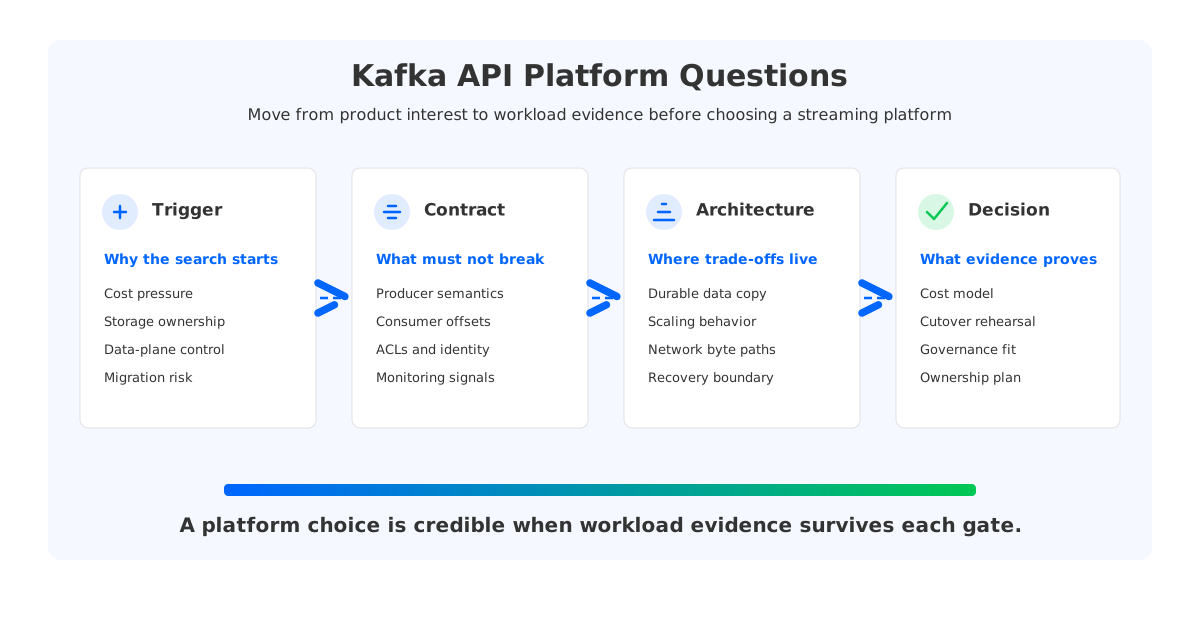
The first discipline is to name the trigger before naming the replacement. Most searches fall into one of five triggers:
- Kafka API continuity. Applications depend on producers, consumers, offsets, consumer groups, ACLs, idempotence, transactions, or admin tooling that should not be rewritten during the platform change.
- Cloud cost shape. The bill is not only broker cost. It includes retained data, replication, consumer fan-out, cross-zone traffic, private connectivity, observability, and incident labor.
- Storage architecture. Broker-local logs, remote tiers, and shared storage create different recovery and scaling behavior, especially when retention is large or partitions move often.
- Operating boundary. Some teams want a managed service boundary. Others want BYOC, private deployment, or stronger control over where the data plane, logs, and metrics live.
- Migration safety. The platform may look compatible in a demo but still require careful testing around offsets, duplicate handling, security policies, rollback, and monitoring.
Once the trigger is explicit, "alternative" becomes a technical category instead of a shopping term. The right answer may be Redpanda, Apache Kafka, Amazon MSK, Confluent, Aiven, AutoMQ, or a mixed estate. The point is to match the operating model to the workload constraint.
2Start With the Kafka Contract
A Kafka API platform decision begins with the contract that applications rely on. Apache Kafka has a broad behavioral surface: client protocol negotiation, producer acknowledgments, idempotent writes, transactions, consumer group coordination, offset commits, ACLs, quotas, topic administration, compaction, retention, and monitoring assumptions. Many workloads use part of that surface, but the part they use is not optional.
Redpanda's documentation describes Kafka client compatibility and lists exceptions and validated clients. That is useful evidence, and it should be treated with respect. It should not replace workload testing. Compatibility is partly about protocol support and partly about habits embedded in applications, deployment pipelines, and incident response. A Java producer with idempotence enabled and a Python consumer with manual offset commits do not create the same risk profile.
Freeze the contract before comparing platforms:
| Contract area | Evidence to collect | Platform question |
|---|---|---|
| Producer behavior | Client versions, retries, acks, compression, batching, idempotence, transactions | Does the destination preserve write semantics under normal load and retry storms? |
| Consumer behavior | Group assignment, offset commits, reset policy, lag alerts, replay windows | Can consumers resume predictably after cutover, failure, and rollback? |
| Security model | ACLs, authentication, private networking, audit trails, secrets flow | Will security teams recognize the identity and network boundaries? |
| Operations | Dashboards, SLOs, topic automation, quotas, incident runbooks | Can the on-call team operate the destination without relearning every signal? |
This table changes the order of the evaluation. Instead of asking which product has the most attractive overview, the team asks which platform preserves the workload contract with the least hidden change.
3Architecture Questions Behind the Shortlist
Kafka-compatible platforms can expose similar APIs while making very different storage and recovery choices. Traditional Apache Kafka stores active log segments on broker-attached storage and uses replication between brokers for durability. Kafka tiered storage adds a remote tier for completed log segments while keeping local storage in the active write path. Shared-storage Kafka-compatible systems move durable stream data into cloud object storage and make brokers less tied to unique local disks.
Those are not minor implementation details. They determine how scaling, recovery, retention, and cloud networking behave when the cluster is under stress. A platform that looks simple during a small benchmark may behave differently during broker replacement, partition movement, replay, or regional architecture review.
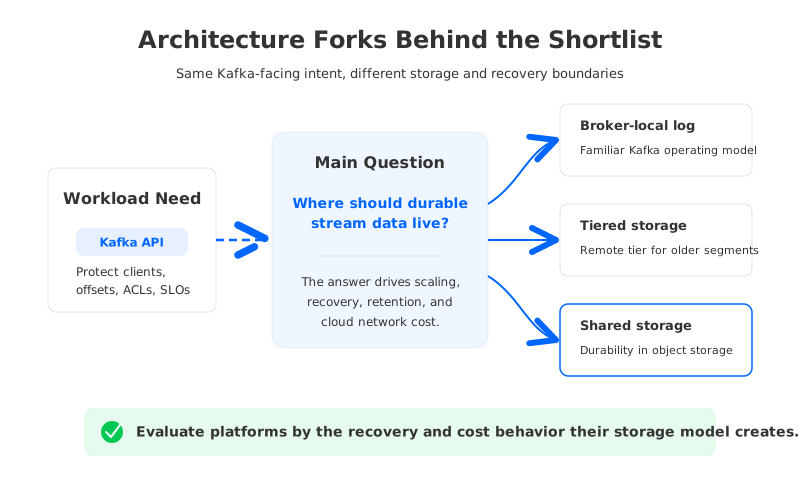
The shortlist should answer four architecture questions before the team spends time on secondary features:
- Where is the durable copy of the stream? If durable data lives primarily on broker-local disks, recovery and scaling involve broker state. If durable data is in shared object storage, the broker can be treated more like compute, but the write path needs a WAL and cache design that keeps latency and durability credible.
- What happens when capacity changes? A broker-local design often makes scaling a data movement event. A shared-storage design can reduce the amount of unique local state that must move, but it still needs clear metadata, cache, and failure handling.
- Which bytes cross availability-zone or network boundaries? Multi-AZ resilience is normal in cloud architecture, but replication, consumer reads, private endpoints, and migration flows can create real cost and security implications.
- What part of the stack remains Apache Kafka versus Kafka-compatible? Some teams need upstream Apache Kafka behavior as closely as possible. Others are comfortable with a compatible implementation if their tested workload contract passes.
None of these answers is universally right. Broker-local storage can be predictable for latency-sensitive workloads and familiar to experienced Kafka operators. Tiered storage can reduce pressure from long retention while preserving much of the Kafka operating model. Shared storage can change the scaling and recovery boundary. The winning architecture depends on the constraint that triggered the evaluation.
4Model Cost by Byte Path
Cost comparisons around streaming platforms often fail because they start with the cluster name. The actual bill follows bytes and operational events: producer writes, replication, consumer fan-out, retained storage, remote reads, cross-zone movement, private connectivity, backfill, observability, and recovery. A platform with a lower entry price can still disappoint if the dominant workload path is not modeled.
AWS pricing and MSK documentation are useful reminders here because cloud architecture turns placement into cost. Cross-zone and cross-region paths, broker storage, private connectivity, and managed service boundaries should be made visible before procurement asks for a single monthly number. The same discipline applies outside AWS: do not compare platforms until the byte paths are drawn.
For each representative topic class, model both steady state and abnormal state:
| Workload dimension | Steady-state question | Abnormal-state question |
|---|---|---|
| Write path | How much data is produced per second, and what acknowledgment policy is required? | What happens during retry storms, producer failover, or a partial outage? |
| Read path | How many consumer groups read the same data, and from which zones or networks? | What happens during replay, catch-up, or consumer group churn? |
| Retention | How long must data remain queryable or replayable? | What is the cost of a large historical read after an incident? |
| Recovery | How quickly must broker or node failure be absorbed? | Does recovery copy large volumes of data or reattach compute to shared durable data? |
This modeling needs consistency more than fake precision. If read fan-out dominates, evaluate consumer placement and cache behavior. If retention dominates, storage architecture matters more than small broker differences. If failure recovery dominates, ask how much data must move when infrastructure changes. If governance dominates, the data-plane boundary may outweigh raw infrastructure cost.
5Migration Risk Is a Platform Feature
A Kafka platform migration is not a file copy. It is a controlled change to producers, consumers, offsets, security, observability, and operating ownership. The migration plan should be judged as part of the platform, because a platform that cannot be migrated safely into production is not production-ready for that workload.
The cleanest migration plans define four moments. First, the destination becomes eligible for validation, with data, security, metrics, and application tests in place. Second, consumers begin reading from the destination under an offset and duplicate-handling policy. Third, producers switch their write path. Fourth, rollback becomes unsafe or expensive enough to require an explicit approval gate. Many plans describe the first three moments and avoid the fourth, where the real risk sits.
The proof of concept should use one representative workload, not a toy topic. A good workload is important enough to reveal client behavior, lag patterns, ACL mapping, dashboard gaps, and recovery behavior, but contained enough that a failed test does not become a business incident.
This is where respectful vendor evaluation becomes more useful than competitive rhetoric. Redpanda, Confluent, MSK, Aiven, Apache Kafka, and AutoMQ sit inside different operating models. The question is which one can accept your workload with clear evidence and an exit path if the evidence fails.
6How AutoMQ Fits the Evaluation
After the neutral framework is in place, AutoMQ becomes relevant as a specific architectural option: a Kafka-compatible, cloud-native streaming system built around Shared Storage architecture. AutoMQ keeps Kafka-compatible APIs for applications while replacing the traditional broker-local storage layer with S3Stream, where durable stream data is offloaded to S3-compatible object storage and the write path is protected through WAL storage.
That design is worth testing when the evaluation trigger is storage ownership, scaling friction, or cloud network cost. If durable data is no longer uniquely bound to broker-local disks, broker replacement and capacity changes can be treated differently. If the platform can avoid cross-AZ replication traffic in the data path, the FinOps model changes for workloads where zone movement is a major cost driver.
AutoMQ should still be held to the same scorecard as any other option. Test the Kafka contract you actually use, including client versions, producer settings, consumer offsets, ACLs, transactions if applicable, monitoring, and failure recovery. Test cost with real write rate, read fan-out, retention, and placement assumptions. The value of a shared-storage design is that it changes the constraints for workloads where broker-local state, cross-zone movement, and storage scaling are the real problem.
7Decision Scorecard for Platform Buyers
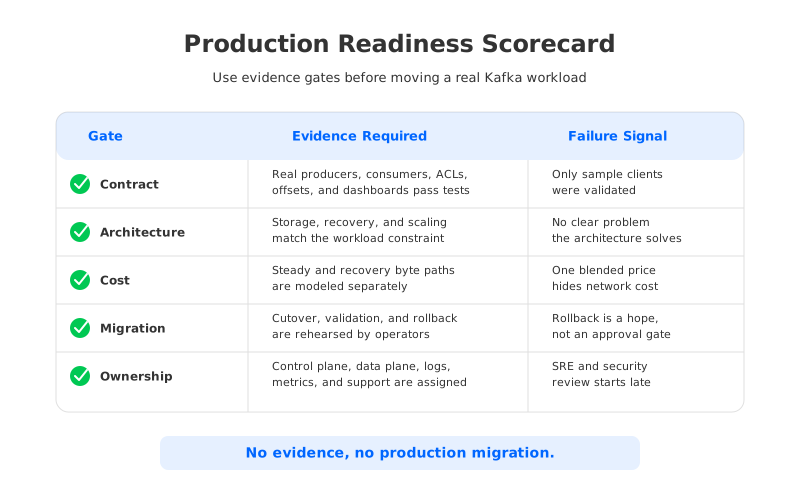
By the time the team reaches procurement, the scorecard should be boring. A mature platform decision should reduce the argument to evidence, not opinions. Each row below should have an owner, a test result, and a failure signal.
| Gate | Pass condition | Failure signal |
|---|---|---|
| Kafka contract | Representative producers, consumers, security, and monitoring behave as expected under normal and failure conditions. | The proof of concept uses a sample client and assumes production clients will behave the same. |
| Architecture fit | Storage, scaling, recovery, and network paths match the workload's dominant constraint. | The team likes the platform but cannot explain what architectural problem it solves. |
| Cost model | Steady-state and recovery byte paths are modeled separately. | The business case uses one blended price and ignores replay, migration, or cross-zone movement. |
| Migration plan | Cutover, validation, rollback, and ownership are rehearsed before production traffic moves. | Rollback is discussed as a hope rather than a defined gate. |
| Operating boundary | Control plane, data plane, logs, metrics, secrets, and support paths are documented. | Security and SRE review begins after the vendor choice. |
This scorecard also creates a graceful way to keep Redpanda. If the platform passes the workload contract, cost model, migration plan, and operating boundary better than the alternatives, staying is rational. If it fails because the workload needs a different storage model or data-plane boundary, the team has a clear reason to evaluate another path.
8Closing the Loop
The phrase redpanda alternatives can pull teams into broad comparisons, but a production decision should start with Kafka API platform questions. Preserve the application contract first. Then evaluate architecture, byte paths, migration safety, and operating ownership. The platform that wins is the one that fixes the constraint that triggered the search without creating a larger one somewhere else.
If your team is evaluating Kafka-compatible infrastructure because storage scaling, cross-zone traffic, or data-plane control has become the constraint, test that boundary directly. Start with the AutoMQ Cloud Console and run one representative workload through your own compatibility, cost, migration, and governance scorecard.
9References
- Apache Kafka documentation
- Apache Kafka Tiered Storage documentation
- Apache Kafka producer configuration
- Apache Kafka authorization and ACLs
- Redpanda documentation: Kafka Compatibility
- AWS pricing: Amazon MSK
- AWS pricing: Amazon EC2 data transfer
- AutoMQ documentation: Compatibility with Apache Kafka
- AutoMQ documentation: S3Stream Shared Streaming Storage
- AutoMQ documentation: WAL storage
- AutoMQ documentation: Inter-zone traffic overview
10FAQ
10.1What should teams ask after evaluating Redpanda?
Start with the workload contract. Document the Kafka clients, producer behavior, consumer offsets, ACLs, monitoring, retention, recovery expectations, and operating boundaries that must survive a platform change. Then compare architectures against those requirements.
10.2Are Redpanda alternatives always lower cost?
No. Cost depends on write rate, read fan-out, retention, network placement, recovery behavior, managed service boundaries, and operating labor. A credible comparison models the byte paths and failure events that matter for the workload.
10.3Is Kafka API compatibility enough for production migration?
Compatibility is necessary, but not enough. Migration also requires testing client behavior, offsets, security policies, monitoring, rollback gates, and ownership.
10.4Where does AutoMQ fit among Redpanda alternatives?
AutoMQ fits when a team wants Kafka-compatible APIs with shared storage, object-storage-backed durability, stateless brokers, and deployment models that keep the data plane closer to customer-controlled infrastructure.
10.5Should every workload move to the same streaming platform?
Not always. Some workloads may fit Redpanda, some may fit managed Apache Kafka, and some may benefit from shared storage. Use one scorecard across workload classes, then let evidence decide whether the platform estate should be standardized or intentionally mixed.


