
Table of Contents
Table of Contents
The expensive Kafka cluster is rarely busy all day. The awkward bill comes from a cluster that is quiet for hours, absorbs a violent spike, and then sits overprovisioned because nobody wants the next spike to page the on-call team. Autoscaling looks obvious until the team remembers that Kafka capacity is not only CPU. It is partitions, disk, replication traffic, retention headroom, client behavior, and the risk of moving data while traffic is flowing.
That is why Kafka autoscaling economics is harder than "can I add brokers automatically?" A scaling action has a technical cost before it has a cloud bill impact. If adding a broker triggers long reassignment, network-heavy replica movement, or uneven consumer lag, the platform may save instance spend while burning reliability budget. If scaling in is risky, the cluster becomes elastic in slides and static in production.
The right economic model starts with the workload shape. Bursty streaming workloads combine a predictable baseline with peak events: promotions, market opens, CDC catch-ups, game launches, fraud model refreshes, IoT reconnects, or incident-driven replay. The platform has to absorb the peak, recover quickly, and avoid turning every spike into a storage migration project.
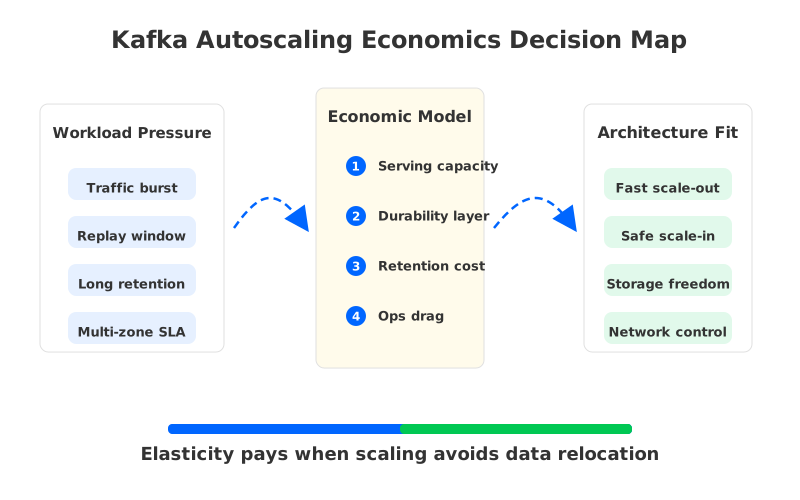
1Where Kafka Autoscaling Costs Actually Come From
The first mistake is treating Kafka brokers as generic stateless compute. A web service instance can often be added or removed behind a load balancer without asking where yesterday's requests live. A traditional Kafka broker owns local log segments for partitions and is part of the storage layout, replication topology, and recovery boundary.
When a burst arrives, four cost centers show up at the same time:
- Provisioned peak capacity. Teams keep brokers, disks, and network headroom ready for the worst expected hour because underprovisioning Kafka creates visible application failures.
- Data movement during rebalancing. Adding capacity may require partition reassignment and replica catch-up. That background work competes with foreground produce and fetch traffic.
- Cross-zone replication and fetch traffic. Multi-AZ Kafka protects availability, but the replication and read path can create inter-zone network charges depending on placement and client behavior.
- Operational delay. Even when automation exists, many teams gate scale-in and large reassignments behind human review because the failure mode is a production incident.
This is the part that makes autoscaling economics non-linear. A broker that is 20% idle looks like waste in a utilization report. A broker removed at the wrong time can force hours of catch-up or create a fragile replica set. The finance view sees unused capacity; the operator sees an insurance policy.
2Shared-Nothing Kafka and the Elasticity Tax
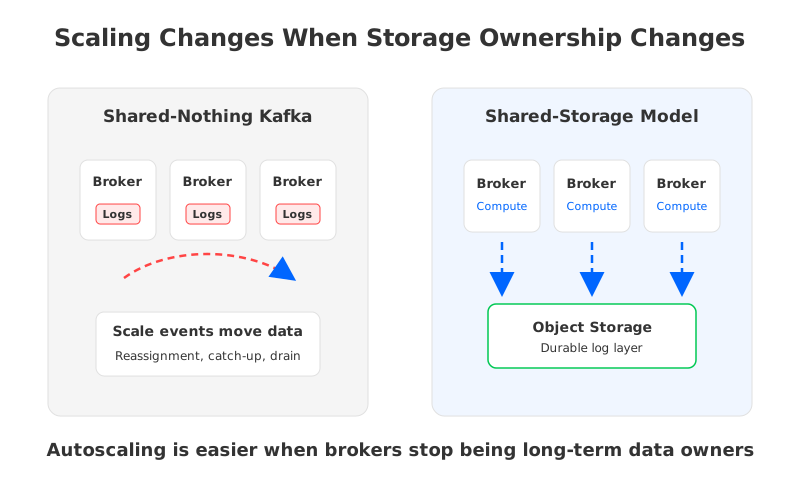
Traditional Kafka was designed around a shared-nothing model: each broker stores the log data for the partitions assigned to it, and replication is handled by Kafka itself. That model is durable and well understood. It also made sense in environments where local disk was the natural persistence layer and machine-to-machine data movement was an infrastructure detail rather than a separate line item.
Cloud economics changes that design. Storage, compute, and network are priced as separate services, but a shared-nothing Kafka cluster still couples them operationally. More write throughput can mean more brokers and disks together. More retention can mean storage-bearing brokers even when CPU is not the bottleneck. Scale-in after a peak still has to account for local broker data.
That coupling creates an elasticity tax: spare disks, background copying, replication bandwidth, longer recovery windows, and human caution. A platform owner can automate parts of it, but automation does not erase the underlying data movement.
| Scaling question | Shared-nothing pressure | Economic effect |
|---|---|---|
| Add brokers for a spike | New capacity may need partition movement before it is useful | Savings arrive later than the traffic event |
| Reduce brokers after the spike | Local logs must be drained or reassigned safely | Scale-in is delayed or avoided |
| Extend retention | Storage often grows with broker footprint | Compute may be overbought for storage needs |
| Replace a failed broker | Replica catch-up reads from other brokers | Recovery consumes cluster network and disk bandwidth |
| Isolate zones | Placement helps, but replication and fetch paths still matter | Network charges can become workload-dependent |
Teams rarely reject autoscaling because they dislike automation. They reject it because the savings are uncertain and the operational side effects are very certain.
3Bursty Workloads Need a Different Capacity Model
Autoscaling makes sense only when the platform can change capacity faster than the workload changes demand. If a campaign creates a 30-minute write spike and the cluster takes several hours to rebalance safely, the autoscaler is mostly a post-event cleanup tool. It may reduce waste later, but it cannot protect the event itself.
A practical capacity model separates three layers that are often blended together in Kafka planning:
- Serving capacity covers produce, fetch, request handling, compression, TLS, and controller overhead. It should follow traffic as closely as possible.
- Durability capacity covers how acknowledged writes survive broker or zone failure. It should be stable and independent of short spikes.
- Retention capacity covers how much history the business wants to keep. It should grow with data lifecycle requirements, not with peak CPU.
Traditional deployments can still be tuned carefully with quotas, rack awareness, follower fetching, partition planning, tiered storage, and conservative reassignment policies. Those controls are valuable, but they do not fully separate the three layers. A burst still lands on brokers that are responsible for both serving traffic and owning log data.
That is why the strongest autoscaling economics usually appear when compute and storage can be scaled independently. Compute should follow the burst. Durable storage should absorb the log without making every temporary compute node a long-term data owner. Retention should live in a tier whose cost profile matches retained bytes rather than broker count.
4A Neutral Checklist for Kafka Autoscaling Economics
Before comparing platforms, build the model around failure modes and unit economics. A lower monthly bill is not useful if it ignores replay, recovery, or governance. A platform that scales quickly is not useful if every client library or connector needs special handling.
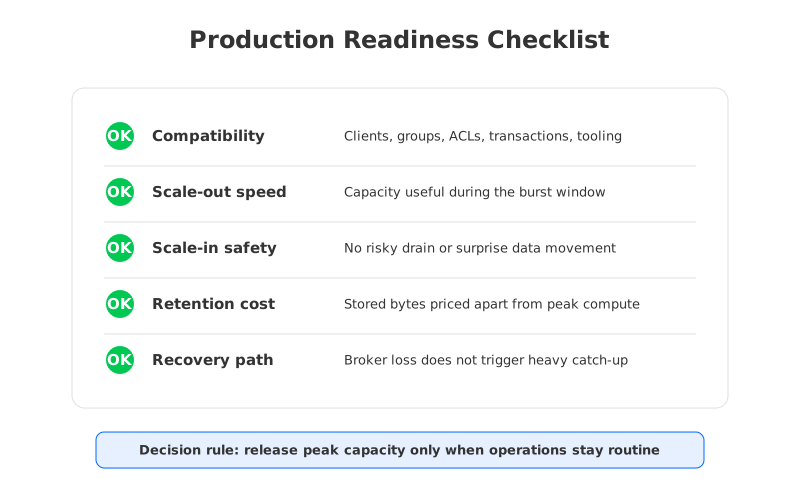
Use this checklist as a first-pass review:
- Compatibility: Can existing Kafka clients, consumer groups, transactions, ACLs, and tooling continue to work without a large rewrite?
- Scale-out latency: How long does added capacity take to absorb real traffic?
- Scale-in safety: What must happen to local state, replicas, partitions, and controller metadata before a broker can be removed?
- Network path control: Can producers and consumers stay zone-local where possible?
- Retention economics: Does longer retention require more broker-local disk, or can retained data move to a lower-cost storage layer?
- Recovery behavior: After broker failure, does recovery depend on copying large amounts of data between brokers?
- Governance boundary: Can security, identity, encryption, and cloud account ownership match the organization's compliance model?
The checklist usually reveals the real decision. Some teams need a better autoscaling policy around a stable Kafka footprint. Others need a different storage architecture because local-disk ownership is the reason scaling cannot act quickly enough.
5How Shared Storage Changes the Operating Model
A shared-storage Kafka-compatible architecture changes the economic equation by moving durable log storage away from broker-local disks and into cloud object storage. Brokers still serve the Kafka protocol, handle client traffic, and participate in the cluster. The difference is that the broker is no longer the permanent home of the historical log.
That change matters because autoscaling becomes less about relocating data and more about adjusting serving capacity. If an added broker can join without waiting for a large local data set to be copied onto it, scale-out can react closer to the traffic event. If a broker can leave without draining a large amount of unique local state, scale-in becomes a normal capacity action rather than a maintenance window candidate.
AutoMQ fits this category as a Kafka-compatible streaming system built around shared storage and stateless brokers. The point is not that every Kafka workload should be moved overnight. Autoscaling changes once storage ownership is removed from the broker lifecycle. Platform teams can evaluate compute, storage, and network as separate levers instead of buying them as a bundle.
This architecture is also relevant to cloud network cost. In multi-zone deployments, the goal is not only to keep replicas healthy. The goal is to reduce avoidable cross-zone movement in normal operation and during recovery. AutoMQ documents a model for eliminating inter-zone traffic by combining storage architecture with client and broker placement controls.
6A Practical Economic Model
A useful model does not need false precision. Start with the quantities your team can measure: baseline throughput, peak throughput, peak duration, retained bytes, consumer fan-out, replay frequency, zone layout, broker count, and engineer time spent on scaling operations. Then map those quantities to the cost centers they influence.
For a bursty workload, the most revealing calculation is often not average utilization. It is the gap between peak readiness and baseline demand:
reserved_capacity_gap = peak_ready_capacity - baseline_required_capacity
That gap is the spend autoscaling is trying to recover. The recoverable portion depends on how quickly the platform can scale down after the burst and how much fixed storage must remain attached to brokers. If storage and compute are tightly coupled, the recoverable portion may be much smaller than idle CPU suggests. If durable storage is independent, the recoverable portion can be closer to the compute delta.
The second calculation is operational drag:
operational_drag = scale_events_per_month x review_time_per_event x loaded_engineering_cost
This number is imperfect, but it forces a useful conversation. A cluster that saves infrastructure spend while increasing manual review, incident risk, and after-hours work may be a bad trade. A platform that makes scaling routine can be valuable even before the cloud bill changes dramatically.
The third calculation is recovery amplification. In local-disk architectures, replacing brokers and rebalancing partitions can create large internal reads and writes. In shared-storage architectures, the recovery path can avoid much of that broker-to-broker data copying because historical data is already outside the failed compute node. Publishable savings should still be verified against current cloud provider pages.
7Migration Risk: The Cost That Does Not Fit on the Bill
Kafka migration risk is part of autoscaling economics because a platform that cannot be adopted safely has zero practical savings. Separate client compatibility from operational equivalence. Client compatibility asks whether applications can produce, consume, commit offsets, and use expected Kafka semantics. Operational equivalence asks whether monitoring, security, deployment, incident response, and rollback procedures still satisfy production requirements.
For most teams, a responsible migration plan has four phases. First, validate client behavior with representative producers and consumers, including consumer group rebalances and replay. Second, mirror or dual-write a bounded workload so the team can compare lag, throughput, and errors. Third, move a workload whose blast radius is clear and whose rollback path is rehearsed. Fourth, scale the migration after the platform team updates runbooks, dashboards, access controls, and cost reporting.
This sequence is slower than a benchmark, but it is faster than discovering during a peak event that the replacement platform changed an operational assumption. It also keeps the economics honest. The business case should include migration effort, not only steady-state infrastructure cost.
8When Autoscaling Is Worth It
Kafka autoscaling is most valuable when demand is variable, the platform can change serving capacity quickly, and storage does not force every scaling action to become a data relocation event. It is less valuable when traffic is flat, retention is small, and a stable cluster already runs near efficient utilization. In those cases, better partition planning, client tuning, and reserved capacity may deliver most of the benefit with less change.
The hard cases are the ones in the middle: meaningful bursts, strict availability expectations, long retention, multi-zone deployments, and a platform team that is already stretched. For those teams, the architecture behind autoscaling matters more than the autoscaling button. Shared-nothing Kafka can be operated well, but its local storage ownership makes elasticity expensive. Shared-storage Kafka-compatible systems change the unit of scaling.
If your team is modeling Kafka autoscaling for bursty workloads, start by separating serving capacity, durability, and retention in your spreadsheet. Then test whether your current architecture lets those lines move independently. AutoMQ's architecture overview is a useful next reference point for that evaluation: review the shared-storage model and compare it against the operational constraints in your own Kafka estate.
9References
- Apache Kafka documentation: https://kafka.apache.org/documentation/
- Apache Kafka KIP-405 tiered storage proposal: https://cwiki.apache.org/confluence/display/KAFKA/KIP-405%3A%2BKafka%2BTiered%2BStorage
- AWS architecture guidance on data transfer costs: https://aws.amazon.com/blogs/architecture/overview-of-data-transfer-costs-for-common-architectures/
- AutoMQ architecture overview: https://docs.automq.com/automq/architecture/overview?utm_source=blog&utm_medium=reference&utm_campaign=aivk-0024
- AutoMQ Kafka compatibility: https://docs.automq.com/automq/architecture/technical-advantage/native-compatible-with-apache-kafka?utm_source=blog&utm_medium=reference&utm_campaign=aivk-0024
- AutoMQ inter-zone traffic documentation: https://docs.automq.com/automq-cloud/eliminate-inter-zone-traffics/overview?utm_source=blog&utm_medium=reference&utm_campaign=aivk-0024
10FAQ
10.1Is Kafka autoscaling only about broker CPU?
No. CPU is only one part of the scaling decision. Kafka autoscaling also has to account for partitions, broker-local storage, replication, consumer lag, retention, and network placement.
10.2Why do bursty workloads make Kafka cost planning harder?
Bursty workloads force teams to keep enough capacity for short peak periods while paying for that capacity during quiet periods. The economic opportunity is the idle gap after the peak, but the platform can recover that gap only if scale-in is safe and fast.
10.3Does tiered storage solve Kafka autoscaling economics by itself?
Tiered storage can improve retention economics by moving older data away from broker-local disks. It does not automatically make brokers stateless or remove every scaling constraint. Teams still need to evaluate how hot data, recovery, partition ownership, and scale-in behavior work in their specific architecture.
10.4When should a team consider a shared-storage Kafka-compatible system?
Consider it when Kafka cost is driven by variable demand, long retention, multi-zone deployment, slow rebalancing, or repeated capacity operations. The question is whether compute, durability, and retention can scale independently enough to match the workload.
10.5How should FinOps teams evaluate Kafka autoscaling savings?
FinOps teams should compare baseline demand, peak-ready capacity, retained data, network charges, and engineering time. The useful number is not only average utilization; it is the portion of peak capacity the platform can safely release after demand falls.


