
Table of Contents
Table of Contents
Kafka autoscaling sounds like it should be a familiar cloud infrastructure problem. CPU goes high, add replicas. Network throughput goes high, add nodes. Disk pressure goes high, add capacity. If a Kubernetes HorizontalPodAutoscaler can adjust the number of pods based on observed metrics, it is tempting to imagine Kafka working the same way: watch broker utilization, start another broker, and let the cluster absorb the load.
That mental model breaks because a Kafka broker is not only compute. It owns partitions, serves leaders, stores log segments, participates in replication, and often carries months of retained data on local disks. Adding a broker increases the possible capacity of the cluster, but it does not automatically move partition leadership, retained bytes, or client traffic onto that broker. Until those things move, the new broker is mostly empty metal with a broker ID.
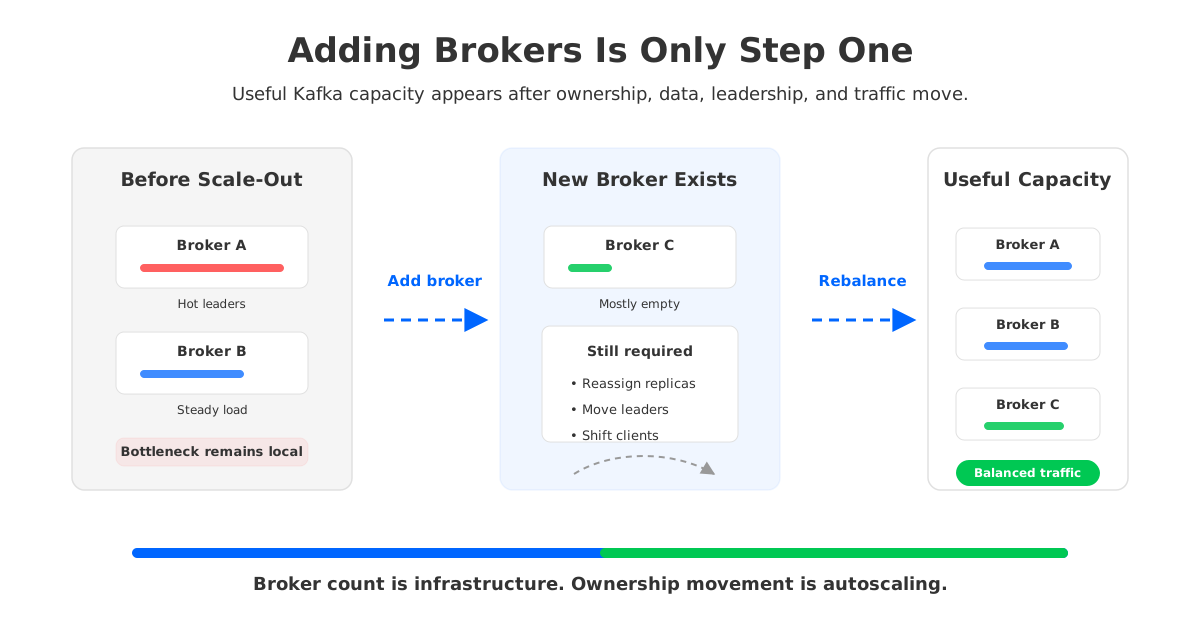
The point is not that Kafka cannot scale horizontally. It can, and mature operators do it every day. The point is that Kafka autoscaling is not a broker-count problem. It is a data placement, leadership, storage, and traffic routing problem that happens to start with broker count.
1The False Promise of Broker Count
Most stateless services make autoscaling look cleaner than it really is. A web tier pod does not own a shard of durable history. A worker can usually receive the next task as soon as a scheduler routes traffic to it. When the load drops, the platform can drain a pod and remove it without copying a local database out of the container first.
Kafka has a different contract. A topic is split into partitions, each partition has replicas, one replica is the leader, and clients read or write through the broker that currently owns the relevant leadership path. A new broker can join the cluster metadata, but existing partitions stay where they are until the cluster changes assignment. That is why "we added three brokers" and "the hot partitions stopped being hot" are two separate statements.
In practice, the mismatch shows up in several ways:
- CPU pressure may be partition-specific. A few hot partitions can overload one broker while the cluster average looks acceptable. Adding brokers does not cool those partitions unless leadership and replicas move.
- Disk pressure is tied to retained bytes. A broker with large local logs cannot become smaller just because another broker exists. Data has to be reassigned, copied, verified, and kept in sync during the move.
- Network pressure follows topology. Producers, followers, consumers, cross-zone replicas, and replays all create paths. More brokers only help if the traffic paths are redistributed.
- Client behavior has inertia. Metadata refreshes, connection pools, sticky partitioners, and consumer group behavior can delay how quickly traffic reflects a new layout.
The result is a useful distinction: capacity can be added quickly, but useful Kafka capacity appears only after ownership changes. Autoscaling has to automate both parts or it only solves the easiest half of the problem.
2What Has to Change After a Broker Is Added
When a broker joins a traditional Kafka cluster, the next question is not "is it running?" but "what should it own?" Apache Kafka documents cluster expansion around reassignment: after new brokers are added, partitions must be moved to the new broker set so the cluster can use the added capacity. The kafka-reassign-partitions workflow exists because Kafka does not treat broker addition as automatic load absorption.
That reassignment has at least four dimensions. Operators often talk about them as one rebalance, but they stress different parts of the system.
| Dimension | What changes | Why autoscaling must care |
|---|---|---|
| Replica placement | Partition replicas are assigned to different brokers | Determines disk usage, replication traffic, and failure domains |
| Leader placement | Partition leaders move across brokers | Determines where producers and many consumers send active traffic |
| Data movement | Existing log segments are copied or caught up | Consumes disk, network, and broker I/O while production traffic continues |
| Client routing | Clients discover the new metadata and shift connections | Determines when new capacity actually receives workload |
The hardest part is that these changes are coupled. Move too little and the new broker does not help. Move too much and the rebalance competes with the production workload it is supposed to protect. Move the wrong partitions and the cluster looks balanced by partition count while still being skewed by bytes, throughput, or consumer fan-out.
That is where autoscaling systems for Kafka become more like control systems than shell scripts. They need a signal, a decision policy, a movement plan, throttles, observability, and a rollback path. A simple CPU threshold can tell you the cluster is under pressure, but it cannot tell you which partitions should move, which brokers have safe disk headroom, how much reassignment traffic the cluster can tolerate, or whether a cross-zone network path is about to become the new bottleneck.
3Why Scale-In Is Harder Than Scale-Out
Scale-out is operationally attractive because it creates room before it removes anything. Even if the first reassignment plan is imperfect, the new broker usually gives the operator more choices. Scale-in reverses the comfort. Before a broker can leave, the cluster must evacuate anything that still depends on it.
That evacuation is not only a disk copy. The cluster has to preserve durability, maintain ISR health, avoid stranding leaders on a broker marked for removal, protect consumer latency, and keep enough free space for the remaining brokers after the move. If the cluster runs close to disk limits, scale-in may be impossible even when average CPU is low. The compute signal says "remove capacity," but the storage layout says "there is nowhere safe to put the data."
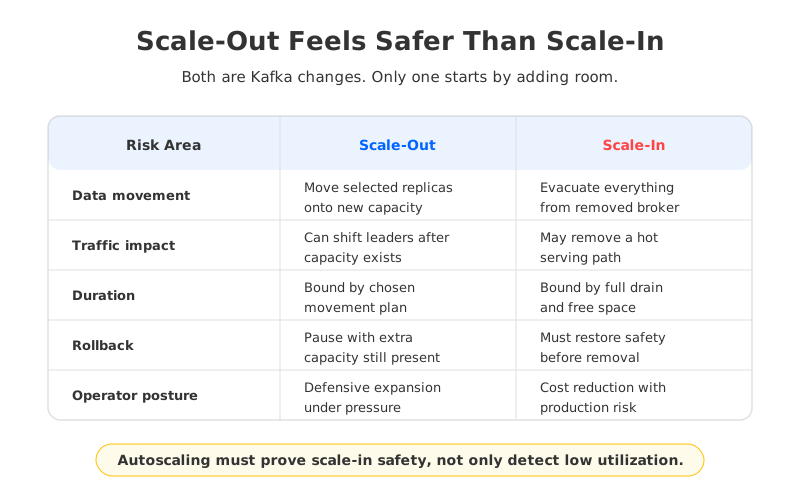
This is why many Kafka environments scale out more willingly than they scale in. Adding brokers feels like a defensive action; removing brokers feels like a maintenance event. Over time, that asymmetry creates permanent over-provisioning. The organization technically has autoscaling dashboards, but the actual cluster shape still follows peak demand, rebalance fear, and disk safety margins.
Scale-in also exposes rollback complexity. If a workload spike returns halfway through an evacuation, the platform has to decide whether to pause, reverse, or finish the move. If a broker being drained is also serving hot leaders, the drain can change latency before it changes cost. These are solvable problems, but they require a design that treats scale-in as a first-class workflow rather than a cleanup step after scale-out.
4What Autoscaling Can and Cannot Automate
A good Kafka autoscaling design should be honest about the boundary between automation and judgment. Automation can observe metrics faster than humans, create candidate plans, enforce throttles, and execute repetitive changes consistently. It cannot make an unsafe storage model safe by adding a loop around it.
For traditional Kafka, the realistic automation target usually looks like this:
- Detect sustained pressure from broker CPU, network, disk, partition skew, request latency, replication lag, and consumer-facing symptoms.
- Add brokers or storage capacity through an infrastructure layer such as Kubernetes, an autoscaling group, or managed service API.
- Generate a reassignment plan that considers bytes, throughput, leaders, replicas, zones, and reserved headroom.
- Execute movement with throttles, progress checks, and stop conditions when production SLOs degrade.
- Validate that client traffic and broker utilization actually changed after metadata updates and leadership moves.
That is valuable work. It can reduce toil and make scaling more repeatable. But it still operates inside a stateful architecture where retained data is attached to brokers. The automation becomes a careful traffic controller for expensive movement, not a magic button that turns Kafka into a stateless service.
There is also a monitoring trap. Broker count, partition count, and average CPU are weak signals on their own. A cluster can have even partition counts and still be unbalanced by bytes. It can have acceptable average CPU and still have one broker serving the hottest leaders. It can have enough total free disk and still lack safe placement for a broker drain because the free space is on the wrong machines or zones.
5Stateless Brokers and Metadata-Level Reassignment
The architecture changes when brokers no longer own the durable log as local state. In a shared-storage or diskless Kafka design, retained data lives in cloud storage, while brokers act more like compute nodes serving protocol traffic, caching, coordination, and active I/O. The scaling problem does not disappear, but the expensive part changes: moving ownership can become a metadata operation instead of a large retained-log migration.
AutoMQ is built around that idea. Its documentation describes a Kafka-compatible architecture with stateless brokers and S3Stream shared storage, so broker scale-out and scale-in do not require moving the full retained data set between broker-local disks. AutoMQ also documents partition reassignment in seconds and self-balancing behavior that can move partitions and balance traffic without the same data-copy burden operators associate with traditional broker-local storage.
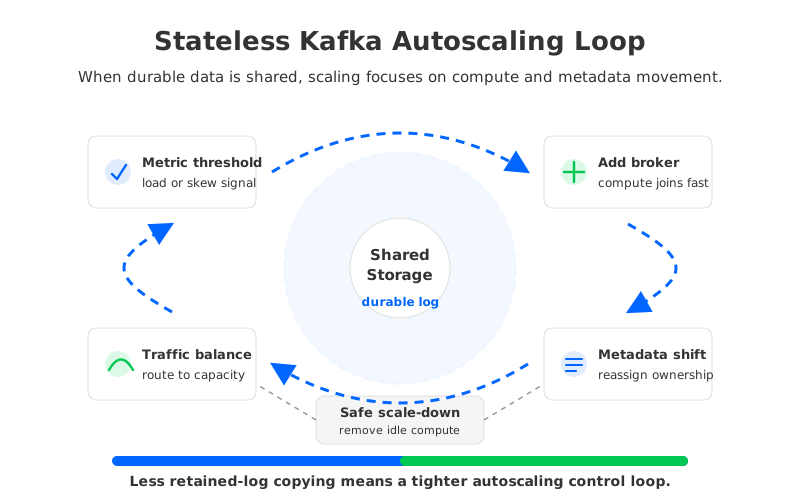
That is the natural entry point for AutoMQ in an autoscaling discussion. The claim is not that every workload can ignore planning, nor that autoscaling should be uncontrolled. The claim is narrower and more architectural: when brokers are closer to stateless compute, the control loop can focus on compute capacity, metadata assignment, and traffic balance instead of copying retained logs every time the cluster shape changes.
This distinction matters most for workloads with bursty traffic, frequent tenant changes, uneven partition heat, long retention, or teams running Kafka on Kubernetes. Kubernetes is good at adding and removing compute. Traditional Kafka makes each compute change carry storage consequences. A stateless-broker design brings Kafka scaling closer to the operating model platform teams already use for other cloud-native services, while preserving Kafka protocol compatibility for clients and ecosystem tools.
6Autoscaling Checklist
Before implementing Kafka autoscaling, force the design through a checklist that separates infrastructure scaling from Kafka ownership movement. If a proposal cannot answer these questions, it is not ready for production traffic.
| Question | Why it matters |
|---|---|
| What signal triggers scale-out? | CPU alone misses disk, leader skew, network, replication lag, and hot partition pressure. |
| What signal allows scale-in? | Scale-in needs stronger proof because it removes safety margin and may require evacuation. |
| What unit is being balanced? | Partition count, bytes, leaders, ingress, egress, and replay load can point to different plans. |
| How is movement throttled? | Reassignment traffic competes with producers, consumers, followers, and disk I/O. |
| Where is rollback defined? | The system needs explicit stop, pause, reverse, and resume behavior under workload spikes. |
| How are clients refreshed? | Capacity is not useful until producers and consumers route traffic through the new layout. |
| What storage model is assumed? | Broker-local storage makes scale operations data movement events; shared storage changes the control loop. |
The checklist also helps evaluate managed Kafka and Kafka-compatible alternatives. Ask vendors or platform teams to describe the full loop: metrics, decision policy, broker creation, assignment changes, traffic shift, scale-in, safety checks, and failure behavior. A diagram that stops at "add broker" is not an autoscaling design. It is an infrastructure provisioning design.
For teams staying on traditional Kafka, the practical path is to invest in better reassignment automation, clear throttling policy, hot-partition detection, and conservative scale-in rules. For teams already hitting the limits of broker-local storage, the more fundamental question is whether the storage architecture is forcing every scaling event to become a data movement event. That is the moment when stateless brokers and shared storage deserve evaluation.
7Sources
- Apache Kafka documentation: expanding your cluster
- Apache Kafka documentation: partition reassignment tool
- Kubernetes documentation: Horizontal Pod Autoscaling
- AutoMQ documentation: stateless broker
- AutoMQ documentation: scale-out/in in seconds
- AutoMQ documentation: partition reassignment in seconds
- AutoMQ documentation: continuous self-balancing
8FAQ
8.1Can Kafka autoscale like a stateless Kubernetes service?
Not in the same way. Kubernetes HPA can add or remove pod replicas based on metrics, but traditional Kafka brokers own partition replicas, leaders, and local log data. A new broker does not help much until partitions, leadership, and traffic move to it.
8.2Why does adding a Kafka broker not immediately reduce load?
Existing partitions keep their current assignments after a broker joins. Producers and consumers route through partition leaders, and retained data remains on the brokers that currently store it. Reassignment and leadership movement are needed before the new broker carries useful work.
8.3Is Kafka scale-in riskier than scale-out?
Usually, yes. Scale-out adds capacity before moving work. Scale-in removes capacity only after data, leaders, and traffic have been safely evacuated from the broker being removed. That makes disk headroom, ISR health, rollback, and throttling more important.
8.4Can Cruise Control or reassignment automation solve Kafka autoscaling?
They can help significantly by planning and executing movement, but they still operate within the underlying storage architecture. If retained data is bound to broker-local disks, autoscaling must still account for data movement, throttling, and recovery risk.
8.5How do stateless brokers change Kafka autoscaling?
Stateless brokers reduce the amount of durable data tied to each broker. In a shared-storage design, scaling can focus more on compute capacity, metadata assignment, and traffic balance rather than copying retained logs between brokers for every topology change.
8.6When should AutoMQ be considered for Kafka autoscaling?
Consider AutoMQ when the team needs Kafka compatibility but scaling is constrained by broker-local storage, slow reassignment, long retention, bursty traffic, or Kubernetes operations. It should still be validated with realistic workload metrics, failure drills, and client behavior tests before production migration.


