
Table of Contents
Table of Contents
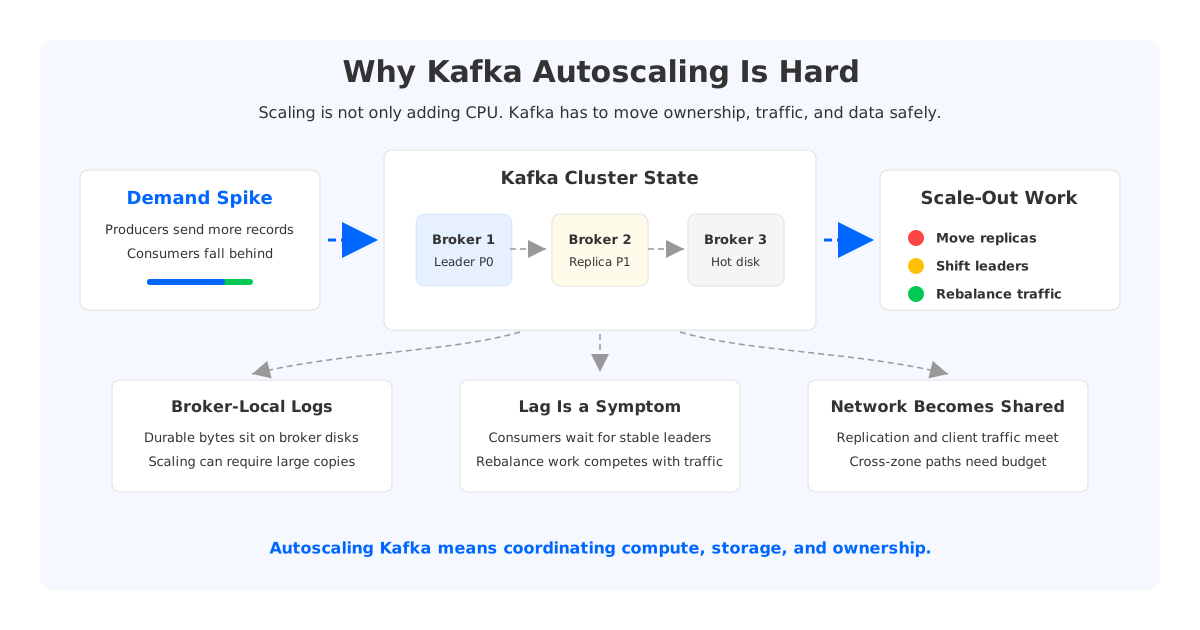
Kafka autoscaling sounds straightforward until a production cluster actually needs to do it. A web service can often scale out by adding pods behind a load balancer. Kafka is different: the broker that accepts traffic also owns partition leadership, replica placement, and usually a large amount of durable log data on local or attached disks.
That coupling is why Kafka autoscaling is not only a CPU problem. A cluster may have spare nodes and still be overloaded because hot partitions remain on the same brokers. A cluster may add brokers and still create risk because reassigning replicas consumes disk, network, controller, and broker resources while the system is under pressure. The hard question is not "Can the cloud add nodes?" It is "Can Kafka safely move ownership and traffic fast enough to make those nodes useful?"
1Why Kafka Is Not a Normal Stateless Service
Horizontal autoscaling works cleanly when instances are interchangeable. If a stateless API service receives more traffic, an autoscaler can start replicas, register them with a load balancer, and let requests spread across the larger pool. Existing instances do not need to transfer durable data first.
Kafka brokers are not interchangeable in that way. Each topic is split into partitions, each partition has leaders and replicas, and clients route reads and writes through the current leader. If broker 2 is hot because it leads several high-throughput partitions, adding broker 5 does not move those leaders. The new broker is capacity, but Kafka still needs a placement change.
The storage layer makes the control loop even heavier. In traditional Kafka deployments, partition log segments are stored on broker-local disks or locally attached volumes. When a partition replica moves to another broker, the target broker must obtain the relevant data and catch up before it can safely serve as a replica. That movement is a real workload, not a metadata label change.
This is the first mental model shift for Kafka horizontal scaling: the autoscaler can create compute, but Kafka must redistribute state. Until those loops are coordinated, autoscaling Kafka can look elastic without delivering elastic throughput.
2What Makes Kafka Autoscaling Hard
The difficulty is not one feature gap. It is a chain of dependencies that must line up under load. A practical plan has to account for partition placement, replica movement, leader balance, consumer lag, and network headroom together.
The most common failure mode is treating one metric as the whole truth. CPU may be high because a few partitions are hot. Disk may be near a limit because retention grew faster than expected. Consumer lag may rise because downstream processing slowed down. A scaler that reacts to one symptom can add capacity while leaving the real bottleneck untouched.
Key constraints tend to appear in this order:
- Partition leadership: producers and consumers connect through partition leaders, so load follows leader placement rather than broker count alone.
- Replica placement: reassignment has to preserve replication and availability goals, not only spread partitions evenly.
- Local disk movement: moving replicas can create large copy jobs that compete with normal replication and client traffic.
- Consumer lag: lag is often the visible symptom, but the cause may be broker saturation, downstream processing, leader movement, or network pressure.
- Network headroom: replication, catch-up reads, inter-zone traffic, and client traffic share finite links.
None of these constraints means autoscaling is impossible. They mean the control loop must understand Kafka as a stateful distributed log, not as a pool of anonymous workers. The more tightly durable data is attached to brokers, the more each scaling event resembles a controlled migration.
3Partition Placement Is the First Gate
Kafka traffic is shaped by partitions. If a topic has few partitions, there are only so many units of work to spread across brokers and consumers. If traffic is skewed toward a few keys, hot partitions still dominate broker load. Kafka autoscaling cannot create finer traffic distribution than the partition model allows.
That matters when teams use autoscaling as a rescue mechanism for unpredictable workloads. Adding brokers helps only after leaders and replicas are placed in a way that uses the new capacity. If the overloaded broker still leads the busiest partitions, the cluster has more machines but the same hot path.
Operators also have to protect availability while changing placement. A balanced-looking assignment can be unsafe if it concentrates replicas in one failure domain, creates uneven disk pressure, or overloads a broker with latency-sensitive leaders. The assignment plan has to respect rack or zone awareness, replication factor, ISR health, and operational limits.
In other words, Kafka auto scaling is not "add N brokers." It is "add capacity, compute a safer assignment, move work toward that assignment, and verify that client-facing SLOs remain healthy while the move is happening."
4Local Disk Data Movement Turns Scaling Into Migration
The biggest difference between traditional Kafka and stateless services is durable log ownership. In broker-local storage designs, the broker is both compute node and data location. Scaling out can require moving replicas to new brokers; scaling in can require evacuating brokers.
That movement is expensive even when it is automated. It consumes disk IO, network bandwidth, and broker resources in the same cluster that is serving producers and consumers. If throttles are too loose, rebalancing can hurt production traffic. If throttles are too conservative, the cluster may remain imbalanced long after demand has changed.
This is why autoscaling policies that work well for compute services often feel awkward for Kafka. Cloud capacity can appear quickly, but data placement catches up more slowly. The operator must choose between speed and risk.
The same issue appears during scale-in. Removing brokers is a data evacuation workflow, so the theoretical FinOps win from elastic capacity can become an availability risk.
5Traffic, Consumer Lag, and Network Pressure Interact
Kafka operators often look at consumer lag when they think about autoscaling, and for good reason: lag is the number that application teams feel. But lag is a downstream symptom. Scaling brokers may help if the broker fleet is saturated; it may do little if consumers are under-provisioned, downstream databases are slow, or a hot partition limits consumer parallelism.
Leader movement can also create short-lived turbulence. Clients need to discover new leaders, connections may shift, and traffic distribution changes across brokers. In a healthy cluster this is normal, but an autoscaler that repeatedly triggers movement can turn normal adjustment into churn.
Network is the hidden budget in many Kafka scaling plans. During reassignment, replication and catch-up traffic may run beside producer writes, consumer reads, and inter-zone replication. In cloud environments, cross-zone traffic can also affect cost. A policy that scales brokers based on CPU alone may ignore the bottleneck that determines whether reassignment can finish safely.
This is the second mental model shift: Kafka autoscaling is a closed-loop operations workflow, not a single infrastructure action. The loop must observe, decide, move, verify, and sometimes stop.
6What Kubernetes and Cloud Autoscalers Can and Cannot Do
Kubernetes and cloud autoscalers are useful pieces of the puzzle. Kubernetes Horizontal Pod Autoscaling can adjust pod replicas based on observed metrics. Node autoscaling systems and tools such as Karpenter can add compute capacity when pending workloads need places to run.
Those systems do not solve Kafka's internal redistribution problem. They can make a broker pod schedulable and add a node with more CPU or memory. But Kafka still has to decide which partitions move, which brokers lead them, how replicas catch up, and how quickly background work should proceed.
This boundary is easy to miss in Kubernetes-based Kafka deployments. A StatefulSet can manage broker identity, persistent volumes can keep storage attached to broker pods, and operators can automate rolling changes. Those capabilities matter, but they do not remove the stateful nature of the Kafka log.
For a traditional Kafka cluster, the practical architecture is usually two coordinated loops:
| Layer | What it can scale | What it cannot decide alone |
|---|---|---|
| Kubernetes or cloud autoscaler | Pods, nodes, VM capacity, scheduling supply | Kafka partition leadership and replica placement |
| Kafka operator or admin workflow | Reassignment, leader balance, broker lifecycle | Cloud capacity availability and node provisioning |
| Monitoring and SLO policy | Signals for CPU, disk, IO, lag, latency | The safe physical movement plan by itself |
The most reliable designs make that boundary explicit. They avoid pretending that infrastructure autoscaling is the same thing as Kafka autoscaling.
7How Stateless Kafka Changes Autoscaling
If the root problem is that brokers combine compute with durable local storage, the architecture-level alternative is to separate those responsibilities. In a stateless shared-storage Kafka design, durable data is stored outside broker-local disks, while brokers focus on protocol handling, caching, ownership, and traffic serving.
That change does not make distributed systems disappear. It changes what has to move during a scaling event. Instead of copying large amounts of partition data from broker-local disks before capacity becomes useful, the system can make scaling closer to ownership and traffic scheduling.
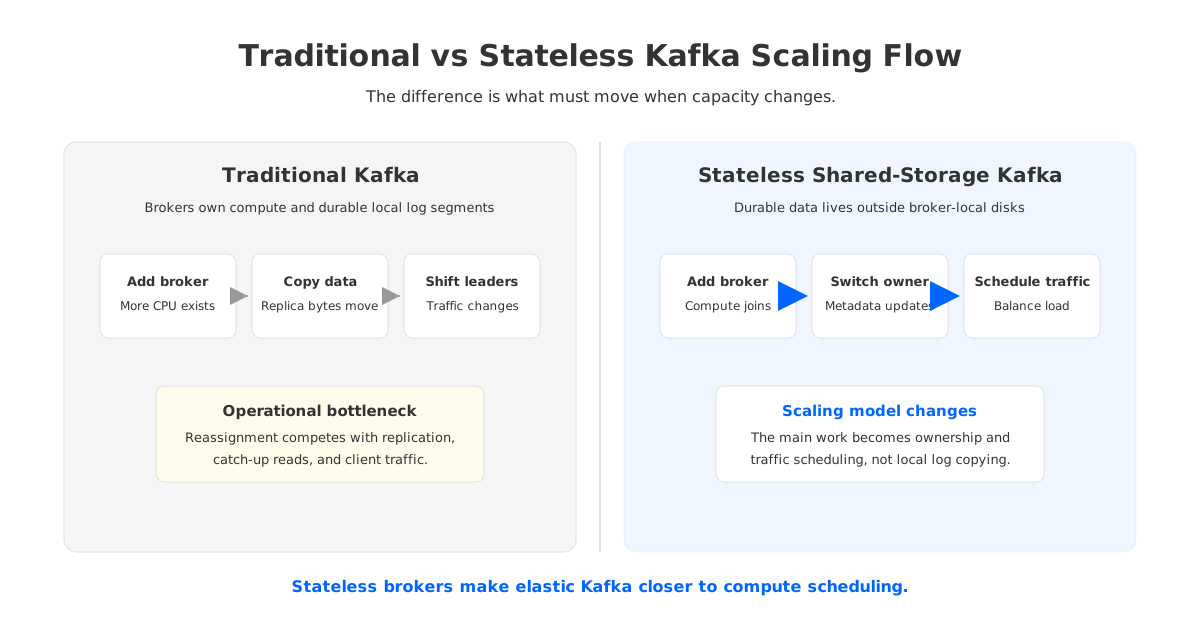
AutoMQ is one example of this architectural direction: a Kafka-compatible streaming platform that uses object-storage-backed shared storage and stateless brokers. Its public documentation describes stateless brokers, shared storage, continuous self-balancing, and Seconds-level partition reassignment. The important point is the model shift, not a magic button. When durable data is decoupled from broker-local disks, scaling moves away from bulk local data migration and toward controlled ownership changes, traffic balancing, and SLO-aware automation.
That is why stateless Kafka is relevant to elastic Kafka and Kafka horizontal scaling searches. It attacks the part of the loop that cloud autoscalers do not own: Kafka's internal relationship between partitions, brokers, and durable data.
8Designing a Safer Kafka Autoscaling Control Loop
Whether you run traditional Kafka or a shared-storage Kafka system, autoscaling should start with a safety model. A good control loop is conservative about production traffic and explicit about rollback.
The strongest autoscaling signals combine several dimensions:
- Broker CPU, network, disk IO, and request latency for infrastructure pressure.
- Partition-level produce and fetch rates for traffic skew.
- Consumer lag by group and topic for application impact.
- Reassignment progress and throttle state for background movement.
- Error rates, under-replicated partitions, and ISR changes for safety.
The policy also needs different actions for different causes. If CPU is high because traffic is evenly rising, adding broker capacity may be appropriate. If one partition is hot, scaling brokers may not help without partitioning or key-distribution changes. If lag is caused by a slow downstream sink, broker autoscaling will not fix the system.
This is where FinOps and reliability goals meet. Elastic capacity is useful only when scaling down is as safe as scaling up. If the cluster cannot evacuate brokers without long data movement windows, teams often keep spare capacity online. If broker capacity is stateless, the economic model becomes more elastic.
9Autoscaling Readiness Checklist
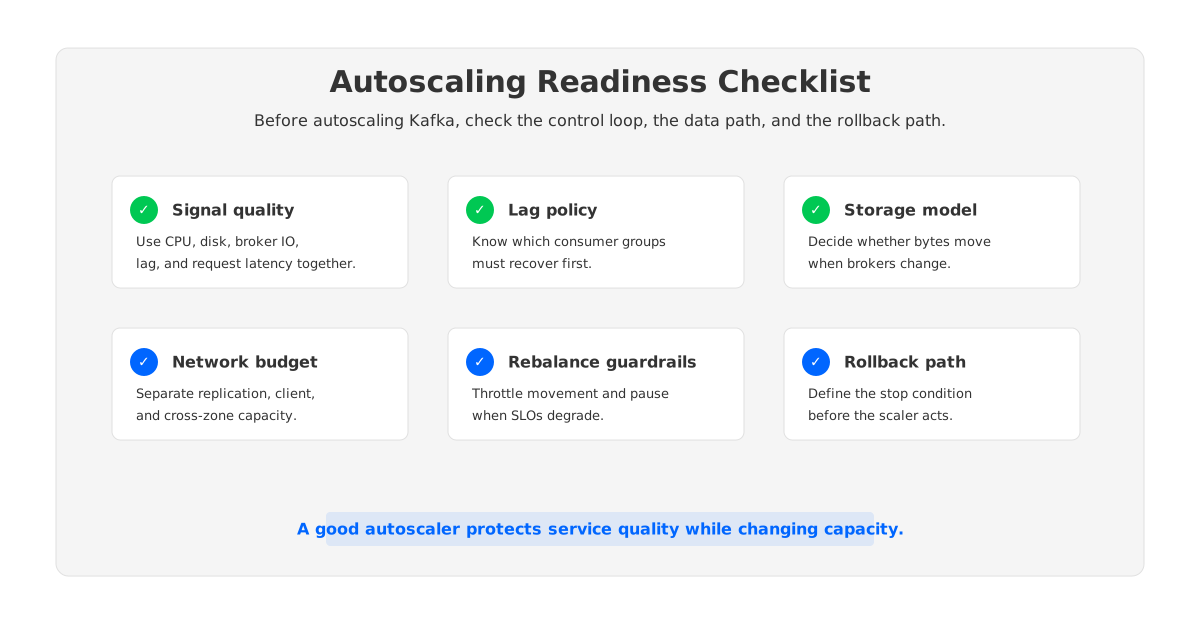
Before enabling autoscaling Kafka in production, treat readiness as an engineering review, not a checkbox in a deployment file.
- Define the bottleneck taxonomy. Separate CPU pressure, disk pressure, network pressure, hot partitions, consumer bottlenecks, and downstream bottlenecks.
- Use multi-signal triggers. Avoid scaling on one metric unless the failure mode is narrow and well understood.
- Set reassignment guardrails. Throttle background work, protect ISR health, and pause movement when SLOs degrade.
- Plan for scale-in. Broker removal must be a tested workflow, not an afterthought after scale-out succeeds.
- Budget the network. Include replication, catch-up reads, client traffic, and cross-zone paths.
- Test with production-shaped skew. Uniform benchmarks do not reveal hot partition behavior.
- Choose the storage model deliberately. Broker-local storage and shared storage create different scaling envelopes.
- Document rollback. The autoscaler should have a clear stop condition and a safe path back.
Autoscaling does not mean unlimited elasticity. Kafka still has partition boundaries, client behavior, topic design, and infrastructure limits. The goal is to make capacity changes safer, faster, and more predictable than manual emergency operations.
For teams evaluating Kafka autoscaling, the architectural question is direct: do you want the scaling loop to move durable log data with brokers, or do you want brokers to behave more like schedulable compute over shared storage? The answer shapes operations, cost planning, incident response, and burst tolerance.
If your team is comparing Kafka architectures for elastic workloads, start with AutoMQ's public architecture documentation and validate the model against your own traffic skew, retention, and failure-domain requirements. The useful proof is a controlled test where brokers change and traffic remains healthy.
10References
- Apache Kafka documentation for Kafka operations, replication, partitions, and broker behavior.
- Kubernetes Horizontal Pod Autoscaling for how Kubernetes scales pod replicas from observed metrics.
- Kubernetes node autoscaling concepts for cluster capacity scaling boundaries.
- Karpenter documentation for Kubernetes node provisioning and autoscaling behavior.
- AutoMQ stateless broker documentation.
- AutoMQ partition reassignment in seconds.
- AutoMQ continuous self-balancing.
11FAQ
11.1Can Kafka autoscale like a stateless web service?
Not in the traditional broker-local storage model. Kafka can add brokers, but useful scaling also depends on partition leadership, replica placement, and data movement. Stateless shared-storage Kafka changes the model by reducing the amount of durable data that must move with each broker.
11.2Does Kubernetes HPA solve Kafka autoscaling?
Kubernetes HPA can scale pods based on metrics, and node autoscalers can add infrastructure capacity. They do not decide Kafka partition reassignment, leader placement, replica catch-up, or traffic balancing. Those Kafka-specific operations still need an operator, automation layer, or architecture that reduces the need for local data movement.
11.3What metrics should trigger Kafka autoscaling?
Use a combination of broker CPU, network, disk IO, request latency, partition-level throughput, consumer lag, under-replicated partitions, and reassignment progress. A single metric is rarely enough because Kafka bottlenecks can come from brokers, partitions, consumers, downstream systems, or the network.
11.4Is stateless Kafka the same as serverless Kafka?
No. Stateless Kafka describes an architecture where broker compute is decoupled from durable storage. Serverless Kafka usually describes an operational or commercial experience where users do not manage cluster capacity directly. A serverless service may use stateless architecture underneath, but the terms are not identical.
11.5When should teams consider AutoMQ for Kafka autoscaling?
Consider AutoMQ when broker-local storage movement is the main obstacle to elastic Kafka, fast partition reassignment, or safe scale-in. It is most relevant for teams that want Kafka compatibility while making brokers behave more like schedulable compute over shared object storage.


