
Table of Contents
Table of Contents
Kafka capacity planning has always had an uncomfortable bargain inside it. The team has to predict peak traffic, choose broker count, size disks, set retention, pick a replication factor, leave headroom for failures, and hope the business does not change the workload too quickly. Under-sizing fails loudly; over-sizing fails quietly through a bill that never really relaxes.
That bargain is why many Kafka teams end up planning around a 2-3x buffer in peak-driven environments. Treat that as a framing pattern, not a universal benchmark: the exact number depends on workload variance, retention, read fanout, availability policy, and how painful it is to scale in production. The broader issue is harder to dispute. Traditional Kafka sizing asks teams to buy tomorrow's uncertainty as today's infrastructure.
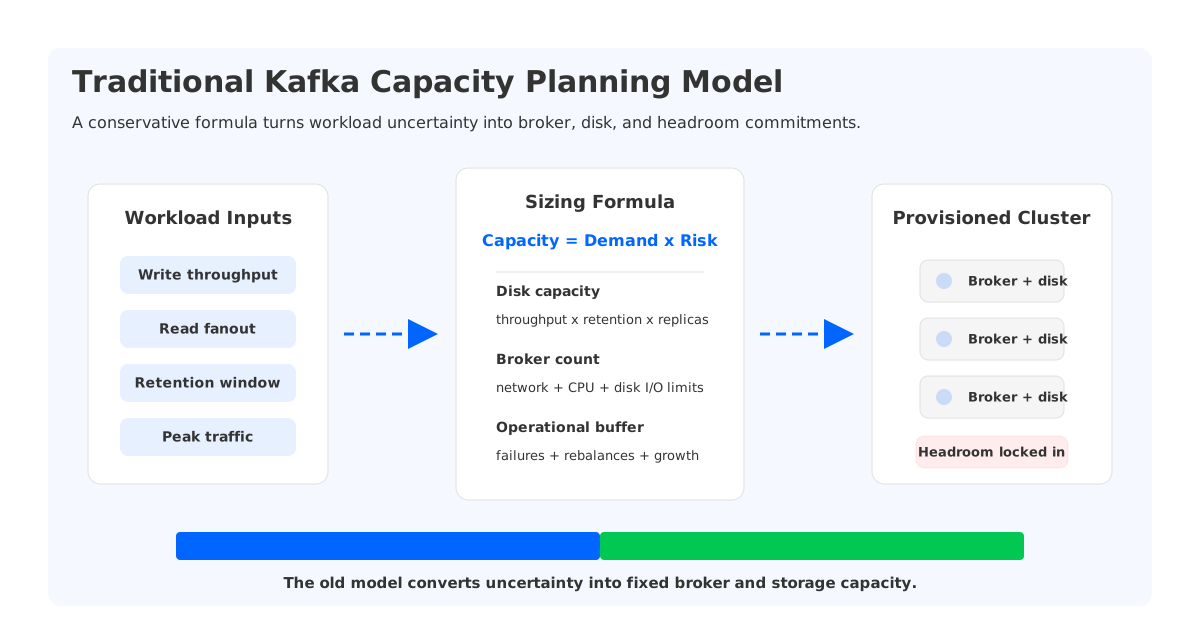
The model worked better when traffic growth was slower, infrastructure was purchased in larger cycles, and Kafka clusters were expected to be relatively stable. Cloud deployment changed the economics. Compute can be provisioned quickly, storage grows continuously, cross-AZ data movement has a direct cost, and spikes can arrive from product launches, analytics backfills, AI pipelines, or customer events with little warning.
1The Traditional Kafka Sizing Model
Most Kafka sizing exercises begin with a reasonable set of inputs. You estimate write throughput, read throughput, retention, replication factor, partition count, broker network capacity, disk capacity, and failure headroom. A Kafka capacity calculator may put those inputs behind a form, but the mental model is usually the same: convert workload into broker count, then round upward until the cluster feels safe.
The calculation reflects real Kafka constraints:
- Broker count is bounded by more than CPU. Brokers also carry partition leadership, replica fetch traffic, page cache pressure, network connections, and disk I/O.
- Disk size is tied to retention and replication. Logical retained data becomes larger physical storage once replicas, segment overhead, and safety margins are included.
- Partition count affects concurrency and operations. More partitions can improve parallelism, but they also increase metadata, leader election work, recovery time, and operational complexity.
- Replication factor protects availability by consuming capacity. A common production replication factor multiplies storage and broker-to-broker traffic.
- Peak traffic drives the upper bound. The cluster must survive the busiest interval, not only the average interval.
Once those variables are combined, the practical answer is rarely clean. If the model says you need a little more than one broker's worth of headroom, you add a full broker. If retention might grow, you add disk early. If a rebalance during peak hours is risky, you provision before the risk appears.
| Planning Input | Traditional Interpretation | Hidden Planning Bias |
|---|---|---|
| Average throughput | Useful baseline | Too optimistic for failure and campaign windows |
| Peak throughput | Required survival target | Often becomes permanent capacity |
| Retention | Disk capacity problem | Forces early storage commitment |
| Replication factor | Availability requirement | Multiplies storage and network load |
| Partition count | Parallelism tool | Raises rebalance and metadata overhead |
| Headroom | Safety buffer | Can turn into normalized idle capacity |
Kafka cluster sizing is less like a single formula and more like risk budgeting. Every variable has a technical reason to be conservative, and those choices compound. By the time the design reaches production, the cluster may be sized less for the workload it sees most days and more for the workload the team is afraid to meet unprepared.
2Why Cloud Breaks the Old Model
Cloud infrastructure did not make Kafka capacity planning harder because cloud is unreliable. It made the mismatch visible because the rest of the stack became more elastic than Kafka's stateful broker model. Application pods scale out, warehouses shrink, and object storage grows without a procurement cycle. Kafka sits in the middle with brokers that own local log segments and partitions that must be moved carefully.
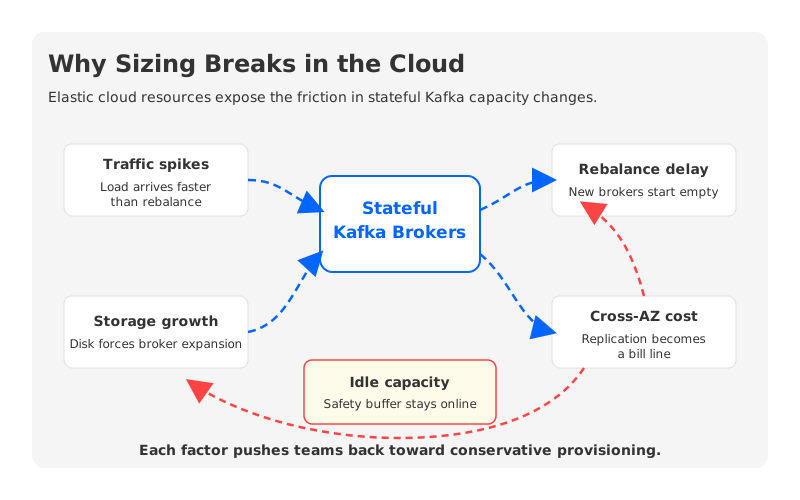
Traffic burstiness is the first break. A retail event, a mobile release, an incident replay, or an added analytics consumer can change producer and consumer load quickly. Traditional Kafka can add brokers, but those brokers start empty. They help only after partition assignments, leader movement, and data placement catch up.
Storage growth is the second break. Security, compliance, replay, feature engineering, and customer analytics all pull Kafka toward longer retention. With broker-attached storage, storage growth often forces compute growth even when the workload does not need more CPU.
Cross-AZ cost is the third break. In a multi-AZ deployment, Kafka's replication model sends data between brokers so replicas remain available across failure domains. That is technically sound, but cloud networking makes the movement visible as a cost line.
The final break is the expansion cycle. In theory, cloud capacity is available on demand. In practice, Kafka expansion still involves planning: validate instance types, adjust partition placement, watch replication, protect consumer lag, coordinate maintenance windows, and verify hotspot risk. The infrastructure is elastic; the operating procedure is not.
3Why "Add More Brokers" Stops Being a Strategy
Adding brokers is still useful. The point is that scaling carries state, and state turns capacity into a project. A stateless service can use an added instance as soon as it passes health checks. A traditional Kafka broker needs partitions, leaders, replicas, and data movement before it changes the cluster's load distribution.
That difference changes the economics of provisioning. If scale-out takes planning and scale-in is risky, teams keep capacity online longer than the workload needs it. If a broker owns durable data on local disks, removing it means draining or reassigning that data.
This creates a loop: stateful scaling is heavy, so teams scale early; early capacity sits idle, so utilization looks low; low utilization is accepted because under-provisioning is more dangerous than waste. None of those steps is irrational. Platform teams are paid to prevent incidents, not to run every broker at the edge of saturation. But a model can be rational at every step and still produce a bad system-level outcome.
4A Better Starting Point: Workload Metrics, Not Broker Counts
Capacity planning should begin with the workload shape before it becomes a broker shopping exercise. The useful input is not only "how many brokers do we need?" but "what makes this workload expensive or risky to serve?" That framing separates steady demand, burst demand, retained data, and failure headroom.
For a practical Kafka capacity planning review, collect the following metrics over a representative window:
- Write throughput and peak-to-average ratio. Use consistent units such as MiB/s and record both normal and peak intervals.
- Read fanout and catch-up behavior. Consumers often create more load during backfills, replays, or downstream recovery than during steady processing.
- Retention by topic class. Short-lived operational topics and long-retention analytical topics should not share the same storage assumptions.
- Partition and leader distribution. Hot partitions can invalidate a broker-level average even when total cluster capacity looks healthy.
- Cross-AZ placement and data movement. Producer, broker, replica, and consumer placement can turn architecture into a network cost problem.
- Scale-out and scale-in runbooks. The time and risk required to change capacity should be treated as part of the model.
This workload-first view does not remove the need for a Kafka sizing calculator. It makes the calculator more honest. Instead of asking for one permanent cluster shape, the team can ask which parts of the workload need durable storage, which parts require broker compute, and which parts should expand only when traffic appears.
5The Elastic Capacity Model
The elastic model starts from a different architectural assumption: durable log storage should not be trapped inside broker-local disks. If storage capacity comes from object storage and broker compute can be treated as a mostly stateless serving layer, Kafka capacity planning changes from "pre-place enough state on enough machines" to "keep enough compute online for current traffic."
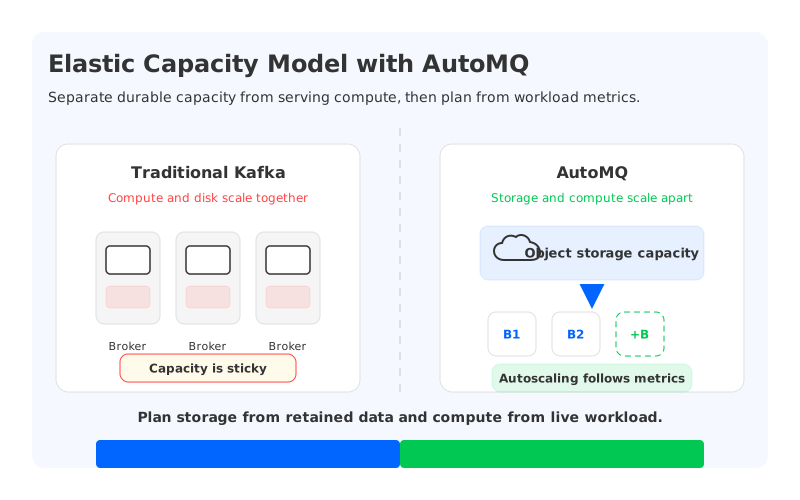
AutoMQ is built around that separation while preserving Kafka protocol compatibility. Producers and consumers continue to speak Kafka. The change is below the API: object storage carries durable capacity, while brokers focus on request handling, metadata ownership, and traffic.
The impact is not that planning disappears. Teams still need partition strategy, quotas, failure drills, latency budgets, observability, and cost controls. What changes is the unit of planning:
| Question | Traditional Kafka Model | Elastic AutoMQ Model |
|---|---|---|
| How do we plan retention? | Size broker disks and replicas | Use object storage as the durable capacity layer |
| How do we add traffic capacity? | Add brokers, then rebalance state | Add broker compute and reassign serving responsibility |
| How do we handle peaks? | Reserve headroom before the event | Scale compute with workload metrics |
| How do we scale down? | Drain or move local state carefully | Remove unneeded broker compute after load drops |
| What does a calculator optimize? | Fixed cluster shape | Separate compute, storage, and burst assumptions |
AutoMQ documentation describes scale-out and scale-in as lightweight because partition reassignment does not require the same large local-data movement pattern as traditional Kafka. The exact result depends on deployment, workload, and automation, so it should be validated before production policy changes. The architectural direction is the important part: when durable data is no longer bound to a broker's local disk, elasticity becomes a Kafka-level property.
6Right-Sizing Without Pretending the Future Is Knowable
Right-sizing Kafka in 2026 should be less about predicting a perfect peak and more about reducing the penalty for being wrong. Forecasts will still miss. Additional consumers will appear. Retention policies will expand. The capacity model should assume change rather than punish it.
A better Kafka provisioning process separates decisions into three layers. First, plan durable storage from retention and logical data growth. Second, plan broker compute from current and expected request load. Third, plan burst behavior from observed peak-to-average ratios, autoscaling policy, and downstream limits.
For teams evaluating a migration, AutoMQ's pricing calculator can be useful as a scenario tool rather than a final answer. Put in the workload, then change one assumption at a time: retention, read fanout, AZ count, peak traffic, and scale-down policy. The goal is to see whether cost grows smoothly with the workload or jumps because the architecture forces compute, storage, and replication to move together.
7The Capacity Planning Question Has Changed
The old question was: how many brokers do we need to be safe? That question made sense when brokers were the natural unit of compute, storage, and availability. It also explains why traditional Kafka capacity planning often feels like an art. The planner is estimating both workload and the pain of changing the cluster later.
The better question is: which parts of this workload need durable capacity, which parts need serving compute, and how fast can each layer respond when reality changes? That question does not make Kafka operations trivial, but it removes the worst assumption in the old model: safe capacity must be bought in advance.
Traditional sizing models are broken in the cloud because they make uncertainty expensive by default. Elastic architectures change the bargain. You still keep headroom, but you no longer have to make peak headroom a permanent fixture. For Kafka teams trying to right-size clusters in 2026, that is the difference between forecasting the future and building a system that can respond when the forecast is wrong.


