
Table of Contents
Table of Contents
Kafka client compatibility sounds like a small question until the platform underneath the clients is about to change. A producer can connect to the new endpoint. A consumer can fetch a record. The first smoke test passes, and the migration plan starts to feel easier than expected. That is usually the moment to slow down.
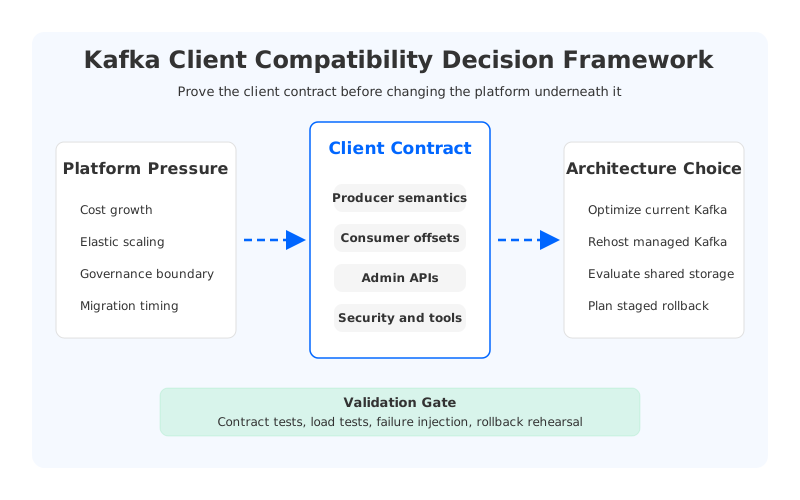
The client contract is larger than produce and consume. It includes protocol versions, idempotent writes, transactions, consumer group rebalances, offset commits, topic administration, schema tooling, connector state, authentication, monitoring, and rollback. A platform team that validates only the happy path may discover the incompatibility later, when the traffic pattern is uglier and the rollback clock is running.
The useful question is not "does this platform speak Kafka?" The useful question is "which parts of our production Kafka contract do our applications actually exercise, and how will we prove each one before the platform changes?"
1Why Kafka Client Compatibility Matters Now
Teams search for kafka client compatibility when Kafka is no longer only a cluster. It has become a platform boundary shared by application teams, SREs, data engineers, governance teams, and procurement. The reason for change may be cost, elastic scaling, cloud migration, regional expansion, AI pipeline freshness, data control, or a managed-service renewal. The application teams hear a simpler message: their clients should keep working.
That expectation is reasonable. Kafka's protocol, APIs, and ecosystem have given organizations a strong portability layer. Compatibility is one reason Kafka became infrastructure rather than another queue library.
But portability is not the same thing as proof. A target platform can support the Kafka protocol and still differ in default limits, security integration, supported broker APIs, transaction behavior, quota enforcement, or operational metrics. Even Apache Kafka version changes require planning because clients negotiate API versions and depend on broker-side behavior.
The mistake is treating compatibility as a vendor label. Production teams should treat it as a test suite.
2The Contract Is Wider Than The Endpoint
The first artifact should be a client matrix, not a cluster diagram. A cluster diagram tells you where brokers run. A client matrix tells you what business behavior must survive the change. The matrix should include every producer, consumer, admin client, connector, stream processor, framework wrapper, and operational script that talks to Kafka.
| Contract area | What to inventory | What can break during a platform change |
|---|---|---|
| Producer path | Client library, retries, acks, batching, compression, partitioner, idempotence, transactions | Duplicate records, reordered keys, retry storms, unexpected timeouts |
| Consumer path | Group ID, assignment strategy, commit mode, fetch settings, auto.offset.reset, lag tolerance | Rebalance instability, skipped offsets, slow catch-up, replay surprises |
| Admin path | Topic creation, config updates, ACLs, quotas, consumer group operations | CI/CD failures, missing topic settings, broken self-service automation |
| Ecosystem tools | Connect, Streams, schema tooling, Flink, monitoring agents, Kafka UI | Connector offsets drift, internal topics misconfigured, dashboards go dark |
| Security | TLS, SASL, ACL principals, certificates, private DNS, secret rotation | Clients connect in test but fail in production runtime |
This inventory changes the tone of the evaluation. Instead of asking whether "Kafka clients" work, the team can ask whether the payment producer with idempotence enabled, the CDC connector with task offsets, the Python batch consumer with manual commits, and the CI job that creates compacted topics work.
3Protocol Compatibility Is Necessary, Not Sufficient
Apache Kafka clients and brokers use API version negotiation so clients can discover which request and response versions are available. That mechanism helps mixed client and broker versions coexist within documented limits. It can tell a client which protocol shape is available; it cannot prove that application-level assumptions are safe.
A producer smoke test usually exercises a narrow path: create a producer, send a few records, flush, and exit. Real producers behave differently. They batch under load, retry during broker failover, refresh metadata when partitions move, preserve ordering per key, and sometimes depend on idempotence or transactions. A consumer smoke test has the same problem. Fetching one record does not prove group coordination under rolling deploys, offset commit behavior after restarts, or catch-up performance after a long outage.
The better baseline is an API contract test suite:
- Produce records with representative keys, headers, payload sizes, compression settings, retry settings, and required acknowledgments.
- Consume with the real group membership pattern, assignment strategy, commit mode, and restart behavior.
- Exercise AdminClient operations used by automation, including topic creation, configuration changes, group inspection, and ACL management.
- Test error paths: authorization failure, stale metadata, broker replacement, network interruption, and request timeout.
The point is not to build a perfect simulation of production. It is to stop proving only the path that is least likely to fail.
4Semantics That Deserve Their Own Tests
Some Kafka features carry stronger semantics than "the client can connect." Idempotent producers, transactions, and consumer isolation deserve dedicated validation because small behavioral differences can change downstream correctness. If a service relies on idempotent production, the test should include retries, leader changes, sequence handling, and duplicate detection under load. If it uses transactions, the test should include transactional.id, transaction timeouts, committed and aborted transactions, consumer isolation.level, and recovery after producer restart.
Offsets require the same care. A consumer group's committed offsets are the platform's memory of business progress. During a platform change, the team must decide whether offsets will be migrated, mirrored, reset, or deliberately replayed. Each choice is valid for some workloads and dangerous for others.
Rebalance behavior is another place where shallow tests mislead. Cooperative rebalancing, eager rebalancing, static membership, session timeouts, and max poll settings shape how consumers behave during deploys and failures. A target platform may be protocol-compatible, but the workload still needs to prove that scaling, broker replacement, network blips, and rolling application restarts do not create unacceptable lag or duplicate side effects.
Connectors and stream processors widen the blast radius. Kafka Connect has offsets, internal topics, plugin versions, source ownership, sink idempotency, and dead-letter queues. Kafka Streams and Flink jobs add state stores, checkpoints, repartition topics, and restore behavior.
5Architecture Changes Can Preserve The API And Still Change Operations
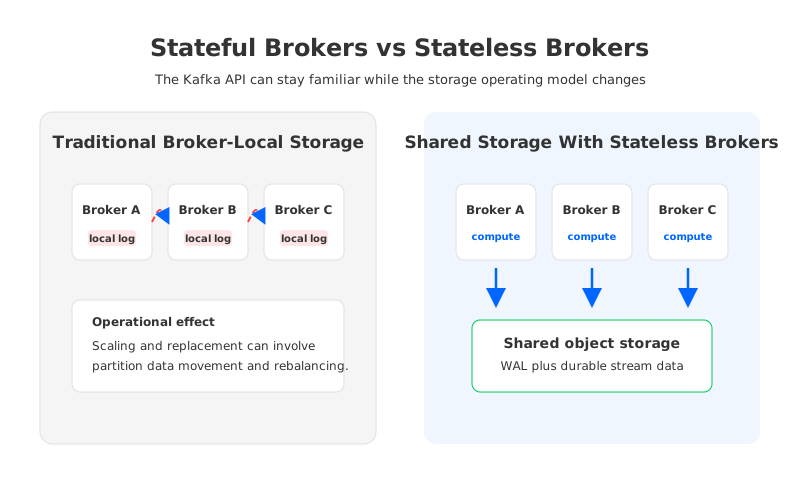
The architecture underneath Kafka matters because many platform changes are motivated by operations, not application syntax. Traditional Kafka uses broker-local storage: brokers own log segments for partitions, and replication across brokers provides durability. That model is mature, but it couples compute capacity, storage capacity, partition placement, and recovery behavior. When the team adds brokers, removes brokers, replaces brokers, or rebalances hot partitions, the platform may need to move data.
That coupling does not invalidate Kafka. It explains why a team can be happy with Kafka clients and unhappy with the operating model. Long retention, uneven partitions, high fan-out, bursty workloads, and cloud-zone traffic can make the broker-local model feel heavy. Tiered Storage can reduce local disk pressure by moving older log segments to remote storage, but the active broker path and operational ownership are still important to validate.
Kafka-compatible shared-storage platforms change that layer. The client-facing contract remains Kafka-oriented, while durable stream storage moves toward shared object storage and brokers become more stateless. AutoMQ fits this category: it is a Kafka-compatible streaming platform that uses Shared Storage architecture with S3Stream and a WAL layer, and it can be deployed in customer-controlled environments through BYOC or private software options.
This is where the evaluation should stay disciplined. Shared storage may reduce data movement during scaling and broker replacement, but it does not remove the need to prove client semantics. What changes is the operating model being tested after those clients connect: scale-out behavior, failover behavior, catch-up reads, object storage configuration, WAL behavior, observability, and the customer environment boundary.
6Load, Replay, And Failure Tests
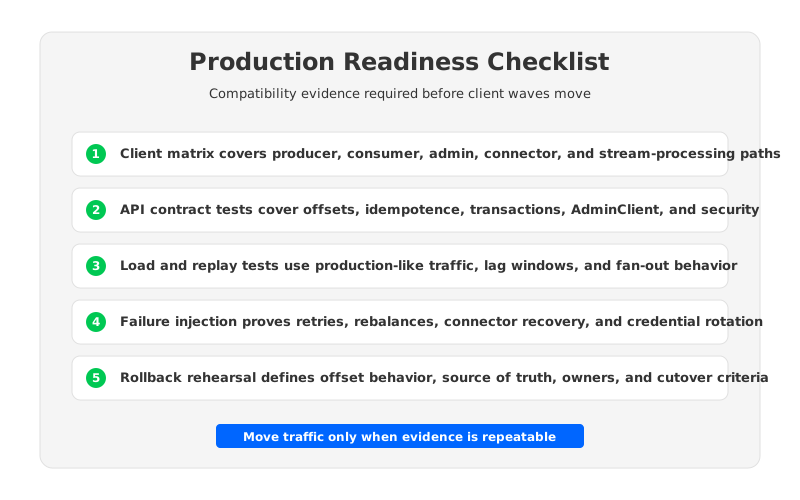
Compatibility testing should include three forms of evidence: contract tests, load tests, and failure tests. Contract tests prove that the client surface works. Load tests prove that normal and peak traffic remain inside SLOs. Failure tests prove that the platform behaves acceptably when something breaks.
For load testing, do not chase an abstract maximum throughput number first. Use production-like traffic shape: message size distribution, key cardinality, compression, partition count, consumer fan-out, commit cadence, and retention window. A platform can look excellent in a write-only benchmark and still disappoint when cold consumers replay historical data while live producers continue writing. Client compatibility includes the user-visible behavior of those clients under pressure.
For replay testing, pick a lag window that matters to the business. Measure catch-up time, foreground produce latency, consumer lag slope, node resource behavior, and any storage or network bottleneck visible to operations.
For failure injection, choose scenarios that match the proposed architecture:
- Restart brokers or compute nodes while idempotent and transactional producers are active.
- Interrupt client network paths and observe metadata refresh, retries, and error surfaces.
- Rotate credentials or certificates from the real runtime environment, not a developer laptop.
- Kill connector workers and stream processors, then verify offsets, checkpoints, and downstream effects.
- Change capacity and confirm whether scaling creates data movement, lag, or degraded tail latency.
The goal is not chaos for its own sake. It is to discover whether the compatibility claim survives the events that normally happen during production operations.
7Migration And Rollback Are Part Of Compatibility
A platform change is not complete when the first client moves. It is complete when the team can move clients in waves, observe them, and reverse a wave if the target fails its acceptance criteria. That means rollback must be designed before cutover, while the source platform is still usable and the client owners are still calm.
The safest migration plans separate producers and consumers by risk. Consumers often move first when replicated or linked data is available on the target and the source remains the write authority. Producer movement requires stronger controls because writes define the source of truth. Dual-write can provide comparison data, but it also creates divergence risk if one write succeeds and the other fails.
Offset strategy is the center of rollback. If a consumer moves to the target and later returns to the source, where should it resume? If a producer moves to the target and the team rolls back, how will downstream consumers treat records written during the target window? These are not generic Kafka questions. They are workload questions, and each critical workload needs its own answer.
8A Practical Decision Table
The final decision should connect evidence to the reason for change. If the current problem is poor client ownership, a new platform will not fix it. If broker-local storage limits elasticity, a like-for-like rehost may preserve the pain.
| Situation | Better first move | Evidence to require |
|---|---|---|
| Client versions, owners, and configs are undocumented | Build the client matrix before evaluating targets | Inventory coverage, config ownership, rollback owners |
| The estate mostly uses simple produce and consume paths | Run API contract and load tests against candidate platforms | Representative traffic, auth, offsets, lag, dashboards |
| Transactions, idempotence, Connect, or Streams are critical | Build feature-specific semantic tests | Aborted transactions, retry behavior, connector offsets, state restore |
| Scaling and broker replacement are operational bottlenecks | Evaluate Kafka-compatible shared storage, including AutoMQ | Scale-out, failover, catch-up read, storage and WAL behavior |
| Customer-controlled deployment is required | Compare BYOC or private deployment boundaries | VPC ownership, encryption, IAM, observability, support model |
| Migration risk is the blocker | Prioritize linking, replication, wave cutover, and rollback rehearsal | Offset policy, dual-run window, rollback test results |
AutoMQ should enter that discussion after the neutral framework is clear. It is relevant when a team wants Kafka client compatibility while changing the storage and elasticity model underneath. Its shared-storage design, stateless broker model, and customer-controlled deployment options can be attractive when broker-local data movement is the operational constraint. The proof still belongs in your environment, with your clients, your security policies, your traffic shape, and your rollback rules.
The original question was whether Kafka clients will remain compatible after a platform change. The stronger answer is a validation system: know the client contract, test the semantics, stress the workload, break the platform on purpose, and rehearse rollback before production traffic depends on the new path. A Kafka-compatible platform earns trust when those tests pass, not when the endpoint accepts a demo producer.
To explore the shared-storage option with that level of evidence, start with the AutoMQ documentation and the AutoMQ GitHub project, then run the same compatibility matrix against a representative workload.
9References
- Apache Kafka Protocol Guide
- Apache Kafka Documentation
- Apache Kafka Message Delivery Semantics
- Apache Kafka Security Documentation
- Apache Kafka Connect Overview
- Apache Kafka Tiered Storage Operations
- AutoMQ Compatibility with Apache Kafka
- AutoMQ Architecture Overview
- AutoMQ S3Stream Shared Streaming Storage
- AutoMQ Migration Overview
10FAQ
10.1What does Kafka client compatibility mean?
Kafka client compatibility means that producers, consumers, admin clients, connectors, and stream-processing tools can preserve their required behavior against a target Kafka-compatible platform. It includes protocol support, security, offsets, transactions, observability, and failure behavior, not only basic connectivity.
10.2Is a producer and consumer smoke test enough?
No. A smoke test proves only a narrow happy path. Production validation should include client versions, real configuration, idempotence, transactions if used, consumer group behavior, AdminClient operations, connector state, security, load, failure injection, and rollback.
10.3Which Kafka clients should be tested first?
Start with clients that carry business-critical writes, irreversible downstream side effects, transactions, manual offset commits, Kafka Connect tasks, stream-processing state, or strict latency SLOs. Low-risk replayable consumers can move earlier, but they should still produce evidence.
10.4How do offsets affect platform migration?
Offsets define where consumer groups resume. During migration, teams must decide whether offsets are migrated, mirrored, reset, or replayed from a chosen point. The right answer depends on duplicate tolerance, downstream side effects, and rollback requirements.
10.5Does AutoMQ remove Kafka client compatibility testing?
No. AutoMQ is Kafka-compatible, but production teams should still test their actual clients and workload semantics. AutoMQ changes the storage and elasticity operating model through shared storage and stateless brokers; the client contract still deserves evidence.


