
Table of Contents
Table of Contents
Teams rarely search for Kafka cloud alternatives when everything is fine. The search usually starts after a renewal quote lands, a compliance review asks where the data plane really runs, a traffic spike exposes partition or throughput limits, or a migration program discovers that "managed Kafka" still leaves hard operational work inside the platform team. At that point the question is no longer whether Kafka is useful. The question is whether the current cloud Kafka service has the right responsibility boundary for the next 3 years of workload growth.
The market makes this harder than it should be. SaaS Kafka, cloud-provider Kafka, BYOC Kafka, private software, serverless Kafka-like services, and self-managed Kafka can all appear in the same buyer spreadsheet. They do not solve the same problem. Some alternatives reduce operations but increase vendor dependency. Some improve data control but move more infrastructure cost into your cloud account. Some preserve Kafka APIs but change the storage and scaling architecture underneath the brokers.
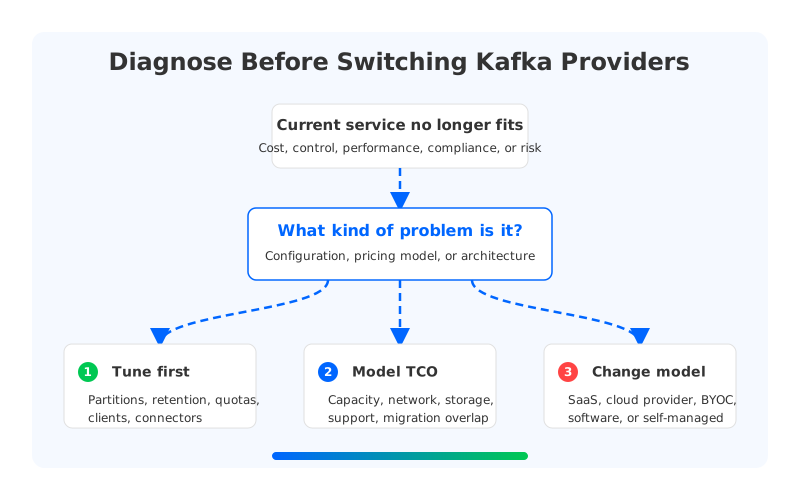
The useful starting point is diagnostic, not vendor-driven: is your pain caused by configuration, a pricing model, or the architecture itself?
1Why Teams Look For Kafka Cloud Alternatives
The strongest Kafka managed service alternatives searches usually come from five pressures.
- Cost pressure. Retention, read fan-out, private networking, cross-zone traffic, support tiers, dedicated capacity, and idle headroom can make a simple per-cluster comparison misleading. A low-entry service may become expensive once production traffic and replay requirements arrive.
- Control pressure. Platform teams may need direct control over VPC/VNet placement, IAM, KMS keys, network routing, audit evidence, Terraform workflows, maintenance windows, and incident runbooks.
- Performance pressure. Kafka workloads are uneven. Some are dominated by write throughput, others by consumer fan-out, long retention, bursty replay, or many small partitions. A service optimized for onboarding may not fit the workload's dominant bottleneck.
- Compliance pressure. Regulated teams often need to explain where data resides, which operators can access infrastructure, how encryption keys are controlled, and whether the vendor's control plane can affect the data plane.
- Vendor-risk pressure. A proprietary linking feature, limited admin API support, connector constraints, or one-cloud service dependency can become a strategic issue when an enterprise wants multi-cloud leverage or a clear exit path.
These pressures overlap, but treating them as one generic dissatisfaction leads to poor decisions. A cost issue caused by over-retention is not the same as a cost issue caused by a storage model that binds retained bytes to broker-local disks. A performance issue caused by too few partitions is not the same as a performance issue caused by a service-level throughput ceiling. A compliance issue caused by missing tags is not the same as a compliance issue caused by a data plane outside the customer's account.
2Diagnose Configuration, Pricing Model, Or Architecture
Before replacing a managed Kafka service, separate fixable operational issues from structural issues. This prevents a team from spending 6 months migrating only to recreate the same constraints under a different brand.
| Question | Often a configuration problem | Often a pricing model problem | Often an architecture problem |
|---|---|---|---|
| Cost is rising faster than traffic | Retention too high for low-value topics, unused partitions, oversized clusters | Dedicated capacity, private connectivity, storage, support, or inter-zone traffic priced in a way that punishes the workload | Local-disk replication makes retention and recovery depend on broker storage ownership |
| Scaling is slow or disruptive | Poor partition planning, hot keys, conservative quotas | Higher tiers required for capacity even when utilization is uneven | Broker compute and durable data are tightly coupled, so scaling implies data movement |
| Compliance review is blocked | Missing evidence, incomplete IAM design, weak tagging | Vendor tier required for private networking or key controls | Data plane cannot run inside the required account, region, or private environment |
| Migration feels risky | Connectors, schemas, ACLs, offsets, and clients are not inventoried | Egress and parallel-run costs are unclear | Target service is not fully compatible with required Kafka APIs or operational semantics |
Configuration problems deserve tuning first. Pricing-model problems deserve a real TCO worksheet across traffic, retention, fan-out, network, support, and migration cost. Architecture problems deserve a broader search because changing vendors without changing the underlying operating model may not help.
That distinction is especially important for FinOps and procurement. A traditional SaaS Kafka service may price capacity through cluster type, throughput, storage, networking, and support. Amazon MSK exposes AWS-native dimensions such as broker instances or serverless units, storage, data transfer, MSK Connect, and replicator usage. Google Cloud Managed Service for Apache Kafka has its own provisioned capacity and storage dimensions. Azure Event Hubs supports Kafka protocol clients, but it is an event streaming service with namespaces, throughput or processing units, retention, partitions, and quotas rather than an Apache Kafka broker fleet. None of those models is inherently wrong. The risk is using the wrong model for your workload.
3Alternative Categories To Evaluate
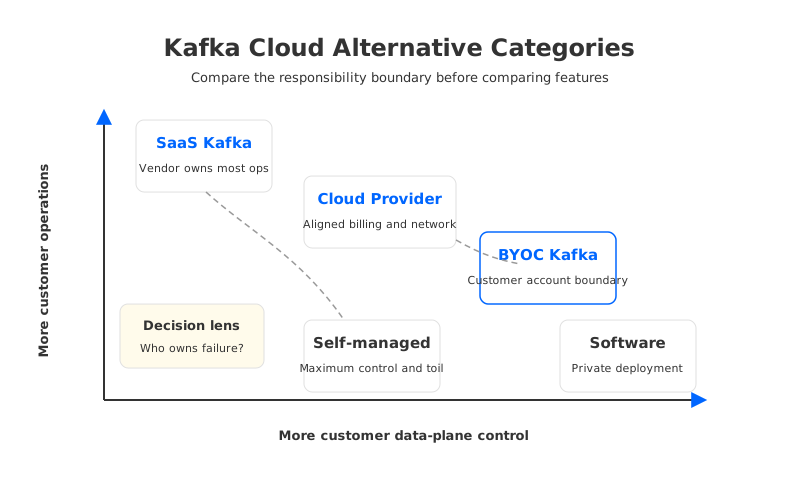
Once the root cause is clear, the alternative set becomes manageable. Most production evaluations fall into five categories.
3.1Another SaaS Kafka Service
SaaS Kafka is attractive when the platform team wants the vendor to own most operational work. Confluent Cloud, for example, documents multiple cluster types and a broader data streaming platform around Kafka. This category can be strong for fast onboarding, global availability, ecosystem integrations, managed connectors, schema governance, and commercial support.
The tradeoff is dependency on the vendor's account boundary, commercial tiers, private networking model, feature packaging, and migration tooling. SaaS may be the right move when your current provider is weak, but the operating model is still acceptable. It is less convincing when the central problem is data-plane control or a storage architecture that does not match retention economics.
3.2Cloud-Provider Kafka Or Kafka-Compatible Service
Cloud-provider options appeal to teams standardized on AWS, Google Cloud, or Azure procurement. Amazon MSK is a managed Apache Kafka service deeply integrated with AWS networking, IAM, encryption, and billing. Google Cloud Managed Service for Apache Kafka gives GCP teams a managed Kafka path inside Google Cloud's operational model. Azure Event Hubs offers a Kafka endpoint for Kafka protocol clients, which can be useful for Azure-native ingestion patterns.
The key is semantic fit. A cloud-provider service can simplify billing and network approval, but it may not preserve every operational expectation from a self-managed Kafka estate. Event Hubs is not a drop-in Apache Kafka cluster; Microsoft documents Kafka support as a protocol endpoint over Event Hubs. That distinction matters for admin APIs, ecosystem tooling, quotas, partition behavior, and migration design.
3.3BYOC Kafka
Bring Your Own Cloud is the middle path between SaaS convenience and customer-owned infrastructure. In a BYOC model, the data plane can run in the customer's cloud account or network boundary while the vendor provides control-plane automation, lifecycle management, software, or support. This can help teams that want managed operations without moving the streaming data plane entirely into a vendor-owned environment.
BYOC is not automatically simpler. The customer still needs cloud account preparation, IAM, network routing, security review, tagging, observability integration, and incident ownership clarity. It becomes valuable when those controls are requirements rather than preferences.
3.4Private Cloud Or Software
Private software fits teams with strict deployment requirements: regulated environments, sovereign cloud, on-prem infrastructure, custom Kubernetes platforms, isolated networks, or internal platform standards that cannot accept SaaS or public-cloud managed service boundaries. This model gives maximum control, but the operational burden is real. Upgrades, capacity planning, monitoring, failover, and Kafka expertise come back into the customer's responsibility model unless the vendor provides strong support.
3.5Self-Managed Kafka
Self-managed Kafka remains rational for organizations with deep Kafka SRE capacity and a reason to customize beyond what managed services expose. It can also be economically sensible at large scale when internal platform teams already have automation, observability, and incident processes. For many enterprises, though, self-managed Kafka is the alternative of last resort: it restores control by restoring toil.
4When BYOC And Object-Storage-Backed Kafka Change The Discussion
The most interesting Kafka cloud alternatives are not merely different hosting contracts. They change the coupling between brokers, storage, and cloud infrastructure.
Traditional Kafka stores durable log data on broker-local disks and uses replication across brokers for availability. That model is proven, but it creates operational side effects in the cloud. Retained bytes live with broker capacity. Broker replacement can involve data catch-up. Scaling may trigger partition movement or rebalancing pressure. Long retention can increase the amount of storage provisioned around compute, even when compute is not the bottleneck.
Object-storage-backed Kafka-compatible architectures attack a different layer of the problem. Durable data moves into cloud object storage, while brokers or agents become more stateless compute. This does not make architecture decisions disappear; latency, metadata, caching, write path, recovery, and network design still matter. It does change the economic and operational shape of the system.
AutoMQ belongs in this part of the evaluation. It is Kafka-compatible, supports BYOC-style deployment, uses object storage as shared storage, and designs brokers to be stateless so compute elasticity is less tied to broker-local disk ownership. For a team replacing an existing cloud Kafka service, the natural question is not "Do we like AutoMQ better than Vendor X?" The better question is whether the current pain comes from the traditional broker-local storage model. If it does, a Kafka-compatible, object-storage-backed alternative gives architects a different design space while preserving familiar Kafka clients and ecosystem assumptions.
5Migration Checklist Before You Replace A Managed Kafka Service
Kafka migrations fail when teams treat "Kafka-compatible" as a single yes-or-no property. Compatibility has layers: client protocol, admin APIs, topic configuration, transactions, consumer offsets, schema registry, Kafka Connect, Kafka Streams, ACLs, observability, and replication tooling.
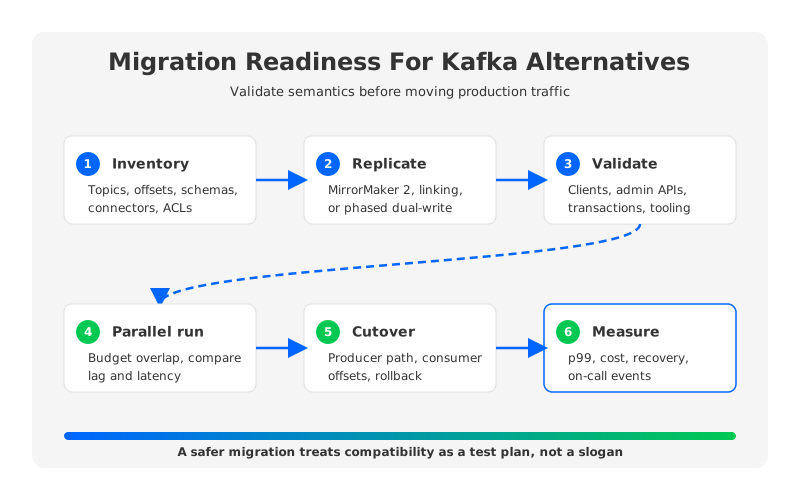
Run the checklist in this order:
- Inventory the workload. List topics, partitions, retention, compression, message size, producer durability settings, consumer groups, lag patterns, connectors, schemas, ACLs, quotas, and peak replay behavior.
- Classify migration style. A cutover may fit small clusters. Large production estates usually need dual-write, replication, or phased consumer migration. Apache Kafka includes MirrorMaker 2 for cluster replication scenarios, while vendors may provide their own linking tools.
- Test semantic compatibility. Validate the actual clients, admin operations, connector plugins, schema registry integrations, transactions, and offset handling your applications use. Do not rely on a generic compatibility claim.
- Model the parallel run. During migration, you may pay for both source and target capacity, extra network transfer, replication tooling, and operational staff time. Procurement should budget for the overlap.
- Define rollback before cutover. A rollback plan must include producer write path, consumer offsets, schema changes, connector state, and data consistency expectations.
- Measure after migration. Compare p99 latency, throughput, consumer lag, recovery behavior, storage growth, cloud bill dimensions, and on-call events against the baseline.
The best alternative is the one that changes the constraint you actually have. If the pain is vendor account boundary, SaaS-to-SaaS migration may not help. If the pain is Kafka operations, self-managed Kafka may make it worse. If the pain is storage-bound scaling and long retention, a shared-storage architecture deserves serious evaluation.
6A Practical Decision Framework
For platform leaders, the final comparison should be a small set of explicit decisions rather than a giant vendor checklist.
| If your main driver is... | Shortlist first | Be careful about |
|---|---|---|
| Faster onboarding and fewer platform tasks | SaaS Kafka | Pricing tiers, network boundaries, ecosystem lock-in |
| AWS/GCP/Azure procurement alignment | Cloud-provider Kafka or Kafka-compatible service | Kafka semantic gaps, multi-cloud exit path, service quotas |
| Data plane in your account with managed help | BYOC Kafka | Shared responsibility, IAM, networking, cloud resource ownership |
| Strict private deployment | Private software | Upgrade burden, SRE coverage, support model |
| Maximum customization | Self-managed Kafka | Operational toil, recovery testing, hiring risk |
| Storage-bound cost or scaling pain | Object-storage-backed Kafka-compatible platforms | Write path, cache design, latency tests, object-storage request cost |
This framework also keeps product evaluation honest. A vendor demo can show a smooth happy path, but your production decision depends on the unglamorous details: failure recovery, private network routing, quota increases, schema compatibility, connector lifecycle, replay economics, and how quickly the team can explain the bill.
Kafka cloud alternatives are worth exploring when your current service no longer matches the shape of your business risk. Start with diagnosis, not dissatisfaction. Then choose the category that changes the right variable: operating model, commercial model, data-plane boundary, or storage architecture. If the core issue is the way traditional Kafka binds compute and durable storage together, Kafka-compatible BYOC systems such as AutoMQ give teams a way to keep Kafka semantics while evaluating a cloud-native architecture built around object storage and stateless broker elasticity.
7References
- Confluent Cloud cluster types
- Confluent Cloud pricing
- Amazon MSK pricing
- Amazon MSK developer guide
- Google Cloud Managed Service for Apache Kafka
- Google Cloud Managed Service for Apache Kafka pricing
- Azure Event Hubs for Apache Kafka overview
- Azure Event Hubs quotas and limits
- Apache Kafka documentation: MirrorMaker
- Apache Kafka documentation: Kafka Connect
- AutoMQ compatibility with Apache Kafka
- AutoMQ architecture overview
- AutoMQ stateless broker documentation
- AutoMQ object storage configuration
8FAQ
8.1What are the main Kafka cloud alternatives?
The main alternatives are another SaaS Kafka provider, a cloud-provider managed Kafka service, a Kafka-compatible service such as Azure Event Hubs for Kafka-client workloads, BYOC Kafka, private Kafka software, and self-managed Apache Kafka. The right category depends on whether the current pain is cost, control, performance, compliance, or vendor risk.
8.2When should a team move beyond a traditional managed Kafka service?
Move beyond a traditional managed service when tuning no longer addresses the root issue. Common signals include storage-bound cost, long recovery windows, data-plane residency requirements, private networking constraints, renewal risk, or scaling behavior that remains tied to broker-local disks and partition movement.
8.3Is BYOC Kafka better than SaaS Kafka?
BYOC is not universally better. It is better when data-plane control, cloud-account ownership, compliance boundaries, and cost transparency matter enough to justify customer-side cloud setup. SaaS is often better when the team wants the provider to own most operations and can accept the vendor's network, account, and pricing model.
8.4Can Azure Event Hubs replace Kafka?
Azure Event Hubs can support Kafka protocol clients for many Azure-native streaming use cases, but it is not the same as operating an Apache Kafka cluster. Teams should validate admin APIs, quotas, partition behavior, connectors, schemas, transactions, and migration tooling before treating it as a full Kafka replacement.
8.5How does object-storage-backed Kafka change cloud Kafka economics?
Object-storage-backed Kafka-compatible systems move durable data away from broker-local disks and into cloud object storage. That can reduce storage-cost pressure, make long retention easier to model, and make broker scaling more compute-oriented. Teams still need to evaluate latency, cache behavior, object-storage request cost, and network paths.
8.6Where does AutoMQ fit among Kafka cloud alternatives?
AutoMQ fits when teams want Kafka compatibility, BYOC or customer-environment deployment, object-storage-backed shared storage, and stateless broker elasticity. It is most relevant when the replacement driver is not only managed-service convenience, but also the architecture and cost pressure created by traditional broker-local storage.


