
Table of Contents
Table of Contents
Cloud storage looks like an obvious answer to Kafka's capacity problem. Kafka retention grows quickly, broker disks are sized for peaks and replay windows, and moving replicas is expensive. S3, Azure Blob Storage, and Google Cloud Storage offer elastic capacity, strong durability, lifecycle controls, and a pricing model that can look friendlier than large broker volumes.
That first impression is directionally right, but incomplete. A Kafka cloud storage architecture is not decided by the storage line item alone. The real question is whether the system can preserve Kafka acknowledgments, serve hot reads locally, control request volume, and survive failures without turning recovery into a data movement project.
The useful comparison is not "disk price versus bucket price." It is the whole path a record takes from producer acknowledgment to long-term retention and later replay.
1Why Cloud Storage Pulls Kafka Architects In
Traditional Kafka binds compute and durable storage together. A broker accepts produce requests, writes logs to local or attached disks, replicates them, and serves consumers from the same storage hierarchy. The model is simple and strong for local sequential I/O, but retained bytes become part of broker identity. When retention grows, brokers become heavier. When a cluster scales down, operators move partition data before removing capacity.
Cloud object storage changes that boundary. S3, Blob, and GCS are regional services built for durable object persistence and large aggregate throughput. They scale capacity independently from compute nodes, expose lifecycle policies, and make data accessible from many workers. For Kafka, the attraction is not only lower storage cost. It is the possibility of making historical log data less dependent on any particular broker.
That possibility matters for long-retention topics, replay-heavy platforms, elastic compute environments, and multi-cloud strategies where teams want storage flexibility without rewriting Kafka clients.
The catch is that Kafka is not a file archive. A producer expects an acknowledgment at a specific durability point. A consumer expects ordered fetches by partition and offset. A controller or metadata layer expects to know where committed data lives. Object storage gives you durable capacity, but Kafka architecture must supply the semantics around it.
2The Evaluation Framework: Six Questions Before the Price Sheet
The first serious design review should be about paths, not prices. Cloud storage pricing pages are useful, but they describe storage classes, requests, retrieval, and network transfer as separate dimensions. Kafka turns those dimensions into workload behavior. A cluster with efficient large sequential object writes can look very different from one that creates small objects and serves many random replay reads.
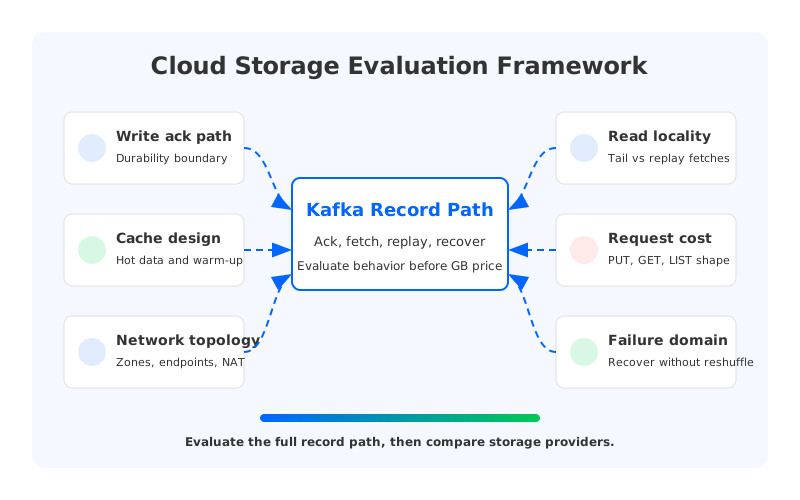
Start with six questions. They force the architecture discussion to stay close to the record path.
| Question | What to inspect | Why it matters |
|---|---|---|
| Write ack path | When is a produce request acknowledged? | Batching for object storage cannot violate Kafka durability expectations. |
| Read locality | Which reads hit memory, local cache, remote objects, or another zone? | Tail latency and replay cost depend on where fetches are served. |
| Cache design | What is cached, where, and for how long? | Cache misses can turn object storage into the hot read path. |
| Request cost | How many PUT, GET, LIST, and metadata operations happen per workload? | Low per-GB storage can be offset by high request volume. |
| Network topology | Do bytes cross zones, regions, NAT gateways, or public endpoints? | Data transfer and gateway charges can dominate storage savings. |
| Failure domain | What fails together, and what recovery moves data? | Cloud storage reduces broker data ownership only if recovery avoids reshuffling retained logs. |
This table is operational by design. Kafka storage designs fail when the steady-state path is efficient but the exception path is not. Broker restart, cache warm-up, replay, object-store throttling, and zone degradation all test parts of the architecture that a pure capacity model misses.
3Write Acknowledgments Come First
Kafka's write path is the part of the architecture that deserves the least hand-waving. In traditional Kafka, a producer using acks=all receives success only after the leader and the required in-sync replicas have persisted the record according to the configured durability model. The exact implementation details vary by version and configuration, but the contract is clear enough for applications: acknowledged records should survive the failures the cluster is configured to tolerate.
Object storage complicates this because object writes are most efficient when data is buffered and written in larger chunks. Kafka records arrive as small ordered appends; object storage prefers immutable objects. If the system waits for every record to become part of a durable object before acknowledging, latency may suffer. If it acknowledges before a durable path exists, the Kafka contract becomes weaker.
Practical cloud storage designs solve this with a write-ahead path, a replicated commit layer, or another persistence mechanism that decouples low-latency acknowledgment from later object compaction. The important point is not the name of the mechanism. The important point is that the architecture must define the exact durability boundary:
- What storage or quorum confirms the record before the producer receives success?
- How is ordering maintained while records are buffered into object-friendly layouts?
- What happens to acknowledged data if the leader broker dies before object compaction completes?
- How does the system recover incomplete objects, indexes, and metadata after a crash?
These questions apply whether the target is S3, Azure Blob, GCS, or S3-compatible storage. The provider changes APIs and performance characteristics; it does not remove Kafka's need for a precise acknowledgment path.
4Read Locality Is Where User Experience Shows Up
Most Kafka clusters have a split personality: many consumers read near the tail, while a smaller set occasionally replays older offsets. Cloud storage architecture should treat those as different read paths.
Tail reads should usually be served from memory, page cache, local cache, or another low-latency tier close to the broker. Sending every fetch to object storage creates avoidable latency and request load. Aggregate throughput does not make object storage a natural hot path for high-QPS tailing consumers.
Replay reads have a different profile. A consumer scanning hours of historical data can tolerate larger sequential range reads if the system has good indexes and prefetch. Object storage can work well here because the workload is closer to reading large byte ranges from immutable objects.
Cache policy connects these modes. A weak cache makes cloud storage appear slow and expensive. A good cache keeps the hot path close to brokers while object storage carries durable history. After broker replacement, the system should rebuild hot state predictably instead of flooding object storage.
5S3, Azure Blob, and GCS: Same Category, Different Operating Surfaces
S3, Azure Blob Storage, and Google Cloud Storage all provide durable object storage, but Kafka architects should not treat them as interchangeable endpoints. APIs, pricing, identity, private connectivity, and ecosystem tooling differ. A portable architecture abstracts the storage path, but an operable platform still needs provider-specific decisions.
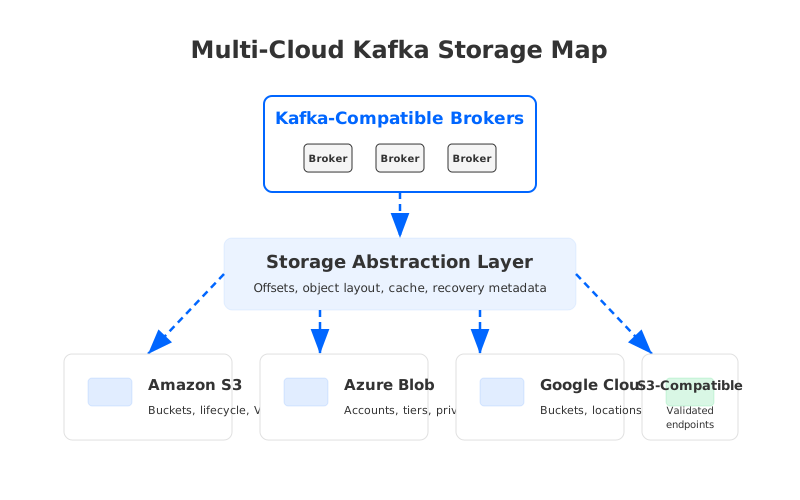
At the design level, the comparison is less about which provider is "better" and more about what each environment makes easy or risky.
| Provider | Useful strengths for Kafka storage | Design checks |
|---|---|---|
| Amazon S3 | Mature ecosystem, S3-compatible tooling, lifecycle policies, storage classes, AWS private networking. | Model requests, endpoint placement, cross-AZ paths, and S3-specific API dependencies. |
| Azure Blob Storage | Azure identity and networking integration, access tiers, and Azure-first platform fit. | Check transaction pricing, private endpoints, account limits, and object layout mapping. |
| Google Cloud Storage | Google Cloud IAM, storage classes, global tooling, and analytics integration. | Check operation classes, network paths, bucket location, and replay cache behavior. |
The safest multi-cloud posture is to separate Kafka semantics from object-store mechanics. Kafka clients should not care whether retained bytes sit in S3, Blob, or GCS. The storage layer must translate offsets into objects, indexes, caches, and recovery flows that fit each provider.
This is also where S3-compatible storage becomes relevant. Some Kafka-compatible systems, including AutoMQ, can use S3-compatible object storage as the durable substrate. That broad interface still requires provider validation for latency, limits, and failure behavior.
6Request Cost Can Beat GB Cost in the Wrong Direction
The easiest spreadsheet compares monthly storage per GB. The better spreadsheet includes object operations and network paths. Kafka turns storage into a living workload: producers create data continuously, consumers fetch near-tail data constantly, and replay jobs can read large historical ranges. Each behavior can generate object requests if the architecture misses caching, batching, or indexing.
Consider two designs storing the same retained bytes. One writes larger objects, caches recent data, uses range reads, and keeps metadata compact. Another flushes tiny objects, lists often, and serves cache misses one fetch at a time. The storage footprint can match while the request bill diverges.
The request model should be estimated under at least four scenarios:
- Normal tailing. How many object reads occur when consumers stay close to the latest offsets?
- Historical replay. How many range reads and index lookups are needed to scan a day or week of data?
- Broker restart. How does the system rebuild cache and metadata after compute replacement?
- Backfill or migration. What happens when many consumers read old data at the same time?
This is where architecture and finance meet. Object storage can make retained capacity elastic and cost-effective, but request-heavy designs can erode that advantage. Model operations per topic, partition, retention window, and consumer pattern.
7Network Topology Is Part of the Storage Design
Cloud storage is a regional service, but Kafka traffic moves through concrete network paths. A broker may reach an object endpoint through a private endpoint, service endpoint, NAT gateway, cross-zone route, or public path. Those details influence cost and failure behavior.
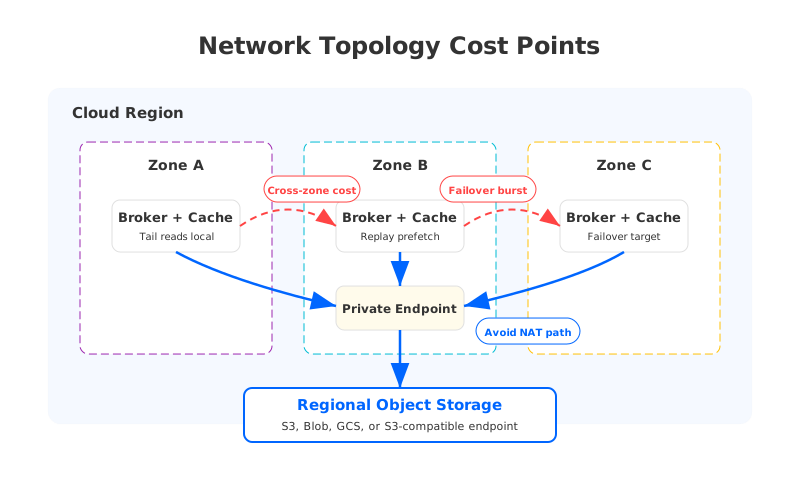
The major topology checks are straightforward:
- Keep producer, broker, cache, and object storage paths inside the intended region and private network whenever possible.
- Avoid accidental NAT gateway traversal for high-volume object traffic.
- Check whether cross-zone traffic appears in the write path, read path, replication path, or cache fill path.
- Decide whether multi-region durability is a storage-layer feature, an application replication feature, or a disaster-recovery workflow.
Failure domains should be drawn on the same diagram as cost points. If brokers are distributed across zones but the cache layer is zonal, a zone failure may shift hot reads and create remote object bursts. Private endpoints and write-ahead paths add their own availability domains.
The lesson is uncomfortable but useful: cloud storage does not remove topology from Kafka. It moves topology from disk placement and partition reassignment into endpoints, caches, write-ahead durability, and object access paths.
8Where AutoMQ Fits in the Architecture Conversation
AutoMQ belongs in this discussion as a Kafka-compatible architecture built around cloud object storage rather than broker-owned disks. Its premise is storage-compute separation: brokers handle Kafka protocol work and hot data access, while durable stream data is organized through an object-storage-backed layer.
Evaluate AutoMQ with the same framework used for any Kafka cloud storage design: write acknowledgment path, cache behavior, read locality, object layout, provider support, and recovery model. The product angle is secondary to the architectural question.
AutoMQ's S3-compatible storage support is relevant for teams standardizing across AWS or S3-compatible environments. For Azure and Google Cloud, provider integration, topology, and validated backends should be checked against current documentation.
9A Practical Design Checklist
A strong Kafka cloud storage architecture should leave the design review with concrete answers, not a bucket name and a retention target.
| Area | Good answer sounds like |
|---|---|
| Ack path | "A record is acknowledged after this durable step, and crash recovery replays from this boundary." |
| Object layout | "Objects are sized and indexed for sequential replay, not created per tiny flush." |
| Hot reads | "Near-tail consumers hit broker-local memory or cache under normal conditions." |
| Cold reads | "Historical replay uses offset indexes, range reads, and bounded prefetch." |
| Requests | "We modeled object operations for steady state, restart, replay, and backfill." |
| Network | "Private endpoints and zone paths are explicit, and high-volume traffic avoids NAT." |
| Failures | "Broker loss, zone loss, and object-store throttling have separate recovery plans." |
Cloud storage is a powerful substrate for Kafka, but it is not a shortcut around Kafka architecture. You still have to design the write path, read path, cache, topology, and recovery story. When those pieces fit, S3, Blob, GCS, and S3-compatible storage can turn Kafka retention from a broker sizing problem into a storage architecture decision.
10References
- Amazon S3 pricing
- Amazon S3 performance guidelines
- Azure Blob Storage pricing
- Google Cloud Storage pricing
- Google Cloud Storage locations
- AutoMQ documentation
11FAQ
11.1Is Kafka on cloud storage the same as tiered storage?
No. Tiered storage usually keeps the active Kafka log on brokers and moves older segments to remote storage. A cloud-storage-centered Kafka architecture can go further by making object storage part of the primary durable storage layer. The operational impact is different because broker replacement and retained data ownership change.
11.2Does object storage make Kafka storage lower cost by default?
Not by default. Object storage can make retained capacity more cost-effective, but request operations, retrieval patterns, private connectivity, NAT, and cross-zone traffic can change the total bill. A good evaluation models the full workload, not only the GB-month price.
11.3Which is better for Kafka: S3, Azure Blob, or GCS?
The right answer usually follows the cloud where the Kafka compute runs. Keeping brokers, caches, private endpoints, and buckets in the same cloud and region is often more important than small differences between object storage services. Multi-cloud designs should validate provider-specific limits and network paths.
11.4Why does the write acknowledgment path matter so much?
Kafka applications rely on producer acknowledgments as a durability signal. If a system batches data for object storage but acknowledges before a durable boundary exists, failure behavior can surprise applications. The architecture must define exactly when a record becomes safe.
11.5Where does AutoMQ fit?
AutoMQ is a Kafka-compatible system designed around object storage and storage-compute separation. It is relevant when teams want Kafka APIs while reducing the dependence of retained data on broker-local disks. It should still be evaluated with the same ack path, cache, topology, and failure-domain checklist.


