
Table of Contents
Table of Contents
Teams usually search for kafka cluster configuration backup after the backup conversation has already become uncomfortable. A broker was replaced and came back with a slightly different config. A migration rehearsal copied topic data but missed consumer group progress. A security audit asked whether ACLs, quotas, users, and TLS material could be restored into a clean environment. Or a disaster recovery plan said "recreate the Kafka cluster" without proving which exact cluster state had to be recreated.
The uncomfortable part is that Kafka recovery is not only about bytes in topics. Durable event data matters, but a Kafka cluster becomes a production system through metadata, security policy, client contracts, offsets, connector state, and operational decisions. If those assets are missing or inconsistent, a restored cluster can contain the right data and still be unusable. Producers may fail authorization, consumers may replay too far, and Kafka Connect may duplicate sink writes.
That is why configuration backup should be treated as a recovery-readiness discipline rather than an export script. The practical goal is simple: a clean Kafka-compatible environment should be able to become the intended production environment again.
1Why teams search for kafka cluster configuration backup
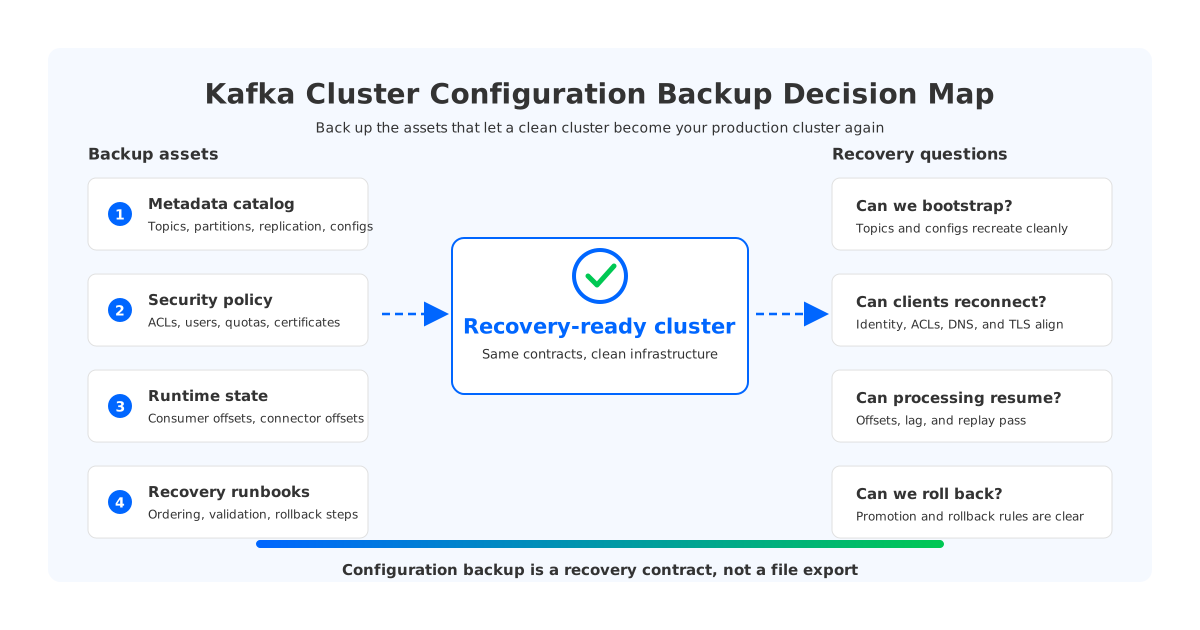
Kafka has several layers of state that operators tend to discuss separately. Topic configuration lives in Kafka metadata. Broker configuration lives in server properties, environment variables, orchestration manifests, and managed-service settings. Access control may live in Kafka ACLs, cloud IAM, private networking, certificate authorities, and secret stores. Consumer progress is stored in internal offset topics, while Kafka Connect keeps connector configs and task offsets in its own internal topics. Recovery fails when a runbook assumes these layers are one thing.
A useful backup inventory starts with the assets that answer a recovery question:
- Metadata catalog: topic names, partition counts, replication factors, cleanup policies, retention settings, min ISR, compaction settings, and dynamic configs. This is the structure that lets applications find the streams they expect.
- Security policy: ACLs, service accounts, SASL users, certificates, quotas, network routes, and identity-provider bindings. This decides whether the right clients can reconnect and the wrong clients stay blocked.
- Runtime progress: consumer group offsets, transactional expectations, Kafka Connect offsets, connector task configs, and stream-processing checkpoints outside Kafka. This decides whether processing resumes safely.
- Operational context: broker configuration, deployment manifests, dashboards, alert rules, capacity assumptions, cutover plans, and rollback rules. This lets humans operate the restored system without improvising.
These categories also explain why "backup" is an overloaded word. A daily copy of topic configs is useful, but it does not prove recovery. A MirrorMaker 2 deployment can replicate topic data, but it does not automatically prove security parity, DNS readiness, connector idempotency, or application cutover. The right test is whether the restore process can recreate the production contract that clients depend on.
2The migration risk behind the workload
Configuration backup becomes most visible during migration because migration compresses every hidden dependency into one cutover window. A team moving from one Kafka cluster to another has to prove that topics exist, producers can write, consumers can resume, security policy still holds, and rollback remains possible. The same discipline applies to disaster recovery, major version upgrades, ZooKeeper-to-KRaft transitions, cloud-region moves, and broker replacement after storage failure.
Traditional Kafka makes this work harder because its operating model is shared nothing. Brokers own local log data, and replication across brokers is the mechanism that provides availability. That model is well understood, but it couples recovery work to broker-local storage, replica placement, partition reassignment, capacity headroom, and cross-zone traffic. A configuration restore may begin as metadata work, but the incident often becomes a data-placement problem.
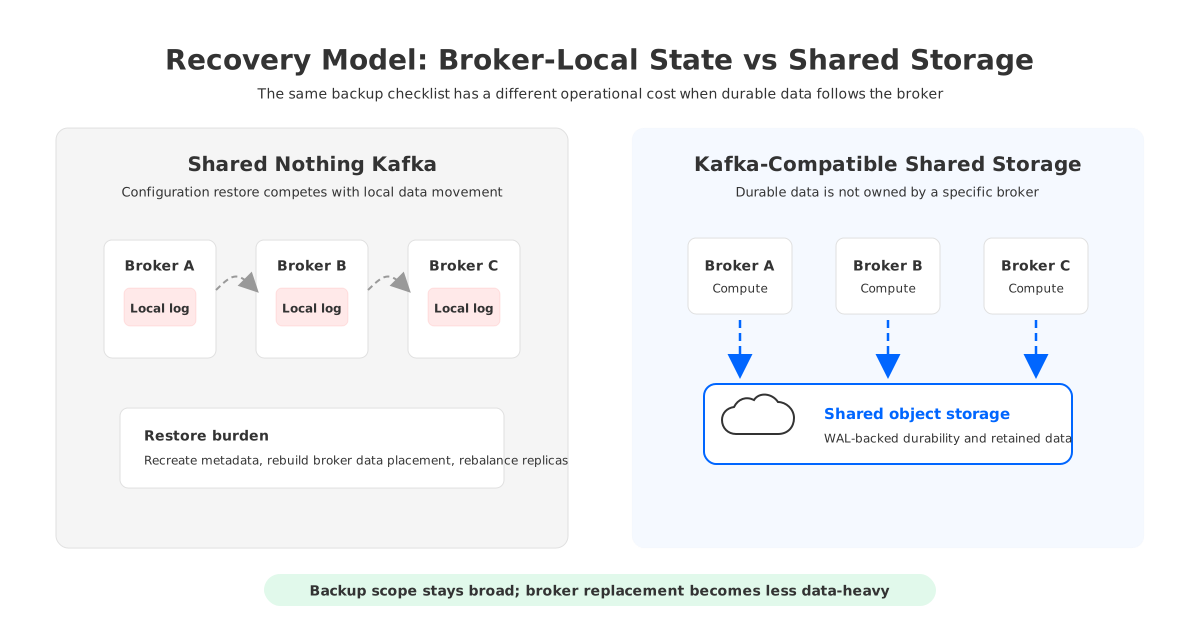
The coupling matters in a recovery drill. When a restored environment uses broker-attached storage, platform teams must reason about configuration state and physical data layout at the same time. Adding brokers may require partition reassignment, replacing brokers may require replica catch-up, and rebalancing hot partitions may compete with client traffic.
Apache Kafka's own evolution reflects the pressure around these boundaries. KRaft removes the ZooKeeper dependency and consolidates metadata management into Kafka's quorum model. Tiered Storage, introduced through KIP-405, lets brokers place older log segments in remote storage. MirrorMaker 2 and Kafka Connect provide mechanisms for replication, migration, and ecosystem integration. These are important building blocks, but they do not decide which cluster state is authoritative at restore time.
That decision is where many recovery plans are thin. If the source cluster is still accepting writes while a target cluster is being built, the backup is not a static snapshot. It is a moving contract: topic configs can change, offsets can advance, ACLs can be updated, and connectors can emit side effects. A production-ready plan defines the source of truth for each layer and the moment at which that source of truth changes.
3Compatibility, replication, rollback, and observability trade-offs
A neutral evaluation framework keeps the backup discussion from becoming a tooling debate too early. The question is not "which command exports the most configuration?" The question is which combination of backup, replication, infrastructure-as-code, and platform architecture gives the team a recoverable operating model.
| Evaluation area | What to prove | Failure mode |
|---|---|---|
| Compatibility | Clients, serializers, compaction, ACLs, quotas, Connect, and Streams behave as expected after restore. | Topic data exists, but one client class fails because a config or security assumption changed. |
| Recovery point | The team knows which metadata, offsets, connector state, and policies are current enough to restore. | Backups are frequent, but nobody knows which one aligns with the data copy. |
| Recovery time | The restore path can meet the target without waiting on avoidable data movement or manual diffing. | A clean cluster is ready, but partition rebuild or policy reconstruction extends the outage. |
| Rollback | The old and new clusters have clear promotion, freeze, and reversal rules. | Teams cut over writes, discover a client issue, and cannot safely move back. |
| Observability | Restore progress, replication lag, consumer lag, broker health, and authorization failures are visible. | The runbook says "validate," but dashboards do not distinguish expected replay from a broken consumer. |
| Ownership | Platform, security, app, and data teams know which backup assets they own. | The cluster is restored technically, but nobody owns connector offsets, certificates, or downstream validation. |
The trade-offs are real. Infrastructure-as-code is excellent for repeatability and drift control, but it usually needs runtime exports to capture offsets and dynamic changes. Replication helps with data and cutover continuity, but it still needs policy backup and recovery validation. Managed snapshots can simplify operations, but teams still need to understand portability, region boundaries, and scope.
This is also where cost and governance enter the discussion. Long retention, high fan-out, and multi-AZ replication can make the recovery environment expensive enough that teams under-test it. If the target environment sits in a different account or region, security policy and private connectivity become as important as topic replication.
4Evaluation checklist for migration teams
The most useful checklist is not long. It should force the team to prove the recovery path with evidence, not intentions.
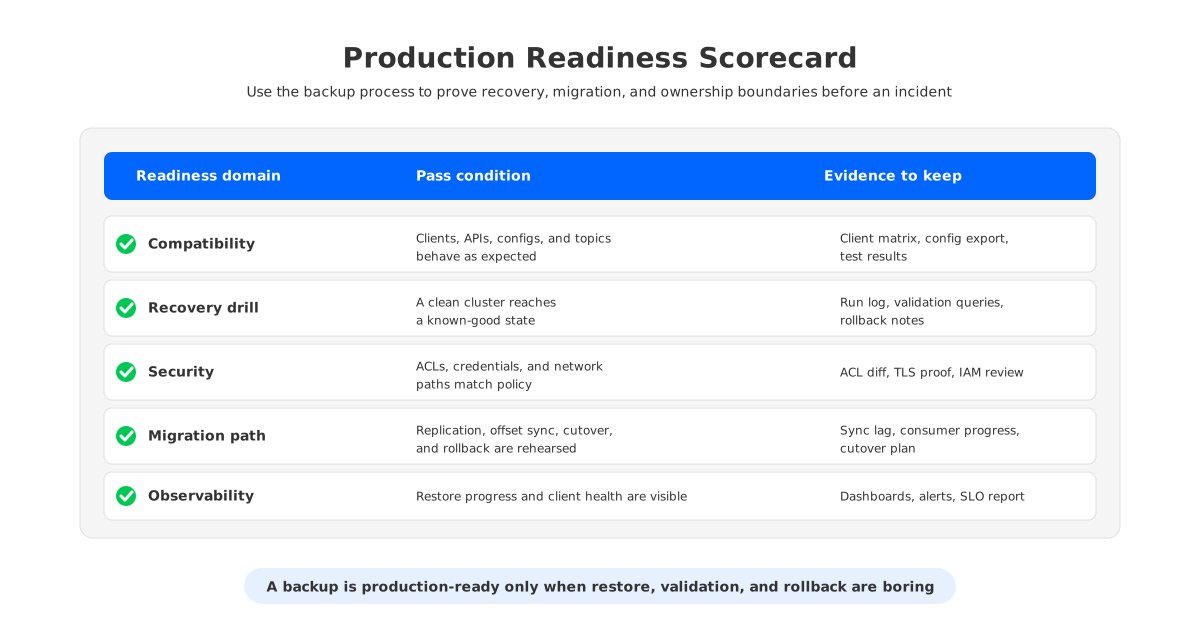
Start with a clean environment and restore in the order clients experience the platform. Bring up infrastructure and brokers first. Recreate cluster and topic metadata. Restore security policy before allowing application traffic. Restore or synchronize runtime progress only after the data path is valid.
A practical readiness checklist should include these tests:
- Config diff: export topic and cluster configs from the source, apply them to the target, and diff the result after restore.
- Security parity: verify ACLs, principals, quotas, TLS trust, private networking, and audit logs with real client credentials.
- Offset validation: sample consumer groups and prove they resume at the expected point. For critical workloads, decide whether replay, skip, or exact resume is intended.
- Connector safety: review Kafka Connect connector configs, source offsets, sink idempotency, and downstream deduplication.
- Failure drill: run at least one restore into an isolated environment and record elapsed time, manual steps, failed assumptions, and rollback decisions.
- Observability proof: capture run logs showing replication lag, consumer lag, broker health, authorization failures, and application-level success criteria during the drill.
This checklist should be owned by multiple teams. Platform engineering usually owns broker infrastructure and Kafka metadata. Security owns identity, network policy, and credential rotation. Application teams own producer/consumer behavior and acceptable replay. Data teams own sink correctness and downstream validation.
5How AutoMQ changes the operating model
Once the evaluation reaches broker-local storage, recovery time, and cloud infrastructure cost, architecture becomes part of the backup conversation. A Kafka-compatible platform can preserve the Kafka protocol while changing where durable stream data lives. That distinction matters because configuration backup is easier to reason about when broker replacement and retained data movement are not the same problem.
AutoMQ fits this category as a Kafka-compatible, cloud-native streaming platform built around Shared Storage architecture. AutoMQ keeps Kafka protocol compatibility while replacing broker-local durable log storage with S3Stream, WAL storage, and S3-compatible object storage. Brokers handle Kafka requests, scheduling, leadership, and cache behavior, while durable stream data is organized outside broker-attached disks.
This does not eliminate configuration backup. In a shared-storage model, the recovery plan still needs topic metadata, security policy, offsets, connector state, deployment configuration, and observability evidence. The difference is that replacing or scaling broker compute is less dominated by moving retained partition data from one broker disk to another.
AutoMQ's model also changes several evaluation points for migration teams:
- Compatibility remains the first gate. A Kafka-compatible architecture should be tested against real clients, Kafka Connect workloads, stream processors, compaction behavior, and operational APIs.
- WAL choice becomes an explicit design variable. WAL storage absorbs writes before data is organized in object storage, so teams should evaluate latency, durability, recovery, and cloud-service dependencies for their workload.
- Self-balancing changes the scaling conversation. When durable data is not anchored to broker-local disks in the same way, workload balancing can focus more on ownership, traffic, and cache behavior.
- Customer-controlled deployment boundaries matter. AutoMQ BYOC and AutoMQ Software deployment models let teams evaluate where the data plane, object storage, networking, and observability data live.
- Migration tooling still matters. Kafka-compatible Linking or replication paths should be validated alongside consumer group progress, cutover rules, and rollback criteria. A better storage substrate does not replace a disciplined migration plan.
The practical benefit is not that a product makes recovery automatic. Recovery is never automatic when applications, credentials, offsets, connectors, and downstream systems are involved. The benefit is that platform architecture can remove broker-local storage work from the critical path.
6A backup plan that survives the incident
A production-grade Kafka cluster configuration backup plan should end with artifacts that an incident commander can use under pressure. Store the export commands, config snapshots, infrastructure version, credential-rotation notes, runbook, validation queries, and rollback criteria together. Version them, review drift, and run the restore periodically into an isolated environment.
The healthiest recovery plans are boring because the hard decisions happened earlier. Which offsets are restored? Which consumers replay? Which source is authoritative during migration? Which team approves promotion? Which conditions trigger rollback? The backup process should answer these questions before the outage.
If your current Kafka platform makes every recovery drill turn into a broker-storage, rebalance, or cloud-cost exercise, evaluate whether a Kafka-compatible Shared Storage architecture changes the constraint. A focused next step is to test one representative workload: export its configs, migrate its data path, validate its consumers and connectors, and compare the recovery drill on your current platform with a shared-storage design. For a customer-controlled path, start with AutoMQ Cloud and run the scorecard against your requirements.
7References
- Apache Kafka documentation
- Apache Kafka KIP-405: Kafka Tiered Storage
- Apache Kafka KRaft documentation
- Apache Kafka Connect documentation
- Apache Kafka MirrorMaker 2 documentation
- AutoMQ Kafka compatibility
- AutoMQ Shared Storage architecture overview
- AutoMQ WAL storage
- AutoMQ migration overview
- AutoMQ Cloud BYOC environment overview
8FAQ
8.1What should be included in a Kafka cluster configuration backup?
A useful Kafka cluster configuration backup should include topic configs, dynamic configs, broker deployment settings, ACLs, users or service accounts, quotas, certificates, consumer group offsets, Kafka Connect configs and offsets, observability assets, and the restore runbook.
8.2Are consumer offsets part of configuration backup?
They are runtime state, not static configuration, but they belong in the recovery plan. Without offset handling, a restored cluster may force critical consumers to replay too much data or skip data unexpectedly.
8.3Does MirrorMaker 2 replace configuration backup?
No. MirrorMaker 2 can support replication and migration workflows, but teams still need to validate topic configuration, security policy, client connectivity, consumer progress, connector behavior, observability, and rollback.
8.4How often should teams test Kafka configuration restore?
Test restore whenever platform assumptions change: major Kafka upgrades, KRaft migration, cloud-region changes, security-policy changes, connector framework changes, or large application migrations. Periodic isolated restore drills are more useful than a backup job that has never been used.
8.5How does Shared Storage architecture affect Kafka backup strategy?
Shared Storage architecture does not remove the need to back up metadata, policy, offsets, and runbooks. It changes the operating model by reducing the extent to which broker replacement, scaling, and recovery depend on moving retained data between broker-local disks. That can make restore drills more practical and recovery plans easier to validate.


