
Table of Contents
Table of Contents
Someone searching for kafka cluster linking alternatives is rarely shopping for a feature name. The pressure usually comes from a migration deadline, a cloud networking boundary, a region strategy, or a platform modernization plan that cannot afford a long application rewrite. The question underneath the search is sharper than it sounds: how do you move Kafka workloads without losing offsets, breaking consumers, or turning the migration tool into the next permanent platform dependency?
That question deserves a wider answer than "use another replication pipe." Kafka migrations touch protocol compatibility, topic topology, consumer group progress, ACLs, schema dependencies, network reachability, observability, cost allocation, and rollback discipline. A tool that copies records can be useful, but the production outcome depends on what happens before and after the records arrive. If the target platform keeps the same broker-local storage constraints that made the source painful, the team may finish the migration and still inherit the same scaling and recovery problems in a new location.
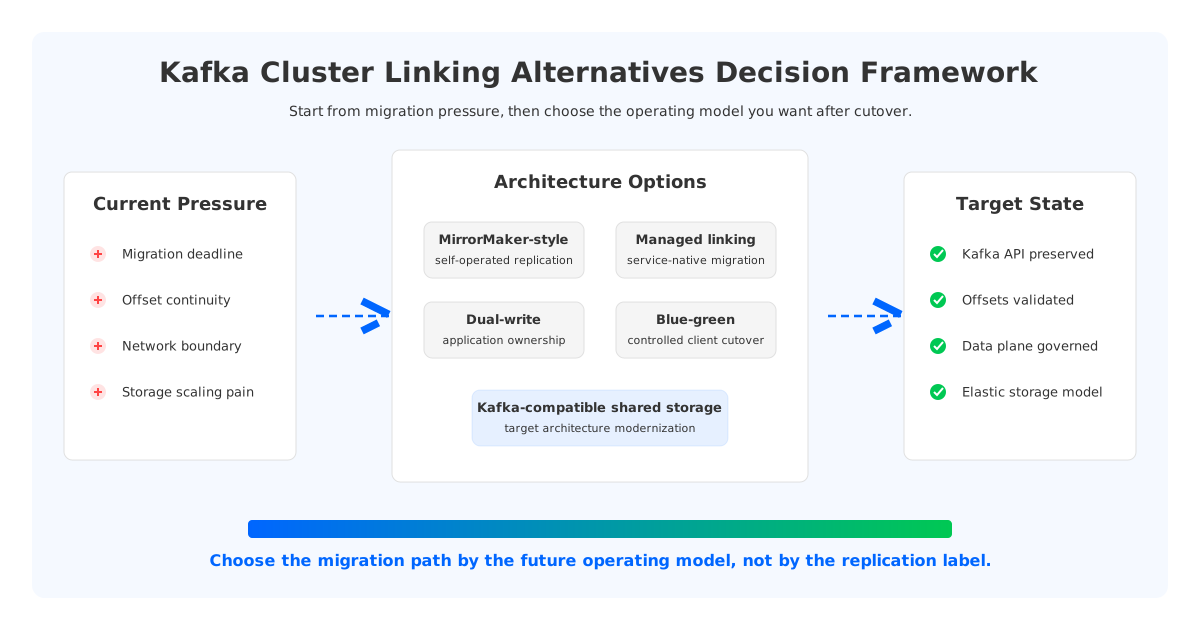
Cluster linking is one pattern in a larger design space. Platform teams should compare it with MirrorMaker-style replication, managed cloud replication services, application dual-write, blue-green client migration, and Kafka-compatible shared-storage platforms. The right choice is not the most elegant diagram. The right choice is the one that preserves application semantics while changing the operating model enough to justify the migration.
1Why kafka cluster linking alternatives matters now
Kafka has become part of the application contract in many companies. Producers depend on batching, idempotence, partition keys, and error handling behavior. Consumers depend on offsets, group coordination, replay, and ordering expectations. Stream processors may rely on checkpoints, transactional writes, or topic naming conventions that were never designed as "migration metadata" but become exactly that during a move. When a platform team changes the cluster underneath those clients, it is not replacing a queue. It is moving a distributed log that many systems use as shared time.
Cloud architecture adds another layer. A migration may cross accounts, VPCs, regions, private connectivity boundaries, or procurement models. Security teams ask where the data plane lives. Finance teams ask whether replication traffic is temporary or part of the future run rate. Application teams ask whether they have to restart consumers, reset offsets, or reprocess state. These questions show why "zero downtime Kafka migration" is a system design problem rather than a checkbox.
The strongest migration plans separate four concerns:
- Data movement: how records, topic configurations, and metadata move from source to target.
- Client movement: how producers, consumers, stream processors, and connectors switch bootstrap endpoints.
- Progress continuity: how committed offsets, checkpoints, and exactly-once assumptions survive the transition.
- Operating model: how scaling, storage, networking, governance, and cost behave after cutover.
A replication feature can cover part of the first concern and sometimes part of the third. It usually cannot answer the fourth by itself. That is where alternatives become worth evaluating.
2The production constraints behind the search
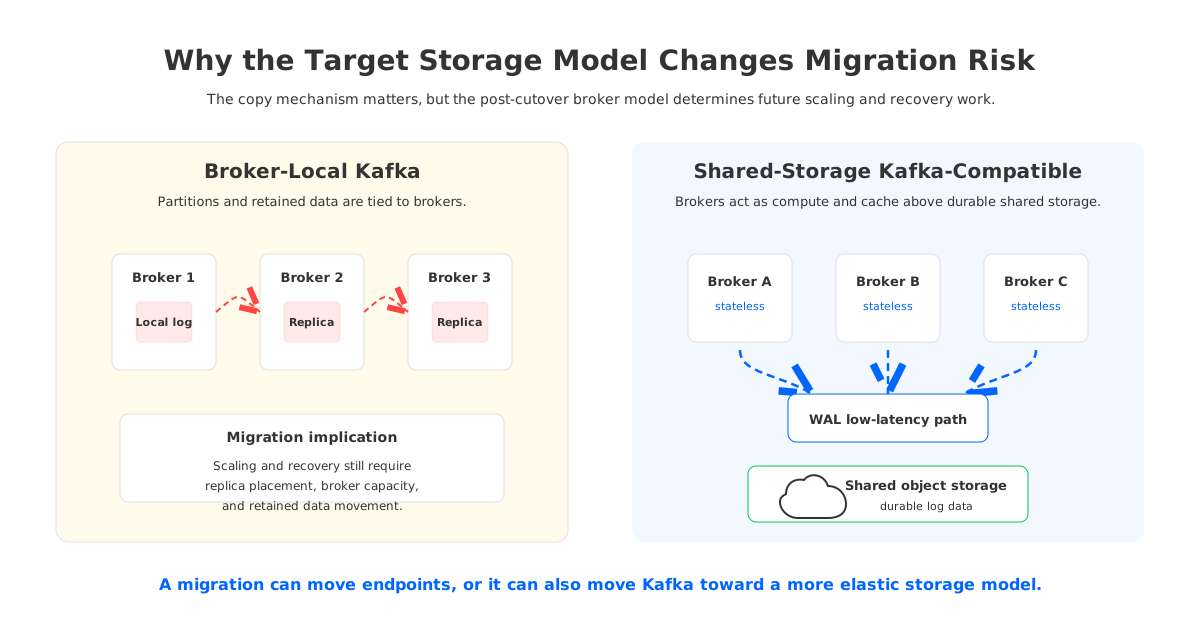
Traditional Apache Kafka uses a Shared Nothing architecture: brokers own partition replicas on local or attached storage, and durability is handled by replicating data across brokers. This model is familiar, mature, and well documented, but it couples capacity to brokers. More retention means more broker storage. More throughput often means more broker and network headroom. Scaling and recovery involve partition leadership, replica placement, and data movement. Those mechanics matter during migration because the target cluster is more than a new endpoint; it is a new place where the same broker-local rules may repeat.
The storage model also shapes rollback. If the source and target clusters diverge after client traffic moves, the rollback path has to decide which side is authoritative. If consumers commit offsets on the target while producers still write to the source, the platform must map progress cleanly. If the migration uses asynchronous replication, lag becomes a business risk, not a background metric. A cutover is only safe when the team can explain exactly which writes are accepted, which consumers are active, and which offsets define the recovery point.
There is a subtle trap here. Teams often evaluate migration tooling by the smoothness of the copy phase, because that is the most visible demo. Production migrations fail in the less photogenic parts: consumer group timing, schema drift, authorization parity, DNS or PrivateLink routing, lag alerts that nobody owns, and unclear rollback windows. The right alternative for one team may be the one that gives them strict migration choreography. For another team, it may be the one that changes the target architecture so future scaling and retention no longer require large broker data movements.
3Architecture patterns teams usually compare
The usual shortlist contains several legitimate patterns. None is universally right, and none removes the need for a cutover runbook. A good evaluation starts by naming the operating assumption behind each one.
| Pattern | Where it fits | What to test before committing |
|---|---|---|
| MirrorMaker-style replication | Open-source or self-operated migrations where the team wants control over replication infrastructure | Offset translation, checkpoint cadence, lag behavior, topic config parity, and operational ownership |
| Managed replication or cluster-linking service | Cloud-to-cloud or service-native migrations where managed operations and private connectivity matter | Supported source/target combinations, metadata coverage, network cost, failover semantics, and exit plan |
| Application dual-write | Narrow migrations where producers can safely write to both systems | Idempotency, ordering, retry behavior, partial failure handling, and duplicate suppression |
| Blue-green client migration | Endpoint migration where the target is preloaded and clients move gradually | Client restart behavior, consumer offset continuity, rollback window, and monitoring across both platforms |
| Kafka-compatible shared-storage platform | Modernization projects where migration is also meant to reduce broker-local storage limits | Compatibility, offset preservation strategy, BYOC or data-plane boundary, storage latency path, and scaling behavior |
The table is intentionally not a ranking. It keeps the decision anchored in workload semantics. A team moving a small set of stateless consumers can accept more manual coordination than a team moving Flink jobs with large state. A team migrating inside one cloud region may care less about private connectivity than a regulated team moving across accounts with strict network controls. A team that only needs a one-time move should be cautious about adopting a permanent replication topology that will outlive the migration.
The hard part is that these patterns can be combined. A platform team may use replication to preload the target, blue-green client updates for producers, consumer group validation for cutover, and a shared-storage Kafka-compatible target to change the long-term operating model. The combination is useful when each piece has a clear job.
4Evaluation checklist for platform teams
Before choosing a cluster linking alternative, make the migration review concrete. Bring platform engineering, SRE, security, application owners, data engineering, and finance into the same review so hidden dependencies appear while there is still time to design around them.
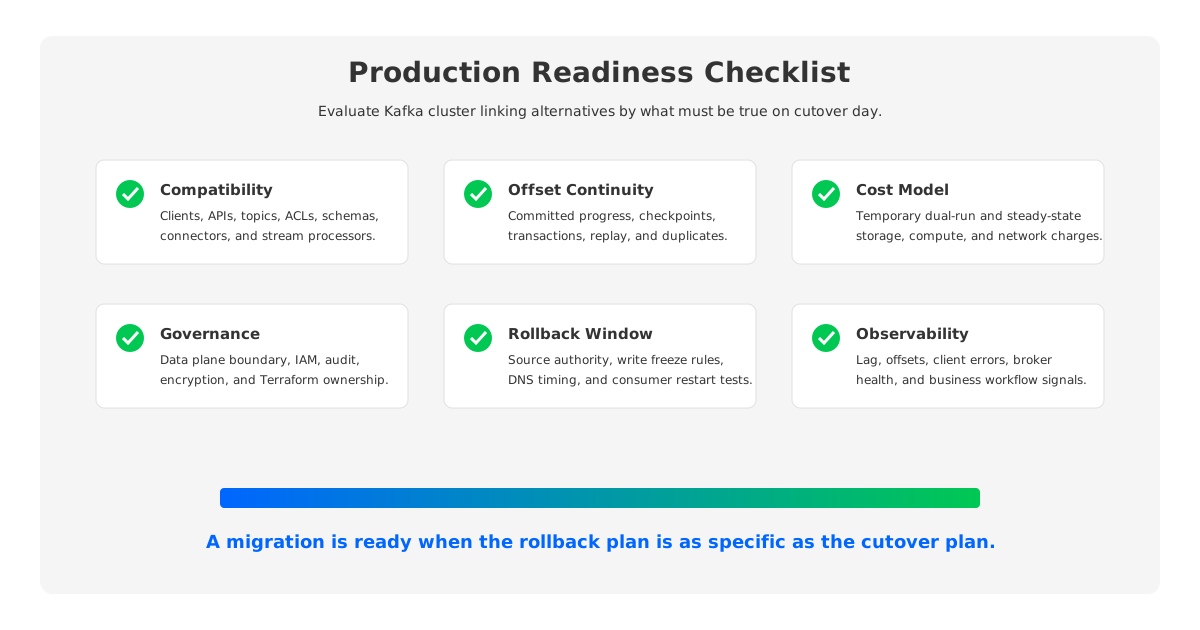
Start with compatibility. Which Kafka client versions and APIs are in use? Are producers using idempotence or transactions? Do consumers rely on cooperative rebalancing, static membership, or specific offset reset behavior? Are Kafka Connect, Kafka Streams, Flink, schema registry, ACLs, quotas, and monitoring integrations part of the migration boundary? Apache Kafka compatibility is not only about accepting the produce and fetch protocol. It is about preserving the behaviors that applications already depend on.
Then test progress continuity. Consumer group offsets are the most obvious piece, but they are not the only one. Stateful processors may store checkpoint metadata elsewhere. Downstream tables may assume exactly-once or effectively-once delivery. Some applications can replay safely; others cannot. A migration plan should define whether offsets are translated, preserved, reset, or intentionally moved through application-controlled checkpoints. If the answer is "we will see during the cutover," the cutover is already carrying too much risk.
Cost needs the same discipline. Replication traffic, cross-zone or cross-region transfer, private connectivity, duplicate storage, longer dual-run periods, and additional observability can all become material. Avoid borrowed numbers unless they come from the same cloud, region, data volume, retention, and read fan-out. The more useful practice is to model the migration period and the steady state separately. Temporary double-running may be acceptable. Permanent double-paying because the target architecture did not change the underlying bottleneck is harder to defend.
Governance looks administrative until it blocks the schedule. A target platform may need customer-owned networking, VPC or VNet isolation, IAM review, encryption, audit trails, Terraform management, and procurement approval. A SaaS-native replication path, a self-operated replication stack, and a BYOC data plane create different review packages even when all three expose Kafka-compatible endpoints.
5Where AutoMQ changes the operating model
Once the neutral evaluation is complete, AutoMQ belongs in the shortlist for a specific kind of project: the team wants Kafka compatibility, but the migration is also a chance to get away from broker-local storage as the center of operations. AutoMQ is a Kafka-compatible cloud-native streaming system that uses a shared-storage architecture. Brokers become stateless compute and cache nodes, while durable log data is stored through shared storage with a WAL path for low-latency writes before data reaches object storage.
That architecture changes the migration conversation. In a broker-local model, the target cluster still has to be sized around local storage, replica movement, and retained data placement. In a shared-storage model, the durable data layer is not owned by an individual broker. Scaling and recovery focus more on compute capacity, cache locality, and metadata ownership than on copying retained log segments between brokers. This does not make migration automatic or remove compatibility testing. It changes what the team is migrating toward.
AutoMQ Linking is the migration capability that fits this architecture. Its role is to help move from existing Kafka-compatible clusters into AutoMQ while preserving the Kafka-facing contract as much as possible. For teams running stateful processors, offset and progress continuity are especially important because replaying large histories can turn a migration into an application recovery project. The practical evaluation should still be hands-on: validate topics, partitions, consumer offsets, producer behavior, stream processor checkpoints, ACLs, schemas, network paths, lag, and rollback timing in a staging rehearsal before production cutover.
The deployment boundary matters as much as the storage model. AutoMQ BYOC is designed for cases where the data plane runs in the customer's cloud account, which can simplify some data residency and network-control conversations compared with moving the data plane into a third-party account. AutoMQ Software gives teams another option when they want to operate the platform themselves. Those choices do not replace security review, but they let the review start from a different premise: Kafka-compatible modernization without sending the data plane outside the environment the organization already governs.
AutoMQ is not the correct answer for every migration. If the source and target are both service-native environments and the team only needs a narrow replication path, a managed replication feature may be enough. If the workload is small and applications can be restarted with clear replay semantics, a simpler blue-green migration may be more economical. AutoMQ becomes more relevant when Kafka compatibility, long retention, elastic scaling, customer-controlled deployment boundaries, and future operating cost all appear in the same decision.
6Decision table and migration path
The final decision should be based on the reason for migration, not the name of the mechanism. A team escaping an end-of-life cluster has different priorities from a team redesigning multi-region streaming or preserving stateful stream processing checkpoints.
| Migration goal | Strong first option | Why |
|---|---|---|
| One-time endpoint move with modest state | Blue-green client migration plus validated replication | Keeps the plan understandable and limits permanent dependencies |
| Complex stateful processing migration | Offset-safe replication or platform-native migration tooling | Reduces the chance that checkpoints and consumer progress diverge |
| Cloud-network or account-boundary migration | Managed private connectivity or BYOC-friendly target platform | Aligns technical cutover with security and governance review |
| Long-retention Kafka modernization | Kafka-compatible shared-storage architecture | Changes the storage and scaling model after migration |
| Multi-region resilience program | Replication plus explicit write-ownership and failover runbooks | Prevents migration tooling from being mistaken for business-level recovery design |
Strong migration plans have a boring production cutover because the risky work already happened. They rehearse with representative topics, measure lag under real write rates, validate consumer restart behavior, compare offsets before and after cutover, test rollback while the source is still authoritative, and keep both platform and application teams on the same clock. That discipline matters more than the label attached to the replication path.
If you are evaluating Kafka cluster linking alternatives because the current platform is becoming hard to scale, recover, or govern, include the target architecture in the review, not only the copy mechanism. AutoMQ is worth testing when the desired end state is Kafka-compatible streaming with shared storage, stateless brokers, and deployment models that can keep the data plane under customer control.
7References
- Apache Kafka Documentation: Core concepts and terms
- Apache Kafka Documentation: Consumer configuration and offset behavior
- Apache Kafka Documentation: Geo-replication overview
- AutoMQ Documentation: Stateless Broker
- AutoMQ Documentation: Migrate to AutoMQ BYOC overview
8FAQ
8.1What is the right Kafka cluster linking alternative?
The right alternative depends on the migration goal. MirrorMaker-style replication can fit self-operated environments, managed replication can fit service-native moves, blue-green migration can fit controlled endpoint changes, and a Kafka-compatible shared-storage platform can fit modernization projects where the target operating model matters as much as the move itself.
8.2Can Kafka migration be done without downtime?
Yes, but "without downtime" usually means the team has rehearsed replication, client movement, offset continuity, lag monitoring, and rollback before production cutover. The migration tool is only one part of that outcome.
8.3Why are consumer offsets so important in Kafka migration?
Consumer offsets define where applications resume reading. If offsets are lost, mistranslated, or committed on the wrong side of the cutover, consumers may skip records or reprocess more data than expected. Stateful processors add another layer because their checkpoints may depend on offset consistency.
8.4Is application dual-write a safe Kafka migration strategy?
Dual-write can work for narrow cases, but it pushes correctness into application code. Teams must test idempotency, ordering, retry behavior, partial failures, and duplicate handling. It is usually risky for broad platform migrations unless the write semantics are simple and well owned.
8.5When should AutoMQ be evaluated?
Evaluate AutoMQ when the migration is also an architecture decision: you need Kafka compatibility, want to reduce broker-local storage constraints, care about elastic scaling or long retention, and prefer BYOC or self-managed deployment boundaries that keep the data plane under your control.


