
Table of Contents
Table of Contents
Teams usually search for kafka cluster management boundaries after a shared Kafka platform has become too important to run on informal agreements. Product teams want topic self-service. Security wants to know who can read customer events. Finance wants to explain why streaming cost grows even when business traffic is flat. SREs want fewer pages caused by partitions, lag, quota surprises, and storage pressure. The problem is not that Kafka lacks controls; Kafka has plenty of them. The problem is deciding which controls belong to application teams, which belong to a platform team, and which must be enforced as infrastructure policy.
That boundary question is harder than it looks because Kafka sits between organizational layers. It is an application dependency, a data governance surface, a network system, a storage system, and an operational service at the same time. A quota can protect a cluster from a noisy tenant. A schema rule can prevent a downstream incident. A partition count can commit the platform to storage, network, and rebalancing work for months. Centralize every decision and the platform becomes a bottleneck. Delegate every decision and local changes acquire global blast radius.
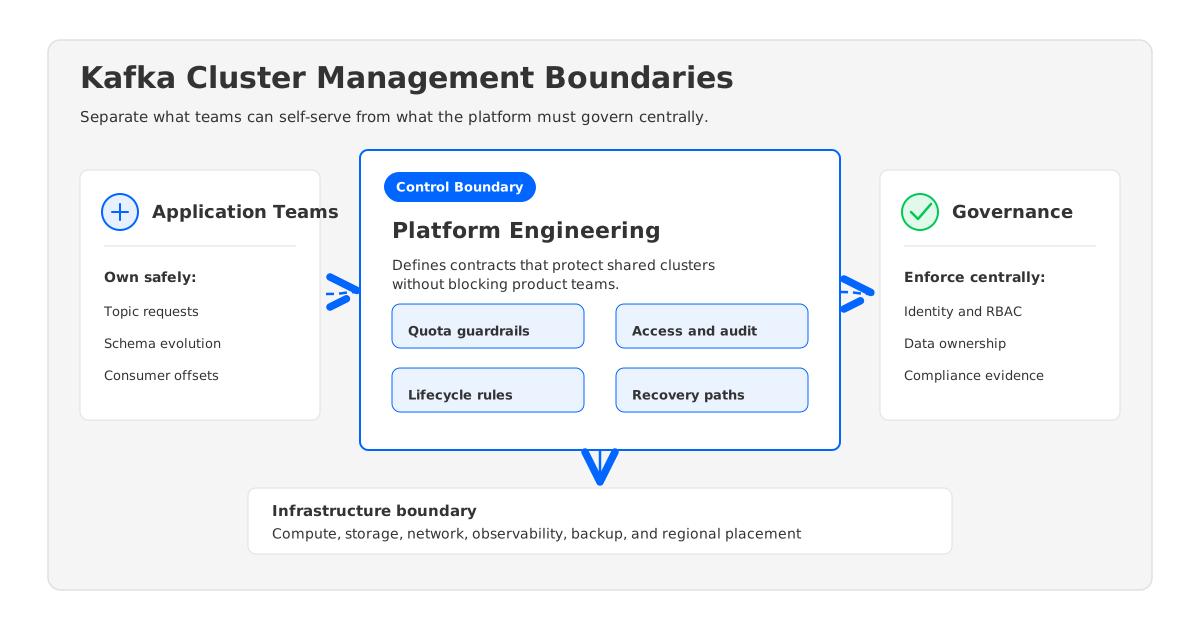
The useful frame is not "who gets admin access." It is "which decisions change the risk profile of the shared system." Topic creation, ACL requests, schema registration, offset resets, retention policies, cluster scaling, broker upgrades, disaster recovery, and audit evidence do not carry the same operational weight. A good Kafka platform makes routine work self-service while keeping irreversible or high-blast-radius changes under explicit platform control.
1Why Kafka cluster management boundaries become a platform issue
Small Kafka estates can survive on personal expertise. A few engineers know which topics matter, which consumers are fragile, and who to call before changing retention. That model breaks once Kafka becomes a shared internal product. Producers, consumers, teams, regions, connectors, schemas, and compliance obligations grow faster than the group of people who deeply understand the cluster.
Kafka encourages this drift because many resources look deceptively local. A team asks for a topic, but the topic consumes partitions, controller metadata, replication bandwidth, monitoring cardinality, and retention storage. A team asks for longer retention, but the cost may land in a platform budget instead of the requesting team's budget. The owner of the request and the owner of the consequence are often different people.
The boundary has to separate four decision types:
- Application contracts such as topic names, schemas, producer behavior, consumer group ownership, and compatibility expectations. These should be close to the teams that understand the business event.
- Platform controls such as quotas, default retention, partition limits, cluster lifecycle, supported client versions, and incident response. These protect the shared service from local optimization.
- Governance controls such as ACLs, identity, audit logging, data classification, encryption, and approval workflows. These protect the organization from accidental exposure or unmanaged data use.
- Infrastructure controls such as compute, storage, networking, regional placement, observability, backup, and recovery drills. These determine the cost and reliability envelope.
The mistake is putting all four into one ownership bucket. Kafka administration then becomes either too centralized to be useful or too decentralized to be safe. Platform engineering exists to avoid that false choice.
2The architectural reason boundaries feel messy
Traditional Kafka was designed around a Shared Nothing architecture. Each broker owns local storage, partitions are placed on brokers, and reliability comes from replicating data between brokers. This model is coherent and proven, but it couples management operations to data placement. When a cluster scales, rebalances, replaces nodes, or recovers from failure, the platform may be moving durable data across machines and availability zones.
That coupling shapes the management boundary. If application teams can create topics freely, they can create future reassignment work. If they can set high retention freely, they can force broker disk expansion. If they can increase partitions freely, they can increase controller and rebalance load. The platform team is asked to provide self-service, but the storage model makes many "self-service" changes physically expensive.
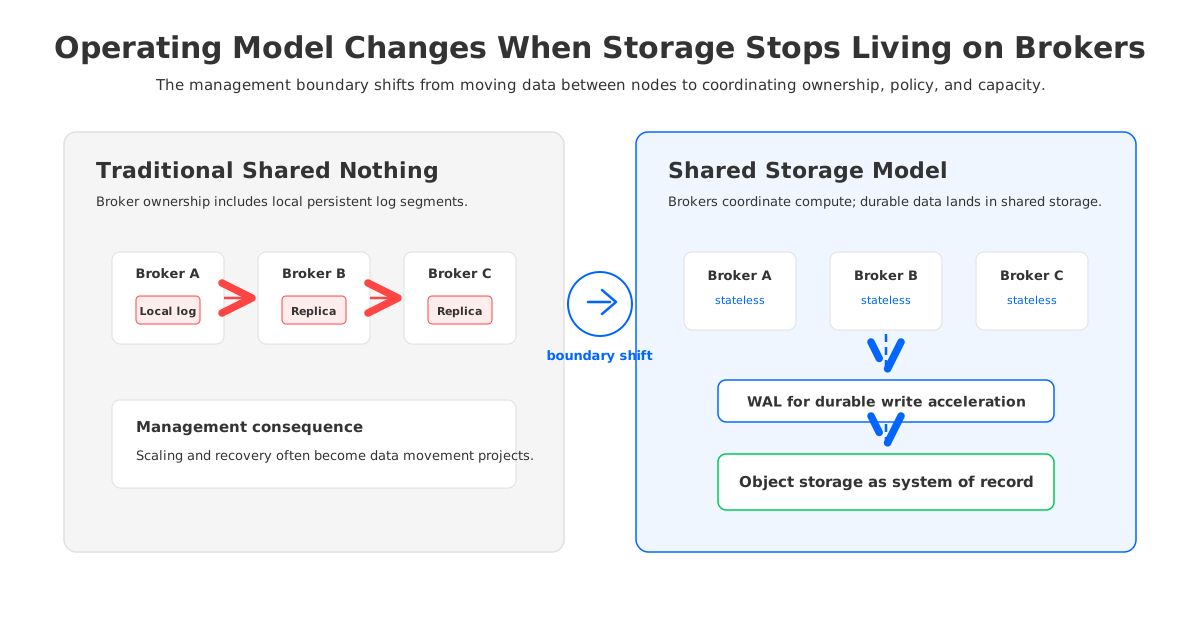
This is where Kafka governance discussions can become too superficial. Access control, schema rules, topic catalogs, and dashboards matter, but they do not remove the underlying operational coupling. A governance portal can approve a topic in seconds; it cannot make broker-local storage rebalance in seconds. A quota can limit a tenant's throughput; it cannot erase the cost of cross-zone replication if the deployment model sends replica traffic across availability zones.
The practical implication is that platform teams should design boundaries around the physical consequences of each action. A topic request is more than a name and a partition count. It is a future storage, replication, metadata, monitoring, and recovery object.
3A neutral framework for Kafka platform boundaries
A durable boundary framework starts with the capabilities the platform promises, not with the tools it happens to use. The platform team should be able to tell application teams what is self-service, what requires review, and what is not supported on shared infrastructure. It should also be able to explain the reason. "Because this change affects cluster-wide recovery time and monthly network cost" is stronger than "because the platform team said so."
The evaluation framework below is intentionally vendor-neutral. It works for self-managed Kafka, managed Kafka services, Kafka-compatible systems, and internal platforms built on top of them.
| Boundary area | Self-service candidate | Platform-owned control | Why it matters |
|---|---|---|---|
| Topic lifecycle | Request, ownership metadata, low-risk config changes | Partition ceilings, retention defaults, deletion policy | Topic settings become storage, metadata, and recovery commitments. |
| Schema and contract | Register compatible schema versions, view lineage | Compatibility modes, breaking-change approvals | Data contracts protect consumers that the producer may not know. |
| Access and identity | Request ACLs through approved workflows | RBAC model, audit evidence, network access | Kafka permissions are data permissions, not only service permissions. |
| Capacity and quotas | Team-level throughput budgets | Cluster scaling, broker sizing, quota enforcement | Noisy tenants must not define the reliability envelope for everyone else. |
| Migration and rollback | Validate clients, test producers and consumers | Cutover strategy, offset validation, rollback criteria | A migration is not complete until reads, writes, and recovery paths are proven. |
| Operations | View lag, errors, topic health, and ownership | Paging policy, failure drills, upgrade windows, SLOs | Shared platforms need shared evidence during incidents. |
This table is less about bureaucracy than about blast radius. Changes with local blast radius should become easy. Changes with shared blast radius should become explicit. Changes with irreversible consequences should have rollback criteria before they are approved. A platform that cannot express these differences will oscillate between ticket overload and uncontrolled sprawl.
4Contracts, ownership, access, and audit trade-offs
The first boundary is the event contract. A Kafka topic is not a queue with a clever name; it is a long-lived interface between producers and consumers. Platform teams should let application teams own the semantics of their events, but they should not let every team invent a different lifecycle. The minimum contract usually includes an owner, data classification, expected producers and consumers, schema compatibility rule, retention class, partitioning strategy, and incident contact.
The second boundary is access. Kafka ACLs and network controls are often managed after the cluster is already running. Access rules should be part of the topic lifecycle from the beginning, especially when topics carry customer, payment, security, operational, or regulated data. A platform can offer self-service access requests while still enforcing least privilege, approval, audit logging, and service account ownership.
The third boundary is cost. Kafka cost is rarely a single line item. Compute, disks, cross-zone traffic, object storage, monitoring, backup, and operational labor can all belong to different accounting categories. Retention and partition decisions made by application teams can land as infrastructure cost owned by the platform. A mature boundary model makes cost ownership visible before the request is approved.
Governance becomes easier when these boundaries use the same language. Topic ownership, ACL ownership, schema ownership, and cost ownership all answer the same question: who is allowed to change the system, who absorbs the consequence, and what evidence exists when something goes wrong?
5How storage architecture changes the operating model
Once the boundary framework is clear, architecture becomes easier to evaluate. The question is whether the architecture makes the desired boundary practical enough to enforce. If every capacity change requires careful data movement, the platform will be cautious about self-service. If every broker replacement carries local data recovery risk, the platform will centralize more operations.
AutoMQ is a Kafka-compatible cloud-native streaming system that changes this part of the operating model by moving Kafka's storage layer from broker-local disks to shared object storage through its S3Stream architecture. Brokers remain responsible for Kafka protocol handling and compute, while durable data is written through a WAL layer and persisted in object storage. The platform consequence is that many operations stop being large data relocation projects and become metadata, ownership, and compute scheduling problems.
That difference matters for boundaries. Stateless brokers reduce the amount of local durable state that a platform team must protect during scaling and replacement. Shared storage reduces the pressure to overprovision broker-local disks for every retention and growth scenario. Independent compute and storage scaling gives the platform team a cleaner way to map workload pressure to infrastructure changes.
This does not eliminate governance work. Topic ownership, schemas, ACLs, audit trails, quotas, and migration plans still need explicit policy. The difference is that the platform can make more of the routine path self-service without treating every request as a future disk and reassignment project.
6A practical readiness checklist
The simplest way to test a Kafka cluster management boundary is to ask whether the platform can handle the next uncomfortable request. A team wants high retention. A producer wants more throughput near a launch event. A compliance team asks who can read a sensitive stream. A migration needs rollback without data loss. If the boundary model has no crisp answer, the platform is not ready.
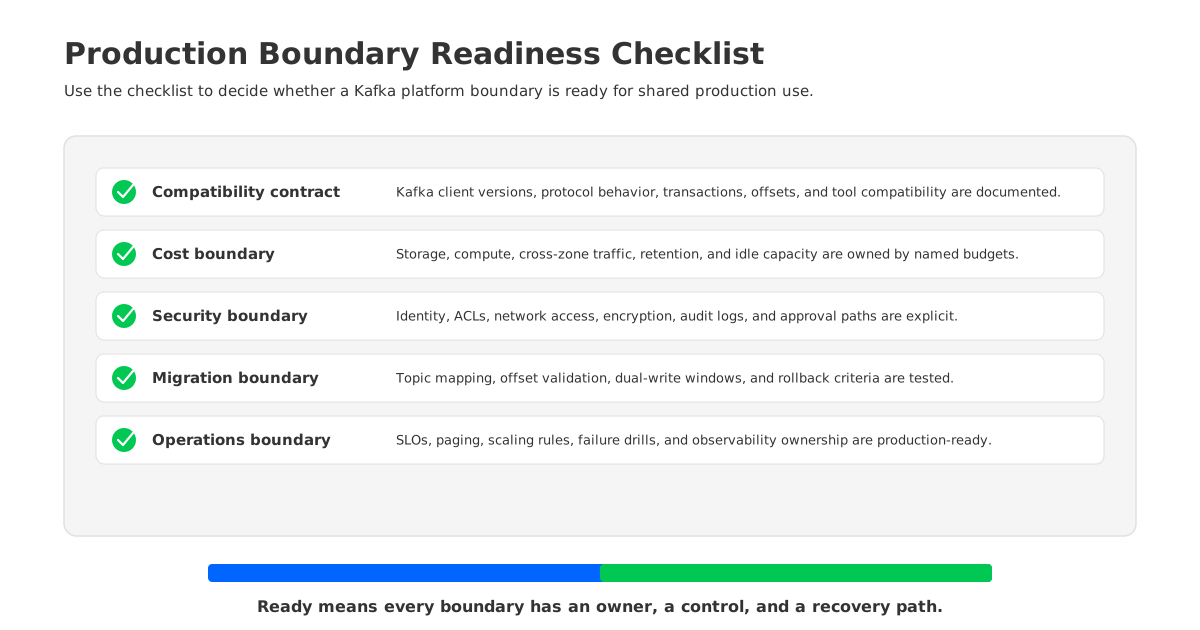
Use the checklist below before opening broader self-service:
- Compatibility is explicit. Supported Kafka client versions, protocol expectations, transactions, offset behavior, and operational tools are documented and tested against the platform target.
- Ownership is queryable. Every topic, schema, connector, service account, and consumer group has an owner that incident responders can find without tribal knowledge.
- Cost boundaries are visible. Retention, partitions, throughput, cross-zone traffic, and storage growth map to team-level budgets or approved platform pools.
- Security controls are built into workflow. ACLs, RBAC, network access, encryption expectations, and audit logs are part of the resource lifecycle.
- Migration has rollback criteria. Topic mapping, offset validation, consumer lag, producer cutover, and fallback paths are tested before production traffic moves.
- Operations are rehearsed. SLOs, paging rules, scaling paths, failure drills, upgrade windows, and post-incident evidence are owned by named teams.
The checklist should produce action, not a slide. If topic owners are missing, block additional production topics until ownership metadata is mandatory. If quotas exist but are not tied to budgets, connect them. If migration rollback is a hope rather than a tested procedure, narrow the migration scope. If cluster scaling requires data movement that conflicts with recovery targets, revisit the architecture before promising broader self-service.
7Where platform teams should draw the line
A strong boundary is usually not a hard wall between "developers" and "operators." It is a contract between speed and safety. Application teams should own the meaning of their events, producer compatibility, the consumers they operate, and the business priority of their data. Platform teams should own default guardrails, supported patterns, shared SLOs, cost model, scaling path, and recovery evidence. Governance teams should own policy requirements, but the platform should encode those requirements into workflows.
This model also prevents a common anti-pattern: buying or building a Kafka management layer that centralizes UI operations while leaving the underlying operating model unchanged. A better UI helps, but it is not a boundary strategy. Boundaries become real when the platform can enforce them technically, explain them financially, and prove them operationally.
For organizations evaluating a Kafka-compatible platform, the decision should come back to the same question that started the search: which management responsibilities can safely move closer to application teams, and which must stay under platform control? Shared storage, stateless brokers, independent scaling, and customer-controlled deployment boundaries can make that answer less painful, but they do not replace the need for clear ownership.
If your team is revisiting Kafka platform boundaries because scaling, governance, or cost has outgrown your current operating model, review AutoMQ's shared storage architecture and migration path at AutoMQ documentation. It is the fastest way to map the framework above to a concrete Kafka-compatible design.
8References
- Apache Kafka documentation
- Apache Kafka KRaft documentation
- Apache Kafka security documentation
- Apache Kafka operations documentation
- KIP-405: Kafka Tiered Storage
- AutoMQ Shared Storage architecture
- AutoMQ compatibility with Apache Kafka
- AutoMQ WAL Storage
- AutoMQ eliminate inter-zone traffic
9FAQ
9.1What are Kafka cluster management boundaries?
Kafka cluster management boundaries define which teams can change which parts of a Kafka platform, under what guardrails, and with what accountability. They usually cover topics, schemas, ACLs, quotas, retention, migration, observability, scaling, upgrades, and recovery.
9.2Should application teams be allowed to create Kafka topics themselves?
Yes, when the platform has guardrails for naming, ownership, retention classes, partition limits, schema expectations, access requests, and deletion policy. Without those controls, topic self-service can create hidden storage, governance, and operational risk.
9.3How do Kafka quotas fit into platform boundaries?
Quotas are a platform-owned control that allows safer team-level autonomy. They let application teams operate within an agreed throughput envelope while protecting the shared cluster from one producer or consumer group consuming disproportionate capacity.
9.4Does a Kafka-compatible platform remove the need for governance tooling?
No. Kafka compatibility preserves ecosystem behavior, but governance still requires ownership metadata, access workflows, audit evidence, schema compatibility policy, and operational runbooks. Architecture can reduce operational friction; it cannot replace policy.
9.5How does shared storage affect Kafka management boundaries?
Shared storage can reduce the amount of broker-local state that must be managed during scaling, reassignment, and recovery. That makes it easier for platform teams to delegate routine work while keeping high-blast-radius controls explicit.
9.6What should be checked before migrating to another Kafka-compatible platform?
Validate client compatibility, topic configuration, schema rules, ACLs, consumer offsets, producer behavior, connector dependencies, rollback criteria, monitoring, and cost assumptions. A migration is ready only when both the data path and recovery path have been tested.


