
Table of Contents
Table of Contents
Teams search for kafka cluster retirement checklist after the migration dashboard has turned mostly green. Producers point to the new bootstrap address. Consumers are reading again. Replication lag looks boring. The project plan says the source cluster can be shut down, but nobody wants to be the person who deletes a broker and discovers that a forgotten batch job still depends on yesterday's offsets.
That is the uncomfortable part of Kafka migration: cutover is not retirement. Cutover proves that traffic can move. Retirement proves that the old cluster no longer carries business, compliance, recovery, or operational meaning. Kafka is more than a pipe between applications. It is also a retention system, an offset ledger, a security boundary, a connector runtime, a schema dependency, a monitoring source, and often the place where an application team can replay a mistake.
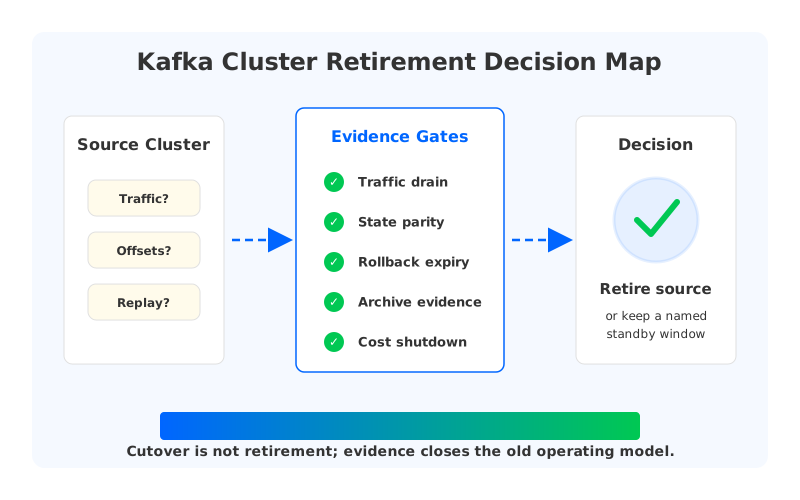
The cleanest retirement plans treat shutdown as a controlled production change, not a cleanup task. They freeze the source, prove target parity, define the last rollback window, archive the evidence, and remove cost in layers. The goal is to know exactly when the old cluster stops being useful.
1Why Cluster Retirement Is Riskier Than Cutover
A Kafka migration has a visible finish line: the moment clients produce and consume against the target platform. That finish line is useful for project management, but it hides slower-moving contracts. Consumer groups may have moved, but a data science replay job might still read a retained topic every Monday. A connector may have been recreated, but its dead-letter topic might still live in the source cluster. A security review may approve the target cluster, but audit evidence for the old ACLs may still be needed during the next control cycle.
Traditional Kafka makes this harder because broker-local storage gives the source cluster lingering operational value. If the target platform has not copied enough historical data, the old cluster becomes the rollback archive. If offsets did not map cleanly, the old cluster becomes the reference ledger. If topic configuration drifted during the dual-run period, the old cluster may be needed to reconstruct expectations. That does not mean the source must stay alive for months. Retirement should be based on explicit exit criteria, not confidence alone.
The first retirement question is therefore not "can we delete the cluster?" It is "which promises are still attached to this cluster?" Those promises fall into five categories:
- Traffic promises. No active producers, consumers, connectors, stream processors, admin scripts, or monitoring jobs still depend on the source endpoints.
- Data promises. Required retention windows, replay obligations, and legal holds are either satisfied on the target or preserved in an approved archive.
- State promises. Consumer offsets, transactional behavior, idempotent producer assumptions, topic configs, ACLs, quotas, and service identities have been validated in the target environment.
- Recovery promises. The team has decided whether rollback is still available, how long it remains available, and what evidence closes that option.
- Cost promises. Compute, storage, network, support, backup, observability, and on-call ownership are removed without destroying required evidence.
These categories are broader than broker health. A broker can be idle while the cluster is still part of a governance or recovery path. A cluster can also look busy because replication or monitoring is still running even though no business workload remains. The checklist has to distinguish useful activity from migration residue.
2The Operating Model Behind the Checklist
Kafka's Shared Nothing architecture was built around brokers that own local logs. That design is powerful and familiar, but it makes cluster retirement a storage event as much as an application event. Before a broker can disappear, the team has to reason about partitions, replicas, log directories, retention, reassignment history, and whether the data that lived there has a valid replacement. During migration, this often creates a long tail of "keep it for safety" infrastructure.
Tiered storage changes part of this equation by moving older log segments to object storage while recent data remains broker-owned. It can reduce retention pressure, but the primary operating model still includes broker-local state. Scaling, replacing, and retiring brokers can still involve local data, replica placement, and the timing of background movement. For retirement planning, tiered storage helps with archive economics but does not automatically make the source cluster stateless.
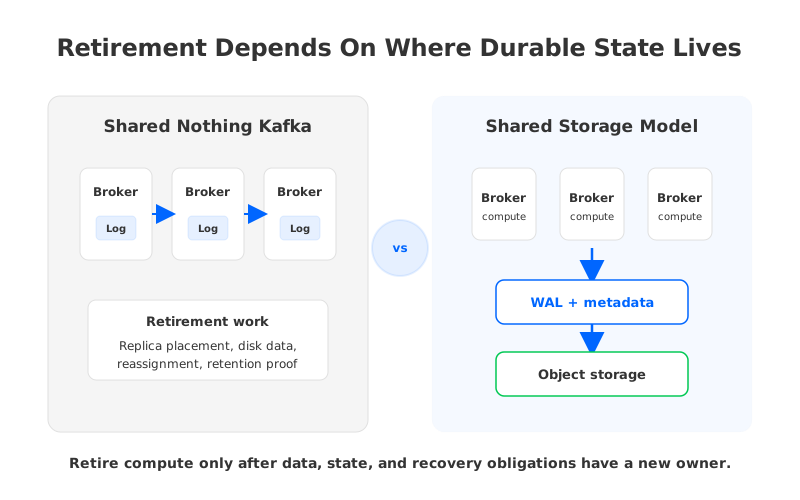
Shared Storage architecture changes the shape of the retirement problem. Durable stream data is no longer tied to a broker's local disk in the same way. Brokers are closer to replaceable compute, while the durable repository sits in shared object storage with a WAL layer in front of it for write efficiency and recovery. Clients, offsets, connectors, security, and observability still need validation, but less broker-local storage logic remains to keep old compute alive after the business dependency has moved.
This distinction is useful even when the source is a traditional Kafka cluster. The target operating model affects the retirement checklist. If the target keeps broker-local storage, the team should validate reassignment, replica health, and retention headroom as part of the final state. If the target uses shared storage, the team should validate object storage durability, WAL behavior, metadata ownership, cache behavior for catch-up reads, and how broker replacement works after cutover. The checklist should test the architecture the team will operate next, not the architecture it is leaving behind.
3A Practical Kafka Cluster Retirement Checklist
The checklist below assumes the migration has completed its main cutover. It is written for platform owners who need a go/no-go artifact before decommissioning a source cluster.
| Gate | What to prove | Evidence to keep |
|---|---|---|
| Ownership freeze | No team can create additional topics, principals, connectors, or producer dependencies on the source cluster. | Change freeze ticket, IAM or ACL diff, topic creation policy, owner sign-off. |
| Traffic drain | Source ingress and egress represent only approved migration residue, not business traffic. | Broker metrics, client connection inventory, DNS or bootstrap logs, connector status. |
| Offset and replay parity | Target consumer groups can resume from expected positions, and required replay windows exist outside the source. | Offset comparison, sampled replay tests, retention map by topic, failed replay runbook. |
| Configuration parity | Topic configs, ACLs, quotas, client auth, transactions, idempotence, and admin workflows behave as expected. | Admin export, config diff, compatibility test results, exception list. |
| Observability parity | Target dashboards and alerts are the operational source of truth. | Alert routing proof, SLO dashboard links, on-call handoff, log and metric retention policy. |
| Rollback expiry | The business accepts a specific point after which rollback to the source is no longer supported. | Rollback decision record, risk owner approval, final rollback drill result or waiver. |
| Cost shutdown | Shutdown sequence removes spend without destroying required audit or recovery evidence. | Resource deletion plan, backup/archive location, cloud cost tags, final invoice review. |
The most important row is rollback expiry. Many retirements stall because the old cluster remains an unofficial insurance policy. That sounds safe, but it creates a second production system with stale automation, weaker ownership, and unclear patching responsibility. If rollback is still required, keep the source in a defined warm or cold standby state with owners and alerts. If rollback is no longer required, say so in writing and remove the cluster deliberately.
4The Migration Artifacts That Matter After Cutover
A good retirement review starts by treating migration artifacts as evidence, not project exhaust. Topic inventories become the scope of retained data. Consumer group mappings become the offset proof. Client restart records become the traffic drain proof. Security exports become the ACL parity proof. The migration runbook becomes the rollback boundary.
MirrorMaker 2, custom replication jobs, dual writes, Kafka Connect pipelines, and managed migration tools all leave different evidence trails. The tool matters less than the properties it preserves. Kafka's semantics around ordering, offsets, idempotent production, transactions, and consumer group coordination are application contracts, so the retirement review should test the contracts the workload uses. A team that never uses transactions should not block retirement on theoretical transaction parity. A team that runs Flink jobs against committed offsets should treat offset and replay validation as a hard gate.
There is also a cost artifact hiding in the migration plan. Dual running often increases spend through duplicate brokers, duplicate storage, replication traffic, extra monitoring, and on-call work. In cloud environments, cross-zone and cross-region data transfer can become a visible line item when replication, consumers, and brokers sit across availability boundaries. The retirement checklist should identify which costs vanish at each step: stop replication, stop source consumers, remove brokers, delete block volumes, reduce object storage retention, remove private connectivity, and close support obligations.
5Where AutoMQ Fits In The Evaluation
The neutral framework above points to a broader architecture question: should the post-migration platform keep the same broker-local operating model, or should the migration become the moment when the team changes how Kafka-compatible storage is operated? That question belongs after compatibility and rollback requirements are clear.
AutoMQ fits the second path. It is a Kafka-compatible streaming platform that keeps the Kafka protocol and ecosystem surface while replacing Kafka's broker-local log storage with S3Stream, a shared storage layer backed by object storage and a WAL. In practice, that means brokers are designed to be stateless from the durable data perspective. Broker replacement, partition movement, scaling, and source-cluster retirement can be evaluated with less emphasis on moving durable data between broker disks and more emphasis on metadata ownership, client behavior, object storage health, and recovery evidence.
For migration teams, the relevant AutoMQ capabilities map directly to retirement gates. Kafka Linking is designed to migrate topics and consumer group progress while preserving offsets for supported scenarios. Shared Storage architecture changes the broker lifecycle after the move. Independent compute and storage scaling helps avoid keeping excess broker capacity only because retention grew. BYOC and software deployment models give teams a way to keep data plane resources in customer-controlled environments when that is part of the retirement approval.
AutoMQ still needs the same scrutiny as any target platform. Validate client versions, authentication protocols, topic configuration behavior, producer and consumer cutover, lag recovery, object storage access, WAL selection, observability, and rollback. The difference is that the test should include the operating model you want after retirement: what happens when a broker is replaced, when capacity changes, when a consumer replays retained data, and when the old source cluster is gone.
6Retirement Scorecard For The Final Review
The final review should be small enough to run in a meeting and concrete enough to survive an audit. A scorecard works better than a long prose sign-off because it forces each owner to choose a state. Green means the source no longer carries that responsibility. Yellow means the source still carries it temporarily with an owner and expiration date. Red stops retirement.
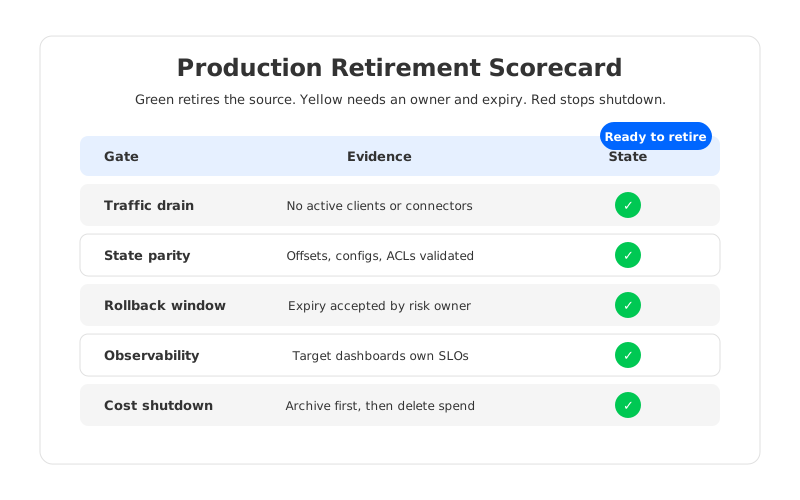
Use the scorecard in this order. First, confirm no additional dependencies can land on the source. Second, prove current traffic is gone. Third, prove the target owns application state and replay obligations. Fourth, close rollback. Fifth, remove cost. That order prevents a common mistake: deleting infrastructure before the team has proven which evidence must remain.
One practical pattern is to split retirement into three shutdown stages. In stage one, block additional use and stop replication or proxy paths that are no longer needed. In stage two, scale the source down to the smallest approved standby shape while preserving required retention and evidence. In stage three, archive what must be kept, delete compute and storage, remove network paths, and close monitoring. Each stage should have a named rollback owner until the rollback window is formally expired.
The final sentence in the runbook should be boring: the old cluster has no active clients, no unique data obligations, no rollback role, no audit evidence trapped inside it, and no owner who still depends on it. At that point, retirement is no longer a leap of faith. It is a completed production change.
7Evaluate The Next Operating Model
If your retirement checklist keeps returning to broker-local data movement, duplicate capacity, rollback uncertainty, or cross-zone replication cost, evaluate the storage model before you lock in the next Kafka platform. You can start with the AutoMQ GitHub project and test a Kafka-compatible Shared Storage architecture against your own clients, retention windows, replay drills, and source-cluster retirement gates.
8References
- Apache Kafka Documentation: Official documentation
- Apache Kafka Documentation: Message delivery semantics
- Apache Kafka Documentation: KRaft
- Apache Kafka Wiki: KIP-405: Kafka Tiered Storage
- Apache Kafka Wiki: KIP-1150: Diskless Topics
- AWS Architecture Blog: Overview of data transfer costs for common architectures
- AWS Cost and Usage Report User Guide: Data transfer charges
- AutoMQ Docs: What Is AutoMQ
- AutoMQ Docs: Architecture Overview
- AutoMQ Docs: Kafka Linking migration overview
9FAQ
9.1When is a Kafka cluster safe to retire after migration?
A Kafka cluster is safe to retire when it has no active business clients, no unique replay or retention obligation, no unresolved offset or configuration dependency, no remaining rollback role, and no audit evidence trapped inside the cluster. The decision should be recorded with owners, timestamps, and the exact artifacts used as proof.
9.2Is cluster retirement the same as decommissioning brokers?
No. Broker decommissioning removes compute from a cluster. Cluster retirement removes the entire source platform from the business operating model. It includes clients, topics, consumer groups, ACLs, connectors, monitoring, network paths, data retention, rollback decisions, and cost cleanup.
9.3How long should the old Kafka cluster stay online after cutover?
There is no universal duration. The right window depends on retention requirements, replay needs, regulatory evidence, rollback appetite, and the confidence gained from production traffic on the target. The important part is to define the window before cutover, assign an owner, and expire it formally.
9.4What should be archived before deleting the source cluster?
Archive topic inventories, topic configuration exports, ACL and quota exports, consumer group mappings, migration logs, offset validation results, replay test results, dashboard evidence, final traffic metrics, rollback decisions, and the deletion approval. Keep the archive outside the cluster being retired.
9.5Where does AutoMQ help in a retirement plan?
AutoMQ helps when the retirement review exposes deeper operating-model pain: broker-local data movement, slow scaling, duplicated capacity during migration, cross-zone traffic cost, or uncertainty around broker replacement. Its Kafka-compatible Shared Storage architecture lets teams evaluate retirement around client behavior, metadata, object storage, WAL, and recovery evidence instead of treating broker disks as the center of the plan.


