
Table of Contents
Table of Contents
The hardest part of replacing Kafka is rarely the first broker. It is the long tail of producers, consumers, Kafka Connect jobs, Kafka Streams applications, dashboards, ACL workflows, incident runbooks, and downstream teams that already depend on Kafka behavior. A platform team can agree that broker storage is too expensive, scaling takes too long, and recovery is too operationally heavy, but still reject a replacement if it turns every application into a migration project.
That is why many searches start with a constraint: Kafka-compatible alternative, Kafka-compatible replacement, or Kafka-compatible streaming platform. The team is not asking whether event streaming matters. It is asking whether the infrastructure underneath Kafka can change while the application contract remains stable enough for existing clients, connectors, libraries, and operational tooling.
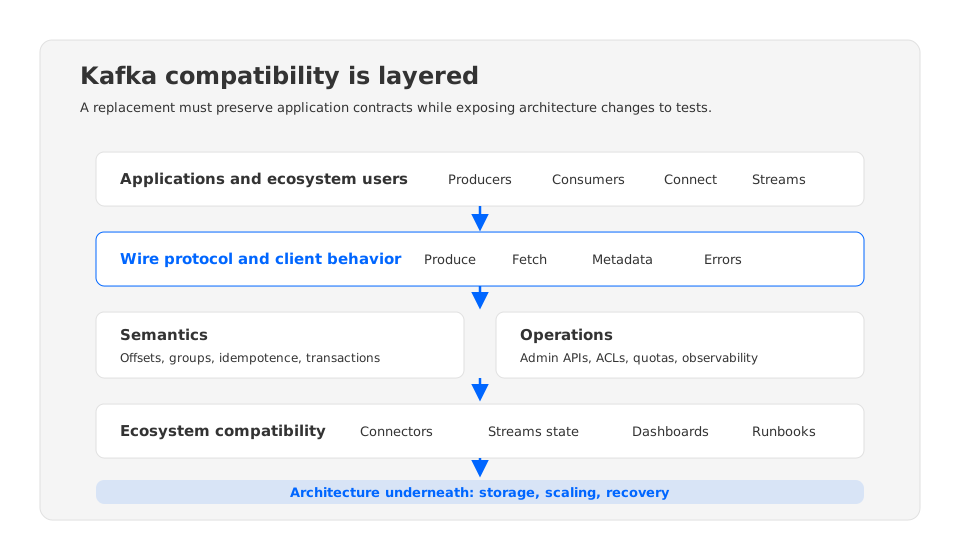
Compatibility is the entry ticket, not the finish line. A replacement can speak the Kafka protocol and still surprise a production system in admin APIs, offset behavior, authentication, consumer group rebalances, transactions, observability, or connector state. The useful evaluation starts by separating what must stay Kafka-like from what the team actually wants to replace.
1Why Kafka compatibility matters more than a feature checklist
Kafka became sticky because it is more than a broker cluster. It is a contract between teams. Application developers depend on producer and consumer APIs, data engineers depend on Kafka Connect, streaming teams depend on Kafka Streams, and SREs depend on familiar metrics, logs, ACLs, and failure semantics. Even when the platform team owns the cluster, the compatibility surface spreads across the company.
That surface changes the replacement economics. A non-Kafka streaming system may be technically strong, but it usually asks application teams to revisit client libraries, delivery assumptions, offset handling, deployment pipelines, and failure modes. For a greenfield project, that may be acceptable. For a company with hundreds of Kafka-speaking workloads, it can turn an infrastructure improvement into a multi-quarter application rewrite.
A Kafka-compatible replacement is attractive because it preserves the most expensive part of the existing investment:
- Existing producers and consumers can often keep their Kafka client model.
- Topic, partition, consumer group, and offset concepts remain familiar.
- Kafka Connect and stream processing dependencies can be evaluated as compatibility questions instead of full redesigns.
- Operational teams can reuse much of their Kafka mental model while testing the parts that may differ.
The phrase "Kafka-compatible" still needs precision. Apache Kafka defines a binary protocol with versioned request and response APIs, but production compatibility includes client behavior and ecosystem expectations around that protocol. The team should treat compatibility as a proof plan, not a vendor checkbox.
2The compatibility layers production teams must test
The first layer is the wire protocol. Kafka clients communicate with brokers through versioned protocol APIs such as produce, fetch, metadata, offset, group coordination, and admin requests. If this layer is weak, nothing else matters; clients fail before the migration reaches application logic.
The next layer is client behavior. A producer with idempotence enabled, a consumer using cooperative rebalancing, and a stream processing application with state stores all exercise the platform differently. Compatibility must cover the behaviors your applications use, not the average behavior of a simple demo producer.
For most production teams, the minimum test surface looks like this:
| Compatibility layer | What to verify | Why it matters |
|---|---|---|
| Protocol and client versions | Java client, librdkafka-based clients, KafkaJS, Go, .NET, Python, and any internal wrappers | Language teams may depend on different protocol versions and error-handling behavior. |
| Producer semantics | acks, batching, compression, idempotence, transactions, retries, partitioners | Small semantic differences can affect ordering, duplicate handling, and latency. |
| Consumer groups and offsets | Group joins, rebalances, committed offsets, reset behavior, lag reporting | Cutover safety depends on predictable consumer progress and replay behavior. |
| Admin operations | Topic creation, configs, ACLs, quotas, partition changes, describe APIs | Platform automation often uses admin APIs more heavily than application teams realize. |
| Kafka Connect and Streams | Connector task state, internal topics, offset storage, Streams state and changelog topics | Ecosystem workloads create hidden dependencies beyond ordinary produce and fetch. |
| Security and observability | TLS, SASL, ACLs, metrics, logs, audit trails, dashboards | Security review and incident response need continuity, not only client success. |
This table is deliberately broader than "does the client connect?" A replacement that passes a smoke test can still fail a cutover if connector offsets do not behave as expected, admin automation cannot update topic settings, or monitoring loses the lag and throughput signals that SREs use during incidents.
3What compatibility does not solve by itself
Kafka compatibility protects the application contract, but it does not automatically solve the operational pain that made the team search for an alternative to Kafka. If the replacement keeps the same basic storage and scaling model, many of the same cloud trade-offs remain.
Traditional Kafka ties durable log data to broker-local storage. Brokers are not only serving compute; they also own partitions and local log segments. When the cluster scales, rebalances, or recovers from broker loss, the system often has to move or rebuild large amounts of data. In cloud environments, that coupling affects cost as well as operations: broker count, disk size, retained data, replication, and cross-zone traffic can become tangled in the same capacity plan.
This is where feature comparisons can mislead. A platform may be Kafka-compatible and easier to operate in several ways, yet still require careful capacity planning around local disks, hot partitions, retained data, and recovery time. Managed Kafka can hide some of that work behind a service boundary, but the underlying architecture still shapes the bill, scaling behavior, and failure response.
For a Kafka-compatible alternative to change the operating model, it needs to change a deeper layer:
- Where durable log data lives.
- Whether brokers are stateful owners of large local datasets.
- How scaling affects partition placement and data movement.
- How recovery works when a broker disappears.
- How long retention affects broker sizing and cost.
The key question is not "Can this system replace the Kafka API?" It is "Can this system keep the Kafka API while replacing the architecture that creates our cost, scaling, or recovery pain?"
4How shared storage changes Kafka operations without changing clients
Shared storage is one answer to that question. Instead of treating each broker's local disk as the durable home for partition data, a shared-storage architecture moves persistent data into a storage layer that is independent of any single broker. Brokers become more focused on compute, protocol handling, caching, and traffic serving.
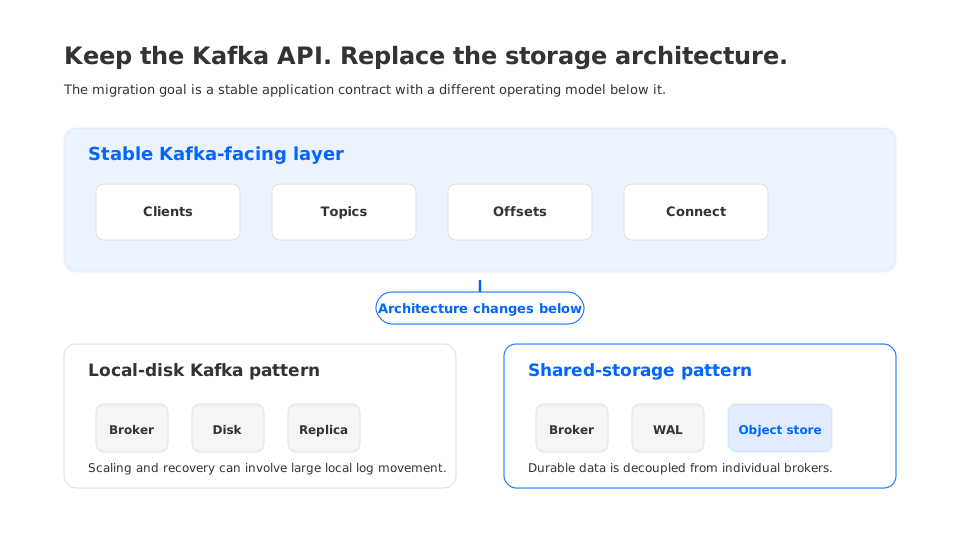
This distinction matters during scaling. In a local-disk architecture, adding or replacing broker capacity can be dominated by data movement because partitions and their logs are attached to broker storage. In a shared-storage architecture, durable data is already outside the broker, so the scaling operation can be less about copying retained logs and more about updating ownership, serving traffic, and warming the right cache paths.
It also matters for long retention. If retained data forces every broker to carry large local disks, storage growth can drive compute over-provisioning. If persistent data lives in object storage or another shared storage layer, teams can evaluate storage capacity and broker compute more independently. That does not remove the need to test object storage latency, request patterns, cache efficiency, and catch-up reads, but it changes the shape of the problem.
There is a useful way to frame the architecture change:
| Layer | Should stay stable | Can change underneath |
|---|---|---|
| Application contract | Kafka clients, topics, partitions, offsets, consumer groups | Broker implementation details |
| Ecosystem behavior | Connect, Streams, admin tooling, observability expectations | Storage layout, WAL design, cache strategy |
| Operations contract | Security model, metrics, rollback criteria, incident workflows | Scaling, recovery, and data placement mechanics |
This is the middle path between "keep Kafka exactly as it is" and "rewrite the streaming stack." The API remains familiar enough for existing applications, while the infrastructure can be redesigned around cloud-native storage, elasticity, and recovery goals.
5AutoMQ as a Kafka-compatible replacement path
AutoMQ fits this category as a Kafka-compatible replacement path for teams that want to preserve Kafka-facing semantics while changing the storage layer. AutoMQ documentation describes compatibility with Apache Kafka protocols and features, and frames its architecture as a replacement of Kafka's native log storage with S3Stream. In that model, brokers become stateless, while WAL storage and object storage form the shared storage layer underneath.
The product should enter the evaluation only after the team has identified the architecture problem. If the problem is a small tuning issue, Kafka optimization may be enough. If the problem is primarily a desire for a fully managed suite around governance, connectors, and stream processing, a managed platform comparison may be more relevant. AutoMQ becomes interesting when the bottleneck is the broker-local storage model itself: retained data, scaling delay, recovery effort, and cloud cost coupling.
The migration promise is not that every workload can move without testing. The practical promise is narrower and more useful: keep the Kafka compatibility surface boring enough that the migration work focuses on validation, cutover, and operational readiness, while the architecture underneath changes storage and elasticity behavior.
That evaluation should include:
- Real client versions and producer settings, including idempotence and transactions if used.
- Consumer group behavior under normal load, restart, rebalance, and replay.
- Kafka Connect workers, connector internal topics, and connector offset state.
- Kafka Streams applications, changelog topics, state restoration, and processing guarantees.
- Authentication, authorization, network paths, certificates, and ACL automation.
- Observability continuity for lag, throughput, errors, broker health, and storage behavior.
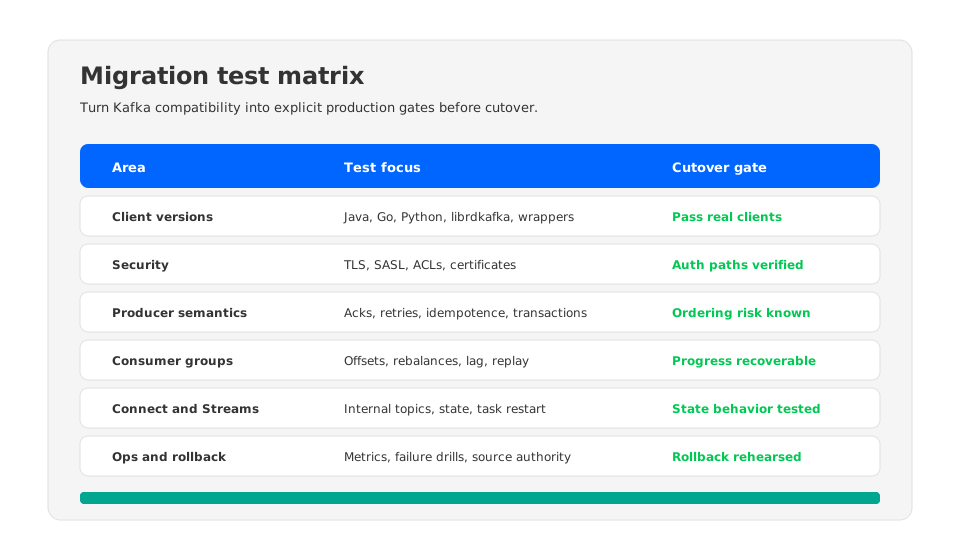
For teams with many downstream dependencies, this test matrix is more valuable than a generic feature list. It turns "Kafka-compatible" into a migration artifact that application teams, data engineering teams, and SREs can review together.
6A practical evaluation sequence
A Kafka-compatible replacement project should start with inventory, not benchmarks. Benchmarks matter, but they do not reveal whether your Go client wrapper handles retriable errors the same way, whether your connector estate can be moved safely, or whether your dashboards still show the signals needed during a cutover.
Start with the client and ecosystem inventory. List all client libraries, versions, producer settings, consumer group patterns, Kafka Connect connectors, Kafka Streams applications, admin scripts, monitoring integrations, and security dependencies. Then mark which items are business critical, which can tolerate replay, and which require strict ordering or transactional behavior.
Next, run a compatibility proof with production-shaped traffic. The goal is not to recreate peak traffic on day one; it is to exercise the behaviors that could block a migration. Produce with real serializers, consume with real group patterns, mirror enough data to validate offsets and replay, and run the admin operations that your platform automation depends on.
Then test the architecture claim. If the replacement is supposed to improve scaling, measure broker add, broker remove, partition movement, and traffic rebalance behavior. If it is supposed to improve recovery, simulate broker loss and validate recovery time, client impact, and operational steps. If it is supposed to improve storage cost, model retained data, object storage usage, WAL behavior, cache hit rate, and catch-up reads under your workload.
The final gate is rollback. Define which cluster is authoritative at each phase, how offsets move or reset, which metrics trigger pause or rollback, and how long any dual-write or mirroring path can run without confusing ownership. Kafka compatibility lowers migration risk only when the rollback path is as explicit as the cutover path.
7References
- Apache Kafka protocol guide
- Apache Kafka documentation
- Apache Kafka Connect documentation
- Apache Kafka Streams documentation
- AutoMQ compatibility with Apache Kafka
- AutoMQ architecture overview
- AutoMQ S3Stream shared streaming storage overview
8FAQ
8.1What does Kafka-compatible mean?
Kafka-compatible means a platform preserves enough of the Kafka protocol, client behavior, and ecosystem expectations for existing Kafka applications and tools to work with minimal change. In production, it should be tested across protocol APIs, client versions, producer semantics, consumer groups, offsets, admin operations, security, observability, Kafka Connect, and Kafka Streams.
8.2Is a Kafka-compatible replacement the same as managed Kafka?
No. Managed Kafka changes the service and operational boundary, while a Kafka-compatible replacement may also change the broker implementation or storage architecture. Some managed services still rely on a Kafka-like local storage model. A shared-storage replacement keeps the Kafka-facing contract while changing where durable data lives and how brokers scale or recover.
8.3Can we replace Kafka without rewriting applications?
Sometimes, but only after compatibility testing with your real clients and workloads. If applications use standard Kafka clients and common semantics, a Kafka-compatible platform can reduce rewrite scope. Teams still need to validate producer settings, offsets, transactions if used, connectors, Streams applications, security, monitoring, and rollback behavior.
8.4What does AutoMQ change under the Kafka API?
AutoMQ keeps Kafka compatibility as the application-facing layer while replacing Kafka's native local log storage with S3Stream, a shared storage architecture built around WAL storage and object storage. The goal is to make brokers stateless and reduce the operational coupling between broker compute, retained data, scaling, and recovery.
8.5What should be in a Kafka replacement test matrix?
Include client versions, authentication, producer semantics, consumer groups, offset handling, admin APIs, Kafka Connect, Kafka Streams, monitoring, failure drills, scaling behavior, recovery behavior, and rollback criteria. The matrix should use production-shaped traffic and the actual libraries, connectors, and runbooks your teams rely on.


