
Table of Contents
Table of Contents
Teams searching for redpanda alternatives rarely need another catalog of streaming products. They already know Redpanda is a serious Kafka-compatible platform, and many have seen the appeal of its non-JVM broker, Kafka API surface, and low-latency positioning. The hard question arrives later, when a platform team has to explain whether a candidate fits the workload contract, cloud cost model, security boundary, and migration plan that will exist after the proof of concept ends.
That is where list-style comparison breaks down. A product list can name Apache Kafka, Confluent, Amazon MSK, Aiven, Redpanda, AutoMQ, and other Kafka-compatible systems, but it cannot tell you which architecture matches a fraud stream, a telemetry pipeline, a data sharing layer, or a regulated SaaS control plane. Those workloads may all speak Kafka, yet they stress different parts of the platform. The evaluation has to move from "which alternative is popular?" to "which platform assumption are we replacing?"
1Why Teams Search for redpanda alternatives
The search usually starts with a constraint that became visible during evaluation or production use. A team may like Redpanda's Kafka client compatibility but need a stronger fit with an existing cloud-account boundary. An SRE group may want a recovery model that does not make broker replacement depend on large local-log movement. FinOps may discover that the streaming bill is shaped less by broker count than by retained data, replay traffic, private connectivity, and network placement. A CTO may need a platform direction that preserves Kafka clients while changing how storage and operations scale.
Those triggers deserve different shortlists. A latency-driven team may compare broker-centric implementations and managed Kafka services. A governance-driven team may care more about BYOC, private networking, support access, audit evidence, and where operational metadata flows. A retention-heavy team may compare broker-local storage, Kafka tiered storage, and object-storage-primary designs. Treating all of those as the same "alternative" question creates a false sense of progress.
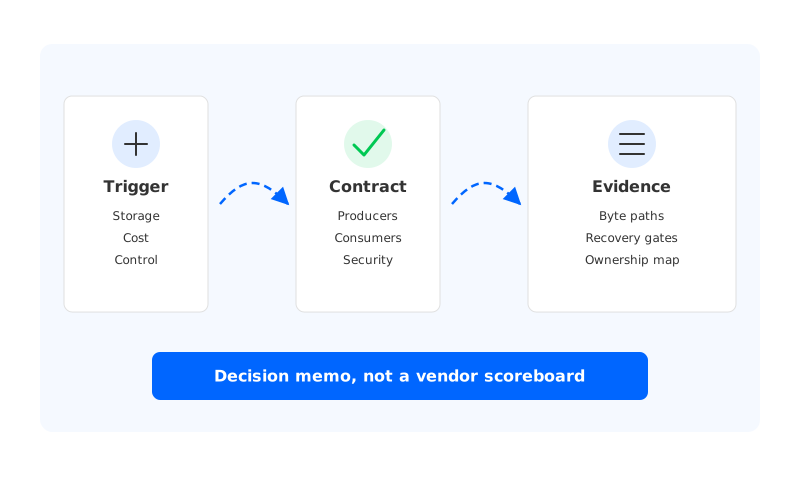
Name the trigger before naming the vendor:
- Compatibility pressure: Existing producers, consumers, admin scripts, security policies, and monitoring should survive the platform change.
- Storage pressure: Retention, replay, broker replacement, and scale events are dominated by where durable stream data lives.
- Cost pressure: The material cost line may be broker hours, storage, data transfer, private connectivity, replay, or idle headroom.
- Control pressure: Security and cloud architecture teams need a clear boundary for data, metadata, keys, logs, metrics, and support access.
- Migration pressure: The team needs a reversible cutover path with offset validation, duplicate handling, rollback gates, and ownership after launch.
This framing keeps the evaluation respectful. Redpanda can be a strong answer when its architecture and operating model match the workload. Confluent can be a strong answer when the organization values a broad managed ecosystem. Amazon MSK can be a strong answer when teams want AWS-native managed Apache Kafka. Aiven can be a strong answer for managed open-source operations across clouds. The point is not to score them in isolation; the point is to test the assumption that triggered the search.
2Start With the Kafka Contract
Kafka compatibility is not a single checkbox. Apache Kafka exposes a broad operational contract: producer acknowledgments, idempotence, transactions, consumer group coordination, offset commits, ACLs, quotas, topic configuration, compaction, retention, Connect, Streams, admin APIs, and observability conventions. Most workloads use only part of that surface, but the part they use becomes the migration contract.
Redpanda's documentation states compatibility with Apache Kafka versions 0.11 and later, with documented exceptions and validated clients. That is useful evidence, and it should be read directly instead of reduced to a slogan. It still does not replace a workload test. A Java producer using idempotence, a Python consumer with manual commits, a compacted topic used for state reconstruction, and a Kafka Connect pipeline all create different risks.
The contract should be written before the shortlist is debated. It does not need to be long, but it must be specific enough that engineers can run it and procurement can understand what risk is being accepted.
| Contract area | Evidence to collect | What a candidate must prove |
|---|---|---|
| Producers | Client versions, acks, retries, batching, compression, idempotence, transactions | Writes preserve expected behavior under normal load, retry storms, and failover. |
| Consumers | Group assignment, commit pattern, reset policy, lag alerts, replay windows | Consumers resume predictably after cutover, rollback, and backlog recovery. |
| Security | Authentication, ACLs, secrets, private networking, audit evidence | Identity and network boundaries survive the move without policy gaps. |
| Operations | Dashboards, SLOs, quotas, topic automation, incident runbooks | On-call teams can diagnose the new system with production-grade signals. |
This table changes the order of the conversation. Instead of asking which platform has the most attractive overview, the team asks which platform preserves the workload contract with the least hidden change. That is a stricter test, and it is fairer to every vendor in the room.
3Architecture Criteria Behind the Shortlist
Kafka-compatible platforms can expose similar APIs while making very different choices under the API. Traditional Apache Kafka keeps active log segments on broker-attached storage and uses replication between brokers for durability. Apache Kafka tiered storage adds a remote tier for completed log segments while keeping local storage in the write path. Other Kafka-compatible engines use broker-local storage with a different implementation. Shared-storage systems use object storage as a core durability layer and make serving brokers less tied to unique local disks.
Those choices decide what happens during scale, recovery, retention growth, and failure. A system that is elegant for hot, short-retention workloads may be less attractive when the hard problem is long replay. A managed service can reduce operational burden while introducing service-specific meters and control-plane boundaries. A shared-storage design can change recovery and cost shape, but it must prove its WAL, cache, metadata, and object-storage behavior under the workload's latency target.
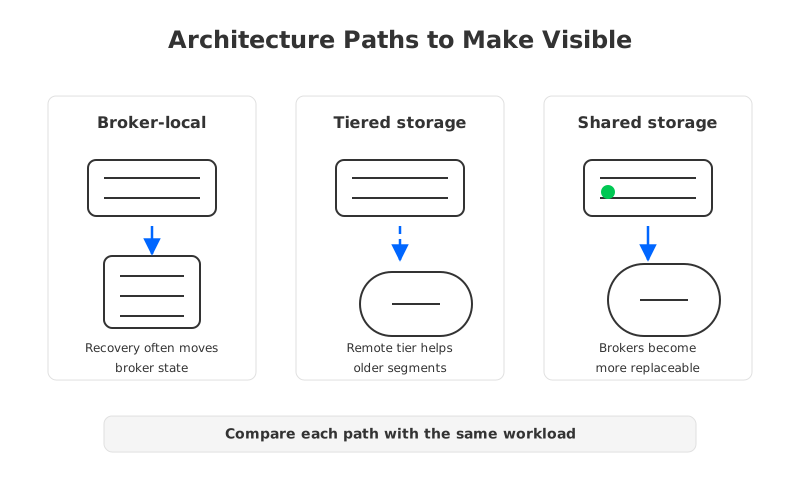
The architecture review should make four paths visible:
- Serving path: Where do fresh writes land, when does the producer receive acknowledgment, and what happens to p99 latency under bursty traffic?
- Durability path: How many durable copies are created, where do they sit, and which system owns the retained stream after a broker is replaced?
- Recovery path: Does node loss trigger local rebuild, partition movement, cache warmup, metadata reassignment, or compute reattachment to shared data?
- Control path: Which service owns upgrades, metadata, telemetry, support access, policy enforcement, and incident escalation?
These are architecture questions, not marketing questions. If a team cannot draw these paths for a candidate, it is not ready to compare cost or declare a winner. The diagram matters because the expensive and risky parts of streaming are often outside the happy-path benchmark.
4Model Cost by Byte Path, Not by Product Name
Kafka cost follows bytes and operating events. Amazon MSK pricing illustrates this clearly: standard broker pricing includes broker instance usage and storage, while AWS also notes that standard data transfer charges can apply for data transferred in and out of MSK clusters. EC2 pricing separately documents data transfer as its own meter. The exact number depends on region, service type, traffic direction, private connectivity, discounts, and contract terms, but the lesson is stable: a platform cost model that ignores byte paths is not credible.
Draw steady state and abnormal state separately. Steady state includes producer ingress, replication or durability writes, consumer fan-out, retained storage, private connectivity, observability, and idle headroom. Abnormal state includes backlog replay, broker replacement, region or zone impairment, migration overlap, reindexing, and incident-driven reads. Many business cases model the first and forget the second, even though the second is where platform architecture shows its real behavior.
| Workload dimension | Steady-state question | Abnormal-state question |
|---|---|---|
| Write path | What ingest rate, message size, and acknowledgment policy define the normal workload? | What happens during producer retries, partial outage, or migration dual write? |
| Read path | How many consumer groups read the same data, and from which zones or networks? | What happens during replay, catch-up, or a consumer group reset? |
| Retention | How long must data remain available for replay or compliance? | What is the cost and latency of reading older data after an incident? |
| Recovery | How quickly must node or zone failure be absorbed? | Does recovery copy durable data, rebuild local logs, or attach compute to shared storage? |
The goal is not fake precision. A first-pass model can use ranges if the team does not have perfect telemetry. What matters is that every candidate receives the same workload input and that the dominant meter is named. If the dominant meter is storage, retention architecture matters. If it is cross-network movement, placement and replication behavior matter. If it is idle headroom, elasticity and scale-down behavior matter. If it is SRE time, the operating model belongs in the cost model.
5Migration Risk Is Part of the Platform
A Kafka platform migration is a change to application behavior, not a storage copy. Producers and consumers need a cutover path. Offsets need validation. ACLs and authentication need mapping. Dashboards need destination-specific signals. Runbooks need destination-specific failure modes. Rollback needs a point where it is still safe, and a point where it becomes a separate recovery project.
Start the proof of concept with a representative workload, not a toy topic. The best candidate workload is important enough to reveal real client behavior, lag patterns, security controls, and incident procedures, but contained enough that a failed test does not become a business outage. Long-lived consumer groups, compacted topics, transactional producers, large messages, Kafka Connect pipelines, and strict replay expectations should enter the test early because they expose the gaps that a simple produce-consume demo hides.
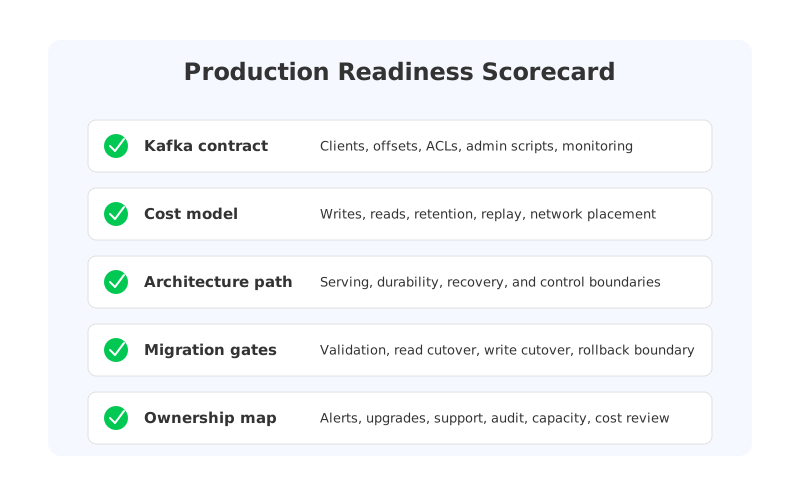
The migration plan should define four gates. First, the destination becomes eligible for validation because data, security, metrics, and application tests exist. Second, consumers read from the destination with an offset and duplicate-handling policy. Third, producers switch their write path under an agreed rollback window. Fourth, rollback becomes unsafe or expensive enough that a formal go-forward decision is required. Skipping the fourth gate is how migrations turn into irreversible experiments.
Ownership belongs in the same review. Managed services reduce some operational work, but they do not remove accountability for alerts, quotas, audit evidence, support escalation, cost review, certificate rotation, and business continuity. BYOC or self-managed models can improve control, but they add cloud-account, IAM, quota, networking, and upgrade responsibilities. A platform is production-ready only when the team that will operate it can explain what changes on Monday morning after cutover.
6How AutoMQ Fits the Evaluation
After the neutral framework is in place, AutoMQ becomes relevant as a specific architecture to test rather than another name on an alternatives list. AutoMQ is a Kafka-compatible, cloud-native streaming system that keeps Kafka protocol compatibility while using S3Stream shared storage, stateless brokers, and a WAL layer to decouple durable stream data from broker-local disks. Its public documentation describes compatibility with Apache Kafka and S3Stream's approach of offloading Kafka log storage to object storage.
That design is most relevant when the trigger behind the search is storage scaling, recovery behavior, retained data, replay cost, cross-zone traffic, or data-plane control. If durable data is no longer uniquely bound to broker-local disks, broker replacement and capacity changes can be evaluated differently. If a deployment can avoid broker-to-broker replica traffic across availability zones, the cost and placement conversation changes for workloads where network movement is a major concern.
AutoMQ should still be tested with the same scorecard as every other candidate. Validate the Kafka contract actually used by applications. Model write rate, read fan-out, retention, placement, migration overlap, and failure recovery. Review WAL and cache choices against latency targets. Confirm who owns the data plane, control plane, logs, metrics, keys, upgrades, and support path. Shared storage changes the architecture assumption, but production trust still comes from evidence.
The search that began with redpanda alternatives should end as a decision memo. State the workload contract, the architecture assumption being replaced, the cost meter that matters, the migration gate that controls risk, and the team that will own the platform. If shared-storage Kafka compatibility is part of your shortlist, start with the AutoMQ Cloud Console and run one representative workload through your own compatibility, cost, and recovery scorecard.
7References
- Apache Kafka documentation
- Apache Kafka tiered storage documentation
- Redpanda Kafka compatibility documentation
- Amazon MSK pricing
- AWS EC2 data transfer pricing
- AutoMQ compatibility with Apache Kafka
- AutoMQ S3Stream Shared Streaming Storage overview
- AutoMQ inter-zone traffic overview
8FAQ
8.1What should teams evaluate before choosing a Redpanda alternative?
Start with the workload contract: Kafka clients, producer settings, consumer offsets, ACLs, monitoring, retention, replay, failure recovery, migration rollback, and ownership. Vendor comparisons are useful after those requirements become testable.
8.2Is Kafka compatibility enough for a production migration?
No. Kafka compatibility is necessary, but production migration also depends on client behavior, admin workflows, security mapping, observability, offset handling, duplicate strategy, rollback gates, and SRE ownership.
8.3How should FinOps teams compare Kafka-compatible engines?
Use the same workload inputs for every candidate and model bytes through writes, reads, retention, replay, private connectivity, migration overlap, and recovery events. The winning cost model is the one that explains which meter dominates as the workload grows.
8.4When does shared storage matter in a Redpanda alternatives evaluation?
Shared storage matters when durable data movement, broker replacement, long retention, replay, elastic capacity, or cross-zone traffic is the constraint. It is less decisive when the workload is small, hot, short-retention, and dominated by local serving latency.
8.5Where does AutoMQ fit among Kafka-compatible options?
AutoMQ fits when a team wants Kafka-compatible APIs while testing a cloud-native shared-storage architecture with stateless brokers and object-storage-backed durability. It should be evaluated with the same compatibility, latency, cost, governance, and migration evidence as any other platform.


