
Table of Contents
Table of Contents
Teams searching for Kafka-compatible messaging on GCP usually want two things that pull in different directions. Application teams want to keep the Kafka clients, connectors, offsets, and stream processing jobs they already trust. Platform teams want fewer broker operations, faster recovery, and a cost model that fits cloud infrastructure better than traditional broker-local storage. The hard part is not finding a messaging service on Google Cloud. The hard part is deciding how much Kafka compatibility you actually need.
"Kafka-compatible" is an overloaded phrase. Sometimes it means a service can exchange data with Kafka through a connector. Sometimes it means the application can continue using Kafka producer and consumer APIs. In stricter evaluations, it means the target supports the Kafka protocol, consumer group semantics, offset behavior, topic administration, security controls, and enough ecosystem compatibility that Kafka Connect, Kafka Streams, Flink, Spark, and observability tools still behave predictably. Those are different promises.
On Google Cloud, this distinction matters because Pub/Sub, Google Cloud Managed Service for Apache Kafka, self-managed Kafka on GKE or Compute Engine, and Kafka-compatible platforms such as AutoMQ solve different problems. Pub/Sub is a native Google Cloud messaging service with its own client libraries and delivery model. Managed Service for Apache Kafka is a managed Apache Kafka service for teams that want Kafka without operating every part of the cluster. AutoMQ keeps Kafka as the application-facing contract while changing the storage and broker architecture underneath.
The useful question is not "Which one is Kafka-compatible?" It is: "Which compatibility surfaces must remain stable for this workload, and which operational surfaces can change?"
1What Kafka-Compatible Really Means
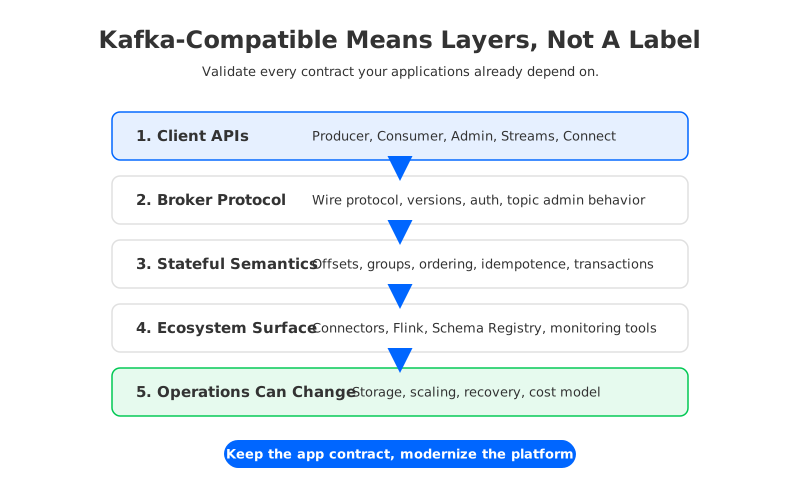
Kafka compatibility starts with the client API, but it does not end there. A producer using acks=all, idempotence, compression, custom partitioning, TLS, and SASL depends on more than a method signature. A consumer group depends on coordination, offset commits, rebalance behavior, fetch behavior, and lag semantics. A Kafka Streams application depends on internal topics, changelog behavior, state stores, and the way offsets map to processing progress.
That is why a compatibility review should be layered. The first layer is the wire protocol and client API: can existing producers, consumers, admin clients, and supported client versions connect without rewriting code? The second layer is state: can topics, partitions, consumer groups, offsets, retention, compaction, ordering expectations, idempotence, and transactions behave in a way your workload can accept? The third layer is ecosystem: can Kafka Connect, Kafka Streams, Flink connectors, schema tooling, monitoring agents, and audit pipelines keep working with limited changes?
The fourth layer is operational compatibility, and this is where teams should allow more change. If you are moving away from traditional Kafka operations, you probably want storage placement, scaling, recovery, balancing, and capacity planning to change. Keeping broker-local disks, manual partition movement, and rigid storage capacity just to preserve a familiar topology defeats the point. The best Kafka-compatible GCP design keeps the application contract stable while modernizing the infrastructure contract.
This is also where "Kafka-compatible Pub/Sub alternative" searches become tricky. Pub/Sub has topics and subscriptions, and it is excellent for many Google Cloud native eventing patterns. It is not a Kafka broker that accepts Kafka clients as-is. If your application can move to Pub/Sub semantics, Pub/Sub may reduce operational work dramatically. If your application must keep Kafka APIs, offsets, partitions, and Kafka ecosystem tools, Pub/Sub is a migration target, not a drop-in compatible layer.
2Compatibility Levels To Verify
Architects should treat compatibility as a test plan, not a claim. A platform can pass a basic produce-consume test and still fail a workload that relies on transactional producers, compacted topics, connector plugins, or exact lag dashboards. Start with a plain inventory: which Kafka features are application contracts, which are operational preferences, and which are historical defaults nobody has questioned in years?
Here is the practical compatibility map most teams need before they choose a GCP target:
| Surface | What to verify | Why it matters |
|---|---|---|
| Client and protocol | Producer, consumer, admin client versions, authentication, TLS, SASL, bootstrap behavior | Determines whether applications can move without code rewrites |
| Consumer groups and offsets | Offset migration, commit behavior, rebalance patterns, lag metrics, replay rules | Protects stream processors and side-effecting consumers from duplicate or skipped work |
| Topic semantics | Partitions, ordering, retention, compaction, max message size, quotas, configuration support | Captures business assumptions hidden in broker configuration |
| Transactions and idempotence | Idempotent producer support, transactional guarantees, failure handling | Critical for exactly-once style pipelines and Kafka Streams applications |
| Ecosystem tools | Connect, Streams, Flink, Spark, Schema Registry, monitoring, audit exports | Prevents a broker migration from becoming a platform-wide rewrite |
| Operations | Scaling, recovery, upgrades, balancing, storage expansion, cost visibility | Determines whether the new platform actually reduces Kafka operational load |
The table has an uncomfortable implication: compatibility is workload-specific. A logging pipeline with simple producers and consumers can tolerate a different target than a payments pipeline using transactions and strict replay controls. A data lake ingestion path built on Kafka Connect has a different risk profile than a microservice event bus with custom consumers. The question is whether your exact workload has been tested across the surfaces it uses.
3GCP Options For Kafka-Compatible Workloads
Google's own guidance frames Pub/Sub and Managed Service for Apache Kafka as different tools rather than interchangeable services. Pub/Sub leans toward operational simplicity and Google Cloud native integration. Managed Service for Apache Kafka leans toward Kafka API compatibility and portability for applications that already use Kafka. That framing is useful because it prevents a common architecture mistake: choosing the service with the lowest operational burden while ignoring the application contract that made Kafka valuable in the first place.
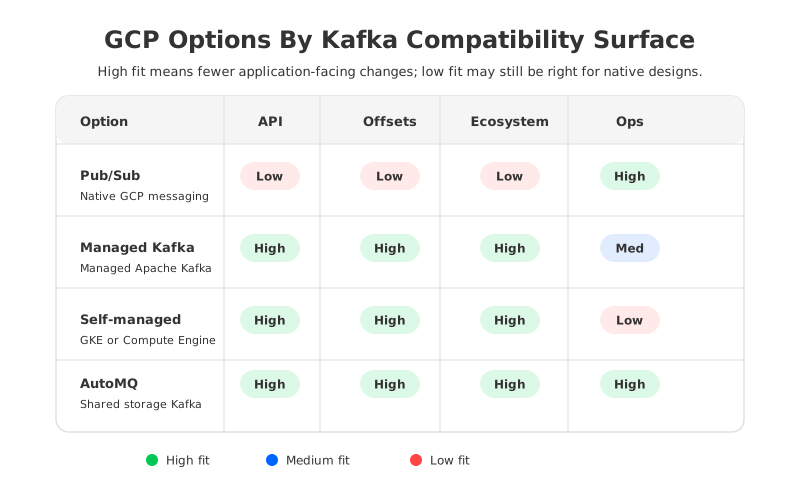
For a new GCP-native application that does not require Kafka clients, Pub/Sub is often the cleanest starting point. It removes broker management, integrates tightly with IAM and Google Cloud services, and supports features such as ordering keys and exactly-once delivery for supported pull subscriptions. But moving an established Kafka workload to Pub/Sub means adopting a different messaging model, not preserving the Kafka protocol.
Google Cloud Managed Service for Apache Kafka is closer to a Kafka-compatible answer. It runs open source Apache Kafka clusters as a managed Google Cloud service, so the application-facing model remains Kafka. The trade-off is that Kafka's capacity model still matters. Google Cloud pricing documentation separates cluster capacity, storage, and networking dimensions, including cross-zone replication traffic for multi-zone designs.
Self-managed Kafka on GKE or Compute Engine preserves Kafka semantics and gives teams control over versioning, plugins, tuning, networking, and storage. It is also the path with the largest operational surface: node sizing, disk expansion, partition reassignment, rolling upgrades, controller migration, security patching, failure drills, and FinOps analysis all remain your responsibility.
AutoMQ fits a different point in the map. It is a Kafka-compatible streaming platform that keeps Kafka protocol and ecosystem compatibility as the application-facing contract, while replacing traditional broker-local log storage with shared object storage and a write-ahead log layer. The architectural goal is not to make applications learn a new messaging API. It is to make brokers more stateless, reduce data movement during scaling and recovery, and move durable storage into cloud-native storage services.
4Why Operations Change Even When APIs Stay
Traditional Kafka ties compute and storage together. A broker is not only a process that handles client requests; it also owns local log segments for specific partition replicas. In cloud environments, that creates familiar operational problems: adding brokers does not automatically rebalance data, partition reassignment moves bytes across the network, retention increases disk pressure, and broker recovery can require rebuilding replicas.
A managed Kafka service can reduce the labor around these tasks, but the underlying storage relationship still shapes the system. If partitions remain attached to broker-local disks, capacity planning remains coupled to brokers. If multi-zone durability depends on Kafka replication, replication traffic remains part of the cost and performance picture. If scaling requires data movement, elasticity is bounded by how fast the cluster can move partition data safely.
Shared-storage Kafka-compatible platforms change that relationship. Durable log data moves out of broker-local disks and into shared cloud storage, while brokers act more like stateless compute nodes over the streaming storage layer. A write-ahead log handles the low-latency write path, and object storage holds durable data for retention and recovery. The trade-offs move from local disks and partition movement toward WAL latency, object storage behavior, network paths, and failure domains.
That is the context in which AutoMQ should be evaluated. It is not a replacement for Kafka semantics. It is a replacement for the traditional storage and operations model behind Kafka while keeping the Kafka-facing contract. For GCP teams, that can be attractive when the application estate is already Kafka-heavy but the platform team wants faster elasticity, simpler recovery, and a cloud storage cost structure.
5A Compatibility Test Plan Before Cutover
The most useful migration artifact is a compatibility test plan that application teams can understand. It should be small enough to run repeatedly and specific enough to catch semantic differences. Do not start with a generic benchmark. Start with the contracts your production systems already depend on.
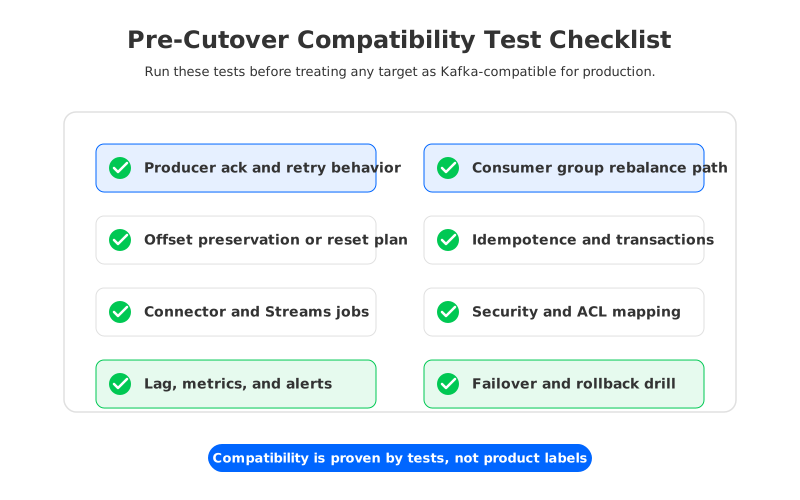
First, test producers under the configurations they actually use: compression, batching, idempotence, retries, timeouts, custom partitioners, authentication, and the largest messages you permit. Then test consumers with real group sizes, rebalance conditions, offset commits, replay behavior, and lag dashboards. If a team operates Flink, Spark, Kafka Streams, or Kafka Connect, those jobs need their own tests.
Second, test failure behavior. Kill clients. Restart brokers or target nodes if you control them. Interrupt network paths in a staging environment. Force a consumer rebalance while writes continue. Validate that monitoring catches the symptoms your SRE team expects to see: produce errors, fetch latency, consumer lag, group churn, storage pressure, and request throttling.
Third, decide how offsets move. Some migrations preserve offsets directly. Others replicate data and cut consumers over at a known timestamp or offset boundary. Some intentionally reset consumer groups when replay is acceptable. The dangerous path is pretending this decision can be made at cutover time. Offset handling is the difference between a calm migration and a replay storm.
Finally, make rollback explicit. A Kafka-compatible target should reduce client rewrites, but it does not remove migration risk. Keep a rollback plan for each topic group, not only for the entire cluster. Validate data comparison, cutover order, and ownership of the final go/no-go decision.
6How To Choose
Choose Pub/Sub when you want a Google Cloud native messaging service and your applications can adopt Pub/Sub semantics. This is especially reasonable for new services, event-driven GCP applications, and teams that value managed simplicity over Kafka ecosystem portability. Treat it as a redesign, not as a Kafka-compatible broker.
Choose Google Cloud Managed Service for Apache Kafka when you want Kafka API compatibility with a Google-managed service and are comfortable with Kafka's underlying capacity and storage model. This path is often the most direct fit for teams that want Apache Kafka on GCP without self-managing every operational detail.
Choose self-managed Kafka when you need maximum control and have the operational depth to own it. That includes specialized plugins, strict version control, custom networking, custom disk strategy, and unusually specific broker tuning.
Evaluate AutoMQ when your real requirement is to keep Kafka APIs while reducing the operational drag of traditional Kafka storage. Its shared-storage design is most relevant when scaling speed, recovery time, storage elasticity, and cross-zone data movement are major concerns. The evaluation should prove client compatibility, ecosystem behavior, and the new operational model under your workload.
Kafka-compatible messaging on GCP is not a single product category. It is a decision about which contracts must stay stable and which parts of the platform you are ready to modernize. If your applications already speak Kafka, preserve that contract deliberately. If your operations model is the part causing pain, change that layer with equal deliberation.
If you are evaluating a Kafka-compatible architecture for GCP, AutoMQ's documentation is a useful next stop: review its Apache Kafka compatibility notes, study the shared-storage architecture, or talk with the AutoMQ team about a workload-specific compatibility review.
7References
- Google Cloud: Choose Managed Service for Apache Kafka or Pub/Sub
- Google Cloud: Managed Service for Apache Kafka overview
- Google Cloud: Managed Service for Apache Kafka pricing
- Google Cloud Pub/Sub overview
- Google Cloud Pub/Sub quotas and limits
- Google Cloud Pub/Sub exactly-once delivery
- Apache Kafka documentation
- AutoMQ: Compatibility with Apache Kafka
- AutoMQ: Architecture overview
8FAQ
8.1Is Pub/Sub Kafka-compatible?
Pub/Sub is not a Kafka broker and does not preserve Kafka producer and consumer APIs as a drop-in target. It is a Google Cloud native messaging service with its own APIs, client libraries, delivery model, and operational strengths. It can be the right replacement when you are willing to redesign around Pub/Sub semantics.
8.2Is Google Cloud Managed Service for Apache Kafka Kafka-compatible?
Yes, it is designed as a managed Apache Kafka service and is the closest Google-native option when the application contract must remain Kafka. You still need to verify version support, security configuration, connector behavior, quotas, networking, storage, and cost assumptions for your workload.
8.3What should I test before moving Kafka workloads on GCP?
Test producer behavior, consumer groups, offsets, rebalances, topic configuration, transactions if used, Kafka Connect jobs, Kafka Streams or Flink jobs, security mapping, monitoring, failure behavior, and rollback. A basic produce-consume test is not enough for production workloads.
8.4Where does AutoMQ fit in a GCP Kafka-compatible architecture?
AutoMQ fits when the goal is to preserve Kafka APIs and ecosystem compatibility while changing the storage and operations model. Its shared-storage architecture is intended to make brokers more stateless and reduce the operational burden tied to broker-local disks, but teams should still validate compatibility against their own producers, consumers, connectors, and stream processors.


