
Table of Contents
Table of Contents
Kafka teams used to treat object storage as a retention extension: keep the hot log on broker disks, then move older segments to lower-cost durable storage when local capacity becomes a constraint. That model still matters, especially for Apache Kafka clusters using tiered storage. But a different category has moved into the center of architecture discussions: Kafka-compatible streaming platforms that make object storage part of the primary durability and scaling model, not only a cold tier.
The attraction is clear if you operate Kafka in the cloud. Broker-local disks tie storage, compute, recovery, reassignment, and cost together. More retention can mean larger brokers. Broker loss can mean replica catch-up. Partition growth can become a data movement project. Object storage promises a different boundary: durable data lives in a cloud storage layer, while compute nodes become more replaceable.
That promise is not a single architecture. WarpStream, AutoMQ, Apache Kafka with tiered storage, and managed Kafka services can all appear in the same search journey, but they answer different questions. The useful comparison is not "Which one uses S3?" It is "Where is the primary log, what acknowledges writes, how does recovery work, and how much Kafka behavior remains compatible?"
1Why Object Storage Entered the Kafka Architecture Discussion
Apache Kafka's original durability model is broker-centered. Kafka documentation describes partitions with leaders and followers, committed messages, in-sync replicas, and replicated logs. This is a strong design for many workloads because it gives operators clear semantics around acknowledgments, replicas, and failure handling. It also means broker disks are not incidental infrastructure. They are the durable home of partition data.
Cloud infrastructure changes the economics around that design. Object storage such as Amazon S3 is built for high durability and elastic capacity, and cloud providers publish pricing dimensions for storage, requests, retrievals, and data transfer. For event streaming, that changes the cost model from "how many broker disks do we reserve?" to "how does the engine map Kafka traffic into object storage capacity, requests, and network paths?"
Traditional Kafka can make infrastructure events feel like data events: broker replacement, partition reassignment, disk expansion, and cluster balancing all interact with local log placement. Object-storage-backed platforms try to reduce that coupling. If compute can be replaced without reconstructing large local replicas, scaling and recovery become metadata and scheduling problems more often than bulk data-copy problems.
The tradeoff is that object storage is not a local SSD. It has different latency, request, consistency, and billing characteristics. A credible platform must show how it bridges Kafka's append/read expectations and an object API designed for durable blobs.
2Three Architecture Patterns
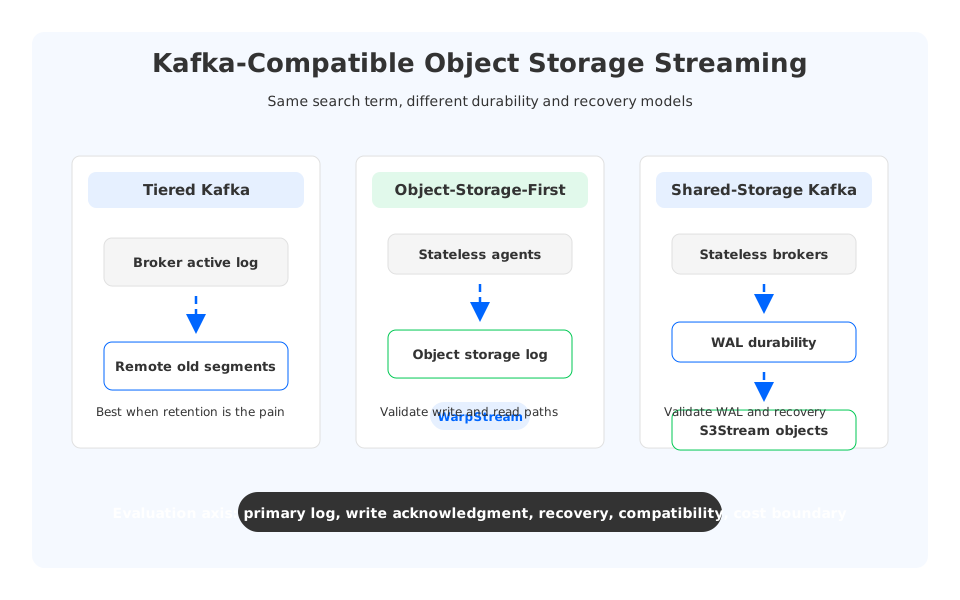
The phrase "object storage Kafka" is imprecise. It can refer to at least three patterns, and mixing them together causes bad procurement decisions. A tiered-storage Kafka cluster, an object-storage-first service, and a shared-storage Kafka-compatible platform may all reduce the amount of hot data kept on broker disks, but they do not offer the same recovery path or latency contract.
| Pattern | Primary idea | What to validate |
|---|---|---|
| Kafka with tiered storage | Broker write path, remote older segments | Local disks, tier fetch latency, reassignment |
| Object-storage-first streaming | Kafka-compatible agents, object storage data plane | Write acknowledgments, metadata, request amplification |
| Shared-storage Kafka-compatible platform | Kafka protocol, separated compute and storage, often WAL plus objects | WAL durability, recovery, read-after-write behavior |
These categories are failure models. When a node disappears, does another node need to rebuild local replicas? When a producer receives an acknowledgment, which durable systems have accepted the write? When consumers replay a backlog, do they read from broker disks, remote objects, a cache, or a shared log layer? The answers determine whether a platform fits low-latency operational streams, high-retention analytics feeds, replay-heavy event sourcing, or mixed workloads.
2.1Tiered Storage Kafka
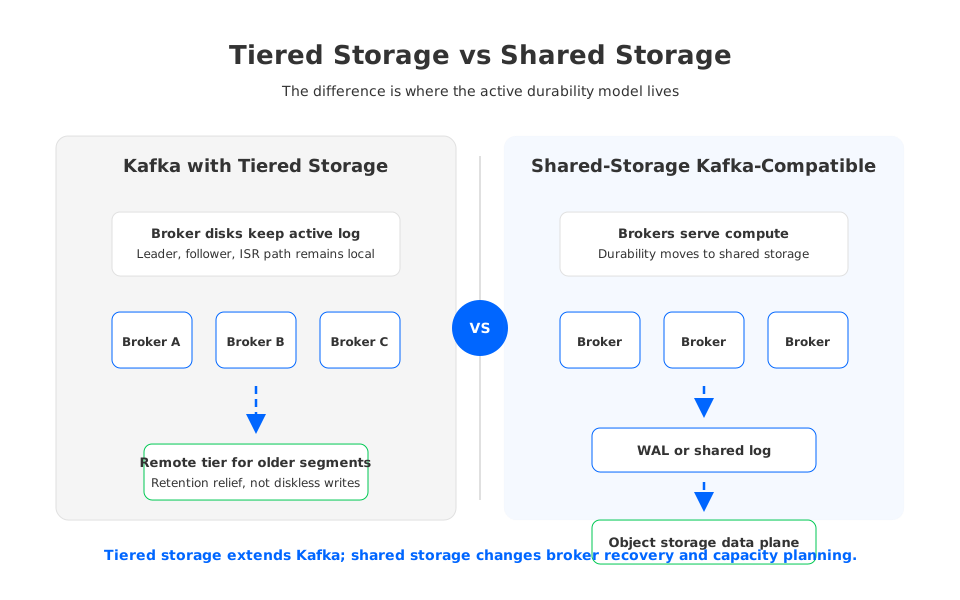
Apache Kafka tiered storage, documented in current Kafka releases, moves completed log segments to remote storage while keeping the active write path on brokers. For organizations already committed to Kafka operations, this can reduce local storage pressure and make historical data less tightly coupled to broker disks.
It should not be evaluated as a full replacement for shared-storage streaming. Broker-local storage still matters for the active log, and client-facing behavior remains anchored in Kafka's traditional model. That continuity helps incremental adoption, but broker lifecycle operations do not become fully stateless.
Tiered storage is often enough when the pain is long retention rather than elastic compute. It is less compelling when the root problem is repeated broker replacement, partition movement, or storage over-provisioning. In those cases, teams usually continue toward diskless or shared-storage designs.
2.2Object-Storage-First Streaming
WarpStream made the object-storage-first category visible for Kafka-compatible workloads. Its documentation describes stateless agents and object storage as the backing store, and Confluent announced its acquisition of WarpStream in September 2024. That announcement validated the architecture category for mainstream Kafka buyers, not only early adopters.
The central appeal is operational elasticity. If agents are stateless and durable data is in object storage, capacity can be added or replaced without treating each agent as a holder of unique partition data. That fits BYOC deployments and workloads where storage growth should not force broker reshaping.
The hard questions are about the write and read paths. Object-storage-first designs must batch, index, cache, and coordinate data in ways that keep Kafka clients usable while avoiding runaway object request costs. High-throughput workloads and tight tail-latency paths need separate validation.
2.3Shared-Storage Kafka-Compatible Platforms
Shared-storage Kafka-compatible platforms occupy a related but distinct branch. The goal is to keep Kafka clients, tools, and operating concepts relevant while separating broker compute from durable storage. The implementation may use a write-ahead log, object storage, metadata services, and object layout strategies that make brokers easier to replace.
AutoMQ belongs in this category. Its public documentation describes a Kafka-compatible architecture with stateless brokers, S3Stream shared storage, and WAL storage options. The important point is not that every buyer should prefer this pattern. It is that WAL plus shared object storage creates a different trust model from a pure "agents write to object storage" mental model. Evaluators should ask how writes are acknowledged, how the WAL is protected, and how readers access fresh versus historical data.
This pattern is relevant when a team wants Kafka compatibility and cloud storage economics without keeping broker-local disks as the primary durability model. It may also fit organizations that want BYOC-style control or a migration path from existing Kafka clients.
3How WarpStream and AutoMQ Differ
WarpStream and AutoMQ are frequently compared because both appear in searches for Kafka-compatible object storage streaming. The comparison is more useful when framed as architecture, not vendor adjacency.
WarpStream's public architecture centers on stateless agents and object storage. That gives buyers a clean mental model: agents serve Kafka-compatible traffic while object storage becomes the durable data plane. The procurement questions then focus on current Confluent packaging, BYOC boundaries, supported Kafka APIs, metadata behavior, read latency, request cost, and operational visibility.
AutoMQ's public architecture centers on Kafka compatibility, stateless brokers, S3Stream shared storage, and WAL-backed durability paths. That gives buyers a different evaluation angle: how the WAL absorbs write latency, how broker recovery avoids local replica reconstruction, and how much existing Kafka tooling remains usable.
The difference is not reducible to "one is lower cost" or "one is more Kafka-like." A better comparison separates five dimensions:
- Durability path: What accepts a write before the producer sees success?
- Compute recovery: What happens to partition service when a broker or agent disappears?
- Read model: How are tail reads, catch-up reads, and historical replay served?
- Compatibility surface: Which producer, consumer, admin, security, transaction, and ecosystem behaviors are supported?
- Cost boundary: Which costs appear in the vendor bill, and which appear in the customer's cloud bill as storage, requests, retrieval, and networking?
This framing also keeps Confluent Cloud, Amazon MSK, Redpanda, and self-managed Kafka in the right context. Managed Kafka services reduce operational ownership, but may still rely on broker-local storage or provider-specific abstractions. Redpanda changes the broker implementation and operational profile. Self-managed Kafka with tiered storage may be the least disruptive option, but it does not remove the local active-log model.
4Cost Is a Workload Model, Not a Slogan
Object storage can reduce the need to provision large broker disks for long retention, but it does not make streaming cost disappear. The bill moves. Storage capacity, PUT and GET requests, retrieval patterns, cross-AZ traffic, caches, metadata services, compute, and vendor usage fees all need to be modeled together.
Start with workload inputs instead of platform claims:
- Average and peak write throughput, including compression assumptions.
- Message size distribution, because small records can amplify request and indexing overhead.
- Partition count, key distribution, and topic skew.
- Consumer fan-out, including lagging consumers and replay-heavy groups.
- Retention by access pattern, not only by days.
- Availability zone placement for producers, consumers, compute, metadata, and object storage access.
- Required Kafka features, including transactions, quotas, ACLs, admin APIs, Kafka Connect, Flink, and schema tooling.
The critical number is not only dollars per terabyte-month. For Kafka-like workloads, object count, request frequency, compaction strategy, cache hit rate, and read amplification can dominate the surprise portion of the bill. Efficient object layout can matter as much as storage price.
Latency has the same dependency. Batching can reduce request cost but add delay. A WAL can absorb write latency but introduces its own failure domain. Caching can protect tail reads but needs eviction and locality rules. The warning sign is when a vendor comparison hides these tradeoffs.
5Compatibility Needs a Real Test Matrix
Kafka compatibility is the adoption bridge. Teams do not search for Kafka-compatible object storage streaming because they want to rewrite producers, consumers, dashboards, and runbooks. They search for it because they want better storage economics while preserving as much of the Kafka ecosystem as possible.
A bootstrap-server smoke test is not enough. The test matrix should include the production behaviors your applications actually depend on:
| Compatibility area | Test examples |
|---|---|
| Producers | idempotence, batching, retries, compression, acks, transactions |
| Consumers | rebalances, offset commits, lag visibility, resets, catch-up reads |
| Administration | topic creation, partition changes, configs, quotas, ACLs |
| Ecosystem | Kafka Connect, migration tooling, Flink, schema registry clients |
| Operations | metrics, logs, alerts, upgrades, incident diagnostics |
The same matrix should run against failure cases. Produce and consume while terminating compute nodes. Replay a backlog while scaling out. Change partitions while consumers lag. The goal is not to prove that a platform is identical to Apache Kafka in every internal detail; it is to discover the differences before migration week.
6Evaluation Scorecard
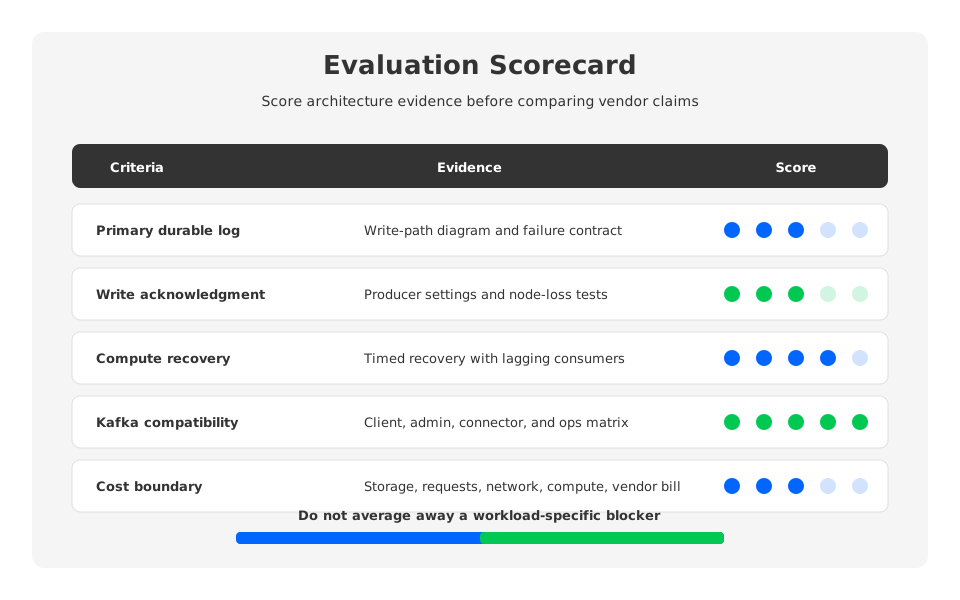
The strongest buying process treats object-storage streaming as an architecture decision before it becomes a vendor shortlist. The following scorecard keeps the discussion concrete enough for platform engineering, SRE, security, FinOps, and application teams.
| Evaluation question | Why it matters | Evidence to request |
|---|---|---|
| What is the primary durable log? | Defines the failure model | Architecture and write-path docs |
| What acknowledges producer writes? | Sets latency and durability semantics | Producer guidance and failure tests |
| How does node loss recover? | Separates stateless recovery from replica rebuild | Timed node-loss test |
| How complete is Kafka compatibility? | Avoids migration surprises | API, client, connector, and admin matrix |
| How does object storage cost scale? | Prevents request and retrieval surprises | Workload-based bill model |
| Who owns the data boundary? | Affects security and procurement | BYOC, VPC, IAM, encryption, support docs |
Score each candidate from one to five, but do not average the result too quickly. A platform with a weak transaction story may still fit analytics ingestion. A platform with excellent operational elasticity may be wrong for a latency-critical fraud path. A shared-storage Kafka-compatible platform such as AutoMQ may be compelling when Kafka ecosystem continuity, stateless recovery, and object storage economics are all first-order requirements.
7A Practical Shortlist
For most teams, the shortlist falls into four buckets:
- Stay on Kafka and add tiered storage when the main issue is long retention and the team wants the smallest architectural change.
- Use a managed Kafka service when the primary requirement is operational offload rather than storage redesign.
- Evaluate object-storage-first platforms such as WarpStream when stateless agents, object storage durability, and BYOC-style economics match the workload.
- Evaluate shared-storage Kafka-compatible platforms such as AutoMQ when the team wants Kafka protocol continuity, stateless broker recovery, and a storage architecture built around WAL plus object storage.
The right answer may also be mixed. A platform team can keep an existing Kafka cluster for ultra-low-latency streams, move high-retention topics to an object-storage-backed system, and standardize future pipelines on shared storage. Production Kafka estates rarely have one workload shape.
What matters is that object storage is no longer only a cold archive in the Kafka conversation. It is now a primary architecture axis. Once that is clear, the evaluation becomes less about brand names and more about the contracts your systems need: write acknowledgment, recovery time, compatibility surface, cost boundary, and operational ownership.
8References
- Apache Kafka Documentation: Replication
- Apache Kafka Documentation: Tiered Storage
- WarpStream Documentation: Architecture
- Confluent: Confluent Acquires WarpStream
- AutoMQ Documentation: Architecture Overview
- AutoMQ Documentation: S3Stream
- AutoMQ Documentation: WAL Storage
- AutoMQ Documentation: Stateless Broker
- Amazon S3 User Guide
- Amazon S3 Pricing
9FAQ
9.1Is object storage Kafka the same as Kafka tiered storage?
No. Kafka tiered storage moves older log segments to remote storage while Kafka's active write path still depends on broker-local storage. Object-storage-first and shared-storage Kafka-compatible platforms make object storage part of the primary durability and scaling architecture.
9.2Why compare WarpStream and AutoMQ?
They both appear in searches for Kafka-compatible streaming systems built around object storage, but they represent different architecture choices. WarpStream is commonly evaluated as an object-storage-first platform with stateless agents. AutoMQ is commonly evaluated as a shared-storage Kafka-compatible platform with stateless brokers, S3Stream, and WAL-backed durability paths.
9.3Can object storage streaming replace Apache Kafka?
It can replace Kafka for some workloads, but the decision depends on compatibility requirements, latency budgets, operational ownership, and failure behavior. Teams should test real producer settings, consumer groups, admin APIs, connectors, replay patterns, and node-loss recovery before treating any Kafka-compatible platform as a drop-in replacement.
9.4Does object storage always lower Kafka cost?
No. Object storage can improve retention economics and reduce broker disk over-provisioning, but request volume, retrieval patterns, network paths, cache behavior, compute, and vendor fees still matter. A workload-based bill model is more reliable than a generic storage-cost comparison.
9.5Where does AutoMQ fit in this category?
AutoMQ fits the Kafka-compatible shared-storage category. It is relevant when teams want to keep Kafka clients and ecosystem tools while moving durable data away from broker-local disks into a storage architecture based on S3Stream, WAL, and stateless brokers.


