
Table of Contents
Table of Contents
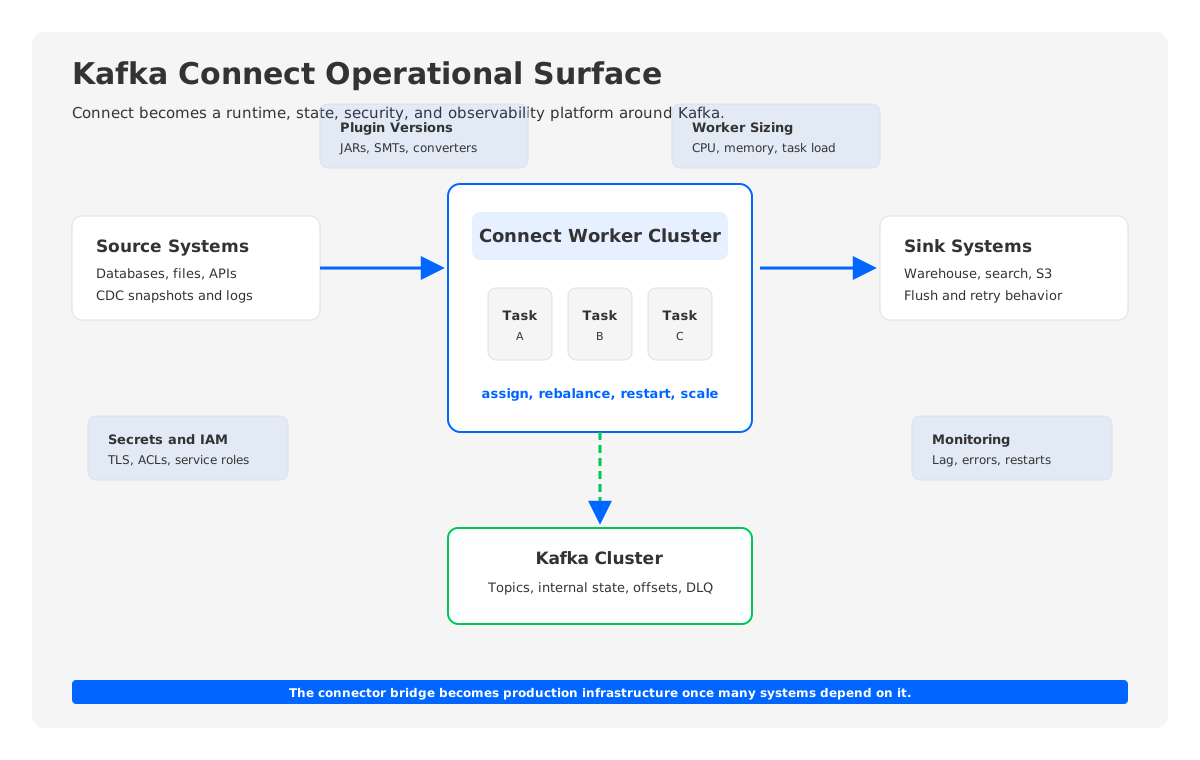
Kafka Connect usually enters the architecture as a practical bridge: move database changes into Kafka, land topics in object storage, push events into a warehouse, or sync search indexes without making every application team write ingestion code. The surprise comes later. After enough connectors, the bridge starts to look like another platform with its own runtime, upgrades, plugin estate, secrets, network paths, failure modes, and bill.
That is why teams searching for Kafka Connect alternatives are often not rejecting the Kafka Connect framework itself. They are questioning the operating model around it. Self-managed Connect can become a worker-sizing and incident-response burden. Managed Connect can reduce that burden, but pricing and provider constraints may shift the bottleneck instead of removing it. SaaS CDC tools can simplify database capture while narrowing flexibility. A platform-integrated approach can make sense when Connect and Kafka are reviewed together rather than as separate tickets.
The useful question is not "what replaces Kafka Connect?" It is "which layer should own connector operations for this workload?" The answer depends on connector type, throughput shape, plugin requirements, network topology, compliance boundaries, and whether the larger Kafka platform is already under review.
1Why Kafka Connect Becomes Its Own Platform Problem
Apache Kafka Connect defines connectors, tasks, workers, converters, transformations, and internal state such as connector configuration, status, and offsets. In distributed mode, multiple workers cooperate as a cluster and assign connector tasks across the available worker processes. This is a strong model because it separates connector logic from application code, but it also creates a second distributed system next to Kafka.
The operational surface grows in places that are easy to underestimate:
| Area | What Teams Must Own | Why It Becomes Painful |
|---|---|---|
| Worker runtime | VM, container, or Kubernetes sizing; worker upgrades; heap and CPU limits | Connectors are not uniform; CDC snapshots and sink flushes can behave very differently from steady state |
| Connector tasks | Task parallelism, task failures, backoff behavior, restart policy | More tasks can increase throughput, but can also overload the source database or sink system |
| Offsets and state | Source offsets, sink commits, internal topics, recovery testing | A migration or restart can duplicate, skip, or replay data if offset strategy is vague |
| Plugins | Connector versions, custom SMTs, classpath isolation, dependency conflicts | A plugin that works in one runtime may fail under another managed policy |
| Security | Secrets, IAM, ACLs, TLS, private connectivity | Connect touches both Kafka and external systems, so it inherits both security models |
| Observability | Lag, errors, DLQ volume, retries, task restarts, throughput | Broker metrics alone do not explain connector behavior |
This is why a connector incident often crosses team boundaries. The Kafka team sees topic traffic and consumer lag. The database team sees replication slots, binlogs, or read pressure. The data platform team sees a broken sink table or bad records. The managed service owner sees a task state. None of those views is enough by itself.
Managed Connect helps when the runtime lifecycle is the main problem. It can remove worker installation, patching, and some scaling work. It does not remove the need to understand connector semantics, offset recovery, schema evolution, bad records, source-system protection, or data-path cost. Those are workload decisions, not merely infrastructure decisions.
2The Cost And Operations Drivers To Evaluate
Kafka Connect cost is rarely a single line item. It includes the connector runtime, Kafka cluster impact, network transfer, storage from retries or dead-letter queues, observability, and human time. Managed pricing pages make part of this visible. For example, AWS describes MSK Connect pricing around worker usage measured in MSK Connect Units, while Confluent Cloud documents managed connector billing dimensions such as task base pricing, throughput, and dedicated Connect cluster behavior depending on cluster type. The exact unit rates and billing policies change by service, region, and plan, so the durable habit is to model the dimensions rather than memorize one number.
Build the estimate around workload states, not average traffic:
- Normal steady state: the regular read or write rate after the connector has caught up.
- Initial snapshot: the burst when a CDC connector scans existing tables or a sink connector backfills historical topics.
- Catch-up after outage: the rate required to recover without violating downstream freshness targets.
- Replay or reprocessing: the cost of intentionally rerunning a connector or rebuilding a sink.
- Failure handling: retries, DLQ writes, bad-record inspection, and duplicate management.
Pricing becomes easier to reason about when those states are tied to ownership. If a managed provider charges by task, throughput, worker capacity, or dedicated runtime, the team should know which state drives the peak. If self-managed Connect runs on Kubernetes, the team should know which state defines node pool size, autoscaling policy, and source-system safeguards.
The second driver is network topology. Connectors sit between systems. A source connector may read from a private database, write to Kafka, and then trigger downstream sinks. A sink connector may read Kafka topics and write to a warehouse, search system, object store, or cache. Every hop can cross VPCs, subnets, zones, regions, NAT gateways, private endpoints, or provider boundaries. A connector that looks inexpensive in runtime terms can still create high data-transfer or operational cost if it forces traffic through the wrong path.
The third driver is compatibility. Some teams use only standard source and sink connectors with simple converters. Others depend on custom plugins, single message transforms, schema registry integration, field-level encryption, exactly-once assumptions where supported, or source-specific CDC behavior. The more custom the connector estate, the more a managed alternative must be tested before pricing is trusted.
3Alternatives To Self-Managed Kafka Connect
There are several Kafka Connect alternatives, but they solve different problems. Treat them as operating models rather than brand categories.
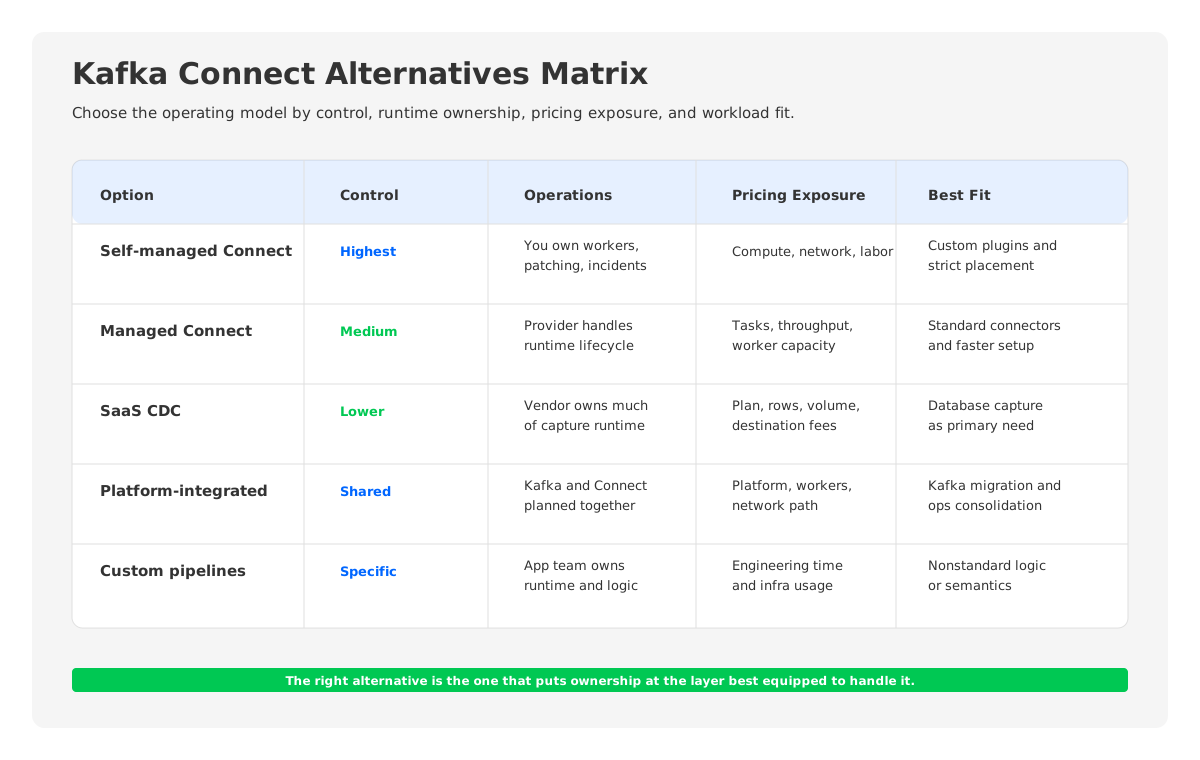
| Alternative | Fits Best When | Watch For |
|---|---|---|
| Keep self-managed Kafka Connect | You need full plugin control, custom networking, and deep runtime tuning | Worker lifecycle, scaling, security patching, incident ownership, and operational toil remain yours |
| Use managed Kafka Connect | Runtime operations are the bottleneck and your connectors fit the provider model | Pricing units, plugin constraints, private connectivity, task limits, and region availability |
| Use SaaS CDC or data integration | Database capture or business-tool integration is the main need | Kafka may become only one endpoint; offset semantics, schema control, and data residency need review |
| Use platform-integrated Connect | Kafka platform migration, data-plane placement, and connector operations are being reviewed together | Confirm connector catalog, custom plugin path, IAM model, observability, and migration workflow |
| Build custom pipelines | The workload needs application-specific semantics or nonstandard transforms | Engineering ownership increases; retries, idempotency, monitoring, and backfills must be designed explicitly |
Self-managed Connect remains a valid choice when control matters more than convenience. Teams running custom connectors, unusual dependencies, strict network placement, or specialized failure handling may prefer owning the runtime. The trade-off is that Connect must be operated like production infrastructure, not a helper process. It needs capacity planning, upgrade discipline, isolation between critical and experimental connectors, and recovery exercises.
Managed Kafka Connect is attractive when the main complaint is operational drag. It can reduce setup time and remove much of the worker-management work. It is especially useful when the connector set is standard, the provider supports the needed source and sink systems, and the team wants fewer runtime responsibilities. The evaluation should still include task scaling, billing behavior during paused connectors, private networking, custom plugin policy, and what happens during source snapshots or sink outages.
SaaS CDC tools can be a better fit when the real requirement is not "run Kafka Connect" but "capture database changes reliably." Debezium, for example, documents a family of connectors for databases such as MySQL, PostgreSQL, MongoDB, SQL Server, Oracle, Db2, and others. Some organizations run Debezium through Kafka Connect because they want Kafka-native integration and offset control. Others choose a managed CDC platform because they want less exposure to connector internals. That can be a good trade when the SaaS tool matches compliance, schema, latency, and cost expectations.
Platform-integrated Connect matters when connector pain is a symptom of broader Kafka platform friction. If the Kafka cluster is already expensive to scale, difficult to operate across zones, or constrained by local broker storage, moving only Connect may not solve the root issue. In that situation, the team should evaluate whether Kafka compatibility, connector runtime placement, and platform operations can be handled together.
4Kafka Connect Migration Checklist
A Kafka Connect migration is less about copying connector JSON and more about preserving behavior. The riskiest mistakes are usually hidden in offsets, schemas, bad records, and source-system load.
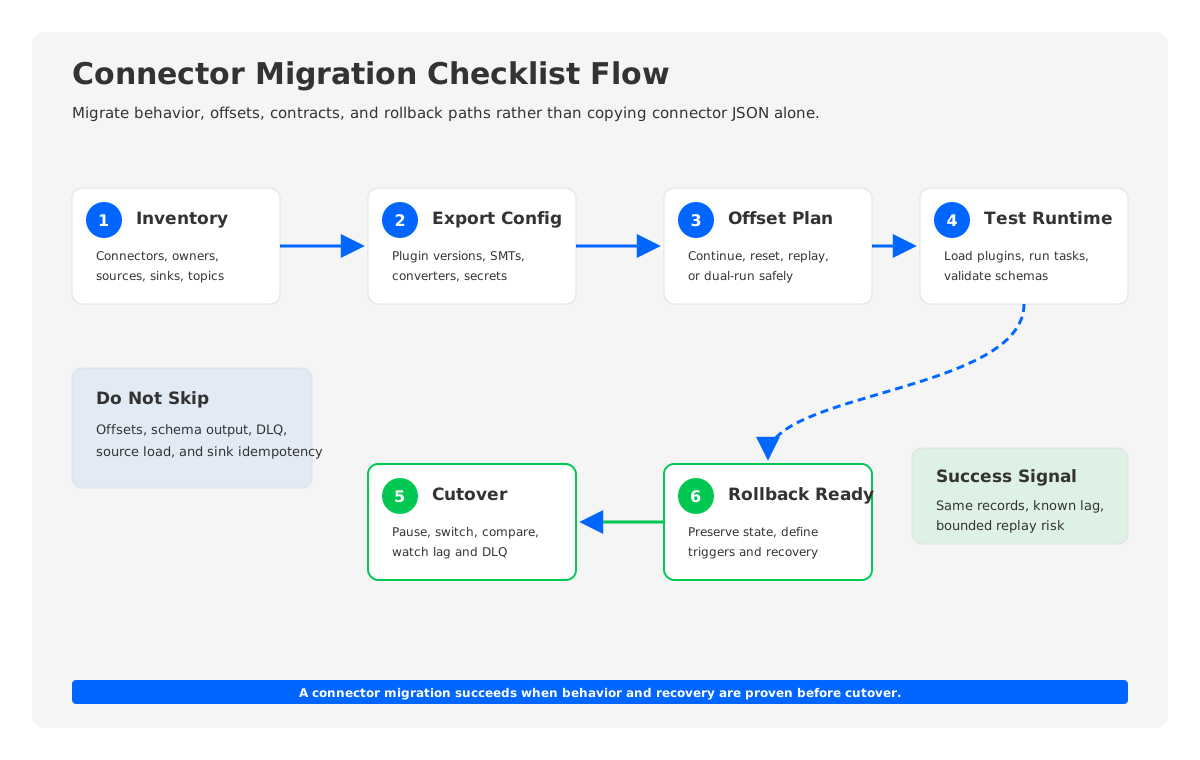
Start with an inventory. List every connector, connector class, plugin version, task count, converter, transform, secret, topic, consumer group, source system, sink system, and owner. Include the connectors that look boring; those are often the ones nobody has tested in years.
Then export configuration and classify state. Source connectors need an offset strategy because their offsets represent progress through a source system. Sink connectors need a commit and idempotency strategy because their behavior depends on what has already been delivered downstream. CDC connectors need special care around snapshots, log positions, replication slots, schema history, and source permissions.
Use a migration worksheet like this:
| Step | Decision | Evidence To Collect |
|---|---|---|
| Inventory | Which connectors and plugins exist? | Config exports, plugin artifacts, owners, source and sink maps |
| Compatibility test | Can the target runtime load and run them? | Dry-run deployment, dependency check, SMT and converter validation |
| Offset strategy | Continue, reset, replay, or dual-run? | Internal topic backup, source positions, downstream idempotency |
| Data contract check | Will schemas and record formats match? | Sample records, schema registry subjects, converter settings |
| Cutover plan | How will traffic move? | Freeze window, dual-write policy, rollback trigger, validation queries |
| Observability | How will success be measured? | Lag, error rate, DLQ volume, throughput, task restarts, sink row counts |
Avoid treating offsets as a checkbox. A source connector offset may refer to a database log position, file position, timestamp, or connector-specific structure. A sink connector may commit Kafka offsets only after writes succeed downstream. If the new runtime cannot reuse the old state safely, a controlled replay may be safer than a fragile offset transplant.
Cutover should have an explicit rollback path. That does not always mean switching back instantly. It may mean pausing the new connector, preserving its generated offsets, replaying a bounded topic range, or restoring a previous sink table snapshot. The important point is to define the failure mode before the failure happens.
5Where AutoMQ Fits For Kafka-Compatible Connector Operations
AutoMQ enters the discussion when connector operations and Kafka platform operations are part of the same architectural review. AutoMQ is a Kafka-compatible, cloud-native streaming platform built around stateless brokers and object-storage-backed durable data. For connector-heavy teams, the relevance is not that every workload must change its connector framework. It is that existing Kafka clients and ecosystem tools, including Kafka Connect-based pipelines, can remain part of the design while the Kafka storage and scaling model changes underneath.
AutoMQ documentation also describes managed Kafka Connect capabilities for BYOC environments, where Connect workers run in the user's cloud environment and can be managed through the AutoMQ control plane. That deployment model is important for teams that care about data-plane placement, private networking, IAM boundaries, and running connector workers near source and sink systems. Product packaging, connector catalogs, and regional availability should still be checked against the current documentation before a production decision.
This framing keeps the decision grounded. If the main pain is "we do not want to patch Connect workers," a managed Connect service may be enough. If the main pain is "connector traffic, broker scaling, local storage, cross-zone placement, and platform ownership are all tangled," then a Kafka-compatible platform review is more appropriate. Connect is the visible layer, but the underlying Kafka architecture may be what makes the pipeline costly or hard to operate.
AutoMQ is most relevant in three scenarios:
- You want Kafka protocol and ecosystem compatibility while changing the storage and scaling model behind Kafka.
- You want connector runtime placement to align with your cloud account, VPC, and source or sink network paths.
- You are evaluating Kafka replacement, managed Connect, and cloud cost optimization in one decision rather than three separate projects.
The practical next step is a side-by-side proof. Pick one source connector and one sink connector that represent real production risk. Run them through the candidate runtime under steady state, snapshot or backfill, failure, and replay conditions. Compare not only throughput, but also who owns the incident, where the data flows, how offsets are recovered, and what the bill counts.
6References
- Apache Kafka documentation: Kafka Connect
- Confluent documentation: Kafka Connect concepts
- Confluent Cloud documentation: fully managed connectors
- Confluent Cloud billing documentation
- Amazon MSK pricing, including MSK Connect
- Debezium connector documentation
- AutoMQ managed Kafka Connect overview
- AutoMQ managed connector product page
7FAQ
7.1What is the most common reason teams look for Kafka Connect alternatives?
The most common reason is not that Kafka Connect stops working. It is that operating many connectors becomes a separate platform responsibility. Worker sizing, plugin versions, secrets, networking, offsets, DLQs, and incident ownership start consuming more time than expected.
7.2Is managed Kafka Connect always lower cost than self-managed Connect?
Not automatically. Managed Connect can reduce operational work, but the cost model may include worker capacity, task hours, throughput, dedicated runtime, networking, and Kafka-side storage or transfer. A fair comparison includes both infrastructure and the work your team no longer has to perform.
7.3Can I replace Kafka Connect with a SaaS CDC tool?
Yes, if the workload is primarily database change capture and the SaaS tool satisfies your latency, schema, residency, and recovery requirements. If you need Kafka-native connector behavior, custom plugins, SMTs, or precise offset control, test carefully before replacing Connect.
7.4What should I test before migrating connectors?
Test plugin compatibility, converter output, schema behavior, offset recovery, source snapshots, sink idempotency, DLQ behavior, private connectivity, and rollback. A connector that starts successfully has not necessarily passed a production migration test.
7.5Where does AutoMQ fit in a Kafka Connect alternatives review?
AutoMQ fits when connector operations are tied to a broader Kafka platform review. It keeps Kafka compatibility while changing the storage and scaling architecture behind Kafka, and its managed connector capabilities can be evaluated when teams want Kafka and connector operations planned together.


