
Table of Contents
Table of Contents
Teams do not search for kafka connect development because they need another hello-world connector. They usually search because a source-to-sink pipeline has crossed the line from useful prototype to production dependency. The connector now carries revenue events, customer records, inventory changes, operational metrics, or machine-learning features, and the old development loop starts to show its weak spots. A failed task is no longer a local test failure; it is a delayed dashboard, an incomplete warehouse table, or a replay that must be explained to downstream owners.
Kafka Connect is attractive because it hides much of the repeated integration plumbing. Workers run connectors, tasks parallelize movement, offsets track progress, converters handle serialization, and the Kafka cluster becomes the durable buffer between systems. That model is powerful, but it also means connector development is never only about the connector class. The production behavior depends on worker configuration, topic design, offset handling, schema evolution, security boundaries, and the underlying Kafka operating model.
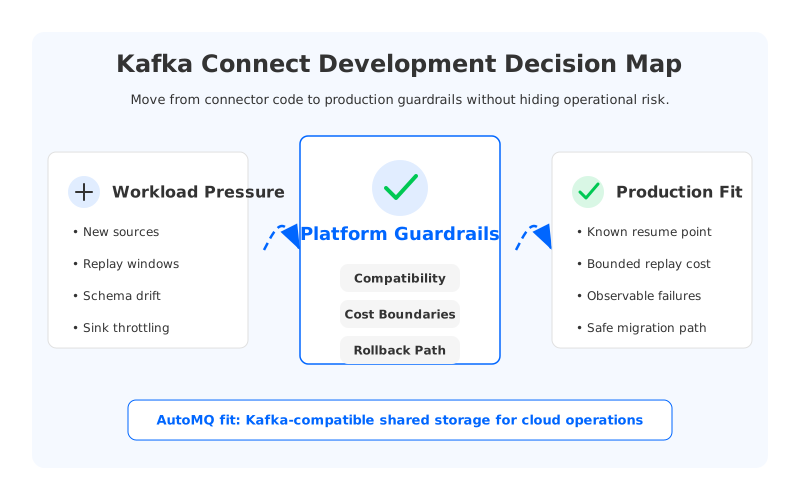
The fastest teams treat Kafka Connect development as platform engineering from the start. They shorten the inner loop for developers, but they do not pretend local speed is enough. They put guardrails around replay, failure isolation, cost exposure, observability, and migration paths before the first connector becomes a shared dependency. That discipline is what separates a useful pipeline from a pipeline that every team is afraid to touch.
1Why Kafka Connect Development Gets Slow
The obvious bottleneck is code: building a connector, configuring it, and testing it against real source and sink systems. The less obvious bottleneck is state. A connector has to know what it has already copied, what it can safely retry, how to handle records that cannot be serialized, and where to resume after a worker restart. Once those questions enter the loop, the development environment needs more than mocked messages and a single broker on a laptop.
Three boundaries usually slow the team down:
- The worker boundary. A connector that runs in standalone mode may behave differently once it is deployed to a distributed worker group. Task assignment, rebalance behavior, plugin paths, and worker-level converters can change the shape of the failure.
- The data contract boundary. Source schemas, sink table definitions, key formats, tombstones, delete semantics, and timestamp handling are often owned by different teams. A connector test that ignores these contracts only proves that bytes can move.
- The Kafka operations boundary. Topics, partitions, retention, compaction, internal Connect topics, ACLs, quotas, and broker capacity decide whether development mistakes stay small or become cluster-wide incidents.
This is why connector development should not be optimized only for "write code faster." A faster bad loop produces bad production pipelines faster. The better target is a loop where developers can test real integration behavior while platform owners can limit blast radius.
2The Integration Constraint Behind the Pipeline
Kafka Connect sits in the middle of systems that have different failure models. A database may expose change data capture through a log, a SaaS API may enforce rate limits, an object store may accept large batches, and a warehouse may expect idempotent writes with a predictable table layout. Kafka absorbs some of that mismatch, but it does not remove it. The connector still has to turn external system behavior into a repeatable stream-processing contract.
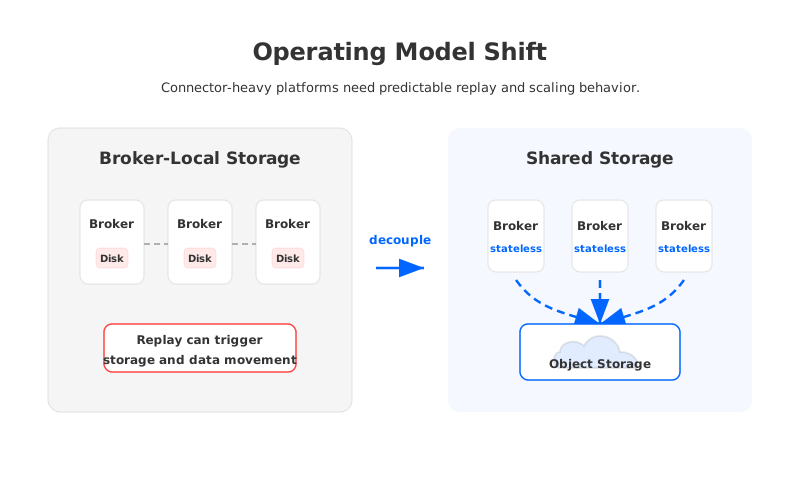
Traditional Kafka architecture adds another constraint. Brokers own local storage, so durability, placement, capacity, and recovery are tied to broker-local disks and replica movement. That design is familiar and battle-tested, but it makes integration pipelines sensitive to capacity planning. A connector surge can fill partitions, trigger retention pressure, increase replication traffic, and force operators to think about storage and compute together even when the pipeline problem is temporary.
The pressure becomes more visible in cloud deployments. A distributed connector platform often spans multiple availability zones for resilience. With broker-local replication, writes and replica traffic can cross zone boundaries, and recovery can require moving large amounts of data between brokers. None of this is a Kafka Connect bug. It is the consequence of putting a bursty integration layer on top of a storage model where brokers are both compute nodes and data owners.
That operating model matters during development because development is where mistakes are concentrated. A new connector may over-poll a source, produce oversized records, generate unexpected tombstones, or create a replay storm after an offset reset. If the platform cannot absorb those mistakes cheaply and predictably, every connector change becomes a negotiation with the Kafka operations team.
3Connector, Schema, Replay, and Stream Processing Trade-Offs
The right guardrails depend on the type of connector. A source connector usually has to answer "where do I resume?" and "what does a duplicate mean?" A sink connector has to answer "what is the commit point?" and "can the target accept retries without corruption?" These questions are different, but they share one rule: connector development has to make failure behavior testable before production traffic arrives.
For source connectors, pay close attention to offset granularity. Offsets that are too coarse make replay expensive because a failure can force the connector to revisit a large range of input. Offsets that are too fine can increase metadata overhead and make source-side coordination harder. The best design usually follows the source system's natural ordering: log sequence number, timestamp plus shard, file plus byte range, or page cursor plus stable object identity.
For sink connectors, idempotence is the center of the design. Kafka's consumer position can be tracked independently from the sink's commit behavior, so a task may see records again after a restart. A sink that writes append-only files, upserts rows by primary key, or commits batches into a transactional target will handle that replay differently. The connector should document the exact duplicate behavior, not hide it behind a vague "at least once" label.
Schemas deserve the same directness. Development teams often spend weeks debating converter choices, but the practical issue is simpler: can a record produced today still be understood by a sink task six months from now? Backward-compatible schema evolution, clear handling of nullable fields, stable key formats, and dead-letter routing for malformed records are more important than the branding of the serialization stack.
Stream processing also changes the decision. Some transformations belong in Kafka Connect because they are format conversions, routing decisions, or light enrichment. Stateful joins, windowed aggregations, and business logic usually belong in a stream processor such as Flink or Kafka Streams. Keeping that boundary clean makes connector development faster because the connector remains an integration adapter, not an application runtime disguised as one.
4Evaluation Checklist for Data Platform Teams
A useful Kafka Connect development platform should be judged by how well it handles bad days. Local tests, sample configs, and connector catalogs are table stakes. The harder questions are about what happens when a connector is wrong, too slow, too fast, or caught between two systems with incompatible expectations.
| Evaluation area | What to ask before production | Why it matters |
|---|---|---|
| Compatibility | Does the platform preserve Kafka client, Connect, topic, ACL, and offset expectations? | Connector teams should not rewrite integration logic just to change infrastructure. |
| Cost exposure | What happens to storage, replication, and cross-zone traffic during a replay or burst? | Development mistakes often create temporary traffic that should not become a permanent bill surprise. |
| Elasticity | Can workers and brokers scale independently when task count changes? | Connector workload changes are often compute-heavy before they are storage-heavy. |
| Governance | Are plugin versions, secrets, schemas, ACLs, and internal topics controlled consistently? | A connector platform becomes a shared production surface once multiple teams deploy into it. |
| Failure recovery | Can the team reset, replay, pause, resume, and roll back with a known blast radius? | Recovery procedures should be rehearsed during development, not invented during an incident. |
| Observability | Are task errors, lag, throughput, retries, and downstream write failures visible together? | Connector metrics alone are not enough if the bottleneck is the source, sink, or Kafka cluster. |
| Migration risk | Can existing producers, consumers, connectors, and operational runbooks move incrementally? | Platform changes fail when the migration path is larger than the original integration problem. |
The checklist is intentionally infrastructure-aware. Connector developers do not need to own every broker detail, but they do need a platform where broker behavior is predictable. If a replay requires a storage expansion, a partition reassignment, and a cross-zone traffic review, the connector team will eventually slow down to match the platform's operational ceiling.
5How AutoMQ Changes the Operating Model
If the main constraint is that brokers own local durable storage, the architectural answer is to separate the data ownership problem from the broker lifecycle. AutoMQ is a Kafka-compatible, cloud-native streaming system that keeps Kafka protocol compatibility while moving durable stream storage to shared object storage. Brokers become more stateless, and compute capacity can be adjusted without treating every broker change as a data movement project.
For Kafka Connect development, that shift changes the failure math. A connector surge still needs topic design, quotas, and monitoring, but burst handling is less entangled with broker-local disk ownership. When brokers are not the long-term home of the data, adding or replacing broker capacity does not have to imply moving partition data across local disks. That makes development environments, staging clusters, and production connector fleets easier to size around workload behavior instead of storage inheritance.
AutoMQ's shared storage architecture also gives platform teams a cleaner way to reason about cloud cost. Object storage is the durable data layer, and AutoMQ documents an approach for reducing cross-availability-zone traffic in cloud deployments. That does not remove the need for careful connector design; a noisy connector can still create noisy traffic. It does make the evaluation more explicit: platform owners can ask whether the streaming layer is amplifying connector bursts through broker replication, or absorbing them through an architecture designed for cloud storage boundaries.
The compatibility point matters just as much as the storage point. Kafka Connect teams usually have existing connector plugins, worker configs, producer and consumer clients, schemas, and operational habits. A Kafka-compatible infrastructure layer is valuable only if it lets those investments carry forward. The practical migration question is not "can we run a benchmark?" It is "can a real connector team move one pipeline, validate offsets and sink behavior, and roll back without changing every surrounding system?"
6A Production Readiness Checklist
The final development gate should be boring. That is a compliment. By the time a connector reaches production, the team should already know how it behaves under duplicate delivery, downstream throttling, schema drift, worker rebalance, and Kafka-side retention pressure. Unknowns should be limited to workload scale, not basic semantics.
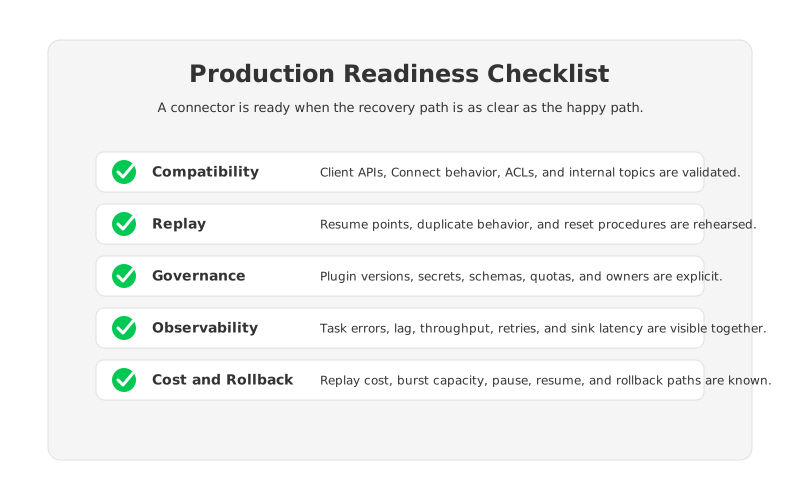
Use this readiness sequence before a connector becomes a shared dependency:
- Prove the connector's resume point with a controlled restart and a forced task failure.
- Run a duplicate-delivery test against the sink and document the visible result.
- Validate schema evolution with old records, new records, nulls, deletes, and malformed payloads.
- Set topic retention, compaction, partition count, ACLs, and quotas deliberately rather than inheriting defaults.
- Observe connector metrics next to Kafka throughput, consumer lag, sink latency, and error routing.
- Rehearse pause, resume, offset reset, rollback, and replay in a staging environment that resembles production.
- Estimate replay and burst cost across storage, network, and compute before the first incident.
The deeper lesson is that Kafka Connect development is not a race to merge connector code. It is a race to remove ambiguity from the pipeline. Once resume behavior, cost boundaries, security ownership, and rollback paths are clear, teams can move quickly without asking the Kafka platform to absorb every unknown.
If your next connector project is also forcing a larger conversation about Kafka capacity, cloud cost, or replay safety, evaluate the streaming layer before the pipeline hardens around it. AutoMQ's Kafka-compatible shared storage architecture is documented for teams that want to keep Kafka semantics while changing the cloud operating model: explore AutoMQ for cloud-native Kafka.
7References
- Apache Kafka Documentation: Kafka Connect
- Apache Kafka Documentation: Connector Development Guide
- Apache Kafka Documentation: Consumer Position
- Apache Kafka KIP-405: Kafka Tiered Storage
- AutoMQ Documentation: Architecture Overview
- AutoMQ Documentation: Difference with Apache Kafka
- AutoMQ Documentation: Save Cross-AZ Traffic Costs with AutoMQ
8FAQ
8.1What is the fastest way to improve Kafka Connect development?
Shorten the feedback loop without removing production semantics. Developers should be able to run connector tests quickly, but they also need a realistic worker mode, internal topics, schemas, offset handling, error routing, and sink behavior. A local-only test is useful for syntax and simple logic; it is not enough for replay or failure confidence.
8.2Should connector logic include stream processing logic?
Usually no. Kafka Connect is best used for integration concerns such as source capture, sink writes, format conversion, routing, and light enrichment. Stateful joins, windows, aggregations, and business rules are better placed in a stream processing layer where state, scaling, and correctness are explicit.
8.3How does shared storage help connector-heavy Kafka platforms?
Shared storage changes the broker operating model. Instead of tying durable data ownership to broker-local disks, the streaming layer can keep durable data in object storage and make brokers more stateless. For connector-heavy platforms, that can reduce the amount of operational work tied to replay, burst handling, broker replacement, and independent compute scaling.
8.4What should be tested before moving a connector to production?
Test restart behavior, duplicate delivery, schema changes, malformed records, worker rebalances, downstream throttling, offset reset, rollback, replay volume, and observability. The goal is not to eliminate every incident; it is to make the connector's failure behavior predictable enough that the incident has a known playbook.


