
Table of Contents
Table of Contents
Kafka platform budgets often start with the cluster: broker hours, storage, partition count, retention, and maybe cross-AZ traffic. Kafka Connect tends to enter the spreadsheet later, after the team has already assumed that "Kafka cost" means "Kafka cluster cost." That assumption breaks down fast when the real workload is not only moving events through Kafka, but continuously pulling from databases, landing data in warehouses, running transformations, handling retries, and keeping private connectivity in place.
The connector layer has its own bill shape. A CDC pipeline can need more tasks than the broker plan assumed. A sink connector can be cheap during normal hours and expensive during backfills. A private network path can cost more than the connector runtime. A managed connector that removes worker operations can still leave the team owning schema drift, dead-letter queues, lag alerts, and source database pressure.
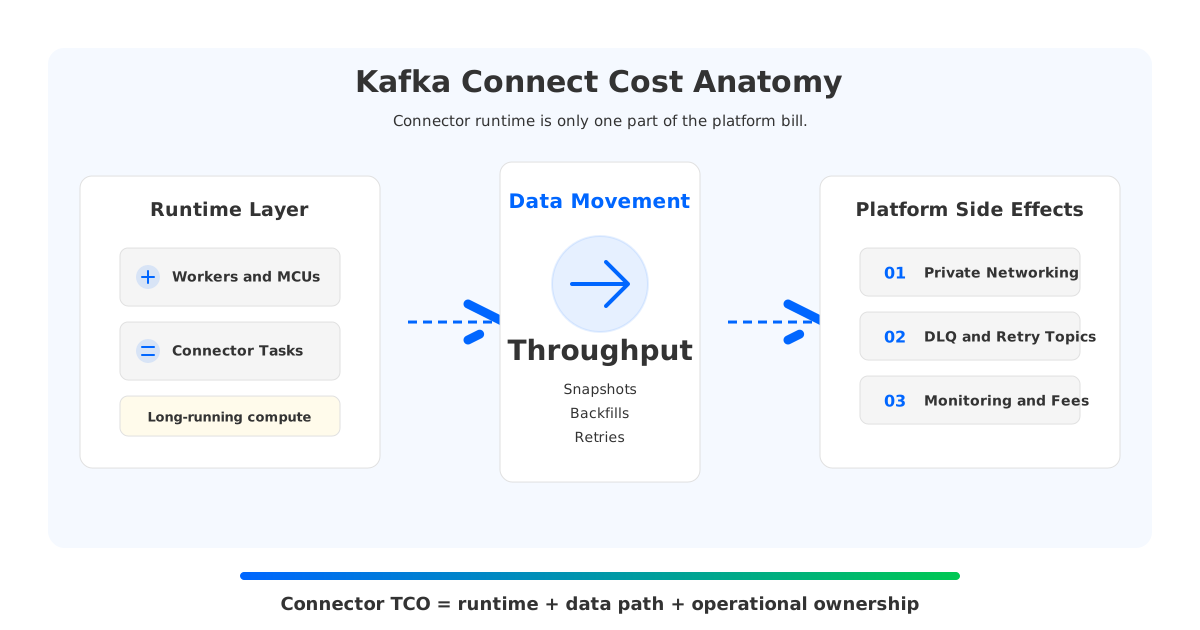
The practical question is not whether managed Kafka Connect is useful. It usually is. The question is where the cost boundary actually sits: inside the connector service, inside the Kafka platform, inside the network, or inside the operations team that still has to make the pipeline reliable.
1Why Connector Cost Is Easy to Undercount
Kafka Connect is easy to undercount because it feels like an ecosystem feature rather than an independent platform tier. In self-managed Kafka, the same team may run brokers and Connect workers on the same Kubernetes platform, using shared observability and shared networking. The bill is blended. In managed Kafka, the components separate into visible line items, and the hidden assumptions become negotiable contracts.
Four cost blind spots show up repeatedly:
- Workers are compute, not metadata. Connect workers run connector code, converters, single message transforms, retries, and task coordination. They need CPU and memory sized for the data path, not for control-plane convenience.
- Tasks multiply with throughput and parallelism. Kafka Connect splits connector work into tasks. More partitions, tables, collections, or sink shards can mean more task capacity, depending on the connector and source system.
- Networking follows the data, not the service boundary. Source databases, Kafka clusters, connector workers, private endpoints, NAT gateways, and sink systems may sit in different networks. The connector service only looks small when the data path is small.
- Operations do not disappear. Managed workers reduce patching and runtime maintenance, but teams still own connector configuration, compatibility, offsets, schema changes, DLQs, replay decisions, and downstream correctness.
That mix creates a subtle FinOps problem. The Kafka cluster may look well-sized while the surrounding integration layer quietly grows into a second platform. The more successful Kafka becomes as a central data plane, the more Connect becomes a shared service with its own capacity planning, incident response, and procurement questions.
2Managed Connect Pricing Components
Managed Kafka Connect products do not all price the same thing. AWS prices MSK Connect around connector capacity measured in MSK Connect Units. Confluent Cloud documents fully managed connector billing around task-hours, with extra dimensions such as data transfer and connector-specific add-ons. Other providers may package connector runtime into platform editions, marketplace offers, or professional services.
The evaluation mistake is to compare the visible unit price and stop there. Connector cost is a stack of triggers:
| Cost driver | What to inspect | Why it changes the bill |
|---|---|---|
| Worker capacity | CPU, memory, autoscaling bounds, runtime units | Backfills, transforms, compression, and converters can increase worker demand. |
| Connector tasks | tasks.max, source table count, sink partitioning, topic count | Parallelism improves throughput but can increase billed task or compute capacity. |
| Data throughput | Ingress, egress, CDC change volume, replay volume | Some services charge transfer separately; all services expose the network somewhere. |
| Private connectivity | PrivateLink, VPC peering, NAT, cross-zone paths | The secure path to sources and sinks can be a material platform cost. |
| Storage side effects | DLQ topics, retry topics, offset/config/status topics | Failed records and replay buffers consume Kafka storage and operational attention. |
| Connector licensing | Premium connectors, marketplace terms, external SaaS limits | The connector may carry a charge outside the Kafka platform bill. |
| Operations | Monitoring, upgrades, schema evolution, incident handling | Managed runtime does not remove data-contract ownership. |
For AWS MSK Connect, the official pricing model charges by the hour for the number of MSK Connect Units used while a connector is running, with regional pricing and examples published on the Amazon MSK pricing page. That means autoscaling limits, minimum worker count, and long-running connectors matter even when throughput is uneven.
For Confluent Cloud, the fully managed connector model should be read together with the connector billing documentation and the pricing page. Confluent describes connector task pricing, throughput-based charges in relevant cases, and additional managed-connector features that can affect cost. The important distinction is not that one model is universally lower cost than another; it is that each model exposes a different operational assumption.
3Networking And Source Database Proximity
Connector economics often hinge on geography. A source database in one VPC, a managed Kafka cluster in another cloud account, and a sink in a third network may be technically valid, but the connector has to sit somewhere. Its location determines latency, security boundaries, egress paths, and who owns the private route.
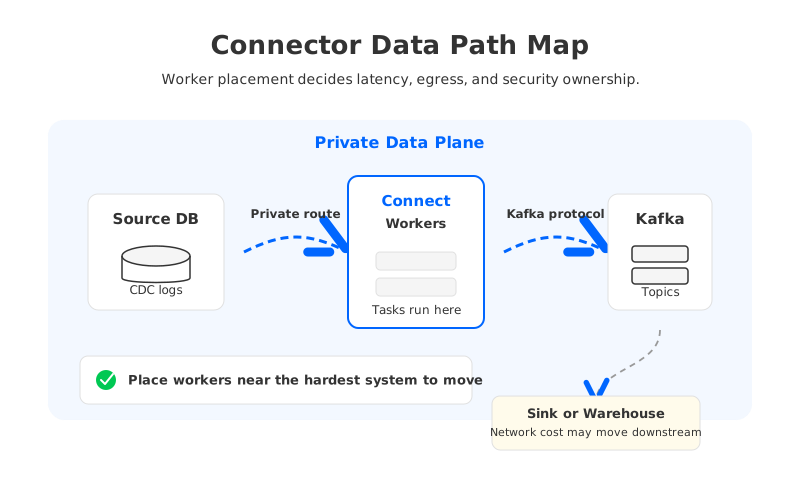
CDC workloads make this especially visible. Debezium-style connectors read database logs and turn source-system change volume into Kafka traffic. The connector is not a passive client; it is part of the critical path between the source database and the streaming platform. If the worker is far from the source, every polling cycle, snapshot, and reconnect has a network consequence.
That leads to a useful design rule: place the connector data plane close to the system that is hardest or most expensive to move. For many teams, that is the source database, because it is protected by strict network policy and has limited tolerance for extra load. For others, it is the Kafka cluster or sink warehouse, especially when backfills dominate the workload.
Before choosing a managed Connect option, map the path in concrete terms:
- Where do workers run? In the provider account, your VPC, a BYOC environment, Kubernetes, or a dedicated integration subnet?
- How does the connector reach the source? Public endpoint, VPN, VPC peering, PrivateLink, transit gateway, or customer-managed routing?
- Where does cross-zone or cross-region traffic appear? A connector can look local at the service layer while producing billable movement in the network layer.
- Who can debug packet-level failures? Managed runtime support is valuable, but network ownership still affects mean time to recovery.
The answer changes the cost model more than a small difference in worker-unit pricing. A connector service that is cheaper per runtime unit can become more expensive if it forces traffic through an awkward network path. A higher-level managed service can be worth it when it removes enough operational surface area and keeps the data path close to the systems that matter.
4Connector Compatibility And Operational Ownership
Kafka Connect compatibility is a larger issue than whether a connector starts. Production workloads depend on converter behavior, offset storage, exactly-once assumptions where supported, custom SMTs, connector plugin versions, schema registry integration, security settings, and failure semantics. A managed platform can support Kafka Connect while still constraining plugins, custom code, or network shapes.
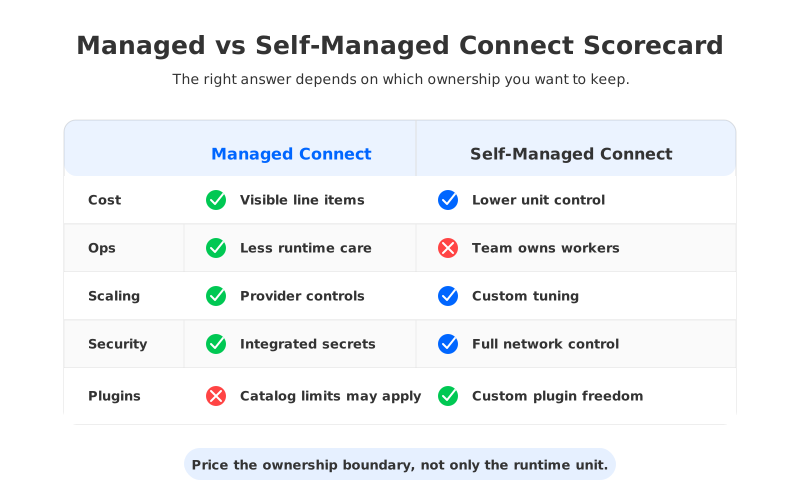
That is why the operating model belongs in the pricing discussion. Teams often compare managed Connect and self-managed Connect as if the only trade-off were runtime cost versus labor. In practice, the split is more specific:
| Decision area | Managed Connect usually helps with | Ownership that often remains |
|---|---|---|
| Runtime lifecycle | Worker provisioning, patching, service availability | Connector version choice, plugin behavior, compatibility testing |
| Scaling | Autoscaling settings or task-level capacity controls | Knowing when more parallelism will overload the source or sink |
| Security | Integrated secrets, network options, IAM/RBAC hooks | Least-privilege design, source credentials, private routing policy |
| Reliability | Service health, restarts, basic metrics | DLQ handling, replay policy, schema drift, data correctness |
| Cost control | Visible connector line items and capacity controls | End-to-end TCO across workers, Kafka topics, network, and operations |
Self-managed Connect keeps more control. It can be the right answer when teams need custom plugins, unusual network placement, strict change control, or existing Kubernetes operational maturity. But that control has a cost: worker upgrades, plugin packaging, JVM tuning, task rebalancing, offset topic care, and incident response all stay with the platform team.
Managed Connect shifts part of that burden to the provider. The stronger the provider's connector catalog, private networking model, observability, and compatibility guarantees, the more attractive that shift becomes. The weaker those pieces are, the more the team pays twice: once for the managed runtime and again for the operational glue around it.
5How AutoMQ Approaches Kafka Connect Workloads
AutoMQ's relevant starting point is Kafka compatibility. Applications and ecosystem tools that speak the Kafka protocol, including Kafka Connect-based pipelines, can keep the familiar Kafka integration model while the underlying storage architecture changes. That matters because connector adoption depends on ecosystem continuity; a lower-cost streaming platform is less useful if every source and sink integration has to be redesigned.
The second point is data-plane placement. AutoMQ is designed as a cloud-native Kafka-compatible platform with stateless brokers and object-storage-backed durable data. In BYOC-style deployments, the platform can be placed inside the customer's cloud environment, which helps teams keep Kafka near the source databases, sinks, and private network controls they already operate. That does not make connector traffic free, but it gives architects more room to design the data path rather than accept a provider-fixed route.
AutoMQ documentation also describes managed Kafka Connect capabilities for BYOC environments. Because connector product packaging can change, treat the docs as the source of truth when deciding whether a specific managed connector, plugin, or deployment mode is available for your account and region. The safe evaluation question is concrete: can the connector runtime run where your source and sink topology need it, with the plugins and operational controls your workload requires?
For teams auditing Kafka Connect cost, AutoMQ fits naturally into a broader platform question: can you keep Kafka compatibility while reducing the storage, scaling, and network constraints that made the original Kafka platform expensive? Connect is only one layer, but it is a revealing one. If every connector decision is dominated by broker-local storage, fixed cluster sizing, or cross-network data movement, the connector bill is pointing at a platform architecture problem.
Use this checklist before signing off on a managed Connect plan:
- Count workers and tasks under peak and backfill conditions. Normal throughput is not enough; snapshots and catch-up periods often define capacity.
- Map every network hop. Include VPC boundaries, private endpoints, NAT, cross-zone traffic, and sink egress.
- Separate runtime cost from platform side effects. DLQ topics, retries, offset storage, and replay traffic still land somewhere.
- Test connector compatibility before pricing optimism. Custom SMTs, plugin versions, schema registry, and security integrations can change the option set.
- Assign operational ownership explicitly. Decide who owns lag, schema drift, bad records, replay, and source-system protection.
- Model the Kafka platform and Connect layer together. A low connector price attached to a costly cluster architecture is not a low-cost pipeline.
The connector budget is not a footnote to Kafka anymore. It is where the platform meets the rest of the data estate, which means it carries compute, network, security, and operational decisions in one place. Once you count those decisions honestly, Kafka Connect pricing becomes less about a single line item and more about whether the streaming platform is shaped for the workloads around it.
6Sources
- Amazon MSK pricing - official Amazon MSK and MSK Connect pricing details, including MSK Connect Unit-based examples.
- Confluent Cloud pricing and Confluent fully managed connectors documentation - official Confluent references for connector billing and managed connector behavior.
- Apache Kafka Connect documentation - official Apache Kafka documentation for Connect workers, connectors, and tasks.
- AutoMQ BYOC documentation and AutoMQ Managed Kafka Connect documentation - official AutoMQ deployment and connector documentation.
7FAQ
What is the biggest Kafka Connect pricing mistake?
The biggest mistake is pricing only the connector runtime. A realistic model also includes tasks, worker capacity, private networking, data transfer, DLQ and retry topics, observability, connector licensing, and the operations team that still owns data correctness.
Is managed Kafka Connect always lower cost than self-managed Connect?
No. Managed Connect can reduce worker operations and speed up delivery, but self-managed Connect may be more cost-effective when the team already has mature Kubernetes operations, needs custom plugins, or must place workers in a very specific network location.
How should I compare MSK Connect pricing with Confluent connector pricing?
Compare the full workload, not only the visible unit. For MSK Connect, inspect MCU-hours, autoscaling bounds, and regional pricing. For Confluent, inspect connector task charges, throughput dimensions where applicable, networking, and connector-specific add-ons. Then add Kafka cluster, storage, and network side effects.
Why does source database proximity matter for Kafka Connect?
Connectors often sit on the critical path between a protected source database and Kafka. If workers are far from the source, snapshots, CDC polling, retries, and backfills can add latency, egress, and operational risk. The best location depends on which system is hardest to move.
Can Kafka-compatible platforms run Kafka Connect workloads?
Kafka compatibility is the foundation, but production readiness depends on connector plugins, security settings, schema registry integration, network placement, and operational controls. Validate the exact connectors and deployment mode before assuming full portability.


