
Table of Contents
Table of Contents
Kafka Connect to S3 usually starts as a practical integration task. A team has Kafka topics, a data lake, and downstream users who want durable files in object storage. The connector path looks direct: subscribe to topics, write objects to S3, let analytics and governance systems consume the files. That pattern is valid, but production teams learn quickly that a working connector is not the same as an operationally ready streaming-to-object-storage system.
The gap appears when the pipeline becomes part of a business contract. Data engineers care about file format and partitioning. SREs care about retries, lag, task rebalances, and alert thresholds. Security teams care about bucket policy and read access. FinOps teams care about storage, request, network, and reprocessing costs. Platform owners care about whether exporting to S3 has changed the Kafka durability, replay, and recovery story in ways nobody wrote down.
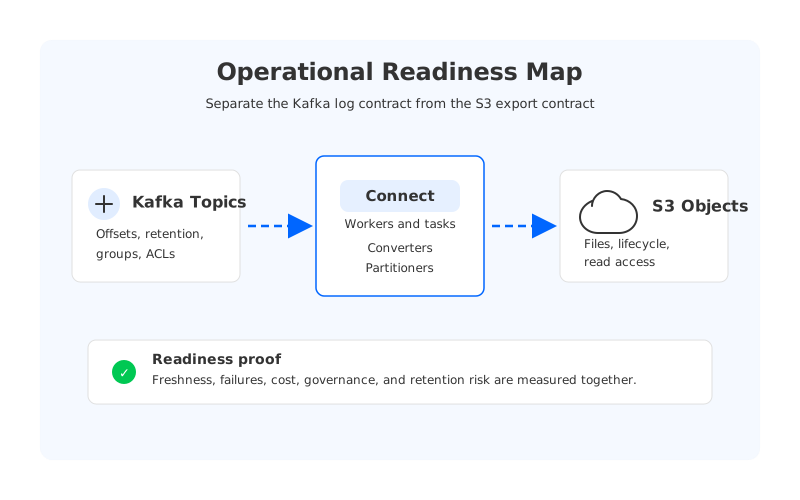
That is why the right planning question is not "Can Kafka write to S3?" The harder question is whether the platform can operate the connector path under production pressure without confusing export durability with Kafka log durability.
1Kafka Connect S3 Is an Export Path, Not a Storage Architecture
Kafka Connect provides a framework for running source and sink connectors as distributed workers. A sink connector that writes to S3 is downstream from Kafka: it consumes records, batches them into files, and writes those files into object storage using a chosen format and partitioning strategy. That makes it valuable for lakehouse ingestion, audit copies, offline processing, and long-term data retention outside the broker cluster.
It does not turn Kafka brokers into an S3-backed storage engine. The source of truth for Kafka clients remains the Kafka log exposed by brokers. Consumer offsets, retention behavior, and replay through Kafka clients are governed by the Kafka cluster, not by exported files. This distinction sounds obvious until an incident forces a team to answer whether data in S3 can replace data that aged out of Kafka.
The safest mental model is a two-contract model:
- Kafka log contract. Producers and consumers use Kafka protocol semantics, topic retention, offsets, consumer groups, access controls, and broker-side availability behavior.
- S3 export contract. Downstream systems use object paths, file formats, bucket policies, object lifecycle rules, and batch or query engines outside Kafka.
- Operational bridge. Connect workers, tasks, converters, partitioners, schema handling, and monitoring connect those two contracts. The bridge can fail even when Kafka and S3 are healthy.
This is not a criticism of Kafka Connect. It is the reason the framework is useful: it separates integration from the broker's core storage model. Production readiness depends on naming that boundary. If exported objects support historical analytics, judge the connector as a data lake ingestion pipeline. If those objects are expected to preserve Kafka replay semantics, the architecture needs additional proof.
2Define the Workload Before Tuning the Connector
Connector tuning often begins with task count, flush size, file rotation, and worker resources. Those settings matter, but they should follow the workload contract. A security audit stream, a high-volume clickstream, and a compacted state topic produce different pressure on S3 and on the Connect cluster. Treating them as one generic "Kafka to S3" workload creates unclear ownership when files are late, duplicated, too small, or hard to query.
The first pass should classify the export purpose:
| Export purpose | Production question | Common failure mode |
|---|---|---|
| Lakehouse ingestion | Can downstream jobs read predictable file formats and partitions? | Files arrive, but layout creates expensive scans or schema confusion. |
| Audit copy | Can the organization prove retention, immutability, and access boundaries? | Data exists, but ownership and read access are unclear during review. |
| Backfill source | Can historical objects feed reprocessing without harming live Kafka traffic? | Reprocessing becomes a one-off recovery project with manual steps. |
| Operational archive | Can teams tell when Kafka retention and S3 lifecycle diverge? | Kafka deletes records while the export pipeline is lagging or failed. |
The table points to a practical rule: tune for the reader, not for the writer alone. Tiny files may keep latency low but punish query engines. Large files may improve scan efficiency but create freshness gaps. A partitioning strategy that works for one tenant may become a governance problem when data residency rules arrive.
Once the workload is clear, connector settings become easier to reason about. Task parallelism should match topic partitions, worker capacity, and S3 request behavior. Rotation policy should match downstream freshness and file-size expectations. Error handling should distinguish between poison records, transient object-store failures, schema mistakes, and authorization failures. Monitoring should show lag, failed records, task restarts, object write rates, and end-to-end freshness.
3Failure Modes Need Their Own Runbook
A Kafka Connect S3 pipeline has more failure surfaces than a broker-only retention policy. Kafka can be healthy while Connect workers are rebalancing. Connect can be healthy while a bucket policy rejects writes. S3 can accept objects while downstream readers fail because schema evolution produced incompatible files. None of these failures are exotic, and none should require the platform team to improvise during an incident.
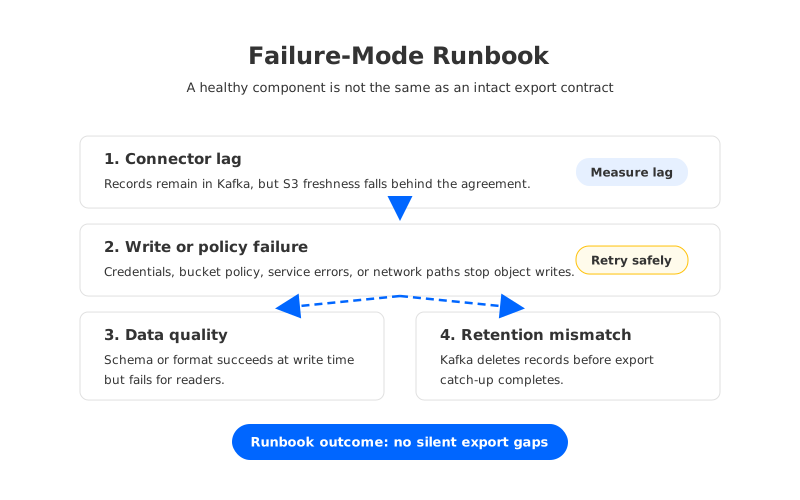
The runbook should separate at least five conditions. Connector lag means records are still in Kafka, but export freshness is behind the contract. Write failure means tasks cannot commit files to S3 because of credentials, bucket policy, throttling, network, or service issues. Data-quality failure means records can be written, but schema or format decisions make them unusable. Worker instability covers repeated restarts, rebalances, or memory pressure. Retention mismatch means Kafka deletes records before the connector has exported them.
The last condition exposes architecture assumptions. If Kafka retention is shorter than the maximum connector outage plus catch-up time, exported data can have permanent gaps. S3 durability does not help with records that never reached S3. Treat connector recovery time as part of Kafka retention planning, not as a separate integration detail.
Monitoring should include both system signals and contract signals. Worker CPU, heap, and task state are useful, but they do not answer whether the business has the data it expects. A stronger dashboard reports topic-to-S3 freshness, exported object counts, failed record rates, connector lag relative to Kafka retention, and the age of the oldest unexported record.
4Cost Planning Follows the Byte Path
Kafka-to-S3 pipelines are often adopted for the lower storage profile of object storage compared with keeping every retained byte on broker-local disks. That can be a sound direction, but the cost model is incomplete if it stops at storage per GB. The byte path includes Kafka broker resources, Connect workers, object storage, object requests, network transfer, catalog or query costs, and repair work for late or malformed exports.
The most useful FinOps view separates steady-state cost from activation cost. Steady-state cost covers the normal flow of records into S3: worker capacity, S3 writes, storage, monitoring, and catalog updates. Activation cost appears when exported data is read: backfills, investigations, replay-like jobs, lakehouse transformations, and downstream scans. A pipeline can be efficient at rest and still expensive during a large reprocess if the file layout creates excessive requests or query scans.
Network cost also needs attention. In AWS, charges can depend on whether traffic crosses availability zones, regions, NAT gateways, or service boundaries. A Connect cluster placed without regard to broker, bucket, and consumer location can turn export into a recurring network charge. Map each byte from producer to broker to Connect worker to S3 to reader, then assign ownership for each segment.
This is where a readiness review becomes concrete:
- At rest: how much data is stored, how many copies exist, what lifecycle rules apply, and who owns deletion?
- During write: how many S3 operations occur per GiB, how much worker capacity is reserved, and where does network traffic cross chargeable boundaries?
- During read: which jobs read the objects, how often they reprocess history, and whether file layout helps or hurts query engines?
- During failure: how much catch-up capacity is needed after an outage, and whether Kafka retention can cover the recovery window?
These questions prevent a misleading comparison between "Kafka disk" and "S3 storage." The export pipeline is a system, not a bucket.
5Governance Cannot Be Added After the Bucket Fills
S3 makes it straightforward to keep a lot of data for a long time. That is useful, but it can also expose weak governance. Kafka topics often carry data from many applications and tenants, while S3 buckets tend to become shared analytical surfaces. If the connector design does not encode ownership, partitioning, encryption, retention, and access policy early, the organization can end up with durable data that is hard to explain.
A production design should answer who owns each exported dataset, which identities can read it, how schema changes are reviewed, how regulated fields are handled, and how deletion requests propagate. It should also define whether S3 is an archive, an analytical copy, or a recovery input. Those labels change the control plane: archives prioritize lifecycle, analytical copies prioritize query layout, and recovery inputs must prove completeness.
6A Production Readiness Scorecard
The readiness scorecard should be written before the connector is treated as a shared platform service. It should force explicit trade-offs without becoming bureaucracy. The goal is to make the pipeline's behavior predictable across compatibility, cost, recovery, governance, and operations.
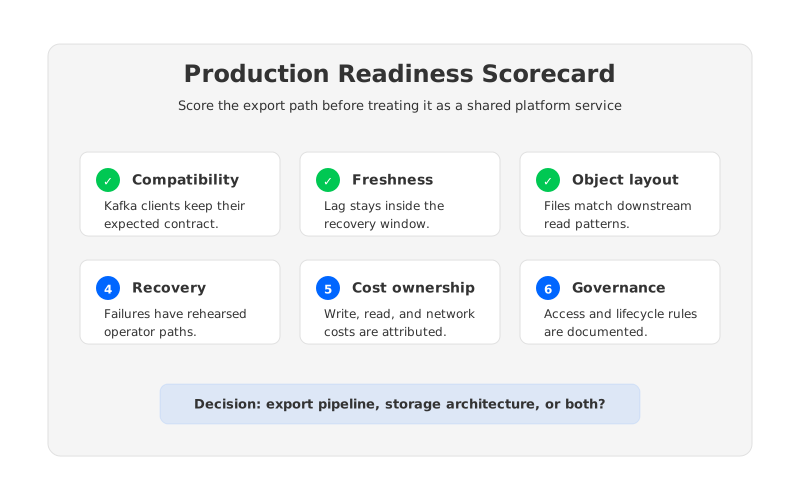
| Readiness area | Evidence to collect | Decision signal |
|---|---|---|
| Kafka compatibility | Existing producers and consumers keep their Kafka contract while export runs. | S3 export is downstream, not a replacement for broker retention. |
| Freshness and lag | End-to-end delay is measured against topic retention and consumer needs. | Catch-up time remains inside the agreed recovery window. |
| Object layout | File size, format, partitioning, and schema evolution are tested with readers. | Downstream teams can query or process data without custom repair. |
| Failure recovery | Worker loss, credential failure, S3 write failure, and poison records have rehearsed paths. | Operators can recover without losing unexported Kafka records. |
| Cost ownership | Broker, Connect, S3, request, network, and read activation costs are attributed. | FinOps can explain both idle and reprocessing costs. |
| Governance | Access, encryption, lifecycle, deletion, and dataset ownership are documented. | Durable data has a clear owner and policy boundary. |
The scorecard clarifies when Kafka Connect S3 is the right answer and when the architecture question is broader. If the requirement is lakehouse ingestion or audit export, Kafka Connect S3 is often a strong fit. If the requirement is to make object storage part of Kafka's primary durability and recovery model, evaluate Kafka tiered storage or Kafka-compatible shared-storage systems instead of expecting a sink connector to carry that responsibility.
7Where AutoMQ Fits the Evaluation
After the export contract is clear, AutoMQ becomes relevant as a different architectural category. AutoMQ is a Kafka-compatible cloud-native streaming platform that uses shared storage and object-storage-backed durability to reduce the coupling between broker compute and durable stream data. In that model, S3-compatible storage is not merely a downstream export target. It is part of the storage architecture behind Kafka-compatible APIs, stateless broker behavior, independent compute and storage scaling, and recovery without rebuilding durable data from broker-local disks.
That does not make Kafka Connect S3 obsolete. Many teams still need S3 exports for lakehouse workloads, audit copies, and offline processing. The distinction is sharper: use Connect when S3 is a downstream data product, and evaluate shared-storage Kafka-compatible architecture when the platform wants Kafka semantics with a storage model designed around object storage. AutoMQ's S3Stream shared storage architecture, write-ahead log design, and zero cross-AZ traffic approach are relevant to the second path.
For platform teams, the practical evaluation is straightforward. Keep the same readiness scorecard, but change the architecture hypothesis. Instead of asking whether a connector can export data before Kafka retention expires, ask whether the streaming platform itself can preserve Kafka-compatible behavior while separating compute from durable storage. Test existing Kafka clients, latency, broker replacement, scaling behavior, cross-zone traffic, and operational ownership.
The opening question was operational readiness, not feature availability. A Kafka Connect S3 pipeline is production-ready when its export contract is observable, recoverable, governed, and costed across the full byte path. If your team is also evaluating whether object storage should become part of the Kafka-compatible storage layer rather than only a downstream export, use the same scorecard to test AutoMQ Cloud against one real workload.
8References
- Apache Kafka documentation: Kafka Connect
- Confluent documentation: Amazon S3 Sink Connector for Confluent Platform
- Amazon S3 User Guide
- Amazon S3 performance guidelines
- Amazon MSK Developer Guide
- AutoMQ documentation: What is AutoMQ
- AutoMQ documentation: S3Stream Shared Streaming Storage
- AutoMQ documentation: WAL storage
- AutoMQ Cloud documentation: eliminate inter-zone traffic
9FAQ
9.1Is Kafka Connect S3 the same as Kafka running on S3?
No. Kafka Connect S3 usually means a sink connector exports Kafka records into S3 as files for downstream use. Kafka running on S3 means the Kafka-compatible storage architecture itself uses object storage as part of the durable data path. The two patterns solve different problems.
9.2Can S3 exports replace Kafka retention?
They can support long-term storage and analytics, but they do not automatically preserve Kafka offset-based replay through existing consumers. If the team wants exported objects to act as a recovery or replay source, it needs a tested restore or reprocessing procedure and Kafka retention must cover connector outage and catch-up windows.
9.3What should teams monitor in a Kafka Connect S3 pipeline?
Monitor connector task state, task restarts, consumer lag, failed records, S3 write failures, object counts, end-to-end freshness, and the age of the oldest unexported record. The last metric matters because it ties connector health directly to Kafka retention risk.
9.4When should AutoMQ enter the evaluation?
AutoMQ should enter the evaluation when the team wants Kafka-compatible APIs while reducing dependence on broker-local durable storage. It is not a replacement for every S3 export use case; it is relevant when object storage needs to be part of the streaming platform's storage and recovery model.


