
Table of Contents
Table of Contents
Teams usually search for kafka connector versioning after a release has become more political than technical. A database driver needs an upgrade, a sink connector changes how it writes deletes, a schema team wants to tighten compatibility rules, and a downstream analytics team is still depending on the old behavior. The connector looks like a small component, but it sits at the point where application contracts, Kafka offsets, external systems, credentials, and replay semantics all meet. A bad connector rollout does not feel like a library mismatch. It feels like duplicate rows, silent data loss, stuck tasks, or a rollback that nobody wants to own.
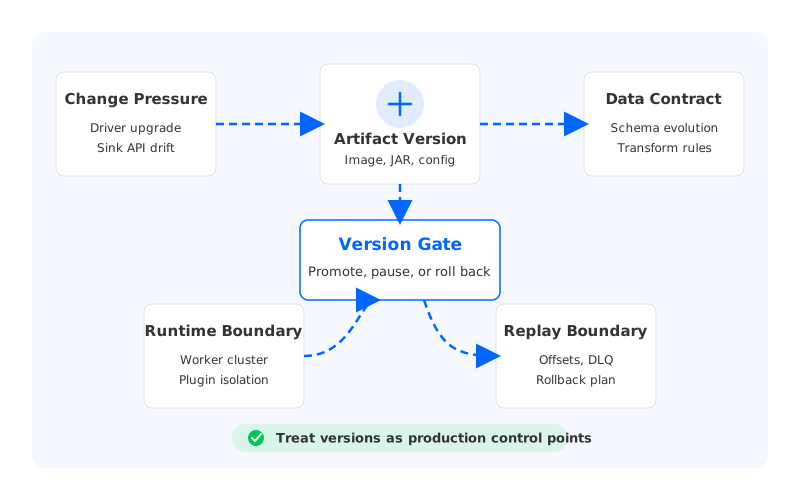
That is why connector versioning deserves its own operating model. Treating it as “bump the image tag and restart the worker” works in development, but production integration platforms are not development clusters with bigger instance types. Kafka Connect workers coordinate tasks, persist offsets, expose a REST API for lifecycle operations, and run connector plugins that often include third-party client libraries. The version you promote is not one thing. It is an artifact version, a connector configuration, a schema expectation, a worker runtime, and a rollback boundary.
1Why Teams Search for kafka connector versioning
The search intent is practical: people want to know how to upgrade connectors without turning every integration into a one-off migration. The hard part is that connectors are stateful at the platform boundary even when the code looks stateless. A source connector may persist offsets for an external database log. A sink connector may depend on idempotent writes into a warehouse, search index, or object store. A single message transformation may change topic names, keys, headers, timestamps, or schema metadata before the record reaches its destination.
Versioning has to answer four questions before the rollout starts:
- What exactly is changing: connector code, plugin dependencies, worker runtime, connector configuration, schema, or destination API?
- Which state must survive the rollout: offsets, topic subscriptions, task assignments, dead-letter queues, and external write checkpoints?
- Which consumers can tolerate replay, reordering, or duplicate delivery if the release has to be rolled back?
- Who owns the release decision when the Kafka platform team, data integration team, schema owners, and destination system owners disagree?
Those questions sound operational, but the root cause is architectural. Kafka Connect was designed to make integration repeatable, not to remove the need for release discipline. Its REST API can create, update, pause, stop, resume, restart, and inspect connectors. It can also report task status and expose offset-management operations in supported versions. Those controls are useful because they turn a connector into a managed service. They are not a substitute for knowing whether version 2.4.1 of a sink connector writes the same data contract as version 2.3.7.
2The Integration Constraint Behind the Pipeline
Connector versioning becomes risky when teams confuse three layers that move at different speeds. The connector artifact is the packaged code: JARs, container images, and dependency versions. The connector instance is the deployed configuration: topics, converters, transformations, credentials, task count, error handling, and destination settings. The data contract is the semantic promise: keys, values, schema evolution rules, delete handling, idempotency, ordering assumptions, and replay tolerance.
These layers do not fail in the same way. An artifact can fail fast because a class is missing from the plugin path. A configuration can fail after deployment because a destination rejects a field or rate limit. A data contract can fail quietly because the connector still runs, but writes records in a shape that downstream jobs interpret differently. The platform needs a release process that catches all three, because a green task status is not the same as a correct integration.
| Versioning layer | What changes | Typical failure mode | Release control |
|---|---|---|---|
| Artifact | Connector plugin, driver, runtime dependency | Startup failure, class conflict, unsupported API | Immutable package, compatibility test |
| Configuration | Topics, converters, transforms, task count | Task crash, wrong route, credential issue | Git-backed config, staged rollout |
| Data contract | Schema, key semantics, deletes, timestamps | Silent semantic drift | Schema checks, replay test, owner approval |
| Runtime | Worker version, JVM, network, secrets path | Cluster-wide instability | Canary workers, blast-radius limits |
The table also explains why “version per connector” is usually stronger than “one worker image for everything.” A shared worker fleet is convenient, but it creates a large blast radius when multiple plugins depend on different client libraries. Isolating connector groups by domain, criticality, or destination gives teams a cleaner promotion path. The price is more platform surface area to operate. For high-value pipelines, that price is usually lower than a shared runtime that makes every upgrade a negotiation across unrelated teams.
3Connector, Schema, Replay, and Stream Processing Trade-offs
The first trade-off is compatibility. Kafka clients are generally designed with protocol compatibility in mind, but connector plugins add their own dependencies and destination assumptions. A connector that reads from PostgreSQL logical replication, writes to Snowflake, or lands files in cloud object storage is also a client of those systems. When any side changes, the connector version has to be tested against the Kafka cluster, the worker runtime, the source or sink API, and the schema path. Pinning versions is not conservatism. It is a way to make compatibility explicit.
The second trade-off is replay. Kafka makes replay possible because records are retained in topics and consumers track offsets, but replay is not automatically safe. If a sink connector writes to an idempotent destination with stable keys, replay may be acceptable. If it appends files, sends emails, triggers webhooks, or writes rows without a natural key, replay may be destructive. Connector versioning should define a replay window, a duplicate-handling policy, and a dead-letter queue strategy before the release, not after the first failed task.
The third trade-off is stream processing ownership. Many teams use connectors beside Flink, Kafka Streams, or batch ELT jobs. A connector may land raw events, while a stream job enriches and normalizes them. If the connector changes schema handling or timestamp conversion, the stream job becomes part of the versioning story. The release plan should name the boundary: connectors own transport and basic transforms; stream processors own business semantics; schema governance owns compatibility policy. Blurring that boundary creates fragile releases because nobody can tell whether the fix belongs in a connector config, a Flink job, or a downstream table definition.
A stable integration platform does not avoid change. It makes every change small enough to understand, observe, and reverse.
4Evaluation Checklist for Data Platform Teams
A useful connector versioning checklist has to be boring. Boring means it can be repeated by a platform engineer on a Tuesday morning without asking five teams to reconstruct tribal knowledge. Start with a manifest for every connector release. The manifest should include the artifact digest, connector class, worker runtime, connector configuration, expected input topics, expected output system, schema compatibility mode, offset policy, rollback command, and owner. That document can live in Git, a deployment system, or an internal catalog. The location matters less than making it reviewable.
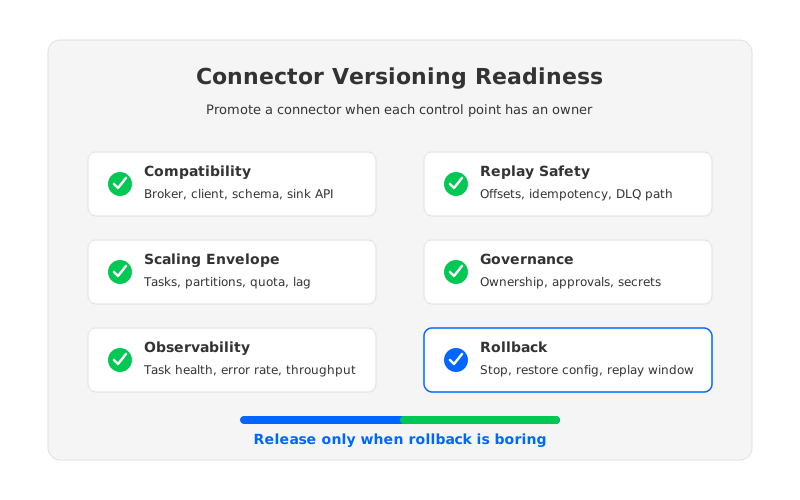
The second step is to separate release stages by evidence, not by environment name. A development cluster proves the connector can start. A staging pipeline proves it can process representative data. A production canary proves it behaves under real network, credential, quota, and destination conditions. Moving from one stage to the next should require evidence: task health, error rate, lag, throughput, destination write validation, and absence of unexpected dead-letter records.
Use this scorecard when the team is deciding whether a connector version is ready for promotion:
| Control point | Pass condition | Risk if skipped |
|---|---|---|
| Artifact immutability | Image digest or plugin package is pinned | Rollback may not restore the same code |
| Worker isolation | Critical connectors do not share risky dependencies | One plugin upgrade can break unrelated pipelines |
| Schema compatibility | Sample records pass converter and schema checks | Semantic drift reaches consumers |
| Offset policy | Stop, alter, reset, or preserve behavior is documented | Rollback creates duplicates or gaps |
| Destination validation | Writes are checked outside Kafka Connect status | Task success hides bad data |
| Observability | Alerts cover task failure, lag, DLQ, and write errors | Release failure is found by users |
| Rollback path | Previous version and config are deployable | Recovery depends on manual reconstruction |
The scorecard is intentionally platform-neutral. It applies whether the Kafka cluster is self-managed, cloud-managed, or Kafka-compatible. The important distinction is not where the broker runs; it is whether the platform gives connector teams predictable capacity, clear recovery boundaries, and low-friction rollback.
5How AutoMQ Changes the Operating Model
Once the connector release process is disciplined, the next question is infrastructure. Traditional Kafka deployments use a Shared Nothing model: each broker owns local storage, and data placement is tied to broker lifecycle. That model is familiar and battle-tested, but it means scaling, broker replacement, and storage operations can involve data movement. Connector platforms feel that pain during version rollouts because canary capacity, replay windows, and rollback tests all consume broker resources at the same time.
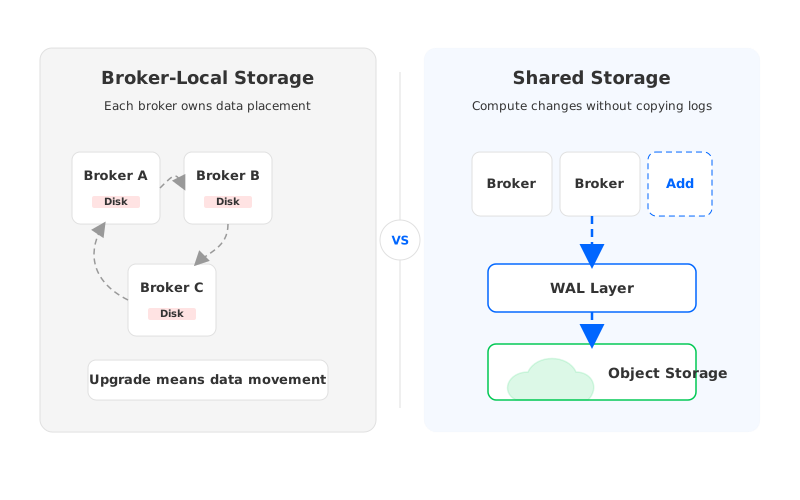
The architecture requirement is straightforward: connector teams need Kafka-compatible semantics while the platform team keeps compute, storage, and network operations from becoming release blockers. This is where AutoMQ fits naturally as a Kafka-compatible cloud-native streaming platform built around Shared Storage. AutoMQ keeps Kafka protocol and ecosystem compatibility while moving the storage layer to object storage, with a WAL layer for write efficiency and stateless broker nodes. For connector versioning, the operational effect is more important than the branding: compute can scale more independently from retained data, and broker-local storage movement is no longer the center of every capacity decision.
That matters for integration platforms in three concrete ways. First, canary connector groups can be provisioned with less anxiety about long storage rebalancing work. Second, replay-heavy validation has a cleaner storage foundation because retained records are not tied to a single broker’s local disk lifecycle. Third, customer-controlled deployment boundaries, including BYOC-style environments and private networking patterns, help platform teams keep connector traffic close to the systems it integrates with. AutoMQ also documents Kafka Connect support and managed connector concepts, which matters because connector platforms need ecosystem compatibility more than they need a novel API.
None of this removes the need for connector versioning. A shared-storage Kafka-compatible platform cannot tell you whether a destination API changed delete semantics or whether a schema evolution rule is acceptable. What it can change is the amount of infrastructure friction around testing, scaling, and recovery. When the broker layer is less entangled with local storage, connector teams can focus more on release evidence and less on waiting for storage-bound operations to finish.
6Migration Pattern for Existing Connector Fleets
Most teams should not start by rewriting every connector. Start with the connectors that already hurt: high-volume sinks, connectors with fragile dependencies, pipelines with strict replay requirements, or integrations where a rollback has failed before. For each candidate, build a release manifest and run a dry rollback. If the rollback plan cannot be executed in a test environment, it is not a rollback plan; it is a hope written in Markdown.
Then split connector fleets into release rings. Ring one contains low-risk internal pipelines that can tolerate duplicates. Ring two contains business-critical but well-understood pipelines with idempotent writes. Ring three contains pipelines with external side effects, weak idempotency, or strict contractual obligations. Each ring should have a different promotion window, approval path, and observability threshold. The point is not bureaucracy. The point is to stop treating a marketing analytics sink and a financial ledger feed as the same operational object because both happen to run on Kafka Connect.
The migration also needs a storage and retention review. Connector versioning relies on the ability to replay enough history to prove correctness and recover from failure. If Kafka retention is too short, rollback becomes a race against time. If retention is long but storage cost forces aggressive cleanup, teams will avoid proper validation. A Kafka-compatible platform that separates compute and storage gives architects more room to design retention around recovery needs rather than around broker disk pressure.
7A Practical Next Step
If you came here because a connector upgrade is already blocked, do not start by asking whether the target version is safe. Start by asking whether your platform can prove it is safe. The release manifest, scorecard, canary ring, and rollback drill will expose most of the missing pieces before a production incident does. After that, infrastructure evaluation becomes clearer: you are not buying a connector feature; you are choosing the operating model that will carry hundreds of connector changes over the next few years.
If your team is evaluating Kafka-compatible infrastructure for integration platforms, AutoMQ’s diskless architecture write-up is a useful next read: see how AutoMQ implements low-latency diskless Kafka. Use it alongside your connector versioning scorecard, not as a replacement for it.
8References
- Apache Kafka documentation: Kafka Connect user guide
- Apache Kafka documentation: Kafka Connect configuration
- Apache Kafka documentation: Kafka operations and core concepts
- AutoMQ documentation: What is AutoMQ
- AutoMQ documentation: Shared Storage architecture
- AutoMQ documentation: Kafka Connect overview
9FAQ
9.1What is Kafka connector versioning?
Kafka connector versioning is the practice of controlling connector artifacts, connector configuration, worker runtime, data contracts, and rollback state as one release unit. It is broader than choosing a plugin version because a connector also carries offsets, schema expectations, destination behavior, and operational ownership.
9.2Should every connector run on its own Kafka Connect cluster?
Not every connector needs a dedicated cluster. A better rule is to isolate by blast radius. Critical connectors, connectors with unusual dependencies, and connectors that write to sensitive systems often deserve separate worker groups. Low-risk pipelines can share workers when dependency conflicts and rollback requirements are understood.
9.3How do offsets affect connector rollback?
Offsets decide where a connector resumes processing. Preserving offsets may avoid duplicates but can skip reprocessing needed after a bad release. Resetting or altering offsets can recover data but may duplicate writes. The right answer depends on whether the destination is idempotent and whether the connector is a source or sink.
9.4Where does AutoMQ fit in a connector platform?
AutoMQ fits at the Kafka-compatible streaming infrastructure layer. It does not replace connector release governance, schema ownership, or destination validation. It can reduce storage-bound operational friction by using Shared Storage, stateless brokers, and object-storage-backed durability while preserving Kafka ecosystem compatibility.


