
Table of Contents
Table of Contents
Teams usually start searching for kafka control plane design after the first version of their Kafka platform has already worked. Producers are sending records, consumers are stable enough, dashboards exist, and somebody has wrapped topic creation in a script. Then the pressure changes. Product teams ask for self-service topics, security wants proof that ACLs match ownership, and finance asks why scaling one workload triggered more brokers, storage, and cross-zone traffic.
That is the moment when "Kafka automation" stops meaning convenience scripts and starts meaning control plane design. The data plane moves records and preserves Kafka semantics. The control plane decides who can create resources, which changes are safe, how capacity is reconciled, what happens during failure, and where human approval still belongs. The question is not whether to automate Kafka. It is which decisions should be automated, gated, or left explicit.
1Why Kafka Control Plane Design Matters Now
Kafka clusters used to be treated like scarce shared infrastructure. A small platform team provisioned clusters, reviewed topic requests, tuned broker counts, and absorbed the operational cost of every data product. That model can still work for a narrow set of high-value streams, but it breaks down when Kafka becomes the default integration layer for applications, analytics, machine learning features, audit trails, and real-time AI context.
The failure mode is subtle. The platform team does automate, but it automates the wrong layer. A script can create topics, but it may not encode retention policy, owner identity, quota boundaries, data classification, or rollback behavior. An operator can reconcile a Kubernetes custom resource, but it may not understand whether a broker expansion is compensating for storage pressure, network pressure, or a partition skew that should be fixed at the workload level. A CI workflow can apply ACLs, but it may not detect that a service account outlived the application it was created for.
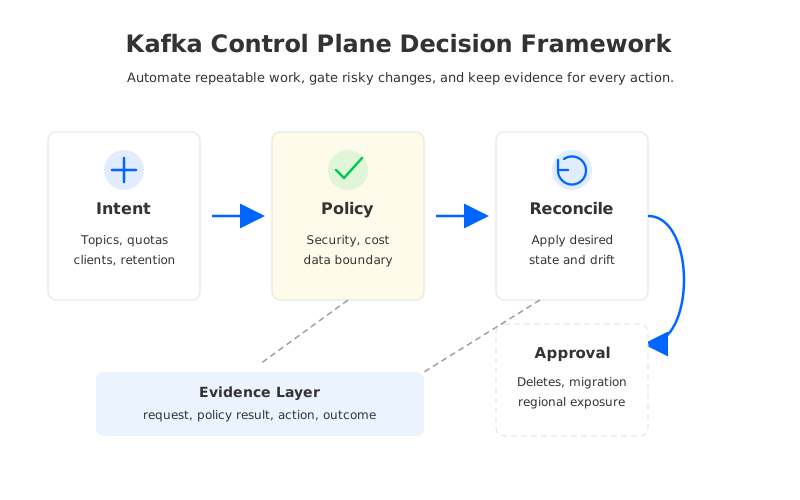
Good control plane design separates four concerns:
- Intent capture: Developers declare what they need: topics, quotas, client identities, network exposure, retention, and recovery objectives.
- Policy evaluation: The platform validates that intent against naming rules, security requirements, cost budgets, data residency boundaries, and compatibility constraints.
- Reconciliation: Automation turns approved intent into Kafka resources and keeps actual state from drifting.
- Exception handling: Humans still approve high-risk changes such as destructive deletes, regional exposure, large retention increases, and migration cutovers.
This split mirrors a broader cloud-native pattern. Kubernetes controllers reconcile desired state with actual state, and the Operator pattern extends that idea to application-specific operations. Kafka platforms can borrow the same discipline, but Kafka adds a harder constraint: state is not only configuration. State includes partitions, offsets, consumer groups, transaction markers, local broker storage, and the data movement triggered by topology changes.
2The Production Constraints Behind the Search
The control plane has to respect Kafka's operational shape. Apache Kafka's documentation covers topics, partitions, consumer groups, offsets, access control, quotas, transactions, KRaft metadata, and tiered storage. Each area can be automated, but each carries a different blast radius. Treating them all as equivalent "resources" turns self-service platforms into incident generators.
Topic creation is a good example. On paper, a topic request is a name, a partition count, a replication factor, and a few configs. In production, it also implies retention cost, partition metadata growth, broker load, consumer parallelism, disaster recovery behavior, and ownership. The safe boundary is not "let developers create topics." It is "let developers request topics inside a policy envelope."
The same logic applies to scaling. Traditional Kafka brokers own compute and local persistent storage together. Adding or replacing brokers can trigger partition reassignment, replica catch-up, and long-running data movement. Automation can initiate those workflows, but it must also know when to stop. If the root cause is a hot partition, adding brokers may hide the signal. If the root cause is retention growth, adding compute to buy disk capacity couples two budgets that should be evaluated separately.
The control plane must answer a few uncomfortable questions before it acts:
| Decision area | Safe to automate directly | Needs policy gate | Usually needs human approval |
|---|---|---|---|
| Topic lifecycle | Standard topic creation from approved templates | Retention, partition count, data class | Destructive delete or compaction changes for shared topics |
| Client access | Service account creation, ACL sync, quota defaults | Cross-domain access, admin permissions | Emergency bypass or broad wildcard access |
| Capacity | Routine rebalance, safe broker replacement, scale within budget | Large retention growth, cross-zone exposure | Migration cutover, regional failover, architecture change |
| Governance | Drift detection, owner mapping, audit evidence | Exceptions to naming and classification | Policy override for regulated data |
The table is conservative. Automation earns trust when engineers can predict where it will stop. A control plane that never asks for approval is opaque, not mature.
3Architecture Patterns Teams Usually Compare
Most Kafka control planes start as wrappers around the existing cluster model. They provide APIs, templates, Terraform modules, GitOps workflows, or Kubernetes custom resources that make the current operating model repeatable. That can be the right first step; a messy manual process should become a clean automated process before the organization debates a deeper architecture change.
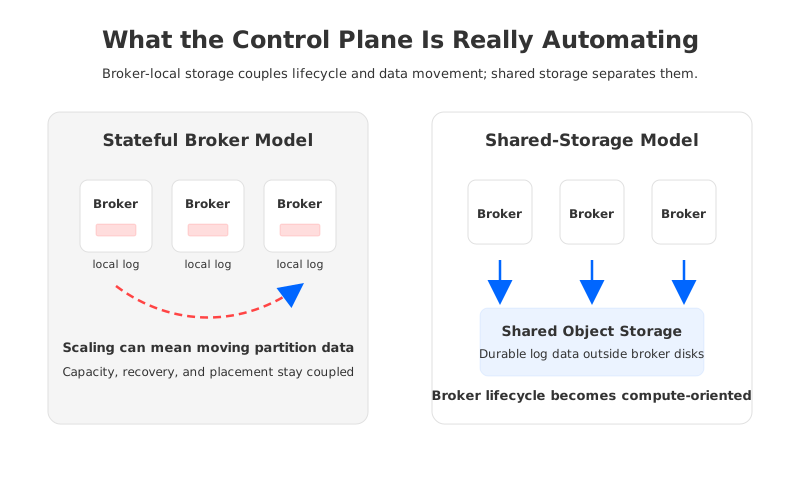
But the shared-nothing broker model shapes what the control plane can promise. Broker-local storage means placement, capacity, and recovery remain tightly coupled. A topic-level decision can become broker-level data movement, a workload spike can become a storage scaling question, and maintenance can become replica catch-up. The control plane can reduce toil around those workflows, but it cannot remove the underlying coupling.
Three patterns show up repeatedly:
- Cluster automation around Apache Kafka: Teams keep the familiar broker architecture and build stronger provisioning, policy, and observability around it. This works when the team has Kafka depth and predictable workloads.
- Kubernetes operator model: Teams express Kafka clusters and supporting resources as Kubernetes objects, then let controllers reconcile desired state. This gives platform teams a common cloud-native operating surface, but it still needs Kafka-specific guardrails around storage, reassignment, upgrades, and failure recovery.
- Shared-storage Kafka-compatible architecture: Teams evaluate platforms where brokers become more compute-oriented and durable log storage moves to shared object storage. This changes the control-plane problem because broker replacement, scaling, and partition movement no longer imply the same volume of broker-local data motion.
The right answer depends on the constraint that hurts most. If the issue is inconsistent resource creation, a control API and policy engine may be enough. If it is Kubernetes-native lifecycle management, an operator can provide a better integration point. If every scaling or recovery action drags broker-local storage with it, the team is solving an architecture problem that automation can only partially mask.
4What Belongs in Automation
A useful Kafka control plane automates boring, repeatable, policy-verifiable work. That sounds obvious until a team writes down the inventory. Kafka has many operational tasks that are repeatable but not safe; it also has tasks that are safe only when input is constrained. The boundary should be explicit in the platform design, API, and runbooks.
Start with resources that have clear ownership and reversible changes. Topic templates, service accounts, ACL binding, quotas, labels, contact metadata, dashboard registration, and alert routing are strong candidates. The platform can validate them before execution and detect drift afterward. The control plane should make desired state visible: who owns the topic, which service reads it, what data class it carries, why retention is set that way, and which budget pays for it.
Capacity automation needs tighter rules. The control plane can collect signals such as disk usage, broker network saturation, partition skew, consumer lag, ISR health, and request latency. It can recommend action or execute within narrow limits. The mistake is to let one metric trigger one infrastructure action. Consumer lag might mean under-provisioned consumers, slow downstream storage, bad fetch settings, hot partitions, broker pressure, or a deployment failure.
The most mature designs treat automation as a decision pipeline:
- Classify the symptom: Is it client-side, topic-level, broker-level, storage-level, or network-level?
- Check policy: Is the proposed action inside budget, security, and availability constraints?
- Estimate blast radius: Which producers, consumers, partitions, and regions are affected?
- Execute or gate: Apply low-risk changes automatically; route high-risk changes through approval.
- Record evidence: Keep the request, policy result, operator action, and outcome together for audit and learning.
This pipeline is more useful than a collection of scripts because it creates operating memory. When an incident review asks why the platform scaled, changed retention, or blocked a topic request, the control plane should have an answer better than "the automation ran."
5What Should Stay Outside Full Automation
Not every Kafka operation belongs behind a button marked "self-service." Destructive deletes, major retention reductions, large partition count changes, cluster-to-cluster migrations, disaster recovery activation, and public or cross-region network exposure deserve friction. Friction is not bureaucracy when a change can delete data, invalidate recovery, or reshape the bill.
The same caution applies to governance exceptions. A developer may have a valid reason to request access across domains, but the control plane should not normalize broad permissions as an easy path. Kafka ACLs and quotas express least privilege and workload boundaries; automation should not turn them into boilerplate.
There is also a psychological boundary. Platform teams automate manual work to reduce interruptions, then discover that hidden automation creates a new interruption: teams stop understanding the platform. The antidote is explainable automation. Every approved resource should carry owner, purpose, policy, and lifecycle metadata. Every rejected request should tell the developer what to change. Every automated action should be visible enough for an SRE to reason about it during an incident.
6Where AutoMQ Changes the Operating Model
After the control plane is designed around intent, policy, reconciliation, and exceptions, the architecture underneath becomes easier to evaluate. A Kafka-compatible platform should preserve the client contract that application teams depend on, but it does not have to preserve every broker storage assumption that made the old model hard to automate.
AutoMQ fits into this discussion as a cloud-native, Kafka-compatible shared-storage option. It keeps compatibility with Apache Kafka protocols and semantics while redesigning the storage layer around object storage and write-ahead log options. In that model, brokers are more stateless because durable log data is not bound to broker-local disks in the same way. For a control plane, broker replacement, scaling, partition reassignment, and recovery can be treated more like compute lifecycle events and less like long storage migration projects.
That distinction matters for automation. If the platform can add or replace broker compute without dragging the same volume of local log data across brokers, the control plane can reconcile capacity with a smaller operational surface. AutoMQ documentation also describes Kafka compatibility, shared storage architecture, continuous self-balancing, and options for reducing inter-zone traffic with S3-based storage and zone-aware routing. Those capabilities do not remove the need for governance, approval, and observability. They make the automation boundary cleaner because fewer routine actions are entangled with broker-local data movement.
Deployment boundary is part of the design, too. For regulated teams, the question is often not "managed or self-managed" but "who owns the data plane, network boundary, encryption boundary, and operational authorization?" AutoMQ's BYOC and software deployment models let teams evaluate cloud-native Kafka-compatible operations while keeping infrastructure and data control aligned with their cloud account or private environment requirements. The point is not that every Kafka platform should move immediately. It is that control plane design should expose when broker-storage coupling is the real bottleneck.
7Decision Framework for Platform Teams
The cleanest way to evaluate your own Kafka control plane is to walk through real requests from start to finish: a topic request, a quota increase, a retention change, and a scale event. For each one, ask what the platform knows before it acts.
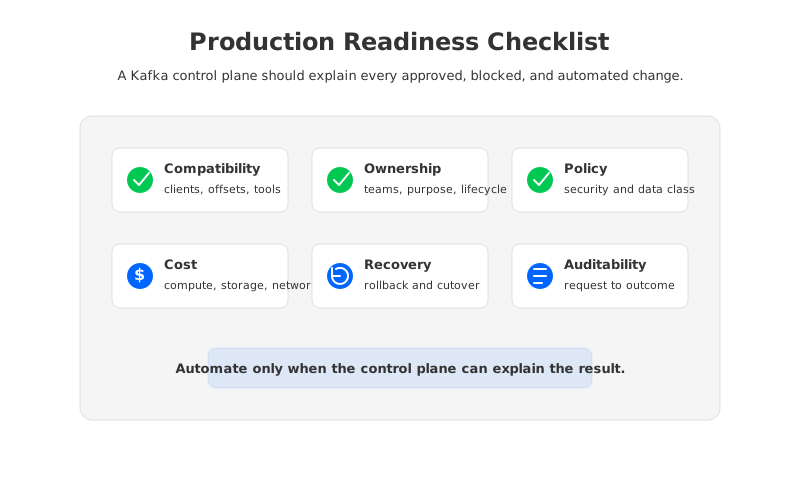
Use this checklist:
- Compatibility: Can existing Kafka clients, producer configs, consumer groups, offsets, transactions, and operational tools keep working during the proposed platform change?
- Ownership: Does every topic, service account, ACL, quota, and dashboard have an owner and lifecycle?
- Policy: Are retention, partition counts, data classification, network exposure, and regional placement validated before execution?
- Cost: Does the control plane distinguish compute, storage, replication, and network cost, or does it hide all cost behind broker count?
- Recovery: Can the platform explain rollback behavior for failed changes, client cutovers, and regional events?
- Auditability: Can an auditor or incident reviewer connect request, approval, execution, and outcome without reconstructing history from chat logs?
If the answer is mostly yes, the next investment may be stronger templates, drift detection, and developer experience. If the answer is mixed, policy gates and metadata quality will likely produce more value than aggressive auto-scaling. If the answer is no because storage movement dominates every operational decision, the team should compare Kafka-compatible architecture options, including shared-storage designs, before adding another layer of scripts.
Kafka control plane design is ultimately a promise to application teams: the platform will move fast where the risk is known and slow down where the risk is real. Automation is the mechanism. The promise is a streaming platform whose operating model is explicit enough that developers can self-serve, SREs can debug, security can govern, and finance can understand the cost curve before the next workload arrives.
8References
- Apache Kafka Documentation
- Kubernetes Operator Pattern
- AutoMQ Architecture Overview
- AutoMQ Compatibility with Apache Kafka
- AutoMQ Inter-Zone Traffic Overview
9FAQ
9.1What is a Kafka control plane?
A Kafka control plane is the layer that manages intent, policy, lifecycle, access, capacity decisions, drift detection, and operational evidence for Kafka or Kafka-compatible platforms. The data plane moves records; the control plane decides how resources are created, changed, governed, and recovered.
9.2Should topic creation be fully automated?
Standard topic creation can be automated when it is template-driven and policy-checked. Retention, partition counts, data classification, ownership, and destructive deletes should be gated because they affect cost, compliance, and recovery.
9.3Is a Kubernetes operator the same as a Kafka control plane?
No. A Kubernetes operator can be part of a control plane because it reconciles desired state, but a full Kafka control plane also needs policy, ownership, audit, cost awareness, migration workflow, client lifecycle, and exception handling.
9.4When should teams evaluate shared-storage Kafka-compatible architecture?
Evaluate it when broker-local storage dominates scaling, recovery, reassignment, or cost decisions. If the control plane spends most of its effort coordinating data movement rather than enforcing intent and policy, architecture may be the constraint.
9.5Where does AutoMQ fit in Kafka control plane design?
AutoMQ is relevant when teams want Kafka compatibility with a cloud-native shared-storage operating model. It can make broker lifecycle and capacity reconciliation cleaner, but it should still be evaluated through the same control-plane checklist: compatibility, governance, cost, recovery, and deployment boundary.


