
Table of Contents
Table of Contents
Teams search for kafka cost allocation when the Kafka bill has stopped being a platform-only problem. Finance wants to know which product line is driving spend. Application teams want a fair model that does not punish them for shared infrastructure. Platform engineers want allocation to reflect workload pressure rather than a split by team name, topic count, or cluster count.
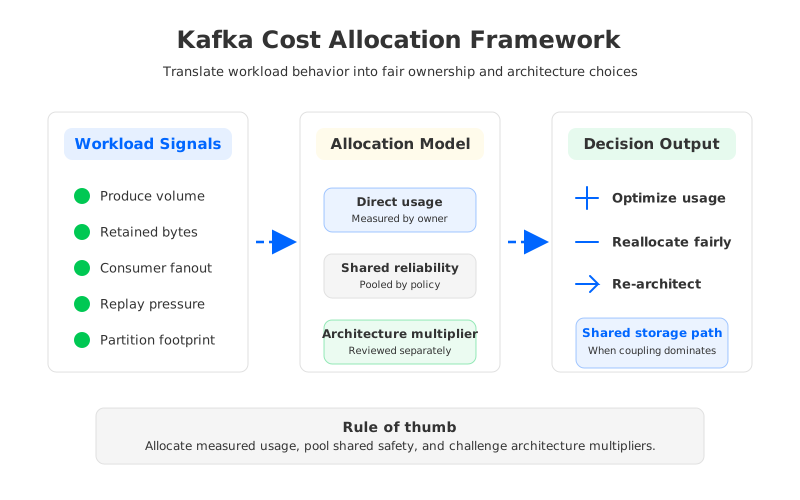
Kafka is often treated as a shared utility, but the cost of a streaming platform is created by workload decisions: write rate, retention, replica placement, read fanout, replay behavior, partition count, and the operational headroom needed to keep production safe.
The hard part is that traditional Kafka cost is not naturally shaped like a chargeback ledger. Brokers own partitions and local log segments, so compute, durable storage, replication traffic, and recovery work are tightly connected. If a platform team keeps spare brokers for failure recovery, every tenant benefits, but no tenant directly "used" that spare capacity. Cost allocation has to translate this architecture into a model people can govern.
1Why Kafka Cost Allocation Is Harder Than Broker Count
Counting brokers is tempting because it is visible. A cluster has broker nodes, instance types, attached storage, network interfaces, metrics, logs, and support overhead. Split those costs across teams and the spreadsheet is done. The spreadsheet is also misleading, because broker count is an output of many workload choices rather than the source of the cost.
Consider two applications on the same Kafka platform. One writes a steady stream with short retention and a few consumers. Another writes less data per second but keeps weeks of history, supports replay jobs, and feeds several downstream teams. A broker-count allocation can make them look similar; a usage-aware allocation shows very different retained bytes, read fanout, and operational risk.
Kafka makes this more subtle because reliability is built into the platform topology. Replication factor, availability zone placement, leader distribution, and partition movement are not optional accounting details. Some spend is directly attributable to a workload; some is shared reliability capacity that protects everyone.
The platform team therefore needs three layers of allocation:
- Direct workload drivers: These are measurable per application, topic family, or tenant. Write volume, retained bytes, consumer traffic, replay traffic, and partition count belong here.
- Shared platform drivers: These are required to operate Kafka safely. Controller quorum, spare capacity, observability, upgrades, security, incident response, and migration tooling belong here.
- Architecture drivers: These are created by the storage and deployment model. Broker-local durable data, inter-broker replication, cross-zone traffic, and reassignment overhead determine how direct workload choices become infrastructure cost.
That last category is where most allocation programs get stuck. The team can measure workload inputs, but the architecture decides how expensive those inputs become.
2Start With a Workload Ledger
A cloud bill is the settlement record. It tells you what was charged after the architecture translated workload into resources. For allocation, start one step earlier with a workload ledger.
| Allocation Input | Useful Measurement | Why It Belongs in the Ledger |
|---|---|---|
| Produce volume | Sustained and peak MiB/s by topic family | Writes create the data set that must be replicated and stored. |
| Retention | Retained bytes or retention hours by workload | Long retention can dominate storage even when compute use is modest. |
| Consumer fanout | Number of active consumer groups and egress volume | The same record can create repeated broker, cache, and network work. |
| Replay and backfill | Catch-up read volume and frequency | Recovery jobs and analytics replays stress different paths than tailing reads. |
| Partition footprint | Partition count, leaders, and metadata share | High partition counts consume scheduling, memory, and balancing capacity. |
| Placement and availability | Replica count, rack or AZ policy, leader locality | Availability decisions create storage and traffic multiplication. |
| Operational share | Incident count, custom support, migration work | Some tenants require more platform engineering time than raw bytes suggest. |
The point is not to build a perfect model on the first pass. The point is to agree on technical inputs before arguing about invoice line items. Once the ledger exists, Finance can apply official prices, commitments, vendor terms, and internal cost center rules.
A practical rule works well: allocate what you can measure directly, pool what protects the whole platform, and review architecture-driven multipliers separately. This prevents a common failure mode where the team debates invoice details while ignoring the storage model that multiplies retained data.
3The Kafka Architecture Multipliers Behind the Ledger
Apache Kafka's traditional architecture binds partition data to brokers. A broker is not only a compute worker; it is also the owner of local log segments. Reliability comes from replication across brokers, and cluster changes involve moving partition data or rebalancing leadership.
When an application increases produce volume, the platform does not only buy write capacity. It also needs durable storage, replication capacity, network capacity, and monitoring. When retention grows, the impact may show up as larger disks, more broker headroom, and harder scaling decisions.
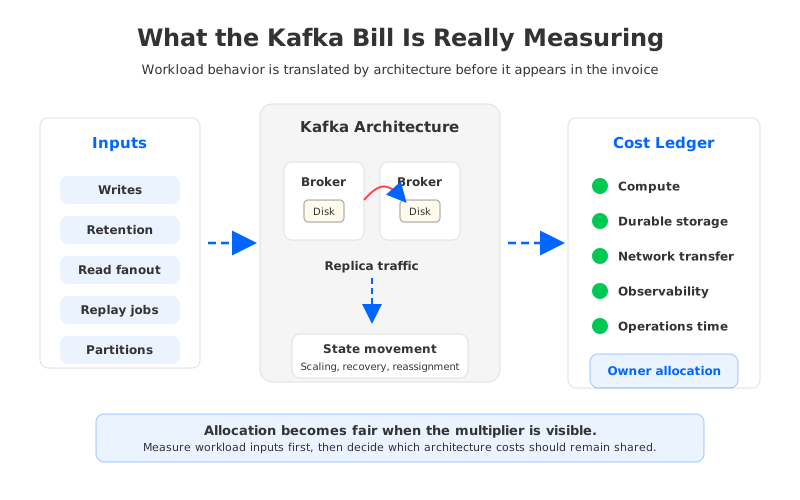
These multipliers matter because allocation can become unfair if they stay hidden. A team with high retention may appear to consume "storage only," but in broker-local Kafka that retained data can also pin compute nodes in place.
The solution is to make the translation explicit:
- Bytes written become replicated durable bytes under the platform's availability policy.
- Retention becomes a storage footprint and a recovery consideration.
- Consumer fanout becomes repeated read, egress, and cache pressure.
- Placement policy becomes cross-zone or cross-rack traffic and failure-domain protection.
- Partition count becomes metadata, scheduling, and balancing overhead.
- Change frequency becomes operations work: expansion, upgrade, reassignment, migration, and rollback.
Once these translations are visible, application teams can make better choices. They may accept a lower retention tier for low-value topics, isolate replay-heavy workloads, or budget for a higher availability target when the business needs it. Allocation becomes a governance tool rather than a punishment mechanism.
4Cost Optimization Before Architecture Change
Every platform team should do the boring work first. It improves the platform, creates cleaner data for any architecture comparison, and builds trust with application owners.
Start with topic ownership. Unknown owners create permanent cost because nobody can approve retention changes or cleanup. Then review retention defaults by workload class, measure compression by payload type, and identify consumers that perform repeated full replays when incremental processing would work.
These steps remove waste that no architecture should carry. If cost is still dominated by retained bytes, cross-zone movement, slow reassignment, or recovery headroom after cleanup, the problem is the architecture's cost curve.
At that point, the review should separate three questions:
| Question | What It Tests | Typical Evidence |
|---|---|---|
| Is the workload wasteful? | Whether topic and consumer behavior can be cleaned up | Owner map, retention review, compression tests, abandoned consumer scan |
| Is the platform overprovisioned? | Whether current resources exceed reliability needs | CPU, disk, network, partition headroom, failure drills |
| Is the architecture coupling the wrong resources? | Whether compute, storage, replication, and recovery scale together | Retention-heavy brokers, costly data movement, slow scale-in, cross-zone traffic |
The third question changes the conversation. If architecture coupling is the dominant driver, better allocation will expose the cost, but it will not remove the cost. The team needs to compare operating models.
5Architecture Patterns Teams Usually Compare
Kafka cost allocation improves when the platform has cleaner cost boundaries, so the allocation model should evaluate patterns before evaluating vendors.
Broker-local Kafka keeps durable data on broker-attached disks and uses broker-level replication for availability. This makes the cost model familiar, but retention and reassignment can stay expensive because compute nodes carry long-lived state. Kafka with remote tiers can reduce pressure on local disks by moving older segments to lower-cost storage, but the local tier, broker lifecycle, and tier management still matter.
Shared-storage Kafka-compatible architectures change the boundary more deeply. Durable data moves out of broker-local disks and into shared storage, while brokers focus more on protocol handling, leadership, caching, and coordination. The model shifts toward object storage footprint, WAL requirements, cache behavior, request patterns, and compute elasticity.
That is where AutoMQ enters the evaluation naturally. AutoMQ is a Kafka-compatible cloud-native streaming platform that keeps Kafka protocol and ecosystem semantics while replacing broker-local durable log storage with S3Stream, a shared storage layer using WAL storage, data caching, and S3-compatible object storage. The key question is whether this separates the cost boundaries that the allocation model is struggling to express.
6Where AutoMQ Changes the Allocation Model
In AutoMQ, brokers are designed to be stateless with respect to durable Kafka log storage. The broker still handles Kafka requests, partition leadership, caching, and coordination, but retained stream data is offloaded through S3Stream. WAL storage absorbs durable writes and supports recovery, while object storage becomes the primary place for retained data.
For cost allocation, this changes four important conversations.
First, retained bytes can be modeled closer to a storage decision than a broker fleet decision. Second, scaling and upgrade discussions can focus more on traffic and less on moving durable partition data. Third, AutoMQ's shared-storage architecture and zone-aware routing patterns can reduce or avoid the inter-broker replica traffic that makes multi-AZ Kafka bills hard to allocate fairly. Fourth, AutoMQ BYOC and software deployment models let teams run the data plane in their own cloud account or private environment.
AutoMQ should enter the budget review after the workload ledger is built. If abandoned topics or poor owner hygiene dominate, fix that first. If valid requirements are being amplified by broker-local storage and stateful scaling, a shared-storage Kafka-compatible design deserves evaluation.
7A Practical Allocation Model for Platform Teams
A workable model usually has three buckets. It is simple enough for Finance to use and technical enough for SREs to defend.
| Bucket | Allocation Method | Examples |
|---|---|---|
| Workload-attributable cost | Charge by measured usage | Produced bytes, retained bytes, consumed bytes, replay volume, partition share |
| Shared reliability cost | Allocate by agreed policy | Spare capacity, controller quorum, baseline observability, security, incident readiness |
| Architecture and transition cost | Review as platform investment | Migration tooling, dual-run period, proof of concept, storage model redesign |
This structure avoids two bad outcomes. It does not pretend every shared reliability cost belongs to the noisiest tenant. It also does not hide architecture migration under normal operating cost.
The model should include a dispute path. Application owners need a way to challenge their allocation with evidence: a retired topic, a corrected owner tag, a retention change, or a consumer cleanup. Platform teams need a way to challenge unsafe optimization requests that weaken recovery or availability.
The goal is not perfect chargeback. The goal is better decisions. A good allocation model lets a product leader ask, "What would reduce my Kafka cost without creating platform risk?" and lets the platform team answer with specific levers.
8Decision Guide: Optimize, Reallocate, or Re-Architect
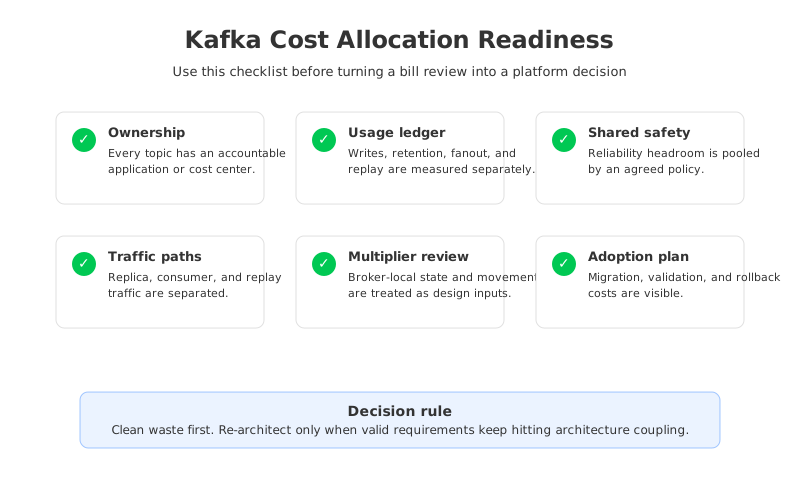
The final decision should match the dominant source of cost pressure. If the pressure comes from poor ownership, start with governance. If it comes from overprovisioning, start with capacity management. If it comes from architecture multiplying valid workload requirements, evaluate architecture change.
| Signal | Best First Move | When to Consider AutoMQ |
|---|---|---|
| Many ownerless topics or stale consumers | Build ownership and cleanup workflow | After cleanup, if retained data and broker state still dominate cost |
| High broker headroom with modest traffic | Review sizing, failure policy, and partition placement | If headroom exists mainly because stateful brokers are hard to scale in |
| Long retention with low CPU usage | Separate retention tiers and storage accounting | If broker-local disks force compute spend for mostly storage-heavy workloads |
| High cross-zone traffic | Review placement, client locality, and replication paths | If replica traffic remains a structural multi-AZ cost driver |
| Frequent reassignment or upgrade toil | Improve automation and runbooks | If state movement keeps making routine operations expensive |
| Strict data control requirements | Clarify account, VPC, IAM, and audit boundaries | If BYOC or software deployment would align cost and governance ownership |
Cost allocation is a mirror. It shows who uses what, but it also shows whether the platform's architecture makes fair allocation difficult. When it reveals structural coupling between compute, storage, replication, and recovery, the platform team has a larger design choice to make.
For teams reaching that point, the next step is to build a workload ledger from real Kafka metrics, then compare the current model with a Kafka-compatible shared-storage model under the same reliability target.
9References
- Apache Kafka Documentation
- Apache Kafka Operations: Tiered Storage
- AWS EC2 On-Demand Pricing: Data Transfer
- AWS S3 Pricing
- AWS Cost Allocation Tags
- AutoMQ Docs: S3Stream Shared Streaming Storage
- AutoMQ Docs: Stateless Broker
- AutoMQ Docs: Save Cross-AZ Traffic Costs
10FAQ
10.1What is Kafka cost allocation?
Kafka cost allocation assigns Kafka platform cost to applications, teams, tenants, or business units based on measurable usage and shared reliability policy. A good model includes produced bytes, retained bytes, consumer traffic, replay behavior, partition footprint, and shared operations overhead.
10.2Why is broker-count allocation usually unfair?
Broker count reflects platform topology, not the workload drivers behind it. Two applications can share the same brokers while creating very different storage, consumer fanout, retention, and replay pressure. Broker-count allocation is easy to calculate, but it hides the decisions that created the cost.
10.3Which Kafka metrics are most useful for FinOps?
Start with write throughput by topic, retained bytes, retention policy, consumer group traffic, replay volume, partition count, leader distribution, and cross-zone traffic paths. Add incident frequency, reassignment time, and upgrade effort when the model includes platform engineering labor.
10.4Does tiered storage solve Kafka cost allocation?
Tiered storage can reduce pressure on broker-local disks for older data and may improve the storage part of the model. It does not automatically make brokers stateless or remove all placement and lifecycle concerns. Compare tiered storage, managed services, and shared-storage architectures against the same workload ledger.
10.5How does AutoMQ affect Kafka cost allocation?
AutoMQ separates Kafka-compatible compute from durable log storage through S3Stream, WAL storage, caching, and object storage. This can make retained bytes, compute elasticity, and cross-zone traffic easier to model separately. Teams should validate the impact with their own workload assumptions and deployment requirements.
10.6When should a platform team re-architect instead of only reallocating cost?
Re-architect when valid workload requirements keep creating high cost because compute, storage, replication, and recovery are coupled. If cleanup, right-sizing, and ownership improvements do not change the largest cost drivers, the allocation model has revealed an architecture problem rather than an accounting problem.


