
Table of Contents
Table of Contents
Pricing pages are useful when a team already knows what it is buying. Kafka platform owners rarely start there. They start with a less tidy question: why does a cluster that looked reasonable in a spreadsheet become expensive after replication, retention, network traffic, upgrades, rebalancing, and recovery are included?
The phrase kafka cost usually means more than the monthly price of a broker. It is a shortcut for a buying conversation that includes managed service fees, infrastructure sizing, cross-zone traffic, storage retention, operational labor, and migration risk. A cloud pricing page can list billable dimensions, but it cannot know whether your workload has one consumer group or 30, whether reads are local to a VPC or crossing a boundary, or whether a broker replacement triggers hours of partition movement.
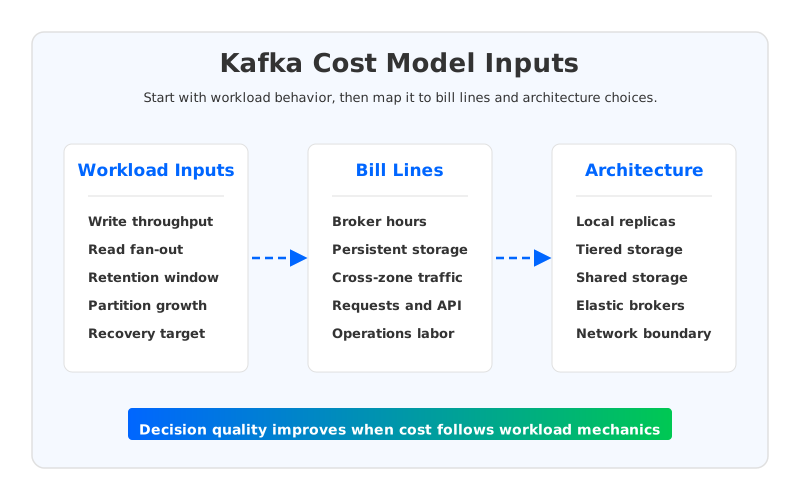
That is why a good Kafka cost model has to begin with workload mechanics before it touches vendor line items. Kafka is not a stateless HTTP service where request count and instance hours explain most of the bill. It is a replicated log. Every byte written can turn into multiple bytes stored, copied, fetched, compacted, retained, restored, and mirrored. The architecture decides how many of those copies are required and where they travel.
1Why Pricing Pages Are Only the First Layer
Official pricing pages provide the first hard boundary: what the provider charges for broker hours, storage, data transfer, requests, and related managed-service features. For example, Amazon MSK pricing distinguishes broker modes and calls out provisioned capacity, storage, and data transfer considerations. AWS also publishes separate pricing pages for EC2 data transfer and S3.
Those pages are necessary, but they are not a cost model. They do not decide your replication factor, topic count, partition growth, read fan-out, or availability target. They also do not explain the operational side of the bill: how often a team has to resize brokers, move partitions, replace failed storage, rebalance leaders, or run migration rehearsals before a production change.
The first mistake is treating Kafka cost as a static quote. The second is treating all Kafka-compatible architectures as if they produce the same traffic pattern. A platform that stores durable data on broker-attached disks has a different cost curve from a platform that separates compute from durable storage. Tiered storage changes the retention equation but may not remove the hot-path replication model. Cross-cluster replication can solve regional recovery but can also create a second steady-state stream of data transfer.
The useful question is not "which price page is lower?" It is "which architecture makes my expensive workload behavior unavoidable?"
2The Workload Inputs Most Teams Miss
A Kafka estimate becomes credible when it starts with the workload shape. The same broker count can support very different bills depending on whether the cluster is write-heavy, read-heavy, retention-heavy, or recovery-heavy. A FinOps team looking only at broker instance hours may miss the larger cost driver because the workload is hiding it in another line item.
Start with five inputs before comparing vendors:
- Ingress throughput. Sustained write throughput determines replication traffic, disk write pressure, broker CPU, and the minimum safe headroom for leader failover. Peak throughput matters too, because Kafka capacity is usually sized for burst safety rather than average utilization.
- Read fan-out. One consumer group is a different system from a dozen independent groups replaying the same topics. Fan-out turns retained data into repeated network and disk activity, especially when consumers are spread across zones or VPC boundaries.
- Retention and replay. Long retention is not only a storage question. It changes recovery behavior, catch-up time, tiered storage access patterns, and how much data must remain easy to fetch after an incident.
- Partition and tenant growth. Partition count affects metadata, file handles, leader balancing, controller load, and operational complexity. A low-cost cluster on day one can become fragile if every team receives independent topics with generous partition defaults.
- Recovery objective. Recovery time and recovery point expectations decide how much redundancy the platform must keep warm. A cluster designed for fast broker replacement has a different cost profile from one that can tolerate long rebuilds.
These inputs require product and platform teams to talk to each other. That is why they work. A pricing calculator can multiply public rates, but it cannot infer whether a fraud pipeline must replay seven days in an hour or whether a batch analytics consumer is allowed to lag overnight.
3Translate Workload Inputs Into Bill Lines
Once the workload is explicit, map each behavior to a bill line. Broker hours pay for compute and memory. Persistent storage pays for retained log segments. Data transfer pays for bytes that cross chargeable network boundaries. API requests and object storage operations may appear if the architecture uses remote storage. Labor appears when humans must keep capacity, balance, and incident response under control.
| Workload behavior | Cost line it tends to drive | Question to ask before sizing |
|---|---|---|
| High sustained writes | Broker capacity, replication traffic, disk throughput | Does every write create multiple hot-path copies? |
| Many consumer groups | Broker network, cross-zone traffic, cache pressure | Are consumers placed near leaders or crossing zones? |
| Long retention | Storage, remote fetch, backup policy | Is old data tied to broker disks or offloaded? |
| Frequent scaling | Operations labor, partition movement, risk | Does scaling require data movement? |
| Strict recovery target | Spare capacity, replication, rebuild time | How much data must move during failure recovery? |
The table changes the conversation. A team may discover that the monthly broker fee is not the dominant issue. The expensive part might be inter-zone traffic from consumers, partition rebalancing, or spare capacity for slow broker replacement. Another team may find the opposite: the workload is compute-heavy with short retention, and a managed Kafka service with straightforward broker sizing is a good fit.
This is also where procurement language can mislead engineering decisions. "Managed Kafka" describes an operating model, not a single architecture. "Kafka-compatible" describes client protocol behavior, not necessarily the same storage model. "Tiered storage" may reduce local disk retention pressure, but it still has to be evaluated for hot-path writes, remote-read behavior, and recovery semantics.
4Network Boundaries Deserve Their Own Section
Kafka teams often underestimate network cost because Kafka makes replication feel internal. In a cloud bill, internal does not always mean free. Traffic can cross Availability Zones, VPC peering links, PrivateLink endpoints, NAT gateways, or regions. Each boundary has its own pricing and operational meaning.
Replication is the first boundary to inspect. With a traditional broker-local durability model, a write to a topic with multiple replicas causes follower traffic between brokers. In a multi-zone deployment, that traffic is often part of the availability design. It is technically correct and operationally necessary, but it is still part of the economic model.
Consumer placement is the second boundary. A consumer group that reads from another zone can create recurring cross-zone traffic even if producers are local. Analytics, search indexing, and ML feature pipelines can multiply that effect because they often read the same topics independently. Fan-out can become a larger network driver than writes.
The third boundary is disaster recovery. Cross-region replication, mirror clusters, and backup restore paths are rarely visible in a base cluster quote. They belong in the same model because they affect both steady-state transfer and recovery drills.
5Architecture Choices That Change the Cost Curve
Kafka's original storage model makes each broker responsible for serving client traffic and storing durable log data. That model is robust and familiar. It also means compute capacity and durable storage are coupled. When retention grows, brokers need more storage. When brokers fail, data has to be rebuilt or replicas have to catch up. When teams scale, partition placement and data movement become part of the operational plan.
Tiered storage changes part of this model by moving older log segments to remote storage. Apache Kafka documents tiered storage as a way to keep a smaller hot set locally while retaining older data remotely. That can be valuable for long retention and replay-heavy workloads, but it should not be confused with making brokers stateless. The hot path, local log, and recovery model still need careful evaluation.
Shared-storage Kafka-compatible systems take a more structural approach. Durable data is placed in object storage or another shared durable layer, while brokers focus more on compute, protocol handling, cache, and coordination. The cost implication is not that object storage is automatically lower cost in every case. The real implication is that storage growth, broker scaling, and some recovery paths no longer have to be tied to broker-local disks.
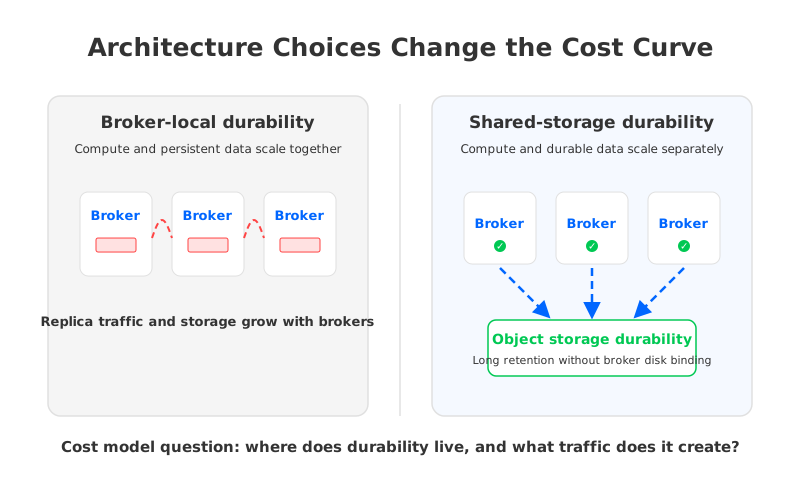
This distinction matters during failure recovery. If replacing a broker requires moving large volumes of data back onto local disks, the platform pays in time, network, and operational risk. If brokers can be treated as replaceable compute nodes because durable state lives outside them, the model shifts toward object storage, write-ahead logging, cache efficiency, and metadata correctness.
There is no universal answer here. A smaller workload with short retention and stable traffic may value the simplicity of a conventional managed Kafka deployment. A larger workload with high retention, high fan-out, or frequent scaling should test whether the storage architecture itself is the reason the cost curve keeps bending upward.
6How AutoMQ Fits The Evaluation
After the workload and architecture questions are clear, AutoMQ becomes relevant as one example of a Kafka-compatible, shared-storage streaming architecture. AutoMQ is designed to keep Kafka protocol compatibility while using object storage as the durable storage foundation. Its documentation describes a cloud-native architecture built on S3, and AutoMQ materials also discuss eliminating inter-zone traffic through broker and client configuration patterns.
The important point is not to insert AutoMQ into the spreadsheet as another row of broker prices. Evaluate it against the inputs that made the spreadsheet hard in the first place:
- If retention dominates the bill, test how object-storage-backed durability changes local disk requirements and long-retention economics.
- If scaling is operationally painful, test whether broker elasticity avoids large partition and data movement events.
- If cross-zone traffic is material, model where replication and consumer traffic travel in both the current architecture and the target architecture.
- If migration risk is the blocker, verify Kafka client compatibility, topic behavior, security controls, observability, and rollback paths before discussing savings.
That is a more respectful comparison for every vendor involved. Managed services such as Amazon MSK are useful for teams that want AWS-operated Kafka with clear service boundaries. Self-managed Apache Kafka remains appropriate when teams need full control and have the maturity to run it. Kafka-compatible shared-storage systems such as AutoMQ should be assessed when the cost problem is tied to brokers, disks, network replication, and recovery.
7Migration Risk Is Part Of Cost
Kafka migration cost is rarely captured in a monthly run-rate chart. It appears as engineering time, dual-running infrastructure, validation work, rollback preparation, and stakeholder risk. A model that ignores migration can make the right long-term architecture look worse than it is.
The practical way to handle this is to separate recurring cost from transition cost. Recurring cost includes broker capacity, storage, data transfer, observability, and routine operations. Transition cost includes compatibility testing, data migration or linking, consumer cutover, producer cutover, security review, and operational training. The decision becomes clearer when both are visible.
For production Kafka estates, compatibility testing should be concrete. Do not stop at "Kafka API compatible" as a phrase. Test the actual client versions, serializers, ACL behavior, quotas, compaction behavior, retention settings, schema registry integration, connector dependencies, and monitoring expectations. The more your platform behaves like a shared service, the more hidden contracts it has accumulated.
8A Practical Cost Worksheet
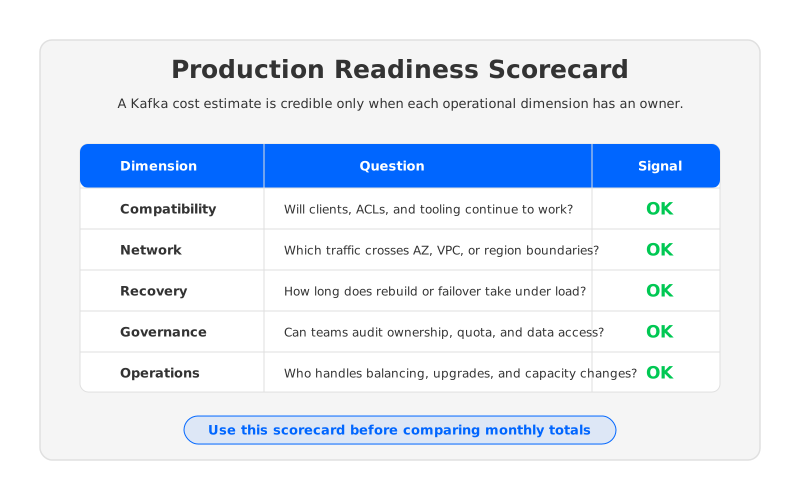
Use the following worksheet before requesting quotes or running a pricing calculator. It keeps the engineering model and the commercial model connected.
| Category | Input | Why it matters |
|---|---|---|
| Traffic | MiB/s written, MiB/s read, consumer groups | Converts product behavior into broker, network, and cache demand |
| Storage | Retention hours, compaction, replay window | Determines whether local disk, remote storage, or both dominate |
| Availability | Zones, replication factor, failover target | Determines data copies, traffic paths, and spare capacity |
| Operations | Scaling frequency, upgrade process, balancing model | Converts architecture complexity into labor and incident risk |
| Governance | Tenant count, ACLs, quotas, audit needs | Determines whether low-cost infrastructure remains controllable |
| Migration | Client inventory, rollback path, dual-run duration | Makes one-time transition cost visible |
The worksheet should produce a range, not a single number. A low case can use average traffic and normal retention. A high case should include peak traffic, replay, broker failure, and a recovery drill.
If your Kafka cost review keeps circling back to broker disks, replica traffic, and recovery time, use AutoMQ's documentation and deployment materials as a concrete shared-storage evaluation path: review AutoMQ for Kafka-compatible streaming.
9References
- Amazon MSK pricing
- AWS EC2 On-Demand pricing and data transfer
- Amazon S3 pricing
- Apache Kafka documentation
- AutoMQ documentation overview
- AutoMQ guide to eliminating inter-zone traffic
10FAQ
10.1What is the biggest hidden Kafka cost?
For many cloud deployments, the hidden cost is not the broker itself but the traffic and operations created by the storage and replication model.
10.2Is managed Kafka always lower cost than self-managed Kafka?
No. Managed Kafka can reduce operational burden and provide clear service ownership, but the total cost depends on workload shape, data transfer, retention, recovery requirements, and the team's ability to operate Kafka safely. Self-managed Kafka can be cost-effective for teams with strong platform engineering, but it carries labor and incident-response cost.
10.3Does tiered storage remove the need to model broker storage?
No. Tiered storage can reduce the amount of historical data kept on broker-local disks, but the hot set, write path, local cache, remote-read behavior, and recovery process still matter. Treat it as a storage architecture input, not a blanket cost answer.
10.4When should a team evaluate AutoMQ?
Evaluate AutoMQ when Kafka cost is driven by long retention, broker storage growth, cross-zone traffic, slow recovery, or operationally heavy scaling. The right test is a workload-based comparison that validates Kafka compatibility, network paths, storage behavior, and migration risk.
10.5How should I start a Kafka cost comparison?
Start with a workload worksheet: write throughput, read fan-out, retention, zones, recovery target, tenant growth, and migration constraints. Then map those inputs to bill lines and architecture behavior before comparing service prices.
10.6Where can I evaluate a shared-storage Kafka-compatible approach?
Use a workload-based proof that compares Kafka compatibility, storage behavior, network paths, recovery time, and migration risk.


