
Table of Contents
Table of Contents
Teams usually search for kafka cost modeling after the invoice stops matching the capacity plan. The cluster may look healthy, the brokers may have headroom, and the monthly bill still grows faster than message volume. That gap signals that the model counts visible line items and misses the architecture behaviors that create them.
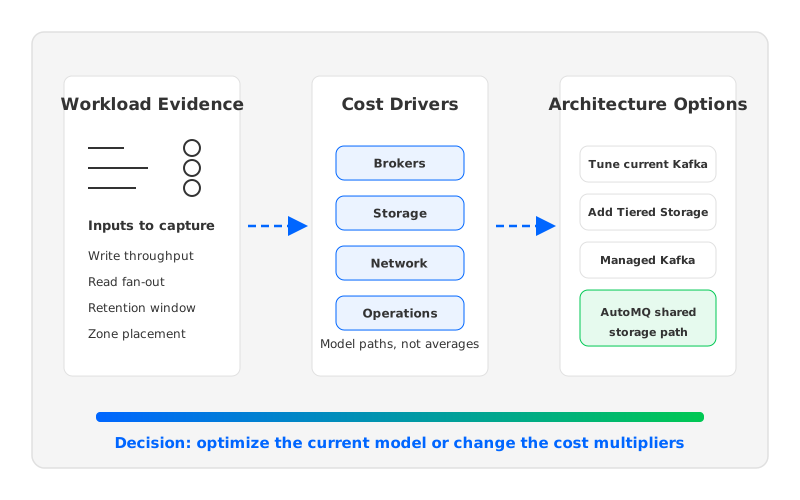
Kafka cost is not one number. It is a chain of decisions: how many brokers are provisioned, how much local storage each broker carries, how replication moves records across failure domains, how many consumers replay old data, and how much spare capacity the team keeps to avoid operational risk. A useful cost model needs to follow records through the system instead of adding up broker hours in isolation.
That distinction matters for real-time AI data pipelines and event-driven AI architecture, where fresh events feed fraud scoring, personalization, telemetry, retrieval pipelines, and feature updates. These workloads combine high write throughput, broad fan-out, long retention, and replay, so the cost question becomes: what architecture can absorb changing data volume without turning storage, traffic, and recovery into budget surprises?
1Why kafka cost modeling matters now
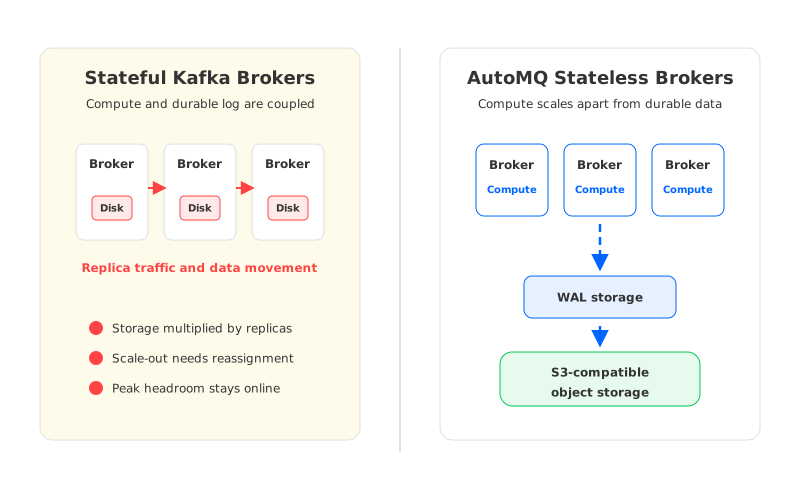
Apache Kafka gives platform teams a durable, ordered, replayable event backbone. Its original Shared Nothing architecture is also the reason cost modeling requires care. Each Broker owns local log storage, each Partition has a leader and followers, and the replication factor determines how many copies exist across Brokers. This design is reliable and familiar, but it makes compute, storage, and data movement hard to separate in the budget.
The visible cost categories are straightforward enough:
- Broker compute. Instances, Kubernetes nodes, CPU, memory, and network capacity sized for peak traffic, failure recovery, and rolling maintenance.
- Broker storage. Local disks, cloud block storage, attached volumes, provisioned throughput, snapshots, and storage headroom for retention and rebalancing.
- Network traffic. Producer writes, follower replication, consumer reads, cross-Availability Zone movement, inter-region replication, connector traffic, and private endpoint processing.
- Operations. Human time, automation, monitoring, incident response, migration windows, and the capacity kept idle because scaling stateful systems is risky.
The hidden part is that these categories multiply each other. A larger replication factor increases storage and network movement. Longer retention increases disk requirements and recovery time. Higher read fan-out can turn historical data into active load. A stricter multi-AZ design improves resilience, but it also changes how records travel through the cloud network.
2The cost equation starts with the write path
A simple Kafka sizing worksheet might begin with daily ingest. That is a good start, but it is not the cost model. In a traditional multi-AZ cluster, one logical producer write can become multiple physical writes because the leader persists the record and followers replicate it.
For example, a workload that writes W GiB per day with replication factor R creates roughly W × R GiB of broker log data before compression, retention, compaction, and segment overhead are considered. If replicas are spread across Availability Zones, part of that path may become cross-zone data transfer. Cloud providers publish different network pricing models, so calculate the exact bill against the chosen provider, region, network path, and service placement.
The read path adds another multiplier. A single topic may feed dashboards, fraud services, data lake ingestion, search indexing, and model feature pipelines. If consumers are distributed across zones or accounts, the same retained data can create repeated outbound traffic from Brokers. Replays make the effect more visible because historical reads compete with live traffic for disk, page cache, and network.
| Cost driver | What to measure | Why it changes the model |
|---|---|---|
| Write throughput | Compressed and uncompressed GiB per day | Determines broker ingress, replicated log volume, and storage growth |
| Replication factor | Copies per Partition | Multiplies local durable storage and follower traffic |
| Retention | Time or bytes per Topic | Turns daily ingest into persistent storage requirements |
| Read fan-out | Consumer groups and replay frequency | Converts one write stream into repeated read traffic |
| Zone placement | Producer, Broker, Consumer, connector, and storage location | Determines which network paths may be billed |
| Peak-to-average ratio | Burst traffic versus baseline traffic | Determines how much idle headroom is carried |
This is why cost modeling should start from traffic shape, not broker count. Broker count is the result of throughput, retention, partition distribution, and failure assumptions. When teams start with a desired broker count, they tend to discover the real constraints during incidents, scaling events, or monthly bill review.
3Stateful Brokers make elasticity expensive
Traditional Kafka Brokers are not interchangeable compute nodes. They own Partition data on local storage, and that ownership turns scaling into data movement. Adding Brokers can improve capacity, but traffic does not become balanced until Partitions are reassigned. Removing Brokers requires moving their data elsewhere.
That behavior has a direct financial effect. Many teams keep extra Brokers and disk online because waiting for reassignment during a traffic spike is too risky. They also reserve bandwidth for recovery because the cluster must survive maintenance and failures while continuing to serve producers and consumers. The model starts to include a quiet premium for "avoid urgent data movement."
Tiered Storage changes part of the storage story by offloading completed log segments to object storage. It can reduce pressure from long retention, especially for older data that is not frequently read. It does not fully remove broker-local state from the primary write path, so the active log, replication model, leader placement, and operational mechanics still need careful sizing.
The practical question is not whether stateful Kafka is wrong. It has been proven in demanding production systems. The question is whether its cost shape matches workloads where retention grows, consumers multiply, and capacity must follow business traffic more closely. If the workload has stable throughput and predictable retention, optimizing an existing cluster may be enough. If the workload is elastic, replay-heavy, or multi-tenant, architecture becomes part of the cost model.
4A neutral framework for Kafka cost optimization
Good Kafka cost optimization separates tactical tuning from architectural change. Tuning can reduce waste, but it cannot always change the multipliers created by broker-local storage and replication. Architecture work costs more to evaluate, yet it can remove entire categories of waste when the current model no longer fits.
Use the same workload profile across every option. Capture write throughput, read throughput, compressed size, retention, partition count, consumer groups, replay frequency, producer and consumer placement, region and zone design, connector traffic, governance needs, and migration tolerance. Compare behavior, not vendor labels.
| Option | When it fits | Cost risks to test |
|---|---|---|
| Tune existing Kafka | Stable traffic, known retention, manageable cluster size | Idle headroom, uneven Partitions, over-wide ACLs, slow reassignments, disk over-provisioning |
| Add Tiered Storage | Long retention with moderate historical reads | Active log still local, remote read performance, object storage request patterns, operational maturity |
| Move to managed Kafka | Team wants less infrastructure ownership | Service pricing dimensions, network paths, private connectivity, quotas, migration parallel run |
| Re-architect around shared storage | Elastic traffic, high retention, replay, cross-AZ cost pressure | Object storage IAM, WAL storage choice, latency profile, migration plan, observability path |
This table usually changes the conversation. FinOps teams care about cost categories, but platform teams care about operational behavior. The right model has to satisfy both. A design that looks lower cost at steady state but creates slow recovery or risky migration is not a better architecture.
5Where AutoMQ changes the operating model
Once the model exposes broker-local storage, replicated traffic, and peak headroom as major cost drivers, AutoMQ becomes relevant as a Kafka-compatible, cloud-native streaming platform built around Separation of compute and storage. AutoMQ preserves the Kafka protocol while replacing Kafka's local log storage with S3Stream, a streaming storage layer that uses WAL storage and S3-compatible object storage.
That shift changes the cost model in three ways. First, durable stream data is centered on shared object storage instead of being permanently bound to broker-local disks. Second, Brokers become stateless compute nodes that can be added, replaced, or removed with less dependence on large Partition data movement. Third, AutoMQ's architecture can reduce cross-Availability Zone traffic created by traditional broker-to-broker replication and client traffic paths, depending on deployment configuration.
It is still a model, not a magic discount. Platform teams should validate producer latency, catch-up reads, object storage request volume, WAL storage type, region design, security controls, and migration method with their own workload. AutoMQ BYOC also matters for governance: the control plane and data plane run in the customer's environment, so the review can align object storage, network, IAM, observability, and audit boundaries with the organization's cloud standards.
The architectural value is that compute scaling and storage growth can be reasoned about separately. Instead of asking every Broker to be compute, durable storage, and replication participant at once, the platform can model Brokers as traffic-handling capacity and object storage as the persistent data foundation. That is a cleaner conversation for teams trying to reduce Kafka cost without rewriting producers and consumers.
6Production checklist for a better model
Cost models fail when they are built from averages. Kafka fails at the edges: peak traffic, consumer lag, broker replacement, hot Partitions, replays, connector backfills, and migration cutovers. A production-grade model needs to price the normal path and the stressed path.
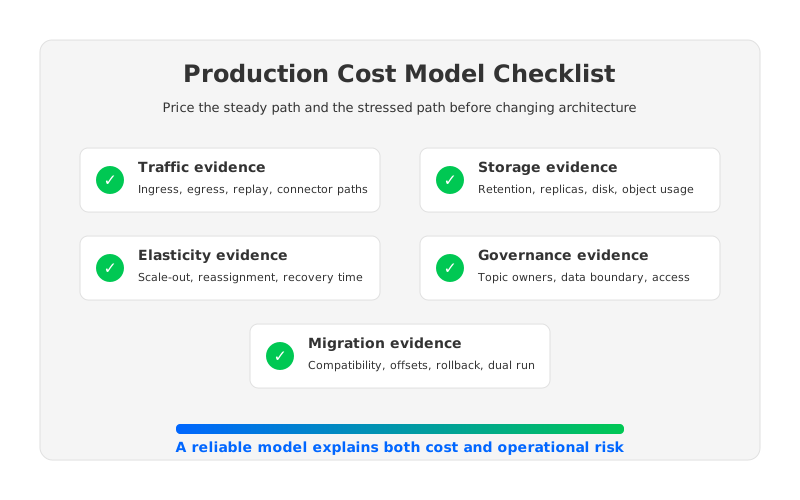
Before changing architecture, collect evidence in five areas:
- Traffic evidence. Measure producer ingress, consumer egress, replication traffic, replay windows, and connector movement separately. Aggregated broker bandwidth hides the path that creates the bill.
- Storage evidence. Track retained bytes by Topic, replica count, segment growth, compaction behavior, disk utilization, snapshot policy, and object storage usage if Tiered Storage is enabled.
- Elasticity evidence. Record how long scale-out, scale-in, partition reassignment, broker replacement, and recovery take under realistic load.
- Governance evidence. Map who owns each Topic, which workloads can read it, where retained data lives, and which telemetry or support artifacts could contain sensitive metadata.
- Migration evidence. Test client compatibility, offset handling, ACL mapping, rollback, dual-running cost, and cutover timing before declaring the target architecture lower cost.
This checklist keeps the evaluation honest. If the biggest cost driver is idle compute, stateless Brokers and Auto Scaling matter. If storage dominates, retention and object storage economics matter. If cross-zone traffic dominates, placement and routing matter. If operations dominate, recovery time and automation matter. The same cluster can have different answers for different business units.
7Decision table: optimize, tier, manage, or redesign
The best outcome of Kafka cost modeling is a decision the platform team can defend. Sometimes the answer is to right-size Brokers, clean up retention, improve partition balance, and revisit the model next quarter. Sometimes the answer is to use Tiered Storage for long retention while keeping the current operating model. Sometimes the answer is to evaluate a Kafka-compatible shared-storage platform because the cost pressure comes from the architecture itself.
| Signal in your environment | Likely next step |
|---|---|
| Broker CPU and network are low, but disks are over-provisioned | Review retention, compaction, replica count, and Tiered Storage fit |
| Cross-AZ traffic grows with producer volume | Model replication paths, client placement, and shared-storage alternatives |
| Scaling requires long reassignment windows | Evaluate stateless Broker architecture and seconds-level reassignment behavior |
| Read fan-out and replay hurt live traffic | Separate hot and catch-up read behavior in benchmarks |
| Multiple teams share one large cluster to improve utilization | Compare multi-tenant governance cost with smaller elastic clusters |
| Migration risk blocks every architecture change | Test offset-preserving migration, rollback, and dual-running cost early |
The useful mental model is simple: Kafka cost is the price of keeping records durable, reachable, replayable, and governed under production pressure. Broker count is only one symptom. The deeper question is which architecture makes those requirements more cost-effective over time.
If your current model shows that broker-local storage, replication traffic, and idle headroom dominate the bill, evaluate a Kafka-compatible shared-storage design alongside tuning work. Start with your own traffic and retention data, then compare it with the AutoMQ architecture to see whether separating compute from storage changes the economics for your workload.
8References
- Apache Kafka Design: replication and broker behavior
- Apache Kafka Tiered Storage documentation
- AWS EC2 On-Demand pricing: data transfer within the same AWS Region
- Google Cloud VPC network pricing
- Azure bandwidth pricing
- AutoMQ Shared Storage architecture
- AutoMQ inter-zone traffic documentation
9FAQ
9.1What should a Kafka cost model include?
A Kafka cost model should include broker compute, broker storage, replication factor, retention, producer traffic, consumer traffic, replay patterns, cross-zone or cross-region network paths, private connectivity, operations, and migration cost. The model should also include stressed conditions such as broker replacement, scale-out, reassignment, and replay.
9.2Why does replication factor matter for Kafka cost?
Replication factor affects how many durable copies of each Partition exist. In broker-local Kafka architectures, a higher replication factor increases storage consumption and follower replication traffic. In multi-AZ deployments, that replication path may also affect network cost depending on the cloud provider and placement.
9.3Does Tiered Storage solve Kafka cost problems?
Tiered Storage can help when long retention drives local disk growth. It does not fully remove the active log, broker-local ownership, leader placement, or operational mechanics of a traditional Kafka cluster. It should be modeled as one option, not as a universal replacement for architecture review.
9.4How does AutoMQ reduce Kafka cost drivers?
AutoMQ uses a Kafka-compatible Shared Storage architecture where durable stream data is stored in S3-compatible object storage through S3Stream, while Brokers act as stateless compute nodes. This can reduce dependence on broker-local disks, large Partition data movement, and cross-AZ replication traffic. Teams should validate the effect with their own workload, cloud region, WAL storage choice, and governance requirements.
9.5Can teams reduce Kafka cost without changing applications?
Often, yes. Many improvements come from retention cleanup, partition balancing, right-sizing, client placement, and replay governance. For larger architecture changes, Kafka-compatible platforms such as AutoMQ are designed to preserve Kafka client and protocol compatibility so teams can evaluate a different operating model without rewriting producers and consumers.


