
Table of Contents
Table of Contents
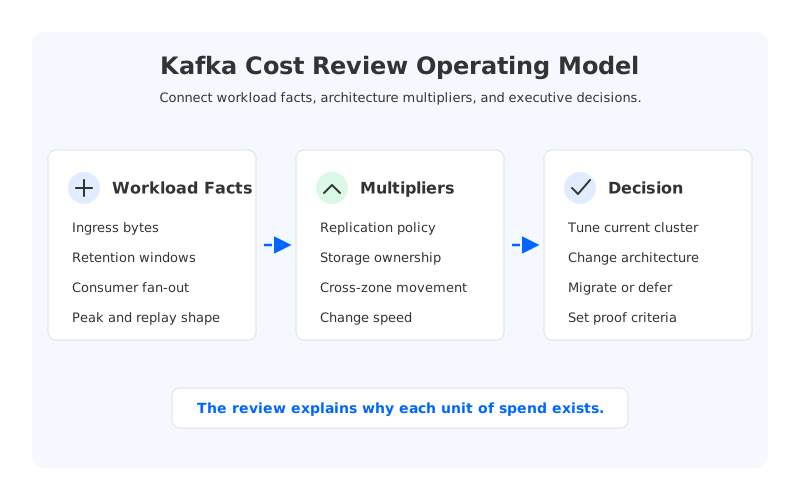
Kafka cost reviews usually begin when the monthly bill stops matching the mental model. Engineering remembers the platform as a few brokers moving events between services. Finance sees compute, storage, data transfer, managed service charges, support, and a growing set of adjacent services. Both views are true, but neither is enough for a CTO or FinOps team deciding whether to tune, resize, migrate, or replace a Kafka platform.
The uncomfortable part is that Kafka cost is rarely a single bad line item. It is an architectural compound effect. Write throughput creates storage. Replication multiplies storage and network movement. Multi-AZ resilience changes where bytes travel. Retention turns short-lived operational data into long-lived capacity. Consumer fan-out turns one write path into many read paths. A useful review has to follow those bytes before it can judge any vendor price.
1Why Kafka Cost Needs a Review Framework
CTOs and FinOps teams ask different questions about the same platform. The CTO wants to know whether the architecture can keep scaling without creating fragility. FinOps wants to know which cost drivers are controllable, which are contractual, and which are consequences of technical requirements. The Kafka platform team sits in the middle, translating workload behavior into infrastructure spend and defending the headroom needed for incidents, maintenance, and growth.
That translation breaks down when teams review Kafka as a shopping exercise. A broker-hour price, a managed-service quote, or an object-storage pricing page can answer one narrow question, but a production Kafka decision spans several layers. Compute price matters. So do local disk sizing, object storage retention, cross-AZ data movement, PrivateLink or load balancer usage, observability volume, mirror traffic, and the engineering hours spent on rebalancing, upgrades, and recovery drills.
The review framework should separate three types of cost:
- Metered infrastructure cost. These are the charges that appear directly on a cloud or vendor bill: instances, storage, requests, data transfer, managed service units, endpoints, and support.
- Architectural multiplier cost. These are not products in a catalog. They are consequences of design choices such as replication factor, leader placement, retention, data locality, and whether brokers own durable storage.
- Change and risk cost. These include migration work, rollback planning, incident recovery time, operational toil, and the cost of carrying extra capacity because change is slow.
Once the review uses those categories, the conversation becomes less emotional. A team can say, "This cost exists because we need three-zone durability," or "This cost exists because the architecture moves every produced byte across zones twice." Those are different problems. One is a reliability requirement. The other may be an architecture choice worth revisiting.
2Start With Workload Shape, Not Vendor Price
A Kafka cost model should start with a workload unit that both engineering and finance can understand. The unit can be one TiB written per day, one business domain, one tenant, or one class of topics. What matters is that the unit includes the inputs that actually change spend: ingress bytes, compression ratio, replication, retention, consumer fan-out, replay behavior, and availability topology.
Event count alone is a weak input. A million tiny records and a million large records do not produce the same storage or network bill. Average throughput is also incomplete because Kafka platforms are sized for peaks, failure recovery, and maintenance windows. The model needs enough detail to explain why the cluster reserves capacity that may look idle during a normal hour.
| Review Input | Why It Matters | Evidence To Collect |
|---|---|---|
| Ingress bytes | Establishes the first copy of data entering the platform | Broker metrics, producer metrics, cloud network metrics |
| Replication factor | Multiplies broker-side storage and replication traffic | Topic configs, ISR behavior, placement policy |
| Retention by topic class | Determines how long data occupies paid storage | Topic policies, compaction settings, replay requirements |
| Consumer fan-out | Turns one write into multiple read paths | Consumer group inventory, read throughput, backfill patterns |
| Availability topology | Defines which bytes cross AZ or region boundaries | Client placement, broker placement, load balancer paths |
| Operational change rate | Exposes the cost of scaling, reassignment, and upgrades | Change logs, incident records, rebalance history |
This table is not a substitute for a benchmark. It is the checklist that keeps a benchmark honest. If a test writes data with one consumer and no replay behavior, it cannot predict the cost of a platform where analytics teams frequently reprocess historical data. If a proof of concept runs in one zone, it cannot explain a production bill for a multi-AZ deployment.
3Follow the Bytes Across Storage and Network
Kafka's cost profile comes from where bytes are persisted and where they move. Traditional Apache Kafka stores log segments on brokers and uses replication between brokers for durability. That shared-nothing design has served many production systems well, and it remains the baseline many teams understand. It also means brokers are stateful storage participants, not replaceable compute workers.
That distinction matters in the cloud. When brokers own durable log data, scaling and recovery are tied to data placement. Adding brokers may require partition movement before the cluster benefits from the capacity. Replacing a failed broker triggers replica catch-up. Increasing retention can push teams toward larger disks or more brokers even when CPU is not the bottleneck. The cost review should show where this coupling forces the team to buy one resource because another resource is constrained.
Network deserves the same scrutiny. Producer writes, follower replication, consumer reads, mirror traffic, and administrative movement do not always follow the same path. In multi-AZ deployments, some of those paths may cross zone boundaries and become billable data transfer. In private connectivity designs, endpoint and data processing charges may appear outside the Kafka service line. The platform may look efficient at the broker layer while leaking cost through the network layer.
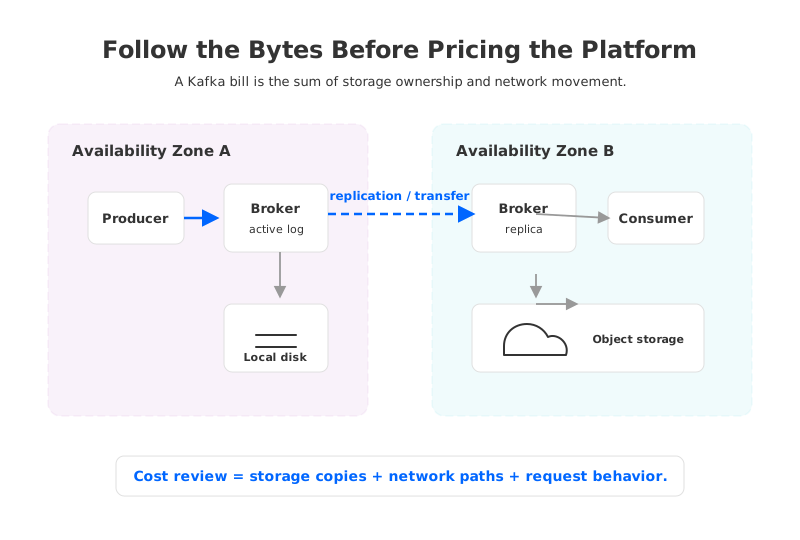
Object storage changes part of the storage conversation, but it does not remove the need for architecture review. Apache Kafka tiered storage, described through KIP-405 and the Kafka documentation, moves older log segments to remote storage while brokers continue to serve the active log. That can be valuable for retention-heavy workloads because older data no longer has to remain entirely on broker-local disks. The review question is still specific: which data is active, which data is remote, which layer is authoritative for recovery, and what request and retrieval patterns will the object store see?
This is why storage pricing pages are useful but incomplete. An object store may offer attractive durability and capacity economics, yet the final Kafka cost depends on object size, request volume, retention policy, read-back frequency, and the surrounding compute and network design. The same price page can support two very different architectures: tiered storage as a retention extension, or shared storage as the primary durable layer behind stateless brokers.
4Review Architecture Choices Against Cost Drivers
The practical CTO question is not "Which Kafka option has the lowest line-item price?" The better question is "Which architecture removes the multiplier that dominates our workload?" A team whose cost is driven by long retention has a different problem from a team whose cost is driven by cross-zone replication traffic. A team blocked by slow reassignment has a different problem from a team that mainly needs a managed control plane.
The review should compare architecture choices against the cost driver they can actually change:
- Self-managed Apache Kafka gives teams deep control over versions, instance types, placement, and operational tooling. That control has value, but it also means the team owns capacity planning, upgrades, rebalancing, incident response, and the consequences of stateful broker storage.
- Managed Kafka services can reduce operational burden and procurement complexity. They do not automatically change the core data path, so the review still needs to model storage, replication, network movement, and scaling behavior.
- Kafka with tiered storage can improve retention economics for workloads with large historical windows. The team should verify how active data, remote reads, compaction, and recovery behave under its workload rather than treating object storage as a universal cost fix.
- Kafka-compatible shared-storage systems change the ownership boundary by moving durable data away from individual broker disks. This can affect scaling, recovery, and storage economics, but compatibility and migration effort must be validated with real clients and operational tools.
This comparison is respectful to every option because each one solves a different operating problem. A small team with modest traffic may value managed simplicity over architectural change. A regulated platform team may prefer self-management for control. A retention-heavy platform may find that storage architecture matters more than service packaging. The framework is designed to make those tradeoffs explicit.
5How AutoMQ Fits the Evaluation
After the workload review identifies storage ownership, network movement, and change cost as material drivers, AutoMQ becomes relevant as a Kafka-compatible shared-storage architecture to evaluate. AutoMQ keeps Kafka protocol compatibility while using S3Stream as a shared storage layer backed by object storage, with a write-ahead log path designed for efficient writes and recovery. The architectural question shifts from sizing stateful brokers around local disks to sizing compute, durable storage, and network movement as separate concerns.
That separation can matter when the current Kafka platform pays for storage headroom because brokers own data, or when scaling requires long data movement before capacity becomes useful. In a shared-storage design, brokers are intended to be stateless because durable data is not bound to one broker's local disk. The benefit is not a magic discount; it is a different cost model. Retention, recovery, and scaling are evaluated against object storage, WAL behavior, cache, and compute needs rather than broker-local storage alone.
AutoMQ's documentation also describes a design for eliminating inter-zone traffic in supported deployments. For a cost review, the right way to handle that claim is measurement. First quantify producer, replication, consumer, and mirror bytes that cross zones today. Then test whether the target architecture changes those paths under representative traffic. If cross-zone movement is a major cost driver, this evaluation belongs in the business case rather than in a footnote.
Compatibility is the guardrail. Lower infrastructure cost is not compelling if migration forces application rewrites, breaks client behavior, or removes operational controls the platform depends on. AutoMQ should be assessed through the same production checklist as any Kafka-compatible option: producer and consumer clients, Kafka Connect, stream processors, transactions if used, ACLs, monitoring, backup and restore expectations, cutover design, and rollback path.
6A CTO and FinOps Review Workflow
The most effective review is a joint exercise rather than a finance audit handed to engineering after the bill arrives. Start with one workload class, map its byte path, price each path with current cloud or vendor rates, and mark every assumption. Then run a representative test or analyze production metrics to replace assumptions with evidence. The model will not be perfect, but it will expose the multiplier that deserves executive attention.
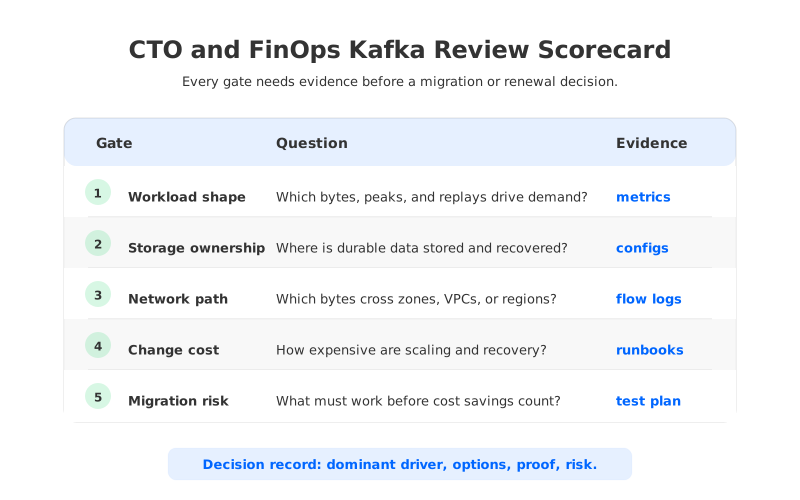
Use a scorecard with five gates. First, confirm workload shape: bytes, retention, fan-out, and peak behavior. Second, confirm storage ownership: what is stored on brokers, what is stored remotely, and which layer is authoritative for recovery. Third, confirm network path: which bytes cross zones, regions, VPC boundaries, or private endpoints. Fourth, confirm operational change: how scaling, failure recovery, upgrades, and tenant growth affect engineering time. Fifth, confirm migration risk: what clients, connectors, security policies, and rollback paths must work before a platform change is financially real.
The outcome should be a decision record, not a prettier spreadsheet. It should state which cost driver is dominant, which architecture choices reduce it, what risks remain, and what proof is required before a commitment. That record gives the CTO a technical rationale and gives FinOps a traceable model they can revisit as traffic changes.
Kafka cost is not solved by staring harder at a pricing page. The price page tells you the unit cost. The architecture tells you how many units your workload creates. If your review shows that stateful broker storage, cross-zone movement, or slow operational change is the force behind the curve, evaluate AutoMQ's BYOC deployment model as one next step in the architecture review.
7References
- Apache Kafka documentation, including replication and tiered storage: https://kafka.apache.org/documentation/#replication and https://kafka.apache.org/documentation/#tiered_storage
- Apache Kafka KIP-405: Tiered Storage: https://cwiki.apache.org/confluence/display/KAFKA/KIP-405%3A+Kafka+Tiered+Storage
- AWS Managed Streaming for Apache Kafka pricing: https://aws.amazon.com/msk/pricing/
- AWS EC2 data transfer pricing: https://aws.amazon.com/ec2/pricing/on-demand/#Data_Transfer
- AWS PrivateLink pricing: https://aws.amazon.com/privatelink/pricing/
- AWS S3 pricing: https://aws.amazon.com/s3/pricing/
- AutoMQ Apache Kafka compatibility: https://docs.automq.com/automq/what-is-automq/compatibility-with-apache-kafka?utm_source=blog&utm_medium=reference&utm_campaign=gs100-0080
- AutoMQ architecture overview: https://docs.automq.com/automq/architecture/overview?utm_source=blog&utm_medium=reference&utm_campaign=gs100-0080
- AutoMQ inter-zone traffic overview: https://docs.automq.com/automq/eliminate-inter-zone-traffics/overview?utm_source=blog&utm_medium=reference&utm_campaign=gs100-0080
8FAQ
8.1What is the first step in a Kafka cost review?
Start with workload shape rather than vendor price. Measure ingress bytes, retention, replication, consumer fan-out, availability topology, and replay behavior for one representative workload class before comparing platforms.
8.2Why do CTOs and FinOps teams see Kafka cost differently?
CTOs usually focus on scalability, resilience, and operational risk. FinOps teams focus on metered spend, allocation, and controllability. A shared framework connects those views by mapping technical byte paths to billable resources and change risk.
8.3Does object storage always lower Kafka cost?
No. Object storage changes the economics of durable capacity, but the final cost depends on architecture, request patterns, remote reads, retention, network paths, and recovery behavior. Tiered storage and shared storage should be modeled separately.
8.4Should managed Kafka be compared only by broker price?
No. Broker price is one input. A fair comparison also includes storage ownership, cross-zone transfer, private connectivity, scaling behavior, upgrade work, observability, support model, and migration risk.
8.5When should AutoMQ enter the cost evaluation?
AutoMQ belongs in the evaluation when the review shows that stateful broker storage, cross-zone traffic, retention growth, or slow operational change is a major cost driver. It should still be validated with real Kafka clients, connectors, security policies, and rollback plans.


