
Table of Contents
Table of Contents
The billing surprise usually arrives after Kafka has already done its job. The cluster stayed available, no data was lost, and the multi-AZ design passed the resilience review. Then the cloud bill shows a data transfer line that is larger than expected, and the first reaction is often confusion: application teams only wrote a certain amount of data to Kafka, so why did network transfer grow faster than the producer workload?
The missing piece is that Kafka traffic does not only move between clients and brokers. In a production cluster, a single producer write can trigger follower replication, acknowledgments, consumer reads, catch-up fetches, and operational data movement. When those paths cross availability zone boundaries, Kafka cross-AZ cost becomes a repeatable part of the architecture rather than a one-time anomaly.
That does not make multi-AZ Kafka wrong. Availability zones exist so platform teams can survive infrastructure failures, and Kafka replication is the mechanism that keeps partitions available when brokers fail. The cost problem appears when the team models Kafka as a client-server workload while the cloud bill sees every byte that crosses zone boundaries.
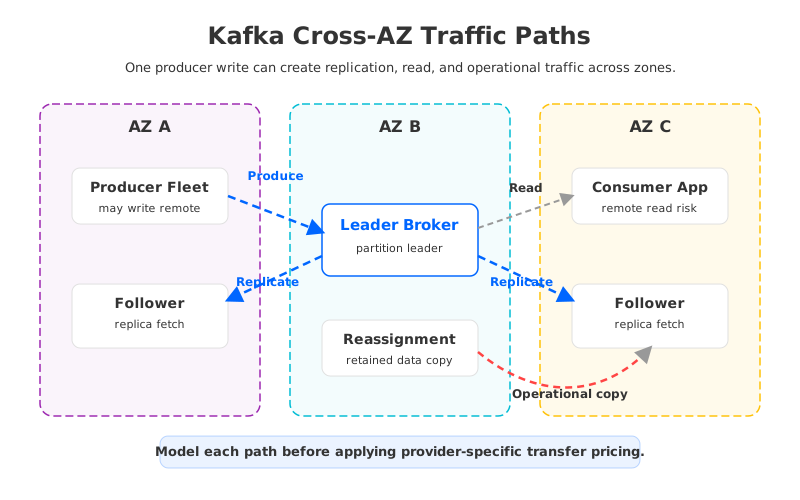
For AWS and cloud platform teams, the useful question is not whether Kafka should run across AZs. The useful question is which Kafka paths cross AZ boundaries, how often they cross, and which architectural choices reduce unnecessary broker-to-broker data movement without weakening durability.
1Why Kafka Creates More Traffic Than Application Teams Expect
Kafka is a distributed log, not a single network endpoint. A producer sends records to the leader replica of each partition. Followers fetch those records from the leader and append their own copies. Consumers read from brokers that host the relevant partition data. Administrators move partitions during scaling, broker replacement, storage pressure, or balancing operations.
From an application perspective, the workload may look like one stream written once and read by a few services. From the broker perspective, the same stream becomes steady follower replication, consumer fanout, and operational flows such as reassignments or recovery. All of them can matter for Kafka inter-AZ cost if the source and destination live in different availability zones.
The most common hidden paths are:
- Producer to leader: a producer in AZ A may write to a leader in AZ B if client placement, DNS, load balancing, or leader distribution sends it there.
- Leader to followers: with replication factor 3 across three AZs, two follower replicas often fetch from a leader in another AZ.
- Broker to consumer: a consumer in one AZ may read from a leader in another AZ, especially when consumer groups run outside the Kafka subnets or are not zone-aware.
- Follower catch-up: a slow follower, replaced broker, or recovered broker can fetch a large backlog across AZs.
- Partition reassignment: scaling or rebalancing a traditional Kafka cluster can copy retained partition data between brokers.
This is why Kafka replication cost and Kafka egress cost are often discussed together, even though they are not the same thing. Replication is a Kafka behavior. Egress and inter-AZ transfer are cloud billing categories. The bill appears when the behavior uses a charged network path.
2The Replication Paths That Can Cross AZ Boundaries
Replication factor is the first multiplier to inspect. A topic with replication factor 3 has one leader and two followers for each partition. Kafka maintains in-sync replicas so that committed records can survive broker failures, and settings such as min.insync.replicas determine how many replicas must acknowledge writes for stronger durability semantics. Those settings protect availability, but they also shape where bytes move.
In a three-AZ design, a common goal is to spread replicas across AZ A, AZ B, and AZ C. That protects against losing a single zone, but it also means a leader in one AZ usually replicates to followers in the other two zones. If the logical write rate is 100 MiB/s and both followers are remote from the leader, the cluster may create roughly 200 MiB/s of cross-AZ replication traffic before consumer reads or operational movement are counted. The exact bill depends on cloud provider, region, and service path, so the formula matters more than a copied price.
The placement details are where many estimates go wrong. If producers are zone-local to leaders, producer traffic may stay local. If producers run in another AZ, the initial write can also be cross-AZ. If consumers are not placed near the brokers serving their reads, consumer traffic can add another recurring path.
| Traffic Path | When It Appears | Cost Question |
|---|---|---|
| Producer to leader | Producer and leader are in different AZs | Are clients zone-aware or randomly routed? |
| Leader to follower | Replica placement spans AZs | How many follower replicas fetch across zones? |
| Broker to consumer | Consumers read from remote brokers | Are consumers co-located with broker subnets or cross-zone by design? |
| Catch-up replication | Follower lag, broker recovery, or restart | How large can backlog become before recovery? |
| Partition reassignment | Scaling, balancing, broker replacement | How much retained data is copied during operations? |
Cloud billing adds another layer. AWS documentation explains that data transfer between Availability Zones in the same Region can appear as regional data transfer usage, and the EC2 pricing page describes same-region cross-AZ transfer for EC2-related paths in each direction. Other providers and managed services have their own terms and exceptions. Treat the cloud bill as the source of price truth, but treat the Kafka topology as the source of traffic truth.
3How to Estimate Cross-AZ Kafka Cost
A practical estimate starts with paths, not prices. Prices change by provider and region; traffic paths change when you alter Kafka placement, topic settings, or client routing. If the team jumps straight into pricing pages, it may miss the larger question: which Kafka flows are being priced?
Use a worksheet that separates steady-state traffic from operational events:
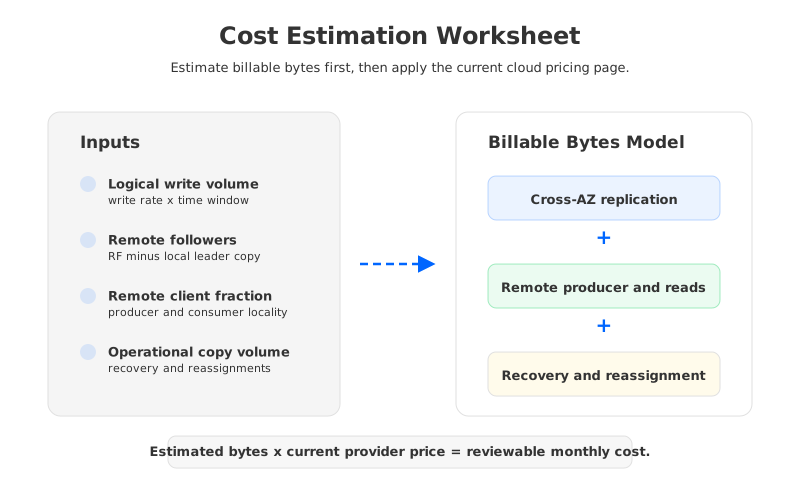
Start with logical write throughput. Convert it into a monthly data volume using the same units throughout the calculation. Then estimate how much of that write path crosses AZ boundaries. For a topic with replication factor 3, the maximum steady-state replication multiplier is two follower copies per leader write, but the cross-AZ portion depends on where followers sit relative to leaders.
monthly_logical_write = write_rate_per_second x seconds_per_month
cross_az_replication = monthly_logical_write x remote_follower_count
cross_az_producer = monthly_logical_write x producer_remote_fraction
cross_az_consumer = monthly_logical_read x consumer_remote_fraction
operational_copy = reassigned_or_recovered_data_crossing_az
estimated_billable_bytes = cross_az_replication + cross_az_producer + cross_az_consumer + operational_copy
This model is intentionally plain. It gives FinOps and platform engineering a shared vocabulary: write rate, replication factor, remote follower count, read fanout, client locality, and operational copy volume.
A concrete example makes the issue easier to see. Suppose a workload writes 50 MiB/s to a topic with replication factor 3, and each partition leader has two followers in other AZs. Before pricing, the replication path alone is approximately 100 MiB/s crossing AZ boundaries. Remote consumers or same-month reassignments can add separate billable paths.
The diagnostic step is to compare the estimate with billing data. In AWS Cost and Usage Reports, regional data transfer usage types can help identify same-region AZ transfer, while tags help connect charges to Kafka brokers, ENIs, load balancers, NAT gateways, or managed Kafka resources.
4A Diagnostic Checklist for Kafka Transfer Charges
When Kafka cross-AZ cost shows up in a budget review, do not start by reducing replication factor. That can trade a financial surprise for a durability problem. Start by mapping traffic and validating whether the cluster is paying for expected availability, accidental placement, or operational churn.
Ask these questions in order:
- Which AZ hosts each broker, and how are partition leaders distributed?
- For high-throughput topics, how many followers are remote from each leader?
- Are producers deployed in the same AZs as the leaders they write to, or do they cross zones through routing?
- Are consumers and stream processors zone-aware, or do they read from remote brokers by default?
- Do load balancers, NAT gateways, PrivateLink endpoints, or transit services sit in the path?
- How often do partition reassignments, broker replacements, storage expansions, or recovery events happen?
- Are the largest data transfer spikes aligned with maintenance, scaling, or incident recovery?
- Do topic-level replication factor and retention settings match actual business requirements?
That sequence protects the team from treating all cross-AZ traffic as waste. Some transfer is the price of high availability. Some is caused by client placement that nobody reviewed. Some is created by data-copy-heavy operations that were invisible until the bill arrived. Cost control works when each optimization is tied to a traffic path and a resilience tradeoff.
5What Optimizations Help and Where They Stop
Traditional Kafka gives teams several levers. You can make client placement more zone-aware, review leader balance, align producers and consumers with broker topology, tune topic replication factor where lower durability is acceptable, and schedule reassignments carefully.
These levers are worth using, but they do not remove the underlying coupling. In classic Kafka, brokers own persistent data on local disks. Durability, partition movement, and broker replacement can all require retained data to move between brokers, and multi-AZ placement can make those copies cross failure-domain boundaries.
The boundary becomes clearer if you separate three goals:
- Availability: keep enough replicas in enough failure domains to survive broker or AZ failure.
- Locality: reduce avoidable remote producer and consumer paths.
- Elasticity: scale, replace, or rebalance brokers without turning retained data into a large network copy project.
Kafka tuning can improve the first two. It can also make operational movement safer. But as long as durable data is tied to broker-local storage, many lifecycle operations remain data movement operations. This is where architecture begins to matter more than a setting.
6How AutoMQ Changes the Replication and Scaling Traffic Pattern
If the cost pressure comes from broker-to-broker copies, a useful architectural question is whether brokers must be the durable storage boundary. AutoMQ is a Kafka-compatible cloud-native streaming platform that moves durable data from broker-local disks to shared object storage while preserving Kafka protocol compatibility. In that model, brokers are much more stateless, and durable log data lives in cloud storage rather than being owned as local disk segments on a specific broker.
That changes the traffic pattern in two ways. Broker-to-broker replication is no longer the primary durability mechanism in the same way it is for traditional shared-nothing Kafka, and partition reassignment or broker replacement can become ownership, metadata, and compute placement changes rather than large retained-data copy operations.
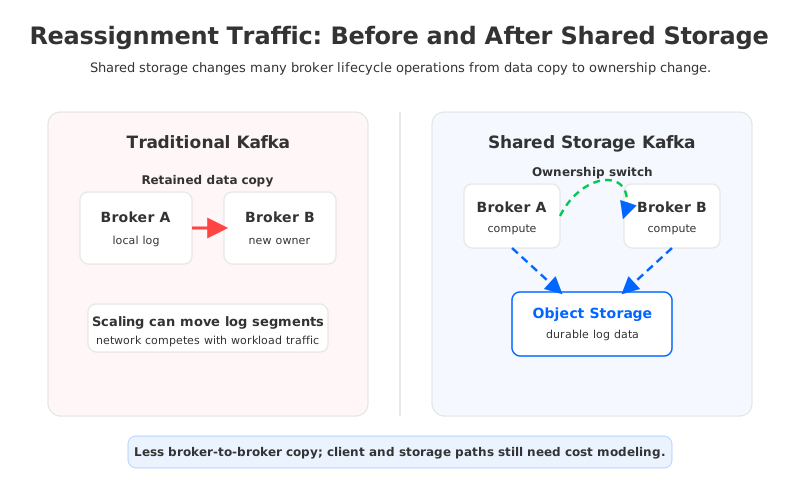
This distinction is important: shared storage does not mean every cross-AZ byte disappears. Producers still connect to brokers. Consumers still read data. Object storage access has its own provider-specific networking and request model. Control traffic still exists, and poorly placed clients can still create remote paths. The claim should be narrower and more useful: shared storage can reduce the broker-to-broker replication and data-copy-heavy operations that make Kafka multi-AZ costs hard to control.
For platform teams evaluating Kafka multi-AZ cost, that changes the decision framework. Instead of only asking how to tune replication factor or rebalance leaders, ask which parts of the architecture require repeated copies of durable data across brokers. A shared-storage Kafka architecture changes the storage boundary, which can reduce the need to move retained data every time compute placement changes.
7Making the Cost Review Actionable
A good Kafka inter-AZ cost review ends with a map, a formula, and a small set of architecture decisions. The map shows producer, leader, follower, consumer, recovery, and reassignment paths. The formula turns those paths into estimated monthly data movement. The decisions define which paths are required for availability and which are accidental or architectural overhead.
For teams staying on traditional Kafka, the next step is usually zone-aware placement, clearer tagging, better transfer dashboards, and stricter review of reassignment-heavy operations. For teams whose largest pain comes from broker replacement, partition movement, long retention, or elastic scaling, it is worth evaluating Kafka-compatible shared storage as a different architecture category.
The budget surprise is not a sign that multi-AZ Kafka was a mistake. It is a sign that the cost model was missing Kafka's internal traffic. Once the model includes replication, client locality, and data-copy-heavy operations, the team can choose deliberately: pay for the paths that protect availability, reduce the paths that come from placement drift, and reconsider the architecture where local-disk ownership keeps turning operations into cloud transfer.
8References
- AWS EC2 On-Demand Pricing: Data Transfer
- AWS Cost and Usage Report: Understanding data transfer charges
- Amazon S3 Pricing
- Apache Kafka Documentation: Replication
- Apache Kafka Documentation: min.insync.replicas
- AutoMQ Documentation: Overview
- AutoMQ Architecture Overview
- AutoMQ Pricing
9FAQ
9.1Is Kafka cross-AZ traffic always bad?
No. Some cross-AZ traffic is the direct result of a high-availability design. The goal is to distinguish required replication from accidental client placement, unnecessary remote reads, and operational data movement that can be reduced.
9.2Does lowering replication factor reduce Kafka inter-AZ cost?
It can reduce replication traffic, but it also changes durability and availability. Treat replication factor as a resilience decision first, then evaluate whether topic-specific requirements justify a different setting.
9.3Why does Kafka replication cost show up as cloud data transfer?
Kafka replication moves records from leader replicas to follower replicas. If those brokers are in different availability zones or regions, the cloud provider may meter that movement as inter-AZ, cross-region, or other data transfer depending on the service path.
9.4Can shared storage remove all Kafka egress cost?
No. Shared storage can reduce broker-to-broker replication and retained-data copies during operations, but producers, consumers, object storage access, cross-region paths, and network services still need to be modeled.
9.5What should I check first in AWS?
Start with the Cost and Usage Report usage types for regional data transfer, then connect those lines to broker ENIs, managed Kafka resources, load balancers, NAT gateways, and deployment timestamps. Compare spikes with Kafka reassignments, broker replacements, and consumer replay events.


