
Table of Contents
Table of Contents
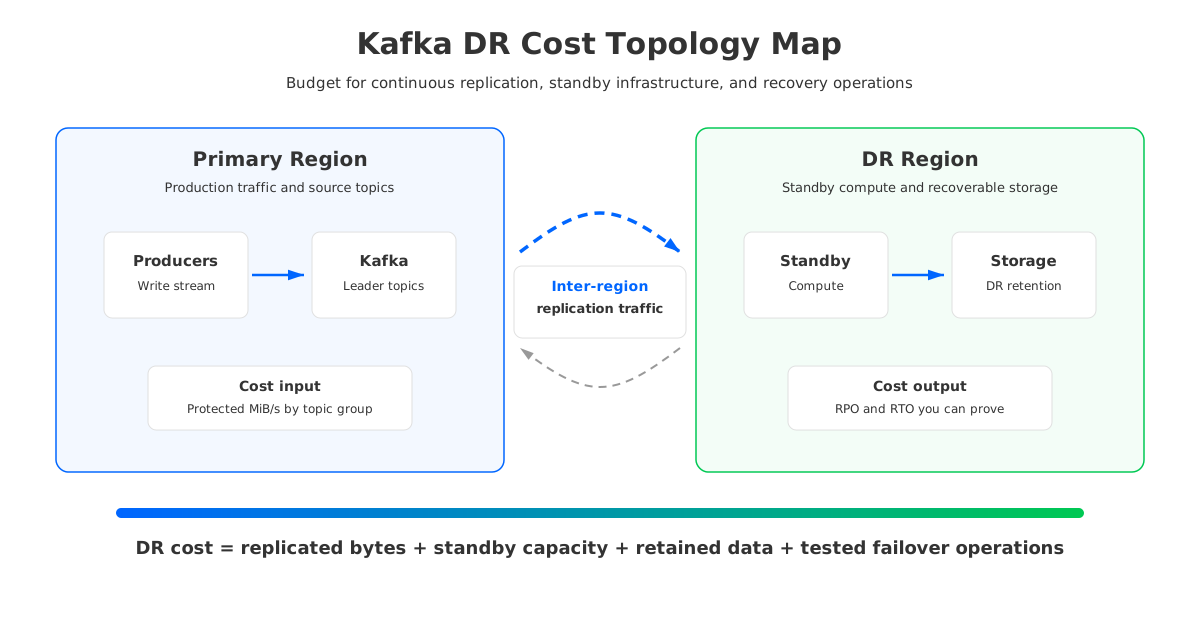
The uncomfortable part of Kafka disaster recovery is that the backup cluster is rarely the expensive surprise. The surprise is the replication path that keeps running every hour: producer data copied across a region boundary, replicated topics retained twice, consumer positions synchronized, schemas and connectors kept consistent, and failover drills repeated often enough that the runbook is not fiction.
That makes Kafka cross-region replication cost a design problem, not only a pricing problem. A cloud bill can tell you how much inter-region transfer cost last month, but it cannot tell you whether you are paying for the right recovery objective. A platform team has to answer a more specific question: what RPO and RTO are worth paying for, and which parts of the Kafka estate actually need that level of protection?
1What actually costs money in Kafka DR
Cross-region DR is different from cross-AZ high availability. Cross-AZ HA keeps a production cluster available inside one region when an availability zone fails. Cross-region DR assumes a larger blast radius: a region outage, regulatory boundary, major network isolation event, or business-continuity requirement that forces traffic to another region. The cost model changes because every protected byte may cross a metered regional boundary.
The main cost drivers usually fall into six buckets:
- Replication data transfer. Every replicated topic creates inter-region traffic. Cloud providers publish data transfer pricing by source, destination, and region pair, so the right number is not universal; it depends on the cloud and the exact route.
- Target-cluster compute. Active-passive still needs enough capacity to receive replicated data, retain it, and serve validation reads. Warm standby can run smaller, but a cold cluster increases recovery time and operational risk.
- Target-cluster storage. Retention policies are often copied from production by default. That can double storage before anyone asks whether all topics need the same retention window in the DR region.
- Replication service charges. Managed replication tools may charge per replication task, per hour, or per GB processed. AWS, for example, prices MSK Replicator with separate dimensions for replicator hours and data processed, while cross-region transfer and PrivateLink processing can also appear in the bill.
- Control-plane synchronization. Offsets, ACLs, schemas, connector state, transaction semantics, and topic configs do not always move with the same guarantees as records. Closing these gaps usually means more tooling and more operational time.
- Failover drills. The first failover is not the real test. The cost of DR includes recurring exercises, client routing updates, rollback plans, and post-drill cleanup.
The first FinOps pass should avoid a false precision trap. A defensible estimate starts with a workload assumption, then applies the current pricing page for the region pair:
| Variable | What to estimate | Why it matters |
|---|---|---|
| Protected write rate | MiB/s by topic group | Replication traffic usually follows write throughput, not storage size alone |
| DR retention | Hours or days in target region | Long retention can dominate low-throughput workloads |
| Replication scope | All topics or selected critical topics | Topic-level replication is often the biggest cost lever |
| Standby capacity | Cold, warm, hot, or active | Determines compute spend and realistic RTO |
| Drill frequency | Monthly, quarterly, or event-driven | Determines whether recovery is practiced or theoretical |
For example, a team replicating all topics from us-east-1 to us-west-2 should not borrow a generic "$/GB" number from another architecture review. It should use the current cloud pricing page for that source and destination, then add any managed replication and private connectivity charges that apply to the chosen tool. That estimate should be labeled with the exact region pair and date checked; otherwise the DR budget becomes folklore.
2Active-active vs active-passive Kafka
The topology decision comes before the tool decision. MirrorMaker 2, Cluster Linking, MSK Replicator, or a vendor-specific migration link can move data, but none of them can decide whether your application is allowed to write to two regions at once. That is a business and data-model question.
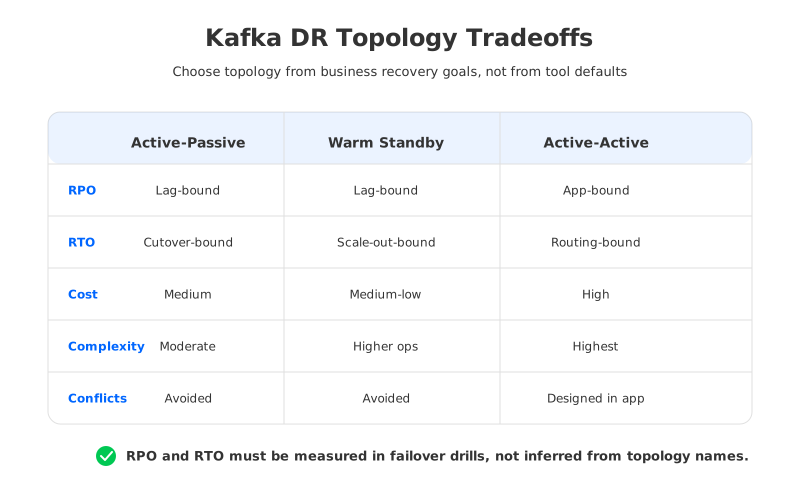
Active-passive is the default for many Kafka DR designs because it preserves a single write authority. Producers write to the primary region, selected topics replicate to the secondary region, and consumers fail over when the primary region is impaired. RPO depends on replication lag and the durability of the source region at the time of failure. RTO depends on standby capacity, DNS or service-discovery cutover, consumer offset readiness, and whether downstream systems can tolerate a sudden region switch.
Warm standby is a cost-conscious variation of active-passive. The target cluster is running and receiving data, but it is not sized for full production load until failover. This can reduce idle compute, but it pushes more pressure onto automation: scale-out must complete before the business deadline for RTO. If your RTO is measured in minutes, warm standby has to be tested under real throughput, not assumed from an autoscaling policy.
Active-active is attractive because it promises low RTO and regional locality, but it is also where Kafka DR becomes an application architecture problem. If both regions accept writes for the same logical stream, teams need a conflict model. They also need to understand how keys, ordering, transactions, idempotent producers, compaction, and downstream materialized views behave when records originate in multiple regions. For some event streams, active-active is reasonable because events are naturally partitioned by geography or tenant. For global account balances, entitlement changes, or workflows that assume a single sequence, active-active can create a correctness problem that no replication tool can hide.
The practical split often looks like this:
- Use active-passive for most systems of record, operational topics, and event streams where single-writer semantics matter.
- Use warm standby when the business can tolerate a measured recovery window and the team has tested scale-out during drills.
- Use active-active only when ownership boundaries are clear, conflicts are designed for, and downstream consumers are built for duplicated or out-of-order regional events.
- Use topic-level replication instead of whole-cluster replication when only part of the Kafka estate is business-critical during a regional incident.
This is also where RPO and RTO need careful language. A tool may support continuous replication, but that does not mean zero data loss under every failure mode. A target cluster may be online, but that does not mean applications can resume instantly. RPO is bounded by replication lag, source availability, producer acknowledgement behavior, and the last committed offsets that are usable in the target region. RTO is bounded by capacity, routing, credentials, client configuration, downstream dependencies, and human approval gates.
3Replication tools and their tradeoffs
Apache Kafka MirrorMaker 2 remains the portable baseline because it is built on Kafka Connect and is designed for cross-cluster mirroring. Its conceptual model is familiar: source connectors copy records, checkpoint connectors help translate consumer group offsets, and heartbeat topics help track link health. That portability is valuable, but the operational burden is real. Teams still have to run Connect workers, tune tasks, monitor lag, size the target cluster, handle topic naming policy, and validate offset translation before cutover.
Confluent Cluster Linking moves the abstraction closer to the Kafka platform by representing remote topics as linked topics. It can reduce the operational surface area compared with running your own replication stack, especially for Confluent users, but it also ties design choices to the platform, supported cluster combinations, and feature limits in the relevant Confluent environment. It is a strong candidate when the organization already standardizes on Confluent and wants platform-native replication.
AWS MSK Replicator takes a managed-service approach for MSK-to-MSK replication. The AWS pricing page is useful because it makes the cost structure explicit: replication is not just "another cluster"; it can include replicator-hours, GB processed, inter-region transfer, and private connectivity processing depending on the setup. The tradeoff is scope. It is most natural when both source and target are Amazon MSK clusters and the team wants AWS-native operations.
AutoMQ Kafka Linking is a different entry point: it is designed for migration into AutoMQ while preserving Kafka compatibility and synchronizing consumption progress. That makes it useful when DR planning is part of a broader cluster consolidation or migration program. It should not be described as making cross-region replication free or automatic in every topology. The more accurate point is that a Kafka-compatible, storage-decoupled target changes what you have to provision and operate after the data lands.
4How storage architecture changes DR planning
Traditional Kafka stores partition data on broker-local disks and replicates it through broker-to-broker traffic. That model is robust, well understood, and operationally familiar. It also means that capacity, recovery, and rebalancing are tied to where data physically sits. In a DR design, the target region often repeats the same pattern: enough brokers, enough disk, enough replication throughput, and enough operational machinery to keep the copy useful.
AutoMQ changes that part of the conversation by keeping Kafka protocol compatibility while moving durable data into shared cloud storage through its S3Stream-based architecture. Brokers become stateless compute nodes rather than long-lived owners of local partition data. In DR planning, this does not remove the need to decide what data crosses regions, how clients fail over, or what RPO/RTO the business accepts. It does change the shape of the target environment because storage and broker compute are no longer scaled as one fixed unit.
That distinction matters in three places:
- Standby sizing. A stateless broker layer can make compute capacity easier to add during a failover exercise, while object storage carries the durable data layer. The recovery plan still needs tested timing, but fewer decisions depend on copying broker-local disks around the cluster.
- Cluster consolidation. When DR work exposes dozens of underused Kafka clusters, a Kafka-compatible shared-storage platform can be part of a consolidation plan rather than only a replication endpoint.
- Migration and cutover. Linking-based migration can reduce the amount of custom plumbing needed to move topics and consumption progress into the target platform, which is valuable when the DR project is also a modernization project.
The honest architectural claim is narrower than a marketing slogan and more useful: object-storage-backed Kafka does not eliminate regional data-transfer physics, but it can reduce the amount of idle, stateful broker infrastructure you maintain around those physics.
5DR checklist
The easiest DR mistake is to declare success when records appear in the target topic. Kafka applications rarely fail over on records alone. Consumers need positions, schemas need compatibility, producers need a new bootstrap path, stateful stream processors need recovery rules, and humans need a rollback point if the first cutover goes badly.
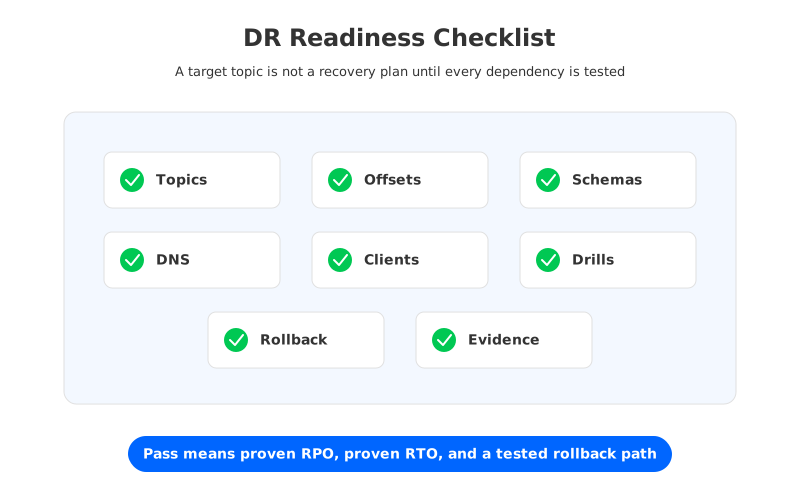
Use this checklist before committing to a topology:
| Area | DR design question | Evidence to collect |
|---|---|---|
| Topic scope | Which topics must be available during a regional outage? | Critical-topic inventory with owners |
| RPO | How much data loss is acceptable by topic group? | Lag SLO, producer ack policy, replication monitoring |
| RTO | How quickly must producers and consumers resume? | Timed failover drill, not a spreadsheet estimate |
| Offsets | Can consumer groups resume at the intended position? | Offset sync validation and replay test |
| Schemas | Are schema subjects and compatibility policies available? | Registry replication or restore procedure |
| Connectors | Are sources and sinks safe to restart in the target region? | Connector ownership and idempotency review |
| Client routing | How do applications discover the target cluster? | DNS, service discovery, secret, and ACL runbooks |
| Rollback | What happens if the target region is unhealthy after cutover? | Explicit rollback trigger and data reconciliation plan |
The best DR design is often not the most symmetrical one. Replicate the topics that matter, retain enough history to recover business processes, keep the standby cluster sized to the RTO you can prove, and avoid active-active unless the data model is built for it. When a Kafka replacement or modernization project is already on the table, evaluate whether the target architecture reduces stateful standby overhead as well as replication toil. That is where AutoMQ belongs in the discussion: not as a magic exception to cross-region cost, but as a Kafka-compatible architecture that can make the recovery environment lighter to operate.
6Sources
- Apache Kafka documentation: Geo-replication and cross-cluster data mirroring
- KIP-382: MirrorMaker 2.0
- Confluent documentation: Cluster Linking
- AWS MSK pricing
- AWS EC2 pricing: Data Transfer
- AutoMQ documentation: Architecture overview
- AutoMQ documentation: Stateless Broker
- AutoMQ documentation: Kafka Linking migration overview
7FAQ
Is Kafka cross-region replication the same as cross-AZ replication?
No. Cross-AZ replication is usually part of high availability inside one region. Cross-region replication is a DR or geo-distribution design that crosses regional boundaries, usually with different transfer pricing, routing, failover, and compliance considerations.
Can Kafka achieve zero RPO and zero RTO across regions?
Treat that claim carefully. Continuous replication can reduce RPO, and active-active can reduce some failover steps, but real RPO and RTO depend on replication lag, client routing, consumer offsets, downstream systems, and conflict handling. They should be measured in drills.
Is active-active Kafka worth the extra cost?
Only when the application data model supports it. Active-active can be appropriate for tenant- or region-partitioned event streams, but it adds conflict handling, ordering, duplicate processing, and operational complexity. Many teams get a better risk-cost balance from active-passive or warm standby.
Does object storage remove inter-region data transfer cost?
No. Moving data across regions can still incur cloud data-transfer charges. Object-storage-backed Kafka changes broker state, storage scaling, and standby infrastructure planning; it does not make regional network economics disappear.
Where does AutoMQ fit in a Kafka DR project?
AutoMQ is most relevant when the DR project overlaps with Kafka modernization, cluster consolidation, or migration. Its Kafka-compatible, shared-storage architecture can reduce the amount of stateful broker infrastructure teams maintain, while Kafka Linking helps migration into AutoMQ. The DR design still needs explicit RPO, RTO, failover, and rollback validation.


