
Table of Contents
Table of Contents
Kafka Cruise Control usually enters the conversation after a team has already felt the pain. One broker is carrying more leader traffic than its neighbors. Another broker is close to a disk limit because a few large topics landed badly. A new broker was added, but the cluster did not become balanced by itself. Someone writes a reassignment JSON, schedules a window, sets a throttle, and watches partition movement compete with production traffic.
That is the moment when automation becomes attractive. Kafka Cruise Control gives platform teams a model-driven way to reason about broker utilization, replica placement, leader distribution, rack awareness, and balancing goals. It is still an active open-source project: as of the public GitHub release data checked for this article, the latest release was 2.5.146, published on November 5, 2025, and the README lists compatibility through Apache Kafka 4.0 for recent 2.5.x releases.
The important question is not whether Cruise Control is useful. It is. The harder question is what kind of Kafka cluster balancing problem you actually have. Some teams need better plans and safer execution. Others are running into a deeper limit: automation can schedule data movement, throttle it, and monitor it, but it does not make broker-local data movement disappear.
1Why Kafka Teams Adopt Cruise Control
Traditional Kafka ties compute, network, and persistent log storage to the broker. That design is powerful because each broker owns concrete partition replicas, participates in replication, and serves reads and writes from local storage. It also means imbalance accumulates as the cluster changes. Topic creation, partition count changes, broker replacement, producer skew, consumer replay, and uneven retention all leave marks on the cluster.
At small scale, an operator can often handle this manually. At larger scale, the symptoms multiply:
- Broker skew: one broker carries more CPU, network, or leadership than peers even when the broker count looks sufficient.
- Disk imbalance: retained log bytes accumulate unevenly because partition size is not the same as partition count.
- Hot partitions: a few partitions dominate write or read load, so a balanced replica count can still produce an unbalanced cluster.
- Manual toil: partition reassignment plans become difficult to reason about because every move affects placement, replication, and live traffic.
- Slow change: adding, removing, or replacing brokers becomes a project.
Kafka's own operations docs show why operators are careful here. Partition reassignment is generated or hand-authored, executed, and then verified. Broker decommissioning requires moving all partitions off the broker before it is removed. The docs also describe throttling reassignment traffic because moving data between brokers and disks is a data-intensive operation that can affect users.
Cruise Control responds to that operational reality. Instead of asking humans to inspect every broker, disk, and partition by hand, it builds a workload model from metrics and cluster metadata, then proposes balancing actions against configured goals.
2What Cruise Control Does Well
Cruise Control is best understood as a decision and execution layer around a stateful Kafka cluster. Its README describes resource utilization tracking for brokers, topics, and partitions; cluster state queries for online and offline partitions, ISR health, log directories, and replica distribution; and multi-goal proposal generation across rack awareness, CPU, disk, network I/O, replica counts, leader traffic, and topic distribution.
That list matters because Kafka load balancing is not one metric. A naive plan might even out replica counts while making disk usage worse. Another plan might fix disk usage while concentrating leaders on a smaller broker set. Cruise Control's value is that it makes these goals explicit and lets operators inspect the proposal before execution.
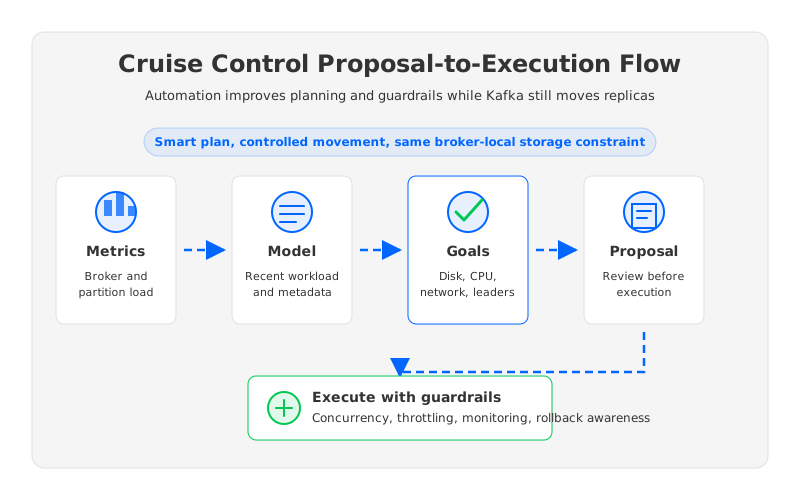
A typical Cruise Control operating loop looks like this:
- Collect broker and partition metrics through the configured metrics reporter or sampler.
- Build a recent workload model from the sampled utilization data and cluster metadata.
- Evaluate goals such as disk capacity, network usage, CPU capacity, leader distribution, rack awareness, and replica distribution.
- Generate optimization proposals for review or API-driven execution.
- Execute approved movements while respecting concurrency, throttling, and operational guardrails.
This does not remove the need for judgment. It gives that judgment a better starting point. Operators still need to choose goals, define broker capacity files accurately, integrate metrics, review proposals, decide which actions are safe during business hours, and monitor execution.
The strongest fit is a Kafka platform team that wants to keep running traditional Kafka while reducing manual balancing toil. Cruise Control helps when the cluster is large enough that manual reassignment is error-prone, but the team still has the staff, observability, and change process to operate a balancing service responsibly.
3Where Balancing Automation Hits Architectural Limits
The hard limit is not specific to Cruise Control. It is the shared-nothing Kafka storage model. When a partition replica moves from one broker to another, Kafka has to move data. If a broker is removed, its partition replicas need somewhere else to live. Automation can make the plan smarter, but the bytes still travel.
This is why throttling exists. Kafka's operations docs describe reassignment throttles as a way to limit the bandwidth used for data migration between brokers and disks. That protects users from uncontrolled movement, but it introduces a tradeoff every operator knows: a lower throttle reduces impact but lengthens the balancing window, while a higher throttle finishes sooner but consumes more cluster capacity during change.
Cruise Control sits inside that tradeoff. It can select a better set of moves and help avoid obvious goal violations. It cannot turn broker-local persistent data into a metadata-only operation. If the cluster has many retained bytes, long retention, or frequent broker churn, movement remains part of the operating model.
This is where the word "alternative" needs care. A team disappointed with manual reassignment may need Cruise Control, not a new architecture. A team disappointed with the ongoing cost and risk of reassignment may need to compare architectures, not only tools.
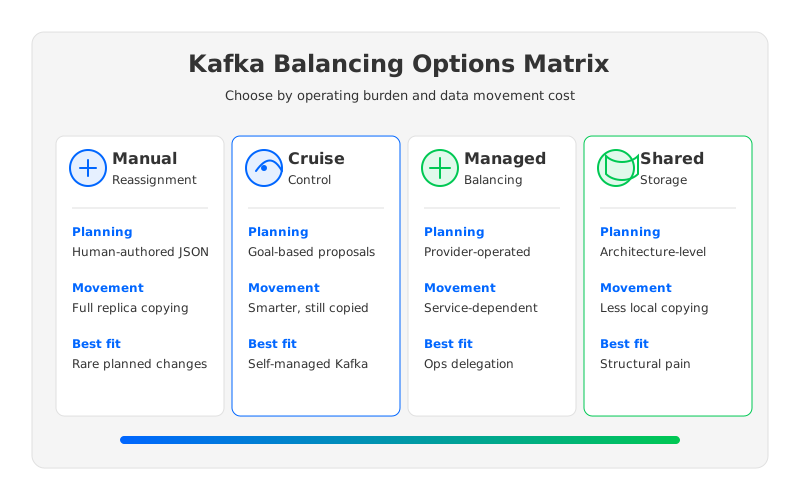
| Option | What It Improves | What It Still Cannot Remove | Best Fit |
|---|---|---|---|
| Manual partition reassignment | Full operator control and no extra balancing service. | Human planning burden, slow iteration, and data movement risk. | Small clusters, rare changes, or tightly controlled maintenance. |
| Kafka Cruise Control | Goal-based proposals, metrics-aware balancing, automation hooks, and operational visibility. | Broker-local replica movement, throttle tradeoffs, and configuration ownership. | Self-managed Kafka teams with mature observability and repeat balancing needs. |
| Managed Kafka balancing | Provider-operated automation, reduced staffing burden, and integrated service workflows. | Limited control, provider-specific behavior, and continued dependence on the underlying storage model. | Teams that prefer managed operations and accept service boundaries. |
| Shared-storage Kafka-compatible architecture | Reduces the amount of broker-local data movement by decoupling durable storage from brokers. | Requires architecture evaluation, migration planning, and object-storage dependency review. | Teams whose balancing pain is structural: scaling, broker replacement, disk skew, and reassignment risk. |
The table is not a ranking. It is a way to name the problem. Manual reassignment is fine when changes are rare. Cruise Control remains valuable when a team needs serious automation for Apache Kafka. Managed services can remove operational burden. Shared storage is compelling when repeated pain comes from durable data being pinned to brokers.
4Managed Balancing Is an Operating Model, Not Only a Feature
Managed Kafka services change the ownership boundary. Instead of running Cruise Control yourself, you may rely on the provider's balancing, scaling, replacement, and repair workflows. That can be the right move when the team wants Kafka outcomes without maintaining another control loop.
The tradeoff is visibility and control. In a self-managed cluster, operators can inspect Cruise Control goals, change capacity definitions, tune concurrency, and decide when to execute. In a managed service, some of those decisions are abstracted away, and the details depend on the service and plan.
This is why managed balancing should be evaluated as an operating model:
- Who owns the balancing decision when a broker becomes hot?
- Can you inspect or influence the placement logic?
- How does the service protect user traffic during movement?
- What metrics reveal reassignment progress, under-replicated partitions, disk pressure, and leader skew?
- How does the service behave during scale-in, broker replacement, zone events, and large replays?
If the provider answers those questions in a way that matches your SLOs, managed balancing can reduce operational risk. If the answers are opaque, the team may have fewer knobs but the same concerns about movement time, maintenance windows, and retained data.
5How Shared Storage Changes the Balancing Problem
A shared-storage Kafka-compatible architecture changes the premise. Instead of treating each broker as the durable home of its partition replicas, durable log data lives in a shared storage layer such as object storage, while brokers focus on protocol handling, leadership, caching, and traffic placement. The cluster still needs coordination and balancing, but balancing does not have to be dominated by copying retained log data between broker disks.
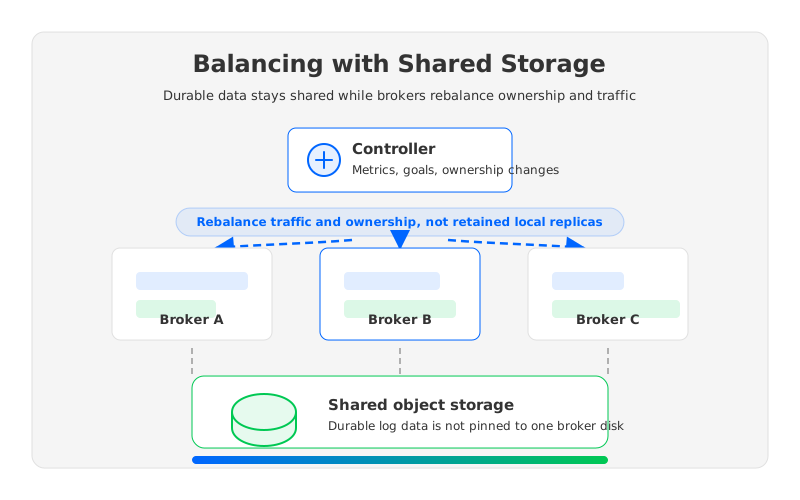
AutoMQ fits this category as a Kafka-compatible streaming platform that separates compute from storage. Its public docs describe stateless brokers, a shared storage architecture, partition reassignment in seconds, and continuous self-balancing. In practical terms, AutoMQ's self-balancing still watches broker load and traffic distribution, but the movement being coordinated is closer to ownership, leadership, and traffic adjustment than bulk copying of broker-local durable logs.
Shared storage does not eliminate operational thinking. Teams still need to validate Kafka compatibility, client behavior, object storage performance, cache warm-up, failure modes, migration approach, and observability. A storage-decoupled architecture changes the constraints; it does not make capacity planning disappear.
The benefit is specific: it reduces the volume and risk profile of balancing operations when the pain comes from broker-local storage. If a team is mostly fighting uneven CPU caused by hot producers, it may still need partition-key or topic-design work. If the team is repeatedly blocked by disk imbalance, broker decommissioning, slow reassignment, and reluctance to scale in, shared storage becomes an architectural alternative rather than another automation layer.
6A Decision Framework for Kafka Cluster Balancing
Start by separating the symptom from the mechanism. "Kafka cluster balancing" can mean replica count balancing, leader balancing, disk balancing, rack-aware placement, network balancing, or hot partition mitigation. Cruise Control helps with several of these, but no balancing tool can make a single hot partition evenly consume multiple brokers unless the workload and partitioning strategy allow it.
Use a simple decision path:
| If Your Main Problem Is | Start With | Escalate When |
|---|---|---|
| Occasional placement cleanup | Manual reassignment with careful verification and throttling. | Plans become too complex or frequent for human review. |
| Repeated broker skew across CPU, disk, network, and leaders | Cruise Control or a similar goal-based automation layer. | Execution windows remain long because movement volume is too high. |
| Staffing burden and routine broker operations | Managed Kafka automation. | Service limits, opacity, or cost structure conflict with SLOs. |
| Scale-in, broker replacement, and disk imbalance risk | Shared-storage Kafka-compatible architecture evaluation. | Broker-local data movement is the reason changes are delayed. |
This framework also keeps AutoMQ in the right place. It is not a drop-in replacement for Cruise Control as a standalone tool. It is an architecture option for teams whose balancing pain persists even after automation improves planning. If your Apache Kafka cluster mainly needs better proposal generation, Cruise Control deserves a fair evaluation. If every balancing discussion becomes a debate about how many terabytes must move and how slowly to throttle them, the architecture itself is part of the problem.
The opening pain returns here: a hot broker, an uneven disk, a risky reassignment window, and a team tired of babysitting movement. Cruise Control can make that work far more disciplined. Managed services can move part of that burden to a provider. Shared storage can reduce the amount of broker-local movement that created the burden. The right answer depends on which cost you are trying to remove: human planning, operational ownership, or the data movement itself.
If your team is comparing these paths, review AutoMQ's docs on shared storage, stateless brokers, partition reassignment, and continuous self-balancing alongside your current Cruise Control or managed Kafka plan. The useful output is a clear statement of whether your cluster balancing problem is a tooling gap or an architecture constraint.
7References
- LinkedIn Cruise Control GitHub Repository
- LinkedIn Cruise Control Releases
- Apache Kafka Basic Kafka Operations
- Apache Kafka Monitoring
- AutoMQ Architecture Overview
- AutoMQ Stateless Broker
- AutoMQ Partition Reassignment in Seconds
- AutoMQ Continuous Self-Balancing
8FAQ
8.1Is Kafka Cruise Control still maintained?
Yes. The public Cruise Control repository is active. For this article, the latest GitHub release checked was 2.5.146, published on November 5, 2025, and the README lists compatibility through Apache Kafka 4.0 for recent 2.5.x releases. Teams should still verify their exact Kafka version, Java version, branch, and deployment requirements before adopting it.
8.2What does Kafka Cruise Control do?
Cruise Control collects Kafka broker and partition metrics, builds a workload model, evaluates balancing goals, and generates optimization proposals. It can help with rack awareness, disk capacity, CPU, network I/O, leader distribution, replica distribution, broker add/remove workflows, anomaly detection, and self-healing patterns when configured appropriately.
8.3What is the main limitation of Cruise Control?
Cruise Control automates planning and execution around Kafka's existing storage model. If a balancing action requires partition replicas to move between broker-local disks, the data still has to move. Throttling can reduce production impact, but lower throttles also lengthen the balancing window.
8.4When is manual Kafka partition reassignment enough?
Manual reassignment can be enough for small clusters, rare changes, or tightly controlled maintenance events. It becomes risky when operators must frequently balance many brokers, topics, disks, and leaders by hand, especially when the plan affects production traffic.
8.5How is AutoMQ different from Cruise Control?
Cruise Control is an automation layer for traditional Kafka cluster balancing. AutoMQ is a Kafka-compatible architecture that separates compute from durable storage with stateless brokers and shared storage. That changes balancing by reducing the amount of broker-local data movement involved in scaling, reassignment, and broker replacement.


