
Table of Contents
Table of Contents
Teams discover Kafka data transfer cost when a cloud bill shows a network line item that does not match application traffic. Producers may be sending reasonable volume, and consumers may look stable, but the Kafka cluster is moving more bytes than the business thinks it produced. Multi-AZ replication, follower fetches, reassignments, connector traffic, and historical reads all turn the same record into several billable movements. That is why kafka data transfer cost is an architecture question inside a finance review.
The core tension is straightforward. Kafka needs redundancy, and production teams need availability zones. Retention supports recovery, analytics backfills, audit use cases, and AI data pipelines that need fresh event history. But the traditional Kafka operating model ties those goals to broker-local storage and broker-to-broker data movement. The more you ask Kafka to retain, replicate, rebalance, and recover across zones, the more the cloud network bill reflects internal platform mechanics rather than user-facing value.
1Why teams search for kafka data transfer cost
The search intent usually comes from a production system that already works. Teams ask this question because a healthy cluster became expensive in a way that is hard to explain. A platform owner can point to input throughput and retention policy, but those numbers do not map directly to the final bill when every byte is replicated, read, moved, and replayed across cloud boundaries.
Kafka operators know the first-order cost drivers: broker instances, disk, managed service fees, observability, and support. Data transfer is harder because it lives between teams. Application owners control write volume and consumer fan-out. Platform teams control placement, replication factor, broker sizing, and reassignment policy. Cloud architects control VPC layout, private connectivity, and inter-zone routing. The invoice compresses all of that into a few network categories, which makes the root cause look less technical than it really is.
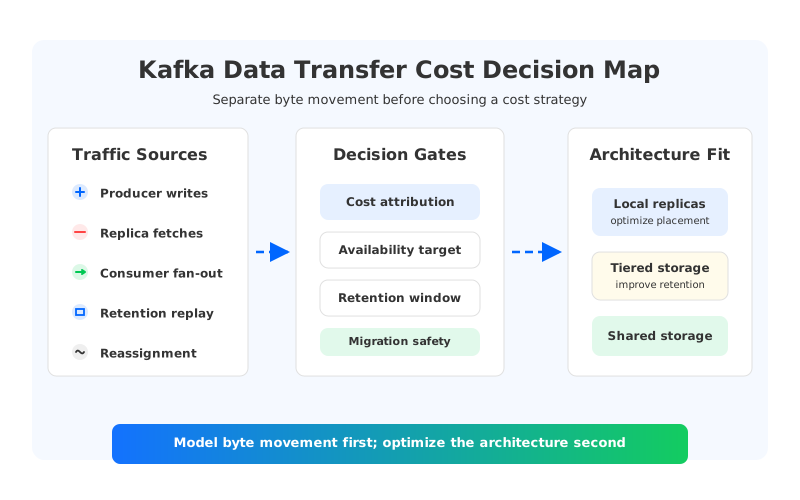
Several traffic paths deserve separate accounting before anyone changes the architecture:
- Producer ingress and consumer egress. A producer or consumer in a different AZ, VPC, region, or account can turn normal application traffic into network cost.
- Kafka replication traffic. With a replication factor of 3 across availability zones, each acknowledged write normally creates additional replica fetch traffic between brokers.
- Rebalancing and reassignment traffic. Partition movement copies existing log data, not only incoming records. This traffic is episodic, but it can be large enough to distort monthly cost.
- Retention and replay traffic. Longer retention increases the amount of historical data that may be fetched during recovery, backfills, or consumer resets.
- Connectors, mirroring, and migration. Kafka Connect, MirrorMaker 2, dual writes, and external sinks can add paths outside the core cluster.
The first useful deliverable is a byte-flow inventory. Trace where a record travels, who reads it, where replicas live, how long the log remains available, and which operations move old data. Once that inventory exists, cost optimization becomes an engineering discussion instead of a bill dispute.
2The production constraint behind the problem
Traditional Kafka is a shared-nothing system at the broker layer. Each broker owns local log segments for the partitions assigned to it, and Kafka maintains durability by replicating those logs between brokers. That design is explicit and understandable. It also means the broker is both compute and storage: it handles the protocol path and acts as durable home for part of the stream.
This coupling gives multi-AZ Kafka a predictable cost shape. If replicas are spread across zones, a leader broker serves follower fetches across zone boundaries for durability. If a broker is replaced, replicas must catch up or be moved. If partitions are reassigned for balance, the cluster copies log data to target brokers. The platform is doing the correct thing for availability, but cloud billing systems do not treat those internal transfers as free background work.
Retention makes the same coupling more visible. Short retention keeps the active dataset small, which limits the amount of broker-local data that can move during recovery or rebalancing. Longer retention changes the operational surface. More bytes sit under each partition assignment, and more historical data may be served when a consumer group resets or an analytics job replays events. Tiered storage can reduce local disk pressure by moving older log segments to remote storage, but it does not erase the cost of the active write path or all consumer and recovery traffic.
The trade-off is easier to see when reliability and cost are placed side by side:
| Decision | Operational benefit | Cost pressure it can create |
|---|---|---|
| Spread replicas across AZs | Higher availability during zone failure | Cross-AZ broker replication and follower catch-up traffic |
| Increase retention | Easier replay, audit, recovery, and backfills | More storage and more historical reads during replay |
| Rebalance for hot partitions or capacity | Better utilization and risk reduction | Large data copies during reassignment windows |
| Add connectors and mirroring | Better integration, migration, and DR options | Extra network paths outside the core cluster |
None of these decisions is wrong. In production, most are necessary. The problem is that each decision is evaluated for reliability or data access first, and its network consequence is discovered later. A useful Kafka cost review keeps those views together: the reliability model explains why the bytes move, and the cloud cost model explains what those bytes cost.
3Architecture options and trade-offs
A Kafka data transfer cost review should not begin by asking which platform costs less. That question is too broad to answer honestly. The better starting point is to compare operating models: where durable data lives, how replicas are maintained, what happens during scaling, and which data paths cross chargeable network boundaries.
Traditional self-managed Kafka gives teams maximum control over topology and tuning. Operators can place brokers carefully, use rack awareness, co-locate clients, and schedule reassignment work during lower-traffic windows. That control is valuable when the team has enough Kafka expertise and the workload is predictable. The trade-off is that every optimization still works inside a broker-local storage model. You can reduce unnecessary traffic, but you cannot make local replicas stop being local replicas.
Managed Kafka services reduce operational labor, but they do not automatically change the underlying cost physics. The platform team may spend less time patching brokers, yet still pay for replication, cross-zone paths, storage growth, and migration traffic. Managed operations and architectural decoupling are different questions.
Tiered storage sits between those worlds. Apache Kafka's tiered storage work, associated with KIP-405 and remote log storage, addresses a real retention problem: keeping all historical data on broker disks is inefficient when most reads target recent segments. For workloads where the dominant pain is long retention, tiering can be a strong fit. The active write path still needs evaluation because recent data, replication, and failover behavior determine much of the multi-AZ traffic profile.
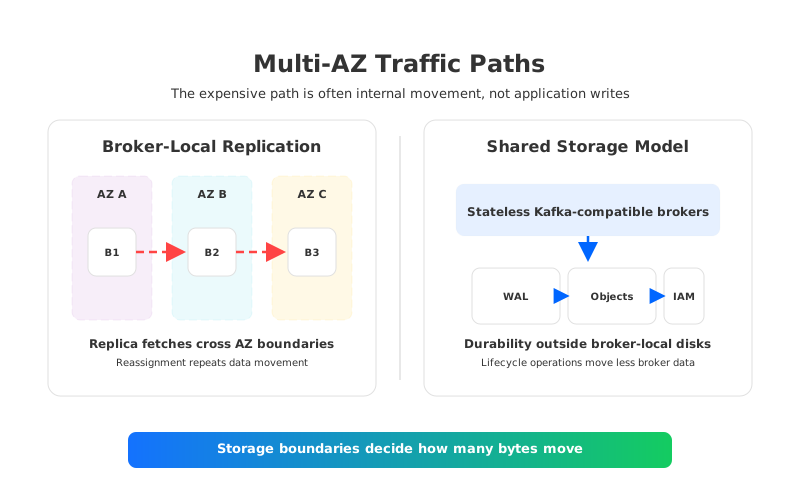
Shared-storage Kafka-compatible systems change a deeper boundary. Instead of making each broker the permanent home of partition data, they place durable stream storage in a shared storage layer and make brokers closer to stateless compute. That does not remove the need for a low-latency write-ahead log, metadata discipline, cache design, or failure testing. It changes which components own durability and how much broker-to-broker movement routine operations require.
The practical difference shows up during change. In a broker-local model, scaling, replacement, and reassignment often imply data movement between brokers. In a shared-storage model, durable data can outlive the broker that served a request, so broker lifecycle operations can become more compute-oriented. For cloud cost, the system can rely less on repeatedly copying durable data across zones during cluster maintenance.
4A cost model that separates traffic classes
Cloud pricing pages are precise, but a Kafka bill is workload-specific. AWS, Google Cloud, and Azure publish data transfer pricing for their own network boundaries, and those boundaries vary across products, regions, and private connectivity options. Verify current provider pricing before publishing a savings estimate. The engineering model is stable: separate traffic classes first, then attach provider rates.
Start with write throughput because it creates the base stream of records. Then multiply only when the architecture moves the byte again. A rough model should include replication factor, AZ placement, consumer fan-out, historical replay, reassignment volume, connector sinks, and migration paths. If most cost comes from remote consumers, client placement and private connectivity may matter more than changing the broker architecture. If most cost comes from replica traffic and reassignment, the storage model deserves serious review. If retention-driven replay dominates, tiered storage, query patterns, and consumer behavior may be the first place to focus.
5Evaluation checklist for platform teams
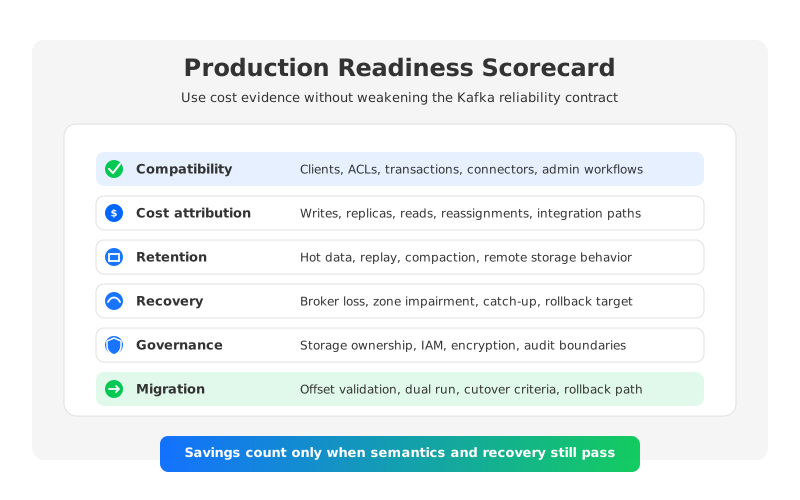
Cost optimization is risky when it weakens the reliability contract that made Kafka useful. The evaluation has to protect semantics before it chases savings. Producer acknowledgments, ordering, idempotence, transactions, consumer group behavior, offset management, ACLs, observability, and ecosystem tooling are the reason application teams trust the platform.
Use the checklist as a gate, not a slide:
- Compatibility. Confirm the Kafka APIs, client versions, security model, admin operations, and connector patterns your workloads actually use.
- Cost attribution. Separate application traffic, replica traffic, consumer reads, operational movement, and integration paths.
- Availability and recovery. Test broker loss, zone impairment, storage throttling, client retry behavior, and consumer catch-up under representative load.
- Retention behavior. Validate hot reads, historical replay, topic-level retention policy, compaction if used, and the operational impact of changing retention.
- Governance. Check where data lives, which account owns storage, how IAM and encryption are managed, and how audit logs are retained.
- Migration and rollback. Plan offset validation, dual writes or mirroring, cutover windows, failure criteria, and the path back if a workload behaves differently than expected.
Kafka data transfer cost crosses team boundaries, so the fix will cross team boundaries too. A platform team can tune brokers, but it may need application teams to move consumers, security teams to approve storage policies, and finance teams to accept a workload-based cost allocation model.
6How AutoMQ changes the operating model
After the neutral evaluation is complete, AutoMQ fits into a specific architectural category: a Kafka-compatible streaming platform built around Shared Storage architecture. It keeps Kafka protocol compatibility while moving durable stream storage away from broker-local disks and into shared storage backed by object storage. In this model, brokers handle Kafka-compatible request processing, coordination, and caching, while the durable data layer is designed to outlive individual broker instances.
That boundary matters for multi-AZ cost because it changes why bytes move. Traditional Kafka spreads replicas across brokers for durability, and those brokers often sit in different zones for availability. AutoMQ's architecture is designed to avoid broker-to-broker replication as the durability mechanism for every record. Its documentation describes an inter-zone traffic model where object-storage-backed shared storage and careful placement can reduce cross-AZ transfer.
The storage design is not magic. A production shared-storage system still needs a write-ahead log for the latency-sensitive write path, object storage for durable capacity, metadata correctness, cache behavior, and clear recovery rules. The benefit is that compute and storage can be scaled and recovered more independently. When broker count changes, the team is not forced to move the same amount of durable log data between brokers first.
This is where AutoMQ becomes relevant to a Kafka data transfer cost review. If the cost model shows that broker-local replication, reassignments, and retention-driven storage growth are the main sources of waste, then shared storage attacks the mechanism that creates the traffic. If the model shows that remote consumers or connector sinks dominate, AutoMQ may still help the platform operate differently, but the first fix may be topology, routing, or ownership.
The right pilot is intentionally narrow. Pick one workload with known throughput, fan-out, retention, and failure objectives. Measure current transfer paths, validate Kafka compatibility, test broker replacement and replay, then compare the operating model under stress.
If your Kafka data transfer cost review points to broker-local replication and retention as the main constraint, use the AutoMQ Cloud entry point to test a Kafka-compatible shared-storage architecture against your own workload. The useful question is not whether the bill can be made smaller in the abstract. It is whether the architecture moves fewer unnecessary bytes while preserving the Kafka behavior your applications depend on.
7References
- Apache Kafka documentation: https://kafka.apache.org/documentation/
- Apache Kafka KIP-405: https://cwiki.apache.org/confluence/display/KAFKA/KIP-405%3A+Kafka+Tiered+Storage
- AWS EC2 data transfer pricing: https://aws.amazon.com/ec2/pricing/on-demand/#Data_Transfer
- Google Cloud VPC network pricing: https://cloud.google.com/vpc/network-pricing
- Azure bandwidth pricing: https://azure.microsoft.com/en-us/pricing/details/bandwidth/
- AutoMQ architecture overview: https://docs.automq.com/automq/architecture/overview?utm_source=blog&utm_medium=reference&utm_campaign=aivk-0022
- AutoMQ Kafka compatibility: https://docs.automq.com/automq/architecture/technical-advantage/native-compatible-with-apache-kafka?utm_source=blog&utm_medium=reference&utm_campaign=aivk-0022
- AutoMQ inter-zone traffic guidance: https://docs.automq.com/automq-cloud/eliminate-inter-zone-traffics/overview?utm_source=blog&utm_medium=reference&utm_campaign=aivk-0022
8FAQ
8.1What is Kafka data transfer cost?
Kafka data transfer cost is the cloud network cost created when Kafka records move between clients, brokers, availability zones, regions, VPCs, connectors, and storage systems.
8.2Why does multi-AZ Kafka increase transfer cost?
Multi-AZ Kafka places replicas and clients across availability zones to improve availability. When leaders send data to followers in other zones, or clients read across zone boundaries, cloud providers may charge for that transfer.
8.3Does tiered storage eliminate Kafka data transfer cost?
No. Tiered storage can reduce broker-local disk pressure by moving older log segments to remote storage. It does not automatically remove active replication traffic, cross-zone client reads, connector traffic, or all replay cost.
8.4How should teams estimate Kafka transfer cost?
Start with a byte-flow inventory. Measure ingress, replication factor, AZ placement, consumer fan-out, replay frequency, reassignment volume, connector traffic, and migration paths. Then map each class to cloud pricing.
8.5When should a team evaluate shared-storage Kafka-compatible architecture?
Evaluate shared storage when broker-local replication, partition reassignment, broker replacement, or retention-driven storage growth drives a large share of Kafka cost. Still begin with compatibility, reliability, governance, and migration gates.
8.6Can AutoMQ remove every network cost in a Kafka deployment?
No architecture removes all network movement. Producers, consumers, connectors, storage, and control systems still communicate. AutoMQ is relevant when the expensive movement comes from broker-local replication and storage lifecycle operations that shared storage can reduce or avoid.


