
Table of Contents
Table of Contents
Kafka developer experience usually gets discussed as tooling: a local broker, a CLI, a schema registry, a dashboard, maybe a few integration-test containers. Those tools matter. A team that cannot test producers and consumers quickly will ship slowly. But the harder problem appears later, when a service that passed local tests starts consuming from a shared production cluster with real partitions, retention policies, access controls, and consumer lag nobody can reproduce on a laptop.
That is why "kafka developer experience" is not only a productivity search. It is a platform architecture search. Teams want developers to move fast without learning every broker setting, but they also need guardrails that prevent local assumptions from becoming incidents. The goal is not to hide Kafka. The goal is to expose the right concepts at the right time: topic contracts during development, replay and offset behavior during testing, quotas and ownership before production, and failure drills before trust.
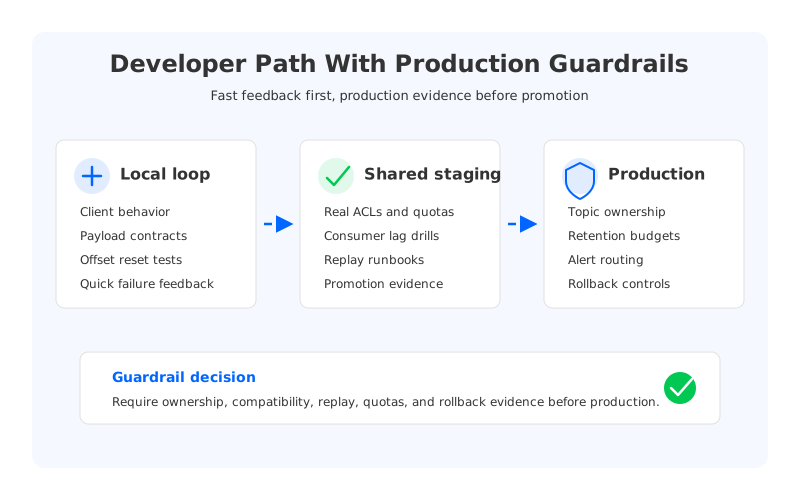
A strong developer experience therefore spans three environments, not one. Local testing should make feedback low-friction. Shared staging should make integration behavior visible. Production guardrails should make unsafe changes hard to deploy and easier to roll back. If those layers are designed separately, developers feel the gaps as friction; SREs feel the same gaps as incidents.
1Why Kafka Developer Experience Breaks at the Environment Boundary
Local Kafka is useful because it collapses distance. A developer can create a topic, publish a few records, consume them, reset offsets, and validate serialization without waiting for a platform ticket. This is the right default for early work. Kafka clients are explicit about producer acknowledgments, consumer group behavior, offsets, transactions, and delivery semantics, so the sooner a team exercises those concepts, the fewer surprises it carries into production.
The catch is that local clusters are usually too friendly. They have small data volumes, short histories, permissive access, simple networking, and no serious tenant contention. They rarely model broker maintenance, downstream throttling, compaction side effects, quota enforcement, certificate rotation, or retention changes. A local test can prove that the code speaks Kafka correctly. It cannot prove that the workload is safe for a shared platform.
The boundary becomes painful when teams promote Kafka work as if it were ordinary HTTP service work. A REST endpoint can often be validated with request and response examples. A Kafka application has a longer contract surface:
- Topic naming, partitioning, replication, and retention define the shape of the shared log.
- Message format, schema evolution, keys, headers, and tombstones define compatibility.
- Consumer group identity, offset commits, retry topics, and dead-letter topics define recovery behavior.
- Producer idempotence, transactions, and acknowledgment settings define delivery guarantees.
- ACLs, quotas, network paths, and observability define operational ownership.
Those are not exotic details. They are the production interface. Good developer experience makes them visible before a service receives production traffic.
2The Production Constraints Behind the Search
The platform team has a different view of the same workflow. Developers want a fast path from idea to stream. Operators want bounded blast radius. Architects want a model that still works as topics, teams, environments, and data products grow. CTOs want a platform that supports AI and event-driven systems without turning every integration into a custom infrastructure negotiation.
This is where Kafka's strengths and operational weight meet. Kafka gives teams a durable distributed log, independent consumers, replay through offsets, and mature client APIs. It also makes ownership explicit. A topic is a shared data product with retention, ordering, compaction, access policy, and downstream consumers that may outlive the producing service.
The developer experience has to answer practical production questions:
| Question | Developer-facing artifact | Production guardrail |
|---|---|---|
| Can I create a stream? | Topic template or self-service request | Naming, ownership, retention, and quota policy |
| Can consumers evolve safely? | Schema and compatibility tests | Promotion gates and rollback plan |
| Can I replay data? | Offset reset runbook in staging | Authorized replay workflow and audit trail |
| Can I handle downstream failure? | Retry and dead-letter test cases | Lag alerts, retention budget, and owner paging |
| Can I migrate clients? | Dual-read or dual-write test plan | Cutover criteria and offset validation |
The table shows the core pattern. Every developer convenience needs a production counterpart. Topic creation needs ownership metadata. Offset reset needs audit. Consumer deployment needs lag budgets, or downstream failure turns into broker storage pressure.
3Architecture Patterns Teams Usually Compare
Most teams start with a local-first workflow. Developers run a lightweight Kafka environment, often through containers, and integration tests publish realistic records. This pattern is effective for client behavior and serialization, but weak for cluster behavior because it cannot recreate production topology or policy.
The next pattern is shared development Kafka. A platform team provides a non-production cluster with standardized topic templates, ACLs, and observability. This catches more integration issues, but it can become a dumping ground if topic lifecycle, quotas, and cleanup are loose.
The strongest pattern is a paved path with progressive guardrails. Local tests validate code and contracts. Shared staging validates integration, failure behavior, and observability. Production promotion requires topic ownership, retention, schema compatibility, ACLs, quotas, alert routing, and rollback criteria. The path is opinionated, but not bureaucratic; it is faster than inventing a one-off route.
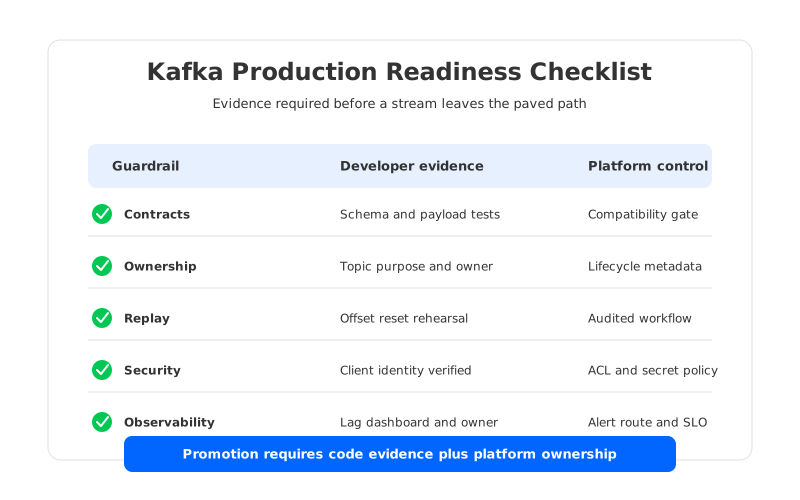
That path should include a few non-negotiable checks:
- Contract tests: validate schema compatibility, key strategy, required headers, and tombstone behavior where applicable.
- Replay tests: prove that a consumer can restart from an offset without duplicating irreversible side effects.
- Lag tests: show what happens when a downstream dependency slows or rejects records.
- Security tests: verify ACLs, client identities, secret rotation, and network policy before production.
- Operational tests: define dashboards, alert owners, runbooks, and retention windows before onboarding users.
These checks are not meant to make every developer a Kafka operator. They protect the platform contract so developers can rely on the system without discovering its rules during an incident.
4Where Broker Architecture Shapes Developer Experience
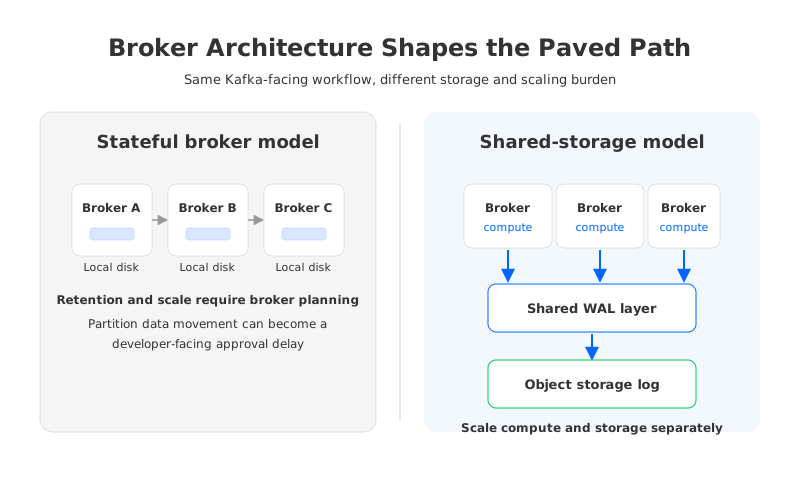
Kafka developer experience is often framed at the API layer, but broker architecture changes what the platform can safely offer. Traditional Kafka deployments are stateful: brokers own local or attached storage for partition data, replication protects durability, and partition movement is an operational event. This model is proven and widely understood, but it couples developer-facing requests to infrastructure work.
When a team asks for longer retention, the platform has to reason about broker disk. More partitions raise placement and balance questions. Throughput growth raises sizing, replication, and reassignment questions. Developers may never see those mechanics, but they experience the result as slower approvals, stricter quotas, or delayed scale-out.
Tiered storage can help with long retention by moving older log segments to remote storage, and Apache Kafka documents tiered storage as an operational capability. It does not automatically make brokers stateless. Hot data, partition ownership, failure recovery, and capacity planning still require careful design. For developer experience, that distinction matters because a self-service platform can only be as elastic as its slowest operational dependency.
A platform team should therefore separate two questions. First, what Kafka semantics must developers depend on: producers, consumers, offsets, delivery guarantees, transactions, security, and tooling compatibility? Second, what storage and scaling model should deliver those semantics? Broker-local storage, tiered storage, managed Kafka, and shared-storage Kafka-compatible systems answer that question differently.
This framing keeps the evaluation honest. A better developer experience is not achieved by making Kafka invisible. It is achieved by keeping Kafka semantics predictable while reducing the operational friction that sits behind common developer requests.
5Production Guardrails That Preserve Speed
Guardrails work when they feel like the shortest path, not an approval maze. A developer should be able to create a topic proposal with a template, run compatibility checks in CI, see consumer lag near service metrics, and request replay through a controlled workflow. The platform should receive ownership metadata, cost signals, alert routes, and deployment evidence without chasing teams in chat.
The first guardrail is topic lifecycle. Every production topic should have an owner, purpose, retention policy, partition strategy, schema policy, access model, and deprecation plan. The metadata can be concise, but it must exist before data starts accumulating.
The second guardrail is compatibility. Kafka allows independent producers and consumers, which is one of its strengths. That independence becomes dangerous when teams change record formats without checking downstream consumers. Schema compatibility tests, sample payload review, and consumer contract tests should be part of promotion, even without a formal schema registry.
The third guardrail is replay safety. Offset reset lets a consumer reprocess data, but some side effects are not idempotent. Staging should include replay exercises for critical consumers, especially those that write to databases, trigger external APIs, update search indexes, or feed AI feature stores. The runbook should say which consumers can replay freely, which require deduplication, and which need approval.
The fourth guardrail is quota and cost visibility. Partition count, retention, throughput, and fan-out map to storage, broker load, network traffic, and downstream capacity. The platform should expose those costs early enough that teams can choose a better design before usage hardens.
6Where AutoMQ Changes the Operating Model
Once the guardrails are clear, the architecture question becomes concrete. If the team needs Kafka-compatible APIs, existing client and ecosystem behavior, and a self-service developer path, but broker-local storage keeps slowing operations, shared-storage Kafka-compatible systems are worth evaluating. AutoMQ fits in that category: it is designed to keep Kafka compatibility while using a cloud-native shared-storage architecture with stateless brokers and object storage as the durable data layer.
That shift does not remove the need for guardrails. Topic ownership, schemas, quotas, replay controls, ACLs, and runbooks still matter. What changes is the operational boundary behind them. When durable data is not primarily tied to a specific broker's local disk, the platform can treat broker capacity more like compute and storage capacity more like shared cloud storage. For developer experience, that can reduce the hidden infrastructure negotiation behind retention, scaling, broker replacement, and workload isolation.
The right way to evaluate AutoMQ is not to ask whether it makes Kafka "simple." Kafka is a distributed log with real semantics. The better question is whether a Kafka-compatible shared-storage model helps your platform team offer a faster paved path without weakening controls. Test the client behaviors that matter: acknowledgments, consumer groups, offsets, transactions if used, security, observability, recovery, and rollback.
AutoMQ is most relevant when the developer experience problem is structural. If the main pain is missing documentation or weak CI tests, fix the path first. If the pain is that each workload creates broker storage planning, slow scaling, partition movement anxiety, or retention pressure, then the storage architecture is part of the developer experience whether developers see it or not.
7Decision Table for Platform Teams
The practical choice is not "tooling or architecture." Mature platforms need both. Tooling gives fast feedback. Guardrails protect the shared environment. Architecture determines how much friction the platform has to impose when workloads grow.
| Situation | Better first move | Why |
|---|---|---|
| Teams cannot test producers locally | Standardize local Kafka and contract tests | The fastest feedback loop is missing |
| Staging catches few production issues | Add integration, lag, replay, and security checks | The environment boundary is too soft |
| Topics lack owners or retention discipline | Build topic lifecycle metadata and review gates | Governance debt will follow any platform |
| Broker disk limits delay developer requests | Evaluate tiered storage or shared-storage Kafka-compatible systems | Storage coupling is shaping the experience |
| Migration risk blocks platform evolution | Use dual-run testing and offset validation | Kafka compatibility helps only when cutover evidence is clear |
Back to the original search intent: Kafka developer experience is not a dashboard feature or a local container recipe. It is the full path from the first producer test to the moment a production consumer falls behind and the team knows what to do. Strong platforms make that path boring in the right way. Developers get quick feedback and clear contracts. Operators get ownership, quotas, observability, and rollback controls. Architects get a storage and scaling model that does not turn every request into a capacity project.
If your current pain sits mostly in workflow, fix the paved path. If it sits in broker-local storage, retention pressure, or slow scaling behind the path, evaluate whether a Kafka-compatible shared-storage architecture such as AutoMQ changes the operating model enough to matter. Either way, measure developer experience by production's standard: can a team change, replay, scale, and recover without surprising everyone else?
8References
- Apache Kafka Documentation
- Apache Kafka Consumer Configuration
- Apache Kafka Message Delivery Semantics
- Apache Kafka KRaft Documentation
- Apache Kafka Tiered Storage Documentation
- AutoMQ Docs: Architecture Overview
- AutoMQ Docs: S3Stream Shared Streaming Storage
- AutoMQ Docs: Stateless Broker
9FAQ
9.1What does Kafka developer experience include?
Kafka developer experience includes local testing, integration environments, topic creation, schema validation, ACL setup, observability, replay workflows, quota visibility, and production promotion guardrails. It is broader than a local broker because Kafka applications depend on shared log semantics and operational policy.
9.2Is local Kafka testing enough before production?
No. Local testing is valuable for client behavior, serialization, and basic producer-consumer flows, but it does not model shared-cluster constraints such as quotas, retention, access control, consumer lag, maintenance, or replay governance. Treat local testing as the first gate, not the final proof.
9.3Which Kafka guardrails should platform teams implement first?
Start with topic ownership, retention policy, schema compatibility, ACLs, quotas, consumer lag alerts, and replay runbooks. These guardrails cover the most common failure modes: orphaned topics, unsafe format changes, uncontrolled access, hidden cost growth, and recovery procedures that nobody has tested.
9.4Does tiered storage solve Kafka developer experience problems?
Tiered storage can reduce pressure from long retention by moving older segments to remote storage. It can improve the platform's cost and retention story, but it does not by itself define topic ownership, schema policy, replay safety, or developer workflows. Those still need guardrails.
9.5Where does AutoMQ fit in a Kafka developer platform?
AutoMQ fits when a team wants Kafka-compatible APIs and ecosystem behavior while evaluating a cloud-native shared-storage operating model. It is most relevant when broker-local storage, scaling friction, or retention pressure limits the self-service path that developers need.


