
Table of Contents
Table of Contents
A kafka developer sandbox request usually arrives after the team has outgrown local testing but before anyone wants another permanent Kafka cluster. Developers need a place to replay events, break consumer groups, test connector changes, and validate transactional behavior. Platform teams need those experiments to stay inside a governed boundary. Finance teams notice that the boundary often looks suspiciously like production: multi-AZ brokers, replicated storage, private networking, observability, connectors, and a long tail of idle capacity.
That tension is the real problem. A sandbox that is too thin teaches the wrong lesson because it hides the broker-side behavior that will decide the release. A sandbox that is too faithful can cost enough that teams ration access to it, which turns the environment into another shared bottleneck. The useful target is not "small Kafka." It is production-relevant Kafka semantics with a cost model that tolerates frequent creation, reset, and deletion.
1Why teams search for kafka developer sandbox
Most teams do not search for a sandbox because they forgot how to run a container. They search because a real application change now depends on Kafka behavior that is hard to fake. Consumer group coordination, committed offsets, idempotent producers, transactions, retention, compaction, ACLs, and Kafka Connect task state all live beyond the application process. Once a release depends on those details, a mock broker or a local single-node setup stops answering the important questions.
The request often sounds operationally simple: give this team an isolated Kafka environment for a few days. Underneath that request are several different jobs. One team may need a clean namespace for feature branch integration. Another may need to replay a bounded data set without disturbing a shared consumer group. A migration team may need to rehearse a cutover and prove that offsets, schemas, and rollback procedures behave as expected. These are not the same sandbox, but they are often funded and operated as if they were.
The hidden danger is that a development sandbox becomes a low-trust production clone. It has enough realism to consume serious infrastructure budget but not enough discipline to prove operational readiness. Topics persist after owners move on. Connectors keep retrying against test systems nobody watches. Retention defaults drift. ACLs become informal because the environment is "not production," even though it may contain representative data and real credentials. The bill is only one symptom; the deeper problem is an operating model without a lifecycle.
2The production constraint behind the problem
Traditional Kafka is a Shared Nothing system. Brokers own local log segments, partitions are placed on brokers, and durability comes from replication across brokers. This design is robust and well understood, especially for long-lived clusters with stable capacity planning. It becomes expensive to treat as disposable because storage, data placement, and broker lifecycle remain coupled.
For a production cluster, that coupling is part of the operating discipline. Operators size broker disks, choose replication factors, monitor partition balance, and plan maintenance around data movement. For developer sandboxes, the same mechanics create a mismatch. A team wants a short-lived environment; the infrastructure behaves like a stateful system that expects careful ownership. If every sandbox needs warm broker capacity, attached disks, replicated data, and cleanup work, the platform team has only two choices: make sandboxes scarce or make them unrealistic.
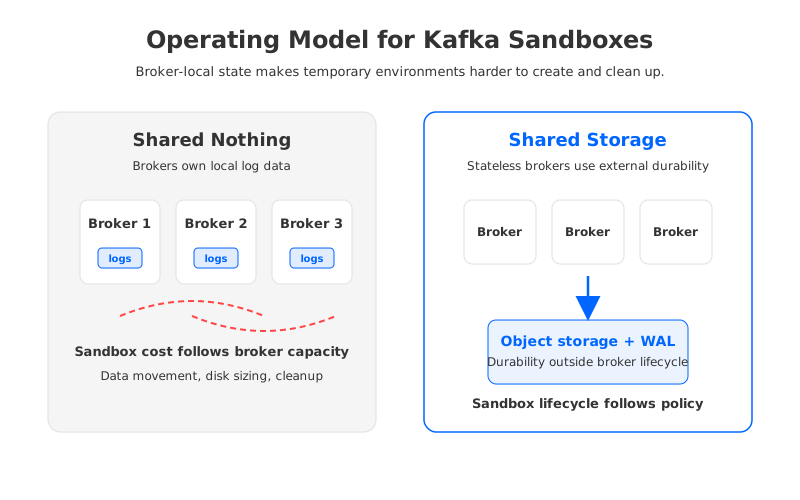
Tiered Storage changes part of this equation by moving completed log segments to a remote tier, which is useful for retention-heavy workloads and historical reads. It does not remove the need to reason about local broker state, placement, metadata, and operational recovery. That distinction matters for sandbox design because the costly part is not only where old bytes sit. The costly part is how much state must be preserved, moved, and cleaned up every time a temporary environment appears or disappears.
Kafka Connect adds another layer of realism. A connector sandbox is not only a broker namespace; it includes worker configuration, task restarts, offsets, credentials, network reachability, and failure visibility. A weak sandbox may pass a happy-path produce-consume test while missing the behavior that breaks the release: a sink connector replaying more records than expected, a source connector losing its offset boundary, or a consumer deployment that triggers a rebalance under load. The cost of a sandbox therefore extends beyond compute and storage. It is the cost of representing the production failure modes that matter.
3Architecture options and trade-offs
A practical sandbox strategy starts by separating test intent from infrastructure shape. A local Kafka container is excellent for serialization checks and simple client loops. A shared development cluster works for early integration when teams can tolerate noise. A persistent staging cluster is appropriate when the environment is part of the release gate. The mistake is using one pattern for every job, then wondering why the result is either expensive or untrusted.
| Sandbox pattern | Best fit | Cost pressure | Operational risk |
|---|---|---|---|
| Local container | Unit tests, client API checks, serializer validation | Low infrastructure cost | Weak coverage of broker-side behavior |
| Shared development cluster | Early service integration and team demos | Efficient until usage becomes noisy | Stale topics, unclear ownership, hard resets |
| Persistent staging cluster | Release qualification and cross-team validation | Production-like baseline cost | Capacity planning and manual environment hygiene |
| Ephemeral production-relevant sandbox | Feature branch tests, migration rehearsals, rollback drills | Cost depends on lifecycle automation and storage model | Requires templates, guardrails, and deletion discipline |
The table points to a useful rule: do not pay production-like cost for tests that do not need production-like semantics, but do not strip semantics from tests that do. If the test only checks that a producer can serialize a message, local infrastructure is enough. If the test checks consumer group recovery, connector offset behavior, transactional writes, or migration rollback, the sandbox must preserve those semantics. Cost optimization starts with this classification, not with a smaller instance type.
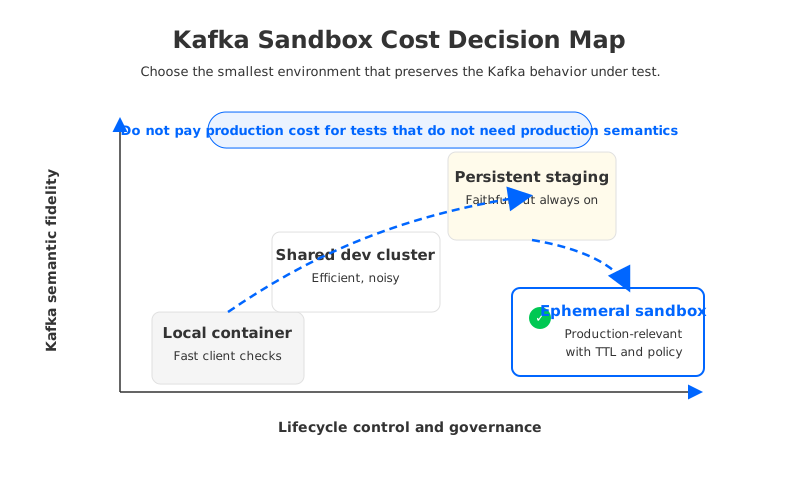
Once the team agrees on intent, the next question is lifecycle. A sandbox should have an owner, a purpose, a time-to-live, a data policy, and a teardown path before the first topic is created. The platform team should know whether the environment is allowed to use production-like schemas, whether sample data is synthetic or masked, how offsets are initialized, which connectors are enabled, and which metrics prove the test succeeded. These details are often treated as documentation, but they belong in the provisioning workflow.
The lifecycle also needs a budget boundary. Long retention, multi-AZ replication, private endpoints, connector workers, and observability pipelines are all defensible when they answer a specific test question. They are wasteful when they remain active after the test. A good sandbox platform makes the default behavior boring: create from a template, run the experiment, export the evidence, and delete the environment without a meeting.
4Evaluation checklist for platform teams
A kafka developer sandbox should be evaluated like an internal platform product. The users are application teams, but the buyers include platform engineering, security, and FinOps. Each group cares about a different failure mode. Developers care whether the environment behaves like Kafka. SREs care whether it can fail without dragging production into the incident. Security cares whether temporary infrastructure still follows policy. FinOps cares whether the lifecycle is visible enough to stop idle spend.
The checklist below keeps those concerns in the same conversation:
- Kafka compatibility: The same clients, protocol assumptions, serializers, consumer groups, transactions, and connector patterns should run without application code changes. A sandbox that requires a special client path is testing a different system.
- Isolation: Teams need isolated topics, credentials, consumer groups, and connector state. Isolation should be designed into the namespace and access model rather than negotiated manually.
- Lifecycle automation: Provisioning, seeding, pausing, expiring, and deletion should be API-driven or template-driven. Manual cleanup is where sandboxes become permanent infrastructure by accident.
- Cost controls: Retention, storage class, connector capacity, broker size, network boundaries, and idle shutdown should be defined at creation time. The budget boundary should be visible before traffic starts.
- Governance: IAM, ACLs, audit logging, network reachability, encryption, and naming conventions should be standardized for the environment class. Temporary should not mean informal.
- Observability: Broker health, request errors, consumer lag, connector status, and storage signals should be available from the first minute. A failed test that cannot explain itself will be repeated in production.
- Rollback evidence: For migration and release rehearsals, the sandbox should produce evidence that offsets, replay boundaries, schema compatibility, and rollback steps were exercised.
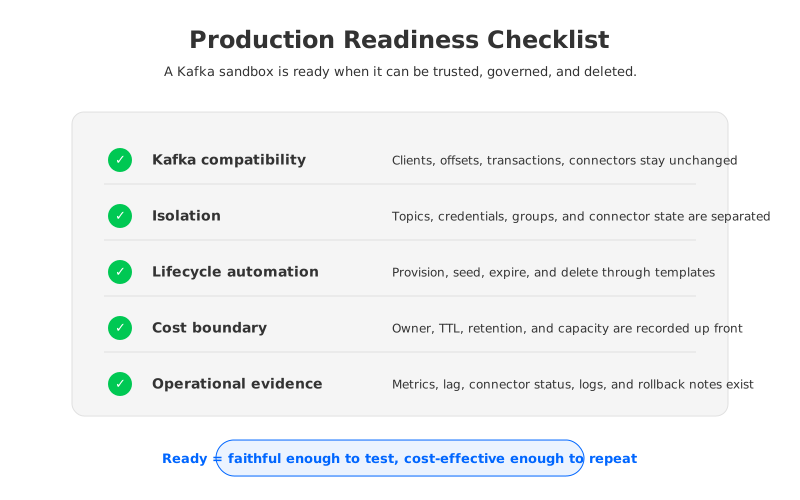
This checklist also prevents overbuilding. A team validating a parser does not need a governed migration rehearsal environment. A team preparing a regulated workload migration does. The platform's job is to make those choices explicit and repeatable so that developers get autonomy without turning every experiment into a bespoke cluster request.
5How AutoMQ changes the operating model
The evaluation framework naturally points to one architectural pressure: sandboxes become easier when brokers are not the long-term home of data. AutoMQ, a Kafka-compatible cloud-native streaming system, approaches that pressure with a Shared Storage architecture. It keeps Kafka protocol compatibility while using stateless brokers, object-storage-backed durability through S3Stream, and WAL storage for durable write acknowledgment and recovery.
That separation changes the economics of temporary environments. In a broker-local design, adding or removing capacity is tied to local data ownership and partition movement. In a shared-storage design, brokers are primarily compute. Durable stream data lives outside the broker lifecycle, so creating, replacing, and deleting broker capacity does not revolve around preserving local disks. For a developer sandbox, that means the platform team can focus more on templates, policies, and test evidence, and less on treating every temporary environment as a miniature permanent cluster.
AutoMQ is not a substitute for good platform design. You still need topic templates, TTLs, credentials, connector configuration, observability, and data policies. Its value is that the storage architecture reduces the penalty for making the sandbox production-relevant. Independent compute and storage scaling helps align capacity with short test windows. Stateless brokers reduce the operational drag of broker replacement and scaling. Zero cross-AZ traffic support can matter when teams want multi-AZ resilience patterns without letting network transfer become an invisible sandbox tax. BYOC and software deployment boundaries also matter for organizations that want development environments inside their own cloud or private infrastructure controls.
This is the right place for a product to enter the discussion, after the requirements are clear. The decision is not "Which vendor offers a developer tier?" The better decision is "Which architecture lets us expose production-relevant Kafka semantics without turning every sandbox into a permanent operations object?" For teams building self-service data platforms, that distinction decides whether sandboxes scale with developer demand or become another queue owned by the Kafka specialists.
6A cost-aware sandbox scorecard
Before approving a broad rollout, score the design on five questions. A "no" answer does not kill the idea, but it narrows where the sandbox should be used.
| Question | Pass condition |
|---|---|
| Can a team create and delete the environment without a ticket? | Provisioning and teardown are driven by a template, API, or Terraform workflow with guardrails. |
| Can the test preserve production-relevant Kafka semantics? | Clients, offsets, transactions, connector behavior, ACLs, and observability match the intended production question. |
| Can finance see why the environment exists? | Owner, purpose, TTL, retention, and expected capacity are recorded when the environment is created. |
| Can security review the environment class once? | Network, IAM, encryption, audit, and data-handling rules are standardized across sandboxes. |
| Can a failed run produce useful evidence? | Metrics, logs, consumer lag, connector status, and rollback notes are available without custom investigation. |
The highest-value sandbox is the one that makes experimentation ordinary without making infrastructure permanent. Developers should be able to test risky Kafka behavior before release. Platform teams should be able to delete the environment without archaeology. Security and finance should see the same controls every time. When those conditions hold, the sandbox stops being a special favor and becomes part of the engineering system.
If your current Kafka development environment feels too expensive to multiply but too weak to trust, start by classifying which tests truly need production-relevant semantics. Then evaluate whether your storage and broker model supports short-lived environments or quietly resists them. To explore the stateless broker model in practice, review AutoMQ on GitHub: https://go.automq.com/github?utm_source=blog&utm_medium=cta&utm_campaign=aivk-0096.
7References
- Apache Kafka Documentation
- Apache Kafka: Kafka Connect
- Apache Kafka: Message Delivery Semantics
- Apache Kafka KIP-405: Kafka Tiered Storage
- AutoMQ Documentation: What is AutoMQ?
- AutoMQ Documentation: S3Stream Shared Streaming Storage
- AutoMQ Documentation: WAL Storage
- AutoMQ Documentation: Eliminate Inter-Zone Traffic
8FAQ
8.1What is a Kafka developer sandbox?
A Kafka developer sandbox is an isolated Kafka-compatible environment used to test application behavior before production. The useful version is not only a broker endpoint; it includes topics, users, ACLs, consumer groups, connector state, observability, lifecycle rules, and teardown automation.
8.2Is a sandbox the same as a local Kafka container?
No. A local container is useful for fast client checks, but it rarely exercises production-relevant broker behavior such as consumer group coordination, transactions, security controls, connector offsets, and multi-service integration.
8.3How can teams reduce sandbox cost without weakening the test?
Start by matching the environment to the test intent. Use local or shared environments for simple checks, and reserve production-relevant ephemeral sandboxes for tests that depend on broker semantics, migration rehearsal, rollback, or connector behavior. Then enforce TTL, retention, owner metadata, and deletion through automation.
8.4Does Tiered Storage make Kafka sandboxes disposable?
Tiered Storage can reduce pressure from long retention by moving completed log segments to remote storage. It does not by itself make brokers stateless or remove the need to manage local broker state, metadata, lifecycle, and cleanup.
8.5Where does AutoMQ fit?
AutoMQ fits when teams want Kafka-compatible behavior with a cloud-native operating model. Its Shared Storage architecture and stateless brokers reduce the broker-local storage coupling that makes short-lived, production-relevant sandboxes hard to operate at scale.


