
Table of Contents
Table of Contents
A search for kafka disaster recovery planning usually starts after the team has outgrown a simple backup conversation. The platform is already carrying payment events, operational telemetry, user activity, AI feature streams, or CDC pipelines. The question is no longer whether Apache Kafka can be made highly available. The question is whether the organization can prove what happens when a region, broker fleet, storage layer, network path, or migration step fails while applications continue to depend on offsets and ordering.
Kafka disaster recovery is hard because the system is both a data platform and an application contract. Producers care about acknowledgements and retries. Consumers care about committed offsets, replay boundaries, and duplicate handling. Platform engineers care about broker recovery, replication lag, controller health, disk pressure, and cross-Availability Zone (AZ) traffic. Security and governance teams care about where data and credentials live during an incident. A DR plan that ignores any one of those contracts becomes a diagram rather than a recovery process.
1Why Teams Search for Kafka Disaster Recovery Planning
The practical pressure usually appears in three places. First, the business wants a clearer recovery point objective and recovery time objective for streaming data. Batch backups are familiar, but Kafka records often drive live workflows where delayed replay can become customer-visible. Second, cloud operations expose costs and failure domains that were hidden in earlier data-center designs. Replication, cross-zone paths, private connectivity, retained storage, and observability all become billable and operationally visible. Third, migration and upgrade programs force teams to define rollback. If a target cluster cannot preserve the application contract, the DR plan is still unfinished.
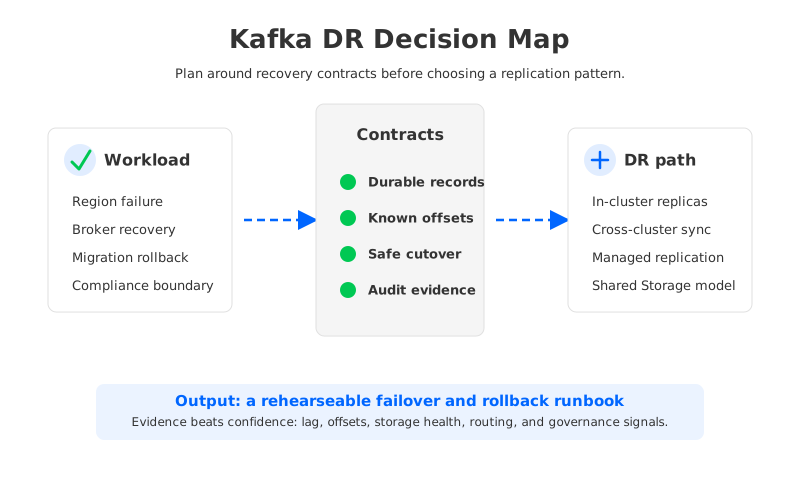
The key mistake is treating Kafka DR as a single mechanism. Replication helps, but it does not answer every question. A useful plan separates the recovery surface into specific contracts:
- Record durability. Which acknowledged records must survive, and where is the durable copy after a broker, zone, or region fault?
- Offset continuity. Can consumer groups resume from a known position without unbounded duplicate processing or skipped records?
- Producer cutover. Can producers move to a target endpoint without creating split-brain writes or ordering surprises?
- Operational visibility. Can the team see lag, broker state, storage health, replication status, and client errors before declaring failover complete?
- Governance boundary. Can security teams explain which account, VPC (Virtual Private Cloud), region, service account, and storage system held data during the event?
These are not abstract enterprise architecture questions. They decide whether the person on call can choose between "keep serving from the primary," "promote the target," "pause consumers," "replay," or "roll back" without guessing.
2The Production Risk Behind the Workload
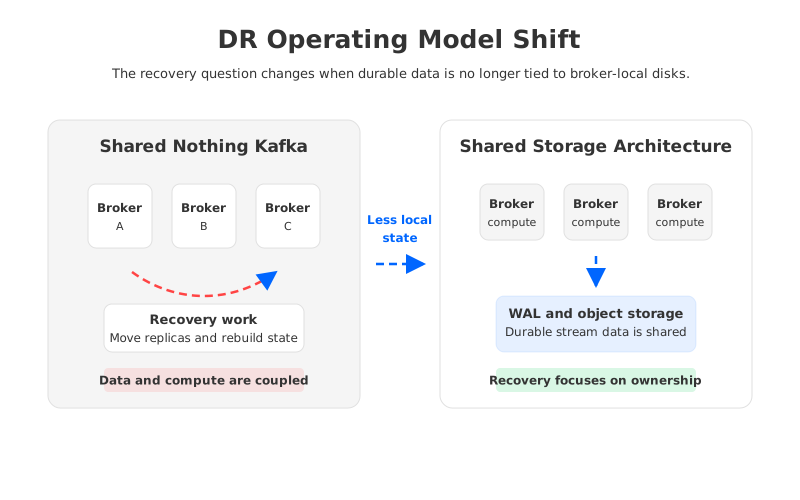
Traditional Kafka uses a Shared Nothing architecture. Each broker manages local or attached storage for the partitions assigned to it, and Kafka uses replication between brokers for availability. That design is mature and operationally familiar. It also means that the broker lifecycle and the storage lifecycle are tightly coupled. A failed broker is not merely a lost compute node; it is also a local replica, recovery, reassignment, and throttling event.
That coupling becomes visible during DR planning. If the primary cluster is degraded, a team may need to rebuild replicas while serving live traffic. If the recovery cluster is behind, the team must understand replication lag and offset translation before promoting it. If a long-retention topic is part of the incident, recovery work can compete with historical replay and catch-up reads. None of these behaviors make Kafka unsuitable for DR, but they do force the plan to model more than "replication factor equals three."
Tiered Storage changes part of this equation by moving older closed log segments to remote storage. It can help with retention-heavy topics and local disk pressure. It does not make the active broker path stateless, and it does not remove the need to validate controller metadata, local active segments, cache behavior, remote log reads, and operational tooling. For DR planning, the distinction matters: remote retention is not the same as a recovery model where durable stream data is designed around shared storage from the write path onward.
Cloud-native platforms add another dimension: infrastructure is expected to be replaceable. Compute groups scale, nodes drain, pods reschedule, zones isolate, and infrastructure-as-code systems recreate resources. Kafka's traditional storage model can still run in that world, but the DR plan must state which operations require data movement and which require metadata or traffic changes. If the plan cannot name that boundary, it will be difficult to rehearse.
3Replication, Rollback, and Observability Trade-Offs
A strong Kafka DR architecture compares operating models rather than labels. The table below is a useful starting point for platform reviews.
| DR pattern | Where it fits | Trade-off to test |
|---|---|---|
| In-cluster replication across brokers and AZs | Local fault tolerance and routine broker failures | Recovery traffic, replica placement, disk pressure, and cross-zone network paths |
| Cross-cluster replication with Kafka ecosystem tools | Region-level recovery, migration rehearsal, or analytics copies | Replication lag, offset mapping, topic configuration parity, connector operations, and promotion steps |
| Managed cloud replication service | Teams standardizing on a single cloud provider's managed Kafka surface | Provider-specific limits, source/target support, network boundary, and rollback behavior |
| Kafka-compatible Shared Storage architecture | Teams that want Kafka APIs while reducing broker-local durable data ownership | WAL choice, object storage behavior, metadata correctness, observability, and migration validation |
The table does not rank the options. In-cluster replication is still the baseline for many workloads. Cross-cluster replication is often the right control point for regional DR. Managed services may reduce operational toil for teams that accept the provider boundary. Shared Storage architecture becomes relevant when the painful part of recovery is not the Kafka protocol but the amount of durable data attached to each broker.
MirrorMaker2 and Kafka Connect also need careful treatment in DR plans. They can replicate data between clusters and are part of the standard Kafka ecosystem, but the team still owns worker capacity, connector configuration, lag monitoring, offset behavior, credentials, and failover procedure. A DR plan should treat replication tooling as a subsystem with its own runbook, not as a background process that will be correct when the incident arrives.
Observability is what turns that runbook into an operational decision. Broker metrics are not enough. The team needs visibility into producer errors, consumer lag, committed offsets, replication progress, controller state, storage-layer errors, network reachability, authentication failures, and the target cluster's readiness. The exact dashboard depends on the platform, but the recovery declaration should be evidence-based: "the target is ready because these signals passed," not "the target is probably ready because the process has been running."
4A Checklist for Migration and DR Teams
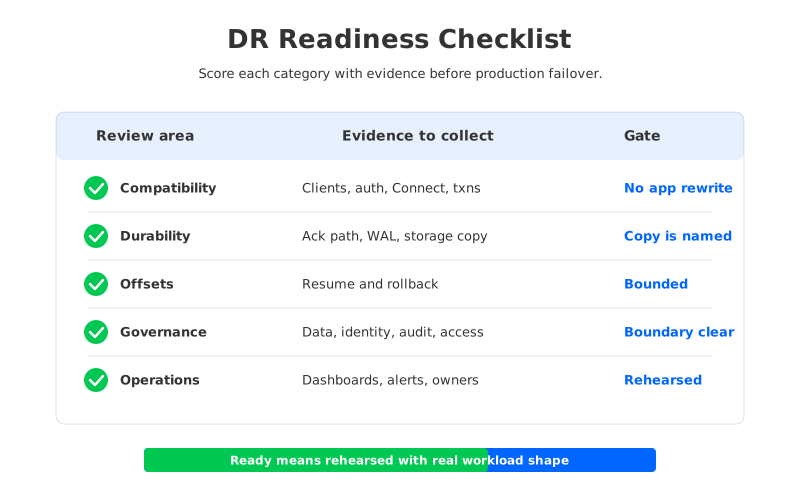
Disaster recovery planning becomes much easier when the team scores evidence rather than confidence. Start with one representative topic family and write down the answers before widening the plan.
| Review area | Question to answer | Blocking signal |
|---|---|---|
| Compatibility | Do current clients, serializers, ACLs, transactions, Kafka Connect jobs, and admin tools work against the recovery path? | A core application requires code changes during failover |
| Durability | Where do acknowledged records become durable, and what storage layer protects them after broker failure? | The plan cannot identify the durable copy for an in-flight write |
| Offset continuity | Can consumers pause, resume, replay, and roll back from known offsets? | Cutover creates duplicate or skipped processing the team cannot bound |
| Cost and capacity | Are compute, storage, replication traffic, private connectivity, object storage requests, and observability modeled separately? | The recovery cluster is sized by guesswork or hidden shared capacity |
| Governance | Are data location, encryption, identity, audit, and operator access documented? | Security review cannot explain the recovery data path |
| Operations | Are dashboards, alerts, ownership, escalation, and rollback rehearsed under load? | The runbook depends on one engineer's memory |
This checklist is deliberately stricter than a proof of concept. A proof of concept often proves that data can move. A DR readiness review proves that the organization can make a recovery decision with bounded application impact. Those are different bars.
5How AutoMQ Changes the Operating Model
After the neutral review, AutoMQ fits a specific category: a Kafka-compatible cloud-native streaming platform built around Shared Storage architecture. AutoMQ keeps the Kafka protocol and ecosystem surface while replacing broker-local persistent log storage with S3Stream, WAL (Write-Ahead Log) storage, data caching, and S3-compatible object storage. AutoMQ Brokers act as stateless brokers for durable data ownership; they handle protocol processing, leadership, request routing, caching, and scheduling while the persistent stream data lives in shared storage.
That architectural shift changes the DR conversation. In a broker-local model, recovery often asks, "How do we rebuild or move enough local replica data to restore the desired placement?" In a Shared Storage architecture, the sharper question is, "How do we restore serving capacity, metadata ownership, WAL recovery, cache warmth, and storage access for data already reachable through the shared storage layer?" The second question is not trivial, but it removes a major source of coupling between retained data volume and broker replacement.
WAL choice remains part of the design. AutoMQ Open Source uses S3 WAL, which offers the simplest object-storage-backed deployment path and fits workloads that can accept its latency profile. AutoMQ commercial editions, including AutoMQ BYOC and AutoMQ Software, support additional WAL storage options such as Regional EBS WAL and NFS WAL for workloads with lower-latency requirements or specific failure-domain constraints. A DR plan should name the WAL type because it changes write-path behavior, infrastructure dependencies, and recovery evidence.
Deployment boundary matters as well. In AutoMQ BYOC, the control plane and data plane run inside the customer's cloud account and VPC. Customer business data remains in the customer's environment. AutoMQ Software addresses private data center or IDC environments where the customer operates the platform. For regulated workloads, the DR plan should treat that boundary as part of the architecture: data path, control actions, credentials, logs, and metrics should be explainable during failover.
Migration tooling is where DR planning and platform modernization meet. AutoMQ commercial editions provide AutoMQ Linking for Kafka migration scenarios, while open-source migrations can use standard Kafka ecosystem tools such as MirrorMaker2. The important evaluation is not the feature name; it is whether the migration path can preserve the contracts that matter for the workload: topic data, offsets, client cutover, rollback, and operational visibility.
6A Practical DR Scorecard
The final scorecard should be small enough to use in an incident review. Rate each category as Ready, Needs Work, or Blocked, and attach evidence for the rating.
| Category | Ready means |
|---|---|
| Application contract | Producers, consumers, stream processors, and connectors have been tested against the failover path |
| Recovery boundary | The team can name which component owns durability, metadata, routing, and rollback at each step |
| Promotion procedure | The target can be promoted with clear gates for lag, offsets, writes, and security controls |
| Observability | Dashboards show client, broker, replication, storage, and governance signals in one operating view |
| Cost model | Standby, active-active, replication, object storage, private connectivity, and incident capacity are visible line items |
| Rehearsal | The plan has been run with production-shaped traffic, not only a synthetic topic |
Return to the original search: kafka disaster recovery planning. The durable answer is not a single replication tool or a bigger cluster. It is a recovery model that respects Kafka's application semantics while making infrastructure failure, migration, cost, and governance explicit enough to rehearse.
If your team is reviewing Kafka DR because broker-local storage, replication lag, or rollback uncertainty keeps expanding the runbook, use the scorecard above against one production-shaped workload. To evaluate how AutoMQ BYOC or AutoMQ Software would map to that recovery model, start with a Kafka-compatible architecture review.
7References
- Apache Kafka documentation
- Apache Kafka geo-replication documentation
- Apache Kafka MirrorMaker2 documentation
- Apache Kafka KIP-405: Kafka Tiered Storage
- AWS S3 data durability documentation
- AutoMQ Shared Storage architecture
- AutoMQ compatibility with Apache Kafka
- AutoMQ WAL storage
- AutoMQ Continuous Self-Balancing
- AutoMQ Linking migration overview
8FAQ
8.1What should a Kafka disaster recovery plan include?
A Kafka disaster recovery plan should include durability boundaries, recovery point and recovery time targets, replication or linking design, producer and consumer cutover steps, offset validation, observability signals, security review, cost model, and rollback procedure. The plan should be rehearsed with production-shaped traffic.
8.2Is Kafka replication enough for disaster recovery?
Replication is necessary for many Kafka recovery designs, but it is not sufficient by itself. Teams still need to validate lag, offsets, topic configuration parity, producer cutover, target readiness, security boundaries, and rollback. A replicated cluster that cannot be promoted safely is not a complete DR plan.
8.3How does Tiered Storage affect Kafka DR?
Tiered Storage can reduce pressure from older retained data on broker-local disks. It does not automatically make brokers stateless or remove the active local log from the recovery path. DR teams should test whether Tiered Storage changes the specific failure mode they are trying to reduce.
8.4When should AutoMQ be evaluated for Kafka DR?
Evaluate AutoMQ when the team wants Kafka compatibility but needs a different operating model for broker replacement, long retention, elastic capacity, customer-controlled deployment boundaries, or reduced broker-local data coupling. The evaluation should include WAL choice, object storage behavior, migration tooling, observability, and rollback.
8.5What is the first test for a Kafka DR proof of concept?
Start with one topic family that has real producers, consumers, retention, and business impact. Replicate or migrate it to the target path, pause and resume consumers, validate offsets, test broker failure, measure lag and latency, and rehearse rollback. That test reveals more than a synthetic throughput run.


