
Table of Contents
Table of Contents
Every serious Kafka architecture review eventually reaches the same uncomfortable question: what happens when a broker, an availability zone, or an entire region fails? The answer cannot be reduced to replication factor alone. Kafka replication protects committed records under specific conditions, but disaster recovery also depends on client routing, quorum health, metadata availability, offset recovery, network isolation, operational runbooks, and the business tolerance for lost time or lost data.
That is why Kafka disaster recovery should begin with RPO and RTO, not with a tool selection. Recovery Point Objective defines how much acknowledged data the business can afford to lose. Recovery Time Objective defines how long the system can remain unavailable or degraded before the failure becomes unacceptable. A trading platform, fraud detection pipeline, IoT command stream, and nightly analytics export may all use Kafka, but they do not have the same recovery target.
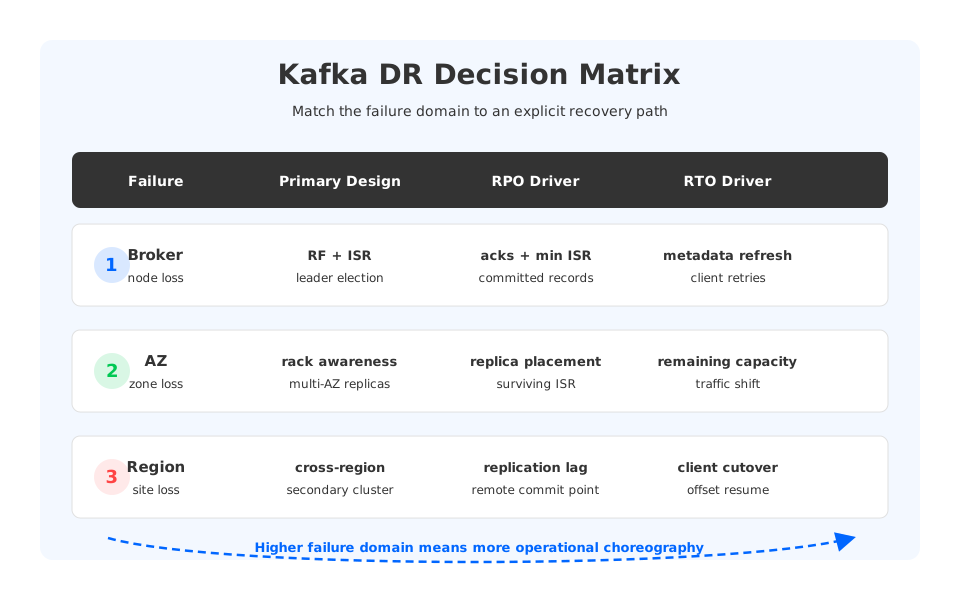
The hard part is that different failure domains require different designs. A broker failure can often be handled inside one cluster. An availability zone failure requires placement discipline and enough in-sync replicas outside the failed zone. A regional failure usually requires cross-region replication, pre-provisioned capacity, DNS or client routing changes, and a plan for offsets and failback. Treating all three as one "Kafka HA" problem leads to overbuilt small systems and underprepared critical systems.
1Start with Failure Scenarios, Not Tools
A useful Kafka DR plan starts by naming the failure event. "Kafka is down" is not specific enough for design. A single broker crash, a full disk, a bad deployment, a zone network partition, a cloud control plane disruption, and a region-wide outage each stress a different part of the system. The failure scenario determines whether the right response is leader election, broker replacement, partition reassignment, application failover, topic promotion, or a regional cutover.
Use these terms consistently before choosing an architecture:
- RPO: the maximum acceptable data loss measured from the last safely recoverable point.
- RTO: the maximum acceptable time to restore service to a usable state.
- Failover: moving clients or leaders from a failed path to a healthy path.
- Failback: returning traffic to the original site after recovery, often with reconciliation.
- Active-passive: one site serves production traffic while another receives replicated data and waits.
- Active-active: more than one site accepts production traffic, usually with topic ownership, conflict rules, or application-level partitioning.
- Multi-AZ: a cluster spans multiple availability zones inside one region.
- Multi-region: data and service capacity exist in more than one region.
These definitions prevent a common planning mistake: assuming that "replicated" means "recoverable under every disaster." Replication is necessary, but DR is the larger operating system around replication. It includes how producers discover a healthy endpoint, how consumers resume with correct offsets, whether the secondary site has enough capacity, and how operators avoid creating duplicate writes during a partial failure.
2Kafka Replication and What It Protects
Traditional Kafka durability is built around partitions, leaders, followers, the in-sync replica set, and acknowledgments. Producers write to the partition leader. Followers fetch from the leader. A record is considered safely replicated when the configured acknowledgment behavior and the in-sync replica requirements are satisfied. Settings such as replication factor and min.insync.replicas define how much replica loss the cluster can tolerate before it stops accepting writes that require stronger durability.
For broker failures, this model is powerful. If a partition has in-sync replicas on other brokers, Kafka can elect a new leader and clients can continue after metadata refresh and retry behavior. The exact user-visible impact depends on controller responsiveness, client configuration, partition count, leader distribution, and whether enough replicas remain in sync. A cleanly designed cluster can turn a broker crash into a short interruption rather than a data-loss event.
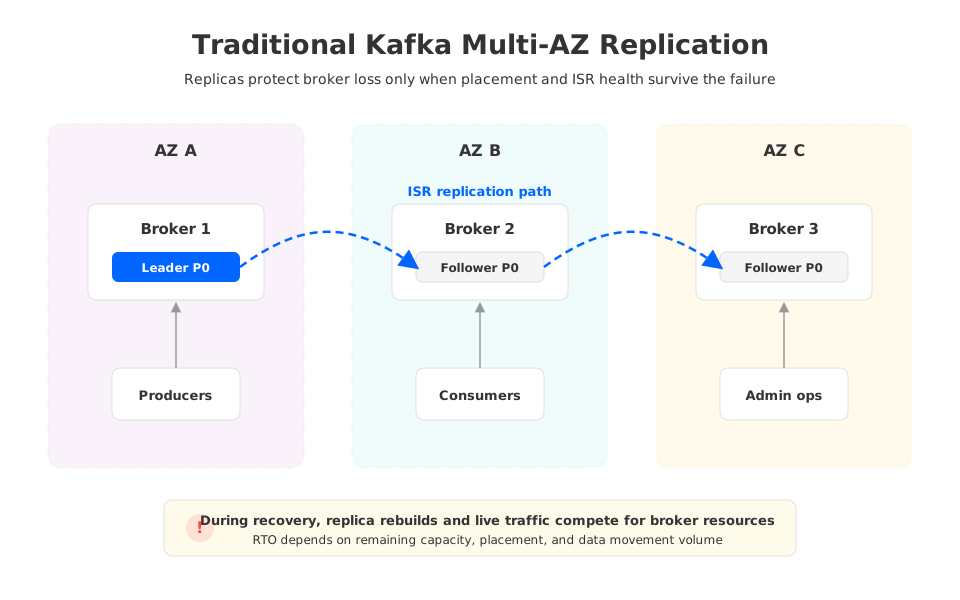
The same mechanism becomes more complicated during zone failure. If leaders and followers are not distributed across zones, an AZ outage may remove too many replicas for some partitions. If replication factor is three but all replicas for a hot topic accidentally land in two zones, the design may not tolerate the failure you believed it covered. Rack awareness and placement rules are therefore not cosmetic settings. They are part of the DR contract.
Replication also has operational cost. Followers consume network and disk bandwidth. Rebalancing, broker replacement, and partition reassignment can move large volumes of data through the cluster. During a recovery event, that background movement competes with producers, consumers, and catch-up reads. A plan that is theoretically durable can still miss its RTO if rebuilding local replicas takes too long or saturates the same resources needed for live traffic.
3Multi-AZ vs Multi-Region DR
Multi-AZ Kafka is usually the first resilience step for production workloads. It keeps one cluster inside one region while spreading brokers and replicas across independent availability zones. The goal is to survive broker and zone-level failures without changing the application topology. Producers and consumers still talk to one logical cluster, and offsets remain in the same cluster.
The main design questions are concrete:
- Are partition replicas placed across zones with rack awareness?
- Can the cluster maintain enough in-sync replicas after one zone disappears?
- Are clients configured with bootstrap brokers in multiple zones?
- Can the remaining brokers absorb leader, produce, fetch, and recovery load?
- Does cross-AZ traffic cost fit the workload's read and write pattern?
Multi-region Kafka solves a different problem. It prepares for a region becoming unavailable or unusable. Because Kafka clusters are normally regional systems, multi-region DR usually means running at least one additional cluster and replicating data between clusters with a replication tool or managed service. That secondary site may be passive, partially active, or fully active depending on business requirements.
The tradeoff is complexity. Cross-region replication adds latency, bandwidth cost, topic mapping, offset translation, security configuration, and failback planning. It also introduces a subtle RPO question: a record acknowledged in the primary region may not yet be present in the secondary region. If the primary disappears at that moment, the recovery point depends on replication lag and the application's write semantics.
For many organizations, the right design is tiered. Critical command, payment, or security streams may justify a multi-region strategy with rehearsed failover. Internal analytics streams may accept a longer RTO and replay from upstream sources. Platform teams should document those tiers rather than force one expensive DR model onto every topic.
4Active-Active and Active-Passive Tradeoffs
Active-passive is easier to reason about because one side owns writes. The passive region receives replicated topics and waits for promotion. During failover, producers and consumers move to the secondary cluster, operators verify lag and topic readiness, and the platform decides where consumers should resume. This design can be cost-effective for workloads that require regional recovery but do not need both regions to accept writes all the time.
The operational risk is readiness. A passive cluster that is under-provisioned, untested, or missing ACLs is a backup in name only. Active-passive DR needs regular failover drills, capacity checks, and runbooks for clients, schemas, connectors, offsets, and downstream dependencies. The failback path also deserves attention because returning to the primary region can be more complex than leaving it.
Active-active can reduce regional dependency because more than one region serves traffic. It is attractive for global applications, low-latency regional writes, and systems that cannot wait for manual promotion. But active-active Kafka is not magic. If two regions can write to the same logical stream, the application needs rules for ordering, idempotency, conflict handling, and ownership. Many successful active-active designs avoid conflict by partitioning writes by tenant, geography, or topic ownership rather than allowing unrestricted multi-writer behavior.
The decision is less about which pattern sounds more advanced and more about what the business actually needs. If the system requires local writes in multiple regions and can define ownership clearly, active-active may be justified. If the primary goal is survivability after a regional outage, active-passive is often simpler to operate and easier to audit.
5DR Decision Matrix by RPO and RTO
RPO and RTO targets should map to explicit architecture choices. Avoid universal promises such as "zero data loss" unless the exact write path, acknowledgment behavior, replication topology, and failure scenario are defined. Kafka can provide strong durability inside a cluster, but regional DR always depends on what has crossed the regional boundary before the incident.
| Failure scenario | Common design | Typical RPO driver | Typical RTO driver | Main risk to test |
|---|---|---|---|---|
| Broker failure | Replication factor, ISR, leader election | Producer acks and ISR health | Metadata refresh and leader election | Insufficient in-sync replicas |
| AZ failure | Multi-AZ placement and rack awareness | Replica placement across zones | Remaining broker capacity | Too much load on surviving zones |
| Region failure | Cross-region replication | Replication lag to secondary | Client cutover and secondary readiness | Offset, ACL, schema, and dependency gaps |
| Bad deployment or data-plane regression | Rollback and traffic isolation | Last good committed state | Detection and rollback speed | Repeating the fault during recovery |
| Operator error or destructive change | Backup, audit, access control | Last restorable state | Human approval and restore process | Unclear ownership during incident |
The matrix should be reviewed per workload, not only per cluster. One Kafka cluster may host topics with very different business meanings. A topic carrying checkout events may need a tighter recovery point than a derived metrics topic that can be recomputed. Treating those topics identically can waste budget in one place and create unacceptable risk in another.
When the target is aggressive, measure it in drills. Record actual time for broker loss, zone evacuation, secondary promotion, client reconnect, consumer resume, and failback. Also record what happened to producer errors, consumer lag, duplicate processing, and downstream systems. A DR plan that has never been exercised is an architectural assumption, not an operational capability.
6How AutoMQ Changes Kafka Recovery Paths
Traditional Kafka brokers combine compute and local durable storage. That design makes brokers meaningful units of state: when a broker fails or a partition is reassigned, local replica data may need to be rebuilt or moved. For steady-state Kafka this is familiar and proven, but for aggressive RTO targets it can make recovery dependent on how fast the cluster can move data through broker disks and networks.
AutoMQ approaches the same Kafka-compatible interface with a different storage model. It separates broker compute from durable data by using shared object storage as the persistence foundation, while brokers remain responsible for serving Kafka protocol traffic. This does not remove the need for multi-AZ or multi-region design. Failure domains still matter. But it changes the mechanics of recovery because replacing or scaling broker compute does not have to mean rebuilding the same amount of broker-local state before service can resume.
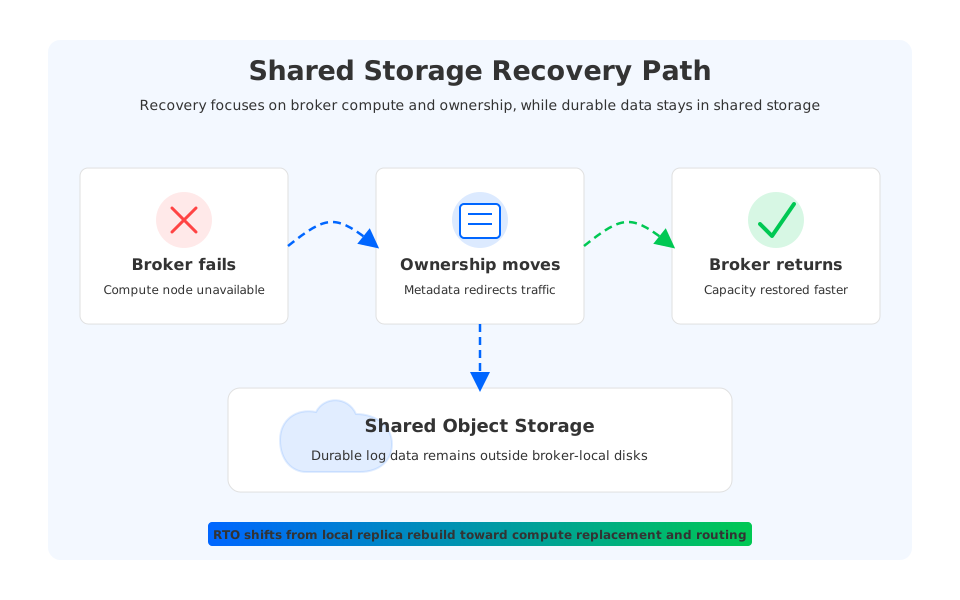
For DR planning, that distinction matters in three places. First, broker replacement can focus more on restoring compute capacity and ownership than copying local replicas. Second, elasticity can help absorb post-failure traffic or catch-up reads when surviving nodes are under pressure. Third, operations such as reassignment and recovery can be less tightly coupled to long-running data movement inside the broker fleet.
This is where AutoMQ fits naturally in a Kafka disaster recovery discussion: not as a replacement for RPO/RTO analysis, but as an architecture option for teams whose recovery objectives are limited by stateful broker mechanics. A shared-storage Kafka-compatible platform can improve the recovery path for broker and zone-level events, while multi-region RPO still depends on regional replication strategy, application write ownership, and failover execution.
The practical recommendation is to evaluate recovery mechanics, not only feature names. Ask how long it takes to add replacement brokers, redistribute partition ownership, serve catch-up reads, and return the cluster to a balanced state after failure. Then compare that measured path against the RTO your business actually needs.
7Build the Runbook Before the Incident
A Kafka DR design without a runbook pushes too much decision-making into the incident. The runbook should define who declares failover, which metrics confirm the failure, which clients move first, what happens to producers during uncertainty, how consumers resume, and how the team decides between waiting, failing over, or accepting partial degradation.
Include these checks in every serious Kafka DR runbook:
- Current ISR health and under-replicated partitions.
- Producer error rate, request latency, and acknowledgment behavior.
- Consumer lag by group, topic, and partition.
- Replication lag to secondary clusters or regions.
- Schema registry, connector, ACL, secret, and network readiness.
- DNS, bootstrap broker, service discovery, and client retry behavior.
- Downstream database, cache, warehouse, and application dependency status.
The runbook should also define what not to do. For example, do not run large partition reassignments during a region failover unless the procedure explicitly calls for it. Do not promote a passive cluster before checking whether required topics, schemas, and permissions are present. Do not fail back while producers might still be writing to both sides without ownership rules.
Disaster recovery is a chain. The Kafka cluster is one link, but producers, consumers, schemas, connectors, identity, network routing, observability, and human approvals are part of the same chain. The best Kafka DR plans make those dependencies visible before the outage, then rehearse the path until the measured recovery time matches the written objective.
8References
- Apache Kafka documentation: replication, producer acknowledgments, and in-sync replicas
- Apache Kafka documentation: MirrorMaker 2 and cluster replication
- AWS documentation: Regions and Availability Zones
- AutoMQ documentation
9FAQ
9.1What is the difference between Kafka high availability and Kafka disaster recovery?
High availability usually focuses on keeping service running through expected component failures such as broker loss or zone loss. Disaster recovery includes broader scenarios such as regional outage, destructive changes, operator error, and the process for restoring service within defined RPO and RTO targets.
9.2Does Kafka replication factor guarantee zero data loss?
No. Replication factor is one input. Data loss risk also depends on producer acknowledgments, in-sync replica health, min.insync.replicas, unclean leader election settings, failure timing, and whether the disaster crosses the boundary of the cluster or region.
9.3Is multi-AZ Kafka enough for disaster recovery?
Multi-AZ Kafka is often enough for broker and availability-zone failures inside one region. It is not enough by itself for a full regional outage. Regional DR usually requires another cluster, cross-region replication, client cutover planning, and tested failback procedures.
9.4Should Kafka DR use active-active or active-passive replication?
Use active-passive when one region can own writes and the main goal is regional recovery. Use active-active when multiple regions must accept writes and the application has clear rules for ownership, ordering, idempotency, and conflict handling.
9.5Where does AutoMQ help in Kafka disaster recovery?
AutoMQ can help when recovery objectives are constrained by stateful broker storage, slow replica rebuilds, or elastic capacity limits. Its shared-storage architecture changes broker replacement and scaling mechanics, but RPO and RTO still depend on topology, replication strategy, and operational discipline.


