
Table of Contents
Table of Contents
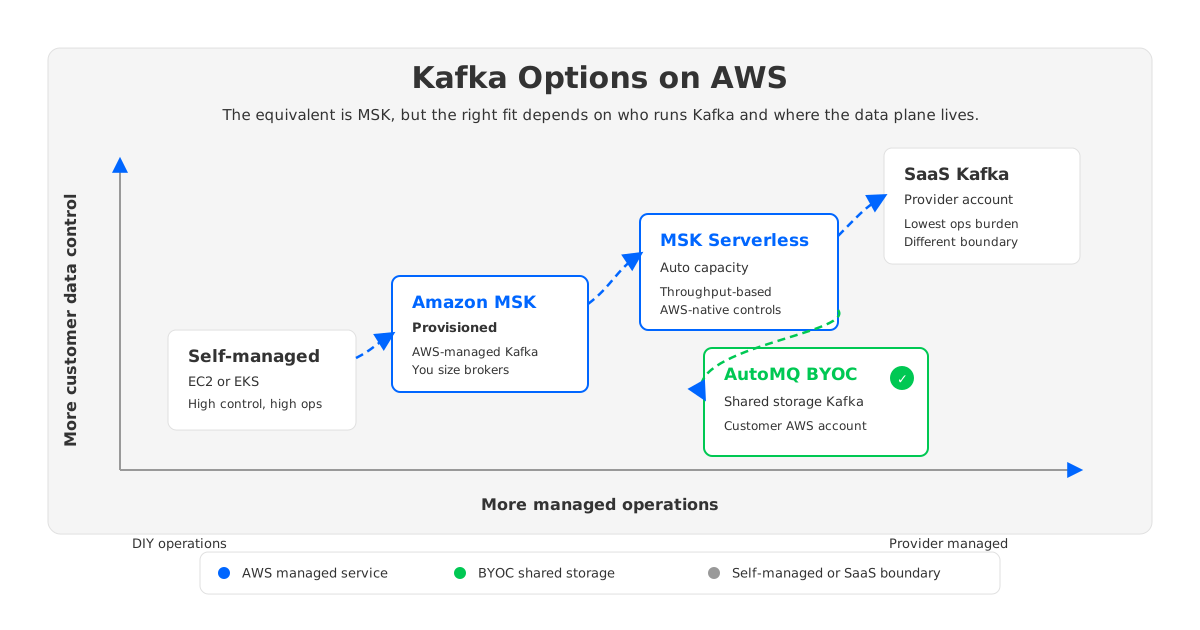
If you are searching for the Kafka equivalent in AWS, the direct answer is Amazon Managed Streaming for Apache Kafka, or Amazon MSK. It is AWS's managed service for running Apache Kafka workloads, and AWS states that MSK runs open-source Apache Kafka versions while supporting existing Kafka applications, tooling, and plugins without application code changes.
That search phrase often hides a second question. Architects and platform teams are also asking which Kafka-compatible operating model belongs in their AWS architecture. MSK Provisioned, MSK Serverless, SaaS Kafka, BYOC Kafka, self-managed Kafka on EC2 or EKS, and shared-storage Kafka systems all preserve different parts of the Kafka experience while changing the responsibility boundary.
1The Short Answer: Amazon MSK
Amazon MSK is the closest native AWS equivalent to Apache Kafka. It keeps the Kafka data-plane interface that producers, consumers, topics, partitions, and Kafka tooling expect, while AWS manages cluster creation, updates, deletion, failure detection, and broker replacement. Apache Kafka's documentation frames Kafka as a distributed event streaming platform that can publish and subscribe to streams, store events durably, and process those streams. MSK is AWS's managed way to run that model.
That distinction matters because Kafka is not only an API. It is also a storage, replication, networking, and operations model. MSK removes a meaningful amount of operational work, but the degree of abstraction depends on which MSK cluster type you choose.
AWS currently presents two main MSK paths for architectural decisions:
- MSK Provisioned gives you managed Apache Kafka clusters where you still choose broker types, broker count, storage, and many configuration details. It is a good fit when you want Kafka compatibility and AWS-native operations, but you also need more predictable capacity planning and control over cluster configuration.
- MSK Serverless is a cluster type that automatically provisions and scales capacity, manages topic partitions, and uses a throughput-based pricing model. AWS positions it for applications that need on-demand streaming capacity that scales up and down automatically.
- MSK ecosystem services such as MSK Connect and MSK Replicator help with connectors and replication around MSK clusters.
The practical answer is not "MSK or nothing." It is "MSK is the AWS-native Kafka service, then choose the right deployment boundary."
2When "Kafka Equivalent" Means More Than MSK
Professional buyers rarely evaluate Kafka in isolation. A data engineering team cares about clients, Connect, schemas, stream processing, and retention. An SRE team cares about failover, throttling, quotas, and day-2 maintenance. A CTO or FinOps leader cares about total cost, cloud commitment, procurement boundaries, and migration risk.
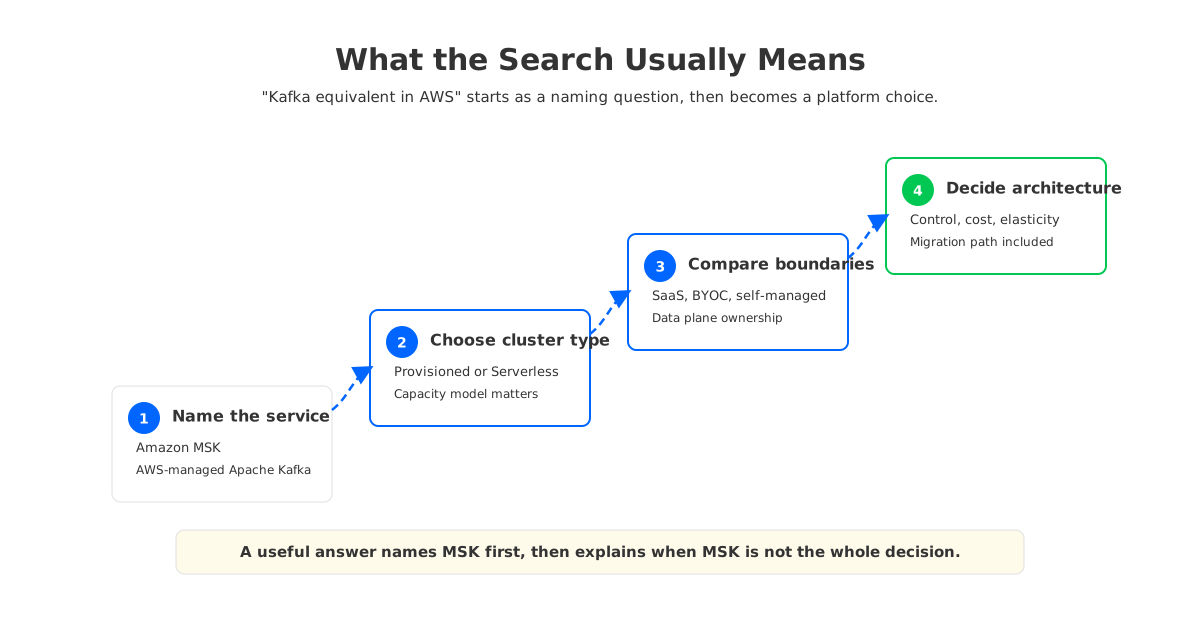
The useful way to read the search intent is as a ladder. The first rung is naming: "What is Kafka called in AWS?" The answer is MSK. The next rung is operating model: provisioned, serverless, SaaS, BYOC, or self-managed. The third rung is data control: does the Kafka data plane stay in your AWS account and VPC, or does it live behind a provider-operated boundary? The fourth rung is architecture: do you want traditional broker-local storage, tiered storage, or shared object-storage-backed Kafka?
This is where many comparisons get sloppy. "Serverless Kafka" can mean MSK Serverless, Confluent Cloud's managed Kafka experience, a BYOC product with elastic brokers, or a shared-storage design that reduces broker-local state. Those are different engineering choices. A serverless bill does not mean unlimited throughput. A SaaS control plane does not mean your data plane remains in your account. Precision here is how you avoid buying the wrong abstraction.
3AWS Kafka Options Explained
3.1Amazon MSK Provisioned
MSK Provisioned is the default mental model for AWS-native Kafka. You create an MSK cluster, choose broker capacity, configure storage and networking, and connect Kafka clients. AWS handles control-plane operations and common failure recovery, while your team still owns workload-level design: partition counts, retention, client behavior, capacity headroom, and cost monitoring.
The pricing model reflects that responsibility split. AWS's MSK pricing page describes hourly broker instance charges for Standard brokers, provisioned storage charges, optional provisioned storage throughput charges, and standard AWS data transfer charges for traffic in and out of MSK clusters. For Express brokers, AWS describes broker instance charges, storage used, and a per-GB rate for data written to an Express broker. A serious comparison should use your workload numbers rather than a generic monthly estimate.
MSK Provisioned fits teams that want Apache Kafka while removing part of the infrastructure maintenance burden. It is less attractive when traffic is highly spiky or when partition growth makes reassignment frequent.
3.2MSK Serverless
MSK Serverless changes the capacity conversation. AWS says it makes it possible to run Apache Kafka without managing and scaling cluster capacity; it automatically provisions and scales capacity while managing topic partitions. It requires IAM access control for all clusters, and AWS notes that Apache Kafka ACLs are not supported for MSK Serverless. Check that tradeoff against existing Kafka authorization models before migration.
The main appeal is operational: fewer broker-sizing decisions and a pricing model based on throughput rather than provisioned broker fleets. The main caution is also operational: serverless services still have quotas, supported Regions, security model assumptions, and feature boundaries. For a large existing Kafka estate with custom ACLs, unusual network patterns, or high partition counts, the evaluation needs a proof of workload fit.
3.3SaaS Kafka on AWS
SaaS Kafka platforms such as Confluent Cloud operate a broader managed data streaming platform. Confluent describes Confluent Cloud as a fully managed data streaming platform with a cloud-native Kafka engine, elastic scaling, enterprise security, stream processing, and governance. For many organizations, that ecosystem is the reason to choose SaaS: fewer platform pieces to assemble, a mature managed connector and governance story, and support across multiple clouds.
The tradeoff is the boundary. With SaaS, the provider typically owns more of the operational environment, and the customer integrates through networking, identity, and data movement controls. That can be acceptable when speed and ecosystem depth matter more than infrastructure ownership. It can also be a blocker for teams with strict VPC residency or a strategic preference to keep the data plane inside their own AWS account.
SaaS should therefore be evaluated as a platform model. The right question is whether the provider's operating boundary matches your governance model and whether the managed capabilities support the total platform fee.
3.4BYOC Kafka and Shared-Storage Designs
Bring Your Own Cloud, or BYOC, sits between AWS-native managed services and external SaaS. In a BYOC model, the service provider may manage or help operate the platform, while the data plane runs in the customer's cloud environment. AutoMQ fits into this category as a Kafka-compatible cloud-native streaming platform built around object-storage-backed shared storage.
AutoMQ's public materials position it as diskless Kafka on S3, with Kafka API compatibility, pay-as-you-go pricing, BYOC deployment, and lower cross-AZ traffic pressure as core themes. Its documentation also highlights Apache Kafka compatibility, stateless brokers, scale-out and scale-in, partition reassignment, and S3Stream shared streaming storage. Those claims are most relevant when your team wants to keep Kafka clients and ecosystem tools, but is dissatisfied with the broker-local storage model.
This is not a universal replacement for MSK. If your team wants a purely AWS-operated Kafka service and your workloads fit MSK's model, MSK remains the natural first choice. AutoMQ becomes interesting when the criteria shift toward BYOC control, shared storage, elasticity, and storage economics.
3.5Self-Managed Kafka on EC2 or EKS
Self-managed Kafka remains valid when platform teams need deep configuration control, custom builds, unusual networking, or Kubernetes operations. The cost is the engineering time required to keep the system healthy through upgrades, broker failures, partition growth, and capacity changes.
Self-managed Kafka is often a strong choice for organizations with a mature streaming platform team. It is a weak choice when Kafka is important but not a core competency, or when the team is already struggling with partition rebalancing, disk alerts, and weekend capacity work.
4How to Choose the Right AWS Kafka Equivalent
The decision gets easier when you separate protocol compatibility from operating model. Existing clients, Kafka Connect, Kafka Streams, schemas, or tooling may require Kafka compatibility. That narrows the field, but it does not decide the deployment model.
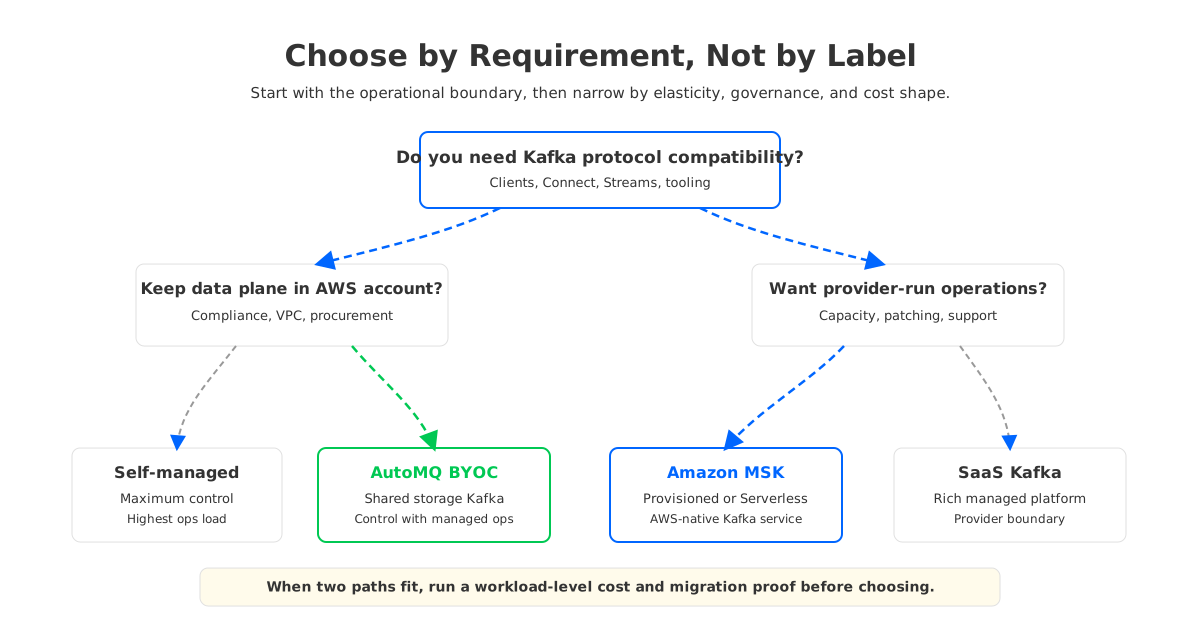
Use the following decision frame before comparing price sheets:
| Requirement | Usually points toward | Why it matters |
|---|---|---|
| AWS-native managed Kafka with familiar broker controls | MSK Provisioned | Strong default for teams that want Kafka in AWS and can plan capacity. |
| New workload with variable traffic and fewer sizing decisions | MSK Serverless | Reduces broker management, but quotas and IAM-only access control must fit. |
| Rich managed platform, connectors, governance, multi-cloud services | SaaS Kafka | Strong ecosystem, with a provider-controlled service boundary. |
| Customer-owned AWS account or VPC plus managed Kafka experience | BYOC Kafka | Keeps more infrastructure boundary control while reducing operations. |
| Elasticity and storage economics are the main pain | Shared-storage Kafka such as AutoMQ | Changes the broker-local storage assumption behind traditional Kafka scaling. |
| Full control and internal Kafka expertise | Self-managed Kafka | Maximum flexibility, maximum operational responsibility. |
For FinOps teams, model the entire workload. Broker instance hours are only one part of the bill. Include storage, data transfer, partition growth, replication behavior, connector costs, support, migration labor, and operational headcount. AWS pricing makes clear that MSK charges can involve broker hours, storage, throughput dimensions, and data transfer depending on the cluster type.
For SRE teams, the sharper question is failure and change behavior. What happens when a broker fails? How long does recovery take under your partition count and retention policy? Can you shrink capacity without moving large amounts of data? Traditional Kafka, MSK, serverless, SaaS, and shared-storage Kafka answer those questions differently.
For architects, the boundary question should come before the feature checklist. If your compliance model requires data to remain in your AWS account, SaaS may need extra review. If your team wants AWS to operate the full Kafka service, BYOC may feel like an extra category to govern. The right answer is the one whose failure modes you are willing to own.
5Where AutoMQ Fits Without Turning This Into a Vendor Checklist
AutoMQ belongs in the conversation when the buyer wants Kafka compatibility but is not satisfied with either side of the usual tradeoff: self-manage Kafka for control, or use a fully managed service and accept its boundary. Its BYOC model preserves more customer-side cloud control, while its shared-storage architecture targets the operational effects of brokers owning durable data locally.
That positioning is useful for three AWS patterns:
- Cost-sensitive high-throughput workloads where storage, cross-AZ movement, or over-provisioning dominates the Kafka bill.
- Elastic workloads where scaling brokers should not require large data movement or long reassignment windows.
- Governed platform environments where data-plane placement in the customer's cloud account is a requirement, but the team still wants a managed experience.
The honest evaluation path is a pilot, not a slogan. Take one representative workload, measure throughput, retention, partition count, network paths, recovery expectations, connector needs, and migration tolerance. Compare MSK Provisioned, MSK Serverless, SaaS Kafka, AutoMQ BYOC, and self-managed Kafka against that same workload.
For teams evaluating a Kafka-compatible BYOC or shared-storage path on AWS, AutoMQ's documentation and pricing calculator are good next steps: review the architecture, test compatibility with existing clients, and run your own workload-based cost model rather than relying on broad category labels.
6References
- AWS Documentation: What is Amazon MSK?
- AWS Documentation: What is MSK Serverless?
- AWS Pricing: Amazon MSK Pricing
- AWS Documentation: Amazon MSK Quotas
- Apache Kafka: Introduction
- Confluent Documentation: Confluent Cloud
- AutoMQ: Pricing
- AutoMQ Docs: AutoMQ Architecture Overview
- AutoMQ Docs: Compatibility with Apache Kafka
- AutoMQ Docs: Deploy AutoMQ to AWS EKS
7FAQ
7.1What is Kafka called in AWS?
The AWS managed Kafka service is Amazon Managed Streaming for Apache Kafka, or Amazon MSK. It runs open-source Apache Kafka versions and supports Kafka data-plane operations for producing and consuming data.
7.2Is MSK the same as Apache Kafka?
MSK is a managed AWS service for Apache Kafka. It preserves Kafka compatibility for clients and tools, while AWS manages many control-plane and infrastructure operations. It is not a separate messaging API like SQS or SNS.
7.3Is MSK Serverless the right Kafka equivalent in AWS?
MSK Serverless is a strong fit when you want Kafka compatibility without managing cluster capacity and your workload fits its quotas, IAM access model, supported Regions, and feature boundaries. MSK Provisioned may fit better when you need more broker-level control.
7.4Is Confluent Cloud an AWS Kafka equivalent?
Confluent Cloud can run on AWS and provides a fully managed data streaming platform with Kafka-compatible capabilities and additional ecosystem services. It is a SaaS platform rather than an AWS-native service, so buyers should evaluate networking, data-plane boundary, pricing, and governance.
7.5What is BYOC Kafka?
BYOC Kafka means Bring Your Own Cloud: the Kafka-compatible data plane runs in the customer's cloud environment while the vendor provides management, automation, support, or a control plane. This model is useful when teams want managed operations but need stronger account, VPC, or data control.
7.6Where does AutoMQ fit among AWS Kafka options?
AutoMQ is a Kafka-compatible BYOC and shared-storage option. It is relevant when teams want to keep Kafka clients and ecosystem tools, run in their own AWS environment, and evaluate an object-storage-backed architecture rather than traditional broker-local Kafka storage.
7.7Should I replace MSK with AutoMQ?
Not by default. MSK is the natural AWS-native answer for many Kafka workloads. AutoMQ is worth evaluating when the main pain is cost structure, scaling, broker-local storage operations, or a BYOC requirement that MSK or SaaS Kafka does not address in the way your organization needs.


