
Table of Contents
Table of Contents
A search for kafka fair usage policy means a buyer has found a soft limit hiding behind a hard requirement. The team may be reviewing a managed Kafka quote, a marketplace contract, a platform SLO, or an internal chargeback rule. The workload is not theoretical: producer throughput is rising, consumer fanout is growing, retention exceptions are multiplying, and someone needs to know which part of the platform becomes expensive or restricted first.
The word "fair" can make the problem sound like a vendor policy question. In production Kafka, it is closer to a capacity-governance question. Kafka exposes familiar APIs, but the infrastructure underneath must still absorb broker-local storage, replication, network transfer, partition growth, compaction, connector traffic, offset management, transactional workloads, and recovery events. A fair usage policy is the place where those technical realities become commercial terms, operational guardrails, or internal platform rules.
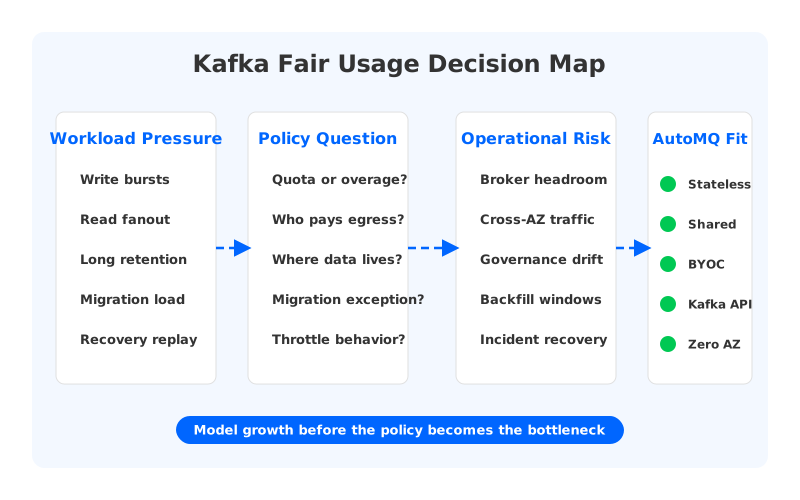
The useful buyer question is not whether a policy is good or bad. The useful question is whether the policy matches the way the workload will grow. A streaming platform can look cost-effective at onboarding and become hard to reason about when a new consumer group doubles read traffic, a compliance team extends retention, or an incident forces a large replay. Buyers should model those paths before growth turns a reasonable policy into an emergency negotiation.
1Why Teams Search for kafka fair usage policy
Most Kafka buyers do not start by asking for a fair usage policy. They ask for "Kafka-compatible streaming," "managed Kafka pricing," "Kafka retention cost," or "serverless Kafka limits." The fair usage search appears after the first layer of comparison fails. Published unit prices may not explain how bursts, throttling, quota enforcement, or overage review map to Kafka behavior. Internal platform teams face the same pattern when they offer Kafka as a shared service and need guardrails for application teams.
The pressure usually comes from four growth paths that look harmless in isolation:
- Write throughput grows in bursts. A product launch, telemetry change, or backfill can push brokers, disks, and network paths far beyond the baseline used in the first quote.
- Read fanout grows faster than writes. Analytics jobs, fraud models, lakehouse loaders, and service consumers can multiply outbound traffic without changing producer volume.
- Retention becomes a governance feature. Teams ask for longer replay windows, audit recovery, and historical debugging. That turns Kafka from a short-lived log into a durable business data surface.
- Operational events consume real capacity. Broker replacement, partition reassignment, consumer reprocessing, connector restarts, and disaster recovery drills can create load that is absent from steady-state dashboards.
These are not edge cases. They are normal signs that Kafka has become important. A fair usage policy that only describes average throughput or a single storage number will miss the behavior buyers actually need to predict. Kafka's consumer groups, offsets, transactions, producer acknowledgments, and admin operations all shape how capacity is consumed during growth and recovery, so the policy must be checked against the full operating model rather than a narrow benchmark.
2The Production Constraint Behind the Policy
Traditional Kafka is a Shared Nothing system: each broker owns local log data, and durability comes from replicating partitions across brokers. That design is clear, proven, and still appropriate for many deployments. It also means that capacity is not a single pool. Compute, local or attached storage, network transfer, partition leadership, page cache, controller metadata, and recovery bandwidth all meet at the broker.
Cloud infrastructure makes that coupling visible in the bill. A multi-AZ Kafka deployment can pay for compute instances, block storage, inter-zone transfer, private connectivity, object storage, monitoring, and connector infrastructure. The buyer may see one Kafka line item, but the platform is consuming several cloud resources with different scaling curves. AWS documents data transfer charges as a distinct billing category, which matters because cross-zone and cross-service paths can be separated from the service that caused them.
The same issue appears in internal platform governance. If one team creates a topic with a high partition count and long retention, another team adds a replay-heavy consumer group, and a third team runs a connector backfill, the platform team must decide who owns the extra cost and risk. The answer cannot be "Kafka is shared." Shared platforms still need boundaries.
| Kafka usage driver | What grows underneath | Why a fair usage policy should model it |
|---|---|---|
| Producer throughput | Broker CPU, network ingress, replication, WAL or local log writes | Average MiB/s hides burst pressure and durability cost. |
| Consumer fanout | Network egress, broker fetch load, cache pressure, replay traffic | A new consumer can change cost without changing writes. |
| Retention | Local disk, remote storage, compaction work, restore expectations | Long retention creates governance and recovery obligations. |
| Partition count | Metadata, leadership distribution, file handles, reassignment work | Small topics can become operationally expensive at high cardinality. |
| Connect and migration | Worker capacity, source/sink traffic, offset state, backfill windows | Data movement often violates steady-state assumptions. |
The table is deliberately about mechanisms, not vendor labels. The point is to expose which growth dimension the policy actually controls and which dimension remains the buyer's risk.
3Architecture Options and Trade-Offs
There are three architecture positions buyers should separate before reviewing policy language. The first is classic broker-local Kafka. It gives teams mature Kafka semantics, ecosystem compatibility, and direct operational control. The trade-off is that broker-local durable state remains part of almost every scaling and recovery question.
The second position is Kafka Tiered Storage, introduced through Apache Kafka's KIP-405 work. Tiered Storage moves older log segments to remote storage while brokers continue to handle the active log locally. This can reduce local disk pressure and improve long-retention economics, especially when replay is occasional and the hot tier remains bounded. It does not make brokers stateless, and it does not remove the need to model hot data, remote fetch behavior, object storage requests, or recovery runbooks.
The third position is Kafka-compatible Shared Storage architecture. Durable stream data is stored in shared storage, often backed by object storage, while brokers focus on Kafka protocol handling, leadership, caching, routing, and coordination. This changes the fairness question. Instead of asking how much state each broker may hold before the platform becomes expensive, buyers can ask how compute, storage, and network boundaries scale independently.
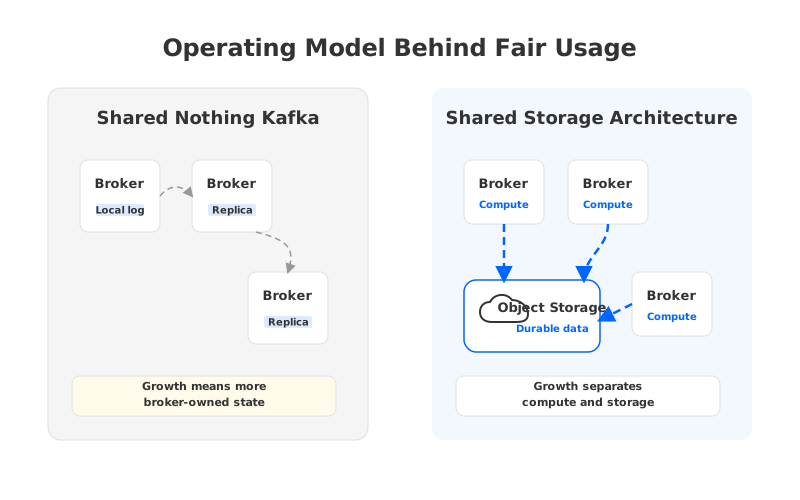
None of these options wins every workload. Broker-local Kafka fits stable workloads with bounded retention and familiar operations. Tiered Storage helps when historical retention is the main pressure. Shared Storage deserves evaluation when the fair usage discussion keeps circling back to the same root cause: broker-local durable state turns growth into data movement, reserved headroom, and policy exceptions.
4Evaluation Checklist for Platform Teams
A fair usage policy should be reviewed like an architecture document. Legal language matters, but the platform owner needs a technical model that explains what happens before, during, and after the limit is reached.
Start with the Kafka compatibility surface. A platform that accepts Kafka producer and consumer traffic may still differ in transactions, idempotent producers, consumer group behavior, offset reset workflows, admin APIs, Kafka Connect support, MirrorMaker 2 migrations, client version support, monitoring integrations, and ACL behavior. Apache Kafka's own documentation covers these pieces as separate concerns because they fail in different ways. Buyers should test the parts they use, not assume the word "Kafka-compatible" covers every operational path.
Then model usage along the dimensions that create cost and risk:
- Baseline and burst throughput. Define sustained write throughput, peak burst duration, acknowledgment requirements, compression assumptions, and whether throttling is automatic or negotiated.
- Read fanout and replay. Count consumer groups, expected fetch volume, historical replay windows, and the worst credible reprocessing event after a bad deployment or downstream outage.
- Retention and deletion. Map topic classes to retention windows, compaction needs, legal hold expectations, encryption scope, and deletion evidence.
- Network paths. Separate same-AZ, cross-AZ, cross-region, internet, private connectivity, and object storage paths. Do not collapse them into a single "network" estimate.
- Operational load. Include broker replacement, scaling, partition reassignment, connector backfills, migration, and disaster recovery drills.
- Governance boundaries. Decide whether the policy is enforced by quotas, chargeback, soft alerts, contract review, throttling, or workload isolation.
The buyer should also ask how the policy behaves at the moment of stress. Does the platform throttle producers, slow consumers, reject new partitions, bill overages, or require a support ticket? Are connector backfills counted as normal usage or migration usage? Kafka incidents often require temporary excess capacity to recover safely.
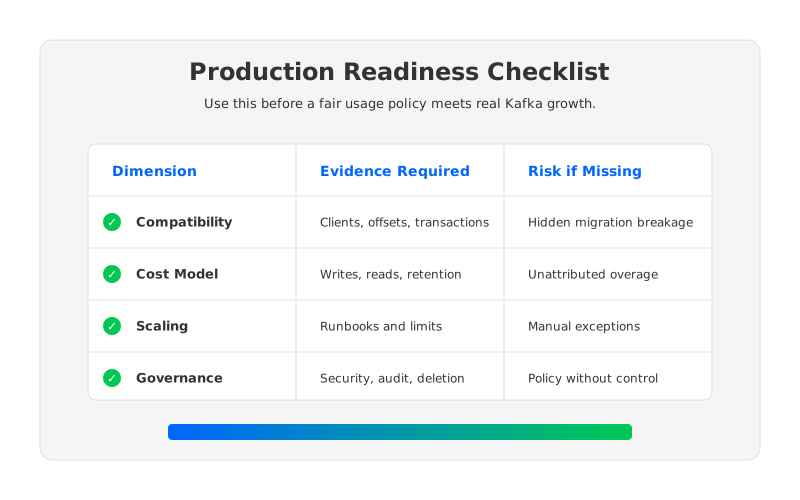
A good checklist produces decisions, not paperwork. If the platform cannot explain how a large replay is billed, how cross-zone traffic is attributed, or how a partition-count limit is enforced, the policy is not ready for a production growth plan.
5How AutoMQ Changes the Operating Model
After the neutral evaluation is complete, AutoMQ fits into a specific architecture category: Kafka-compatible streaming built around Shared Storage architecture. AutoMQ keeps Kafka protocol compatibility while moving durable stream storage away from broker-local disks into S3-compatible object storage through S3Stream, WAL storage, and cache components. Brokers continue to serve Kafka clients, but durable data is no longer planned as long-lived state owned by a single broker's disk.
That distinction changes how buyers can model fair usage. In traditional Kafka, a policy around throughput or retention often maps back to broker sizing because the broker is the place where compute, local storage, replication, and recovery collide. In AutoMQ's model, compute and storage can be considered more independently. Object storage handles durable stream data, while brokers are closer to replaceable compute units for protocol handling and caching. That does not make capacity planning disappear, but it moves the hardest planning question away from "how much data can this broker safely own?"
WAL is important because object storage alone is not a low-latency streaming write path. AutoMQ uses WAL storage as a bounded part of the write path before data is persisted into shared object storage. WAL helps make object-storage-backed durability practical for streaming workloads, while retained stream data lives in the shared storage layer.
This model also affects cloud-cost governance. AutoMQ's documentation describes a zero cross-AZ traffic design for reducing inter-zone data movement in supported deployments. Buyers should still validate the exact deployment, client placement, object storage configuration, and workload pattern, but the architecture gives them a different policy lever: reduce broker-to-broker replica movement rather than merely pricing it into the fair usage limit.
AutoMQ is not a way to avoid policy design. It is a way to make the policy map to cleaner infrastructure boundaries. Buyers still need compatibility tests, latency SLOs, retention classes, quota rules, object storage controls, observability, incident runbooks, and rollback plans.
6Buyer Scorecard Before Growth
The practical scorecard is short enough to use in procurement and technical design reviews. Give each item a green, yellow, or red rating and attach evidence. Green means measured or contractually clarified; yellow means plausible but untested; red means the policy hides growth or recovery risk.
| Scorecard item | Green evidence | Red signal |
|---|---|---|
| Compatibility | Tested clients, transactions, offsets, Connect, admin tooling, and monitoring. | Only producer and consumer happy paths were tested. |
| Cost model | Writes, reads, retention, requests, and network paths are separated. | One bundled number hides cross-AZ or replay cost. |
| Elasticity | Scaling and broker replacement have measured runbooks. | Growth requires large data movement or manual exceptions. |
| Governance | Quotas, chargeback, alerts, and escalation paths are defined. | Policy language exists, but enforcement is unclear. |
| Migration | Mirror, cutover, rollback, and offset validation are rehearsed. | Migration traffic is treated as an afterthought. |
| Ownership | Data residency, encryption, audit, and deletion scope are explicit. | The platform cannot explain where retained data lives. |
The scorecard should make the buyer more demanding in the right way. A strict policy can be acceptable when the architecture and enforcement model are transparent. A generous policy can be risky when it hides throttling, unclear overages, or recovery limits.
For teams comparing Kafka-compatible platforms, the next step is to take one real workload class and model it across write throughput, read fanout, retention, cross-zone traffic, replay, and migration. If broker-local durable state is the source of repeated policy exceptions, evaluate whether Shared Storage architecture changes the model enough to justify a proof of concept. AutoMQ's architecture and Kafka compatibility documentation are useful starting points, and teams that want to test the operating model can explore AutoMQ BYOC in a customer-controlled cloud environment.
7References
- Apache Kafka documentation: Kafka Documentation
- Apache Kafka KIP-405: Kafka Tiered Storage
- Apache Kafka documentation: Kafka Connect
- Apache Kafka documentation: MirrorMaker 2
- Apache Kafka KIP-1150: Diskless Topics
- Apache Kafka documentation: Consumer configuration
- AWS documentation: Data transfer charges in AWS Cost and Usage Reports
- AutoMQ documentation: Compatibility with Apache Kafka
- AutoMQ documentation: Shared Storage architecture
- AutoMQ documentation: S3Stream shared streaming storage
- AutoMQ documentation: Eliminate inter-zone traffic
8FAQ
8.1What is a Kafka fair usage policy?
A Kafka fair usage policy defines how a platform handles growth in throughput, retention, partitions, consumer fanout, migration traffic, and operational bursts. It may appear in a vendor contract, managed service plan, serverless quota model, or internal platform rule. The important test is whether it maps to real Kafka behavior rather than a single average usage number.
8.2Why is fair usage harder for Kafka than for simple storage services?
Kafka usage is multidimensional. Writes, reads, retention, partitions, replication, transactions, connectors, and recovery events all consume different infrastructure resources. A policy that looks clear for stored bytes may be incomplete for a streaming workload where replay, fanout, and cross-zone traffic can dominate cost or capacity.
8.3Should buyers prefer unlimited Kafka plans?
Not automatically. "Unlimited" can still include throttling, acceptable-use review, hidden overage paths, or architecture constraints. A transparent limit with clear enforcement can be safer than a broad promise that does not explain bursts, migration, or replay.
8.4How does Shared Storage architecture affect fair usage modeling?
Shared Storage architecture separates durable stream data from broker-local disks. That can make retention, scaling, and broker replacement less dependent on moving data between brokers. Buyers still need to model throughput, latency, cache, object storage, and network paths, but the capacity model can be cleaner than a broker-local storage design.
8.5Where does AutoMQ fit in a fair usage review?
AutoMQ fits when a team wants Kafka-compatible APIs and ecosystem behavior while reducing the operational weight of broker-local durable storage. Its Shared Storage architecture, WAL storage, object-storage-backed durability, stateless brokers, and zero cross-AZ traffic design can give buyers a different way to model growth, especially when retention, fanout, and cloud cost are all rising together.


