
Table of Contents
Table of Contents
Teams usually search for kafka cost after the bill has become harder to explain than the cluster. The platform may be healthy by ordinary Kafka signals: under-replicated partitions are zero, producer latency is acceptable, consumer lag is controlled, and broker disks have headroom. Yet the invoice still grows through broker compute, attached storage, inter-zone transfer, retained data, support work, and the spare capacity nobody wants to remove before the next traffic spike.
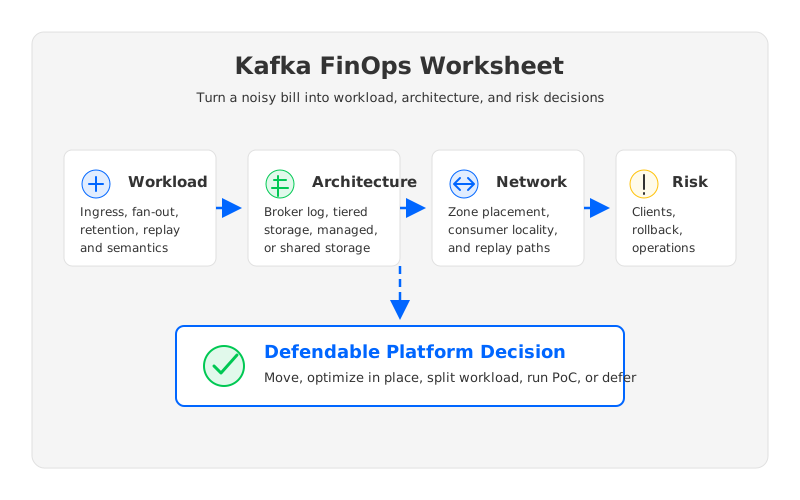
That mismatch is why Kafka FinOps needs a worksheet, not a pricing shortcut. A Kafka estate is a set of technical contracts: partition ordering, retention, compaction, transactions, access control, client compatibility, disaster recovery, and operational ownership. Cost reduction that breaks one of those contracts is not savings. The useful question is narrower and more practical: which parts of the platform create cost because the workload needs them, and which parts create cost because the architecture keeps data, compute, and network movement coupled too tightly?
1Why Teams Search for kafka cost
Kafka cost reviews often start with a single complaint, but the complaint is usually a symptom of several interacting line items. A team may blame broker size, then discover that read fan-out is driving network transfer. Another team may blame retention, then realize that hot data and cold data are being priced through the same storage tier. A third team may blame managed service fees, then find that the largest risk is operational: the cluster is expensive because it must stay over-provisioned to avoid slow rebalancing during incidents.
The first worksheet step is to separate cost visibility from cost control. Visibility tells you where the invoice lands. Control tells you which engineering decision can change it without weakening the service. For Kafka, those decisions sit at different layers:
- Workload shape: producer ingress, consumer fan-out, replay frequency, compaction, retention, and peak-to-average ratio determine the baseline load.
- Storage model: broker-attached disks, tiered storage, and shared storage each place durable bytes in different services with different recovery behaviors.
- Network topology: cross-zone replication, consumer placement, private connectivity, and multi-region paths can turn ordinary data movement into recurring transfer cost.
- Operational policy: headroom, reassignment windows, upgrade strategy, incident rollback, and compliance retention often keep capacity larger than steady-state traffic requires.
These categories matter because Kafka costs are rarely reduced by one knob. Lowering retention can reduce storage but may violate replay requirements. Shrinking brokers can reduce compute but increase failure risk. Moving to a managed service can reduce staffing work while changing the line items the FinOps team sees. A good worksheet keeps those tradeoffs visible instead of flattening them into a single monthly number.
2Build the Workload Ledger Before the Cost Model
The cost model should begin with workload classes, not vendors. Most Kafka platforms carry multiple businesses inside one cluster: operational telemetry, user events, fraud signals, CDC streams, search indexing, feature pipelines, and audit logs. They share brokers, but they do not share the same economics.
For each workload class, record the following inputs before comparing platforms:
| Input | Why It Changes Kafka Cost |
|---|---|
| Ingress rate and peak ratio | Drives broker throughput, write path pressure, and required headroom |
| Consumer fan-out | Multiplies egress, cache pressure, and cross-zone exposure |
| Retention and replay behavior | Determines stored bytes and whether old data is read often enough to need faster storage |
| Topic semantics | Compaction, transactions, and ordering requirements constrain architecture choices |
| Availability boundary | Zone, region, or multi-region goals define replication and recovery cost |
| Operating model | Self-managed, managed, BYOC, or software deployment changes labor, support, and procurement |
This ledger stops teams from averaging the estate. An observability topic with high ingress and short retention should not be evaluated with the same assumptions as a compliance topic with modest ingress and long retention. A Kafka Streams changelog should not be treated like an append-only event log if compaction and recovery time matter. The worksheet should produce a small portfolio view: which workloads are storage-heavy, which are network-heavy, which are operationally fragile, and which are simple enough to move first.
The ledger also gives procurement a better question. Instead of asking "what is Kafka cost per GB?", ask "what does this architecture charge us for the bytes we write, keep, reread, replicate, and move across boundaries?" That phrasing forces the evaluation to follow the data path.
3Follow the Bytes Through the Architecture
Kafka cost becomes clearer when every byte has a route. A producer write may be acknowledged by the leader, replicated to followers, retained on broker-attached storage, copied into remote storage through tiered storage, fetched by consumers in another zone, replayed during backfills, and moved again during partition reassignment. Each step exists for a reason, but each step can also create a billable event in cloud infrastructure.
Traditional Kafka uses a replicated local log. That model gives brokers direct ownership of partition replicas and keeps the active log close to the broker. In cloud deployments, the same model can create heavy attached storage requirements, zone-aware replica placement, and network transfer as replicas and clients cross availability-zone boundaries. Apache Kafka tiered storage changes part of that picture by moving older log segments to remote storage, which helps long retention workloads, but it does not remove every cost tied to active broker storage and replication.
Shared-storage Kafka-compatible designs change the route again. They move durable topic data toward object storage or another shared storage layer while brokers focus more on compute, cache, protocol handling, and coordination. That can reduce the amount of durable state tied to individual broker disks and make broker replacement or scaling less dependent on moving local log replicas. The tradeoff is that the write path, cache strategy, object storage request pattern, and recovery model must be examined carefully.
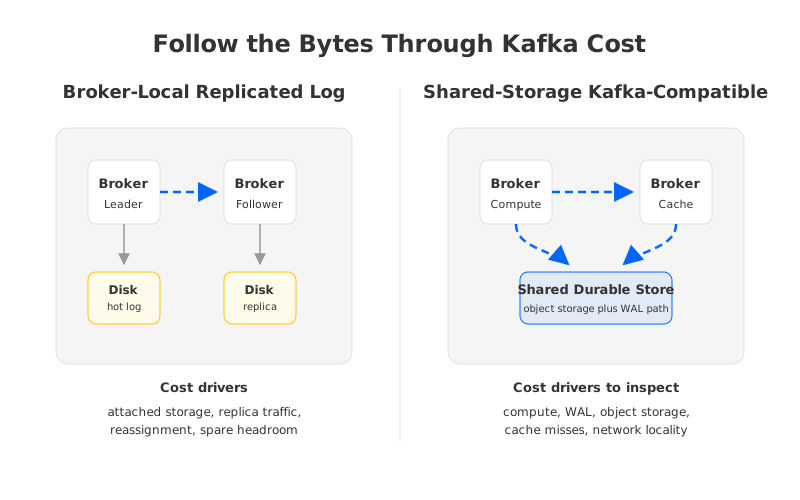
The worksheet should compare architectures by mechanism rather than label:
| Architecture Choice | Cost Line Items to Inspect | Operational Question |
|---|---|---|
| Broker-local replicated log | Broker compute, attached storage, replication traffic, reassignment time | How much durable data must move when brokers fail, scale, or rebalance? |
| Kafka tiered storage | Broker storage for hot segments, remote storage for older segments, fetch behavior | Which reads hit local storage, and which reads create remote storage or network activity? |
| Managed Kafka service | Service units, broker/storage/network charges, support plan, data transfer | Which operational tasks are removed, and which cloud line items remain? |
| Shared-storage Kafka-compatible engine | Compute nodes, WAL or write path resources, object storage, cache, network | Does the design preserve Kafka semantics while changing the expensive byte paths? |
This comparison avoids a common FinOps trap: treating an architecture as lower cost because one visible line item shrinks. The worksheet should require an explanation for where the bytes went. If broker disk cost falls but object storage requests, cache misses, or cross-zone reads rise, the model should show that movement explicitly.
4Model Network Cost as a First-Class Constraint
Network cost is often missed because it rarely appears in Kafka diagrams. Engineers draw producers, brokers, consumers, and storage; cloud invoices draw regions, availability zones, NAT, PrivateLink, internet egress, and cross-region transfer. The two views need to be reconciled before a cost review is credible.
Amazon MSK and EC2 pricing guidance make the same practical point: data transfer depends on where traffic crosses service and availability boundaries. In Kafka, those crossings can happen through replication, producer placement, consumer placement, connector infrastructure, monitoring pipelines, and disaster recovery. A healthy cluster can still be expensive if its traffic pattern ignores those boundaries.
Use a network worksheet for each workload class:
- Where are producers located relative to broker leaders?
- Where are consumers located, and how many independent consumer groups read the same data?
- Does replication cross zones, regions, or VPC boundaries?
- Are connectors, stream processors, and analytics jobs deployed near the data path?
- Which traffic is steady, and which traffic appears during replay, restore, or backfill?
This is where platform owners should work with FinOps and cloud architecture teams rather than handing them a Kafka-only export. A topic with low storage cost can still be expensive if every consumer group reads across zones. A backfill can be acceptable when it is rare, or financially painful when it becomes a weekly analytics pattern. The worksheet should mark network-sensitive workloads so the architecture review includes placement and locality, not only broker count.
5Add Migration Risk to the Same Worksheet
Cost models become dangerous when migration risk lives in a separate document. A lower-cost target platform is not lower cost if the team must rewrite clients, rebuild security controls, duplicate data for months, or accept unclear rollback behavior. Kafka estates contain old clients, varied connector versions, business-critical consumer groups, and alerting assumptions that may be more important than the broker software itself.
For each proposed cost change, add a migration-risk row:
| Cost Lever | Risk to Validate |
|---|---|
| Reduce broker count | Partition balance, failover headroom, controller load, and peak traffic handling |
| Change storage model | Produce acknowledgment path, read latency, compaction, transactions, and recovery behavior |
| Move to managed service | Quotas, networking, IAM, observability, upgrade policy, and support boundaries |
| Introduce shared storage | WAL durability, object storage dependency, cache behavior, and failure isolation |
| Change traffic placement | Client routing, rack awareness, connector deployment, and consumer group behavior |
The output should be evidence, not opinion. Run representative client versions. Test idempotent producers and transactions if the estate uses them. Validate compaction if compacted topics carry state. Create a backfill test for high fan-out consumers. Fail brokers, degrade storage paths, scale out, scale in, and prove that the rollback path is operationally realistic. That level of testing is not bureaucracy; it is how a FinOps proposal survives contact with production.
6Where AutoMQ Fits the Evaluation
After the worksheet identifies which costs come from architecture rather than workload demand, AutoMQ fits into one specific category: a Kafka-compatible, cloud-native streaming system that separates compute from storage and uses object storage as the durable foundation through its S3Stream shared storage architecture. That positioning matters when the expensive part of the Kafka estate is not the Kafka API. The expensive part is the way broker-local storage, replication, scaling, and network movement interact in the cloud.
AutoMQ is relevant to evaluate when a team wants to keep Kafka-compatible clients and operational semantics while changing the cost drivers underneath the broker. Its documentation describes stateless broker design, object-storage-backed persistence, WAL and cache paths, and deployment options such as BYOC and software-based operation. The important evaluation question is not whether shared storage sounds attractive. It is whether the target workload can preserve the Kafka behaviors it depends on while reducing the byte movement, storage coupling, and operational drag identified earlier in the worksheet.
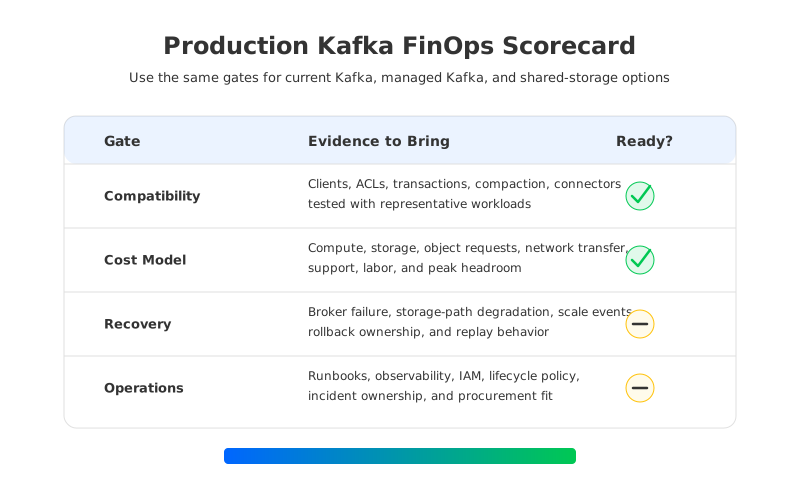
The strongest AutoMQ proof of concept should use the same worksheet gates as any other architecture option. Start with one or two workload classes where broker storage, scaling friction, or cross-zone traffic are material. Keep the existing client compatibility requirements explicit. Model object storage, WAL, cache, and network paths as real cost components. Then compare the result with the current Kafka or managed Kafka deployment using the same ingress, retention, fan-out, and recovery assumptions.
That keeps the product evaluation honest. AutoMQ should not be introduced as a generic replacement for every Kafka cluster. It should be evaluated where Kafka-compatible shared storage changes the cost curve without forcing application teams to absorb a platform rewrite.
7The Worksheet Platform Owners Can Reuse
A useful Kafka FinOps worksheet should fit on a page, even if the supporting evidence is deeper. The goal is to create a shared language for platform engineering, SRE, FinOps, procurement, and application owners.
| Worksheet Area | Required Evidence |
|---|---|
| Workload class | Topic group, ingress, fan-out, retention, semantics, and business owner |
| Current byte path | Write, replica, storage, read, replay, and recovery routes |
| Cost drivers | Compute, attached storage, object storage, network transfer, support, and labor |
| Architecture options | Current Kafka, managed Kafka, tiered storage, shared-storage Kafka-compatible engine |
| Migration risk | Client compatibility, topic semantics, observability, security, rollback, and downtime tolerance |
| Decision | Move, optimize in place, split workload, run PoC, or defer |
This worksheet also improves vendor conversations. Instead of asking for a broad discount or a generic benchmark, the platform owner can ask pointed questions: which byte paths disappear, which ones move to object storage, how cross-zone reads are handled, what happens during broker replacement, and what compatibility gaps remain. The answers are easier to compare because every option is being tested against the same workload shape.
Kafka cost is frustrating because it hides in the gap between a stable cluster and a cloud bill that keeps changing. A worksheet closes that gap by tying money back to architecture. When your team is ready to test whether shared storage can reduce broker-local state, scaling friction, and network exposure while keeping Kafka-compatible behavior, review AutoMQ's architecture overview here: AutoMQ architecture overview.
8References
- Apache Kafka Documentation
- Apache Kafka 3.8 Operations: Tiered Storage
- Amazon MSK Pricing
- Amazon EC2 On-Demand Pricing: Data Transfer
- AWS Big Data Blog: Optimize traffic costs of Amazon MSK consumers on Amazon EKS with rack awareness
- AutoMQ Documentation: Architecture Overview
- AutoMQ Documentation: S3Stream Shared Streaming Storage
9FAQ
9.1What is the biggest driver of Kafka cost?
There is no single driver across all Kafka estates. Broker compute, attached storage, retained data, consumer fan-out, cross-zone traffic, operational headroom, and support model can each dominate depending on workload shape. A useful review follows bytes through writes, replication, storage, reads, replay, and recovery.
9.2Is managed Kafka always lower cost than self-managed Kafka?
No. Managed Kafka can reduce operational burden and shift responsibility for upgrades, availability mechanics, and support, but the total cost still depends on workload volume, storage, network transfer, service pricing, and the staffing model being replaced. It should be compared against the current platform with the same workload ledger.
9.3Does tiered storage solve Kafka cost problems?
Tiered storage helps when long retention on broker disks is a major cost driver. It does not automatically solve active-log storage, replication traffic, consumer locality, operational headroom, or migration risk. It should be modeled as one architecture option, not as a complete FinOps strategy.
9.4When should a team evaluate AutoMQ?
Evaluate AutoMQ when your Kafka cost review shows that broker-local storage, scaling friction, retained data, or cloud network paths are material constraints, but your applications still need Kafka-compatible APIs and ecosystem behavior. The right next step is a workload-class proof of concept using your actual ingress, retention, fan-out, and recovery requirements.


