
Table of Contents
Table of Contents
AI agent prototypes usually start with a prompt, a tool registry, and a few API calls. Production systems get uncomfortable when the agent needs to understand what is happening across orders, users, devices, fraud signals, inventory, incidents, logs, and customer interactions at the same time. A nightly snapshot can answer yesterday's question. An agent deciding what to do now needs a fresher operating picture.
That is why Kafka keeps appearing in agentic AI architecture discussions. Apache Kafka is built for events: it captures, stores, routes, and replays streams from many producers to many consumers. Apache Flink and Kafka Streams can transform those streams into stateful signals before agents ever see them. MCP can expose tools, resources, and prompts to the AI application. None of those pieces replace one another. They sit at different layers of the same production problem: how do agents observe the business, decide within guardrails, and act without turning every workflow into synchronous API spaghetti?
The missing line item is cost. Teams often model GPU spend, model API spend, vector database spend, and feature store spend. The streaming backbone is treated as already solved because "we have Kafka." But agentic AI changes the shape of Kafka traffic. More services emit context. More consumers subscribe. More logs and traces become decision inputs. More replays are needed for evaluation, audit, simulation, and recovery. If the backbone is disk-bound, replicated across brokers, and over-provisioned for peak bursts, streaming cost can quietly compete with the model budget.
1Why Agents Need Streaming Data
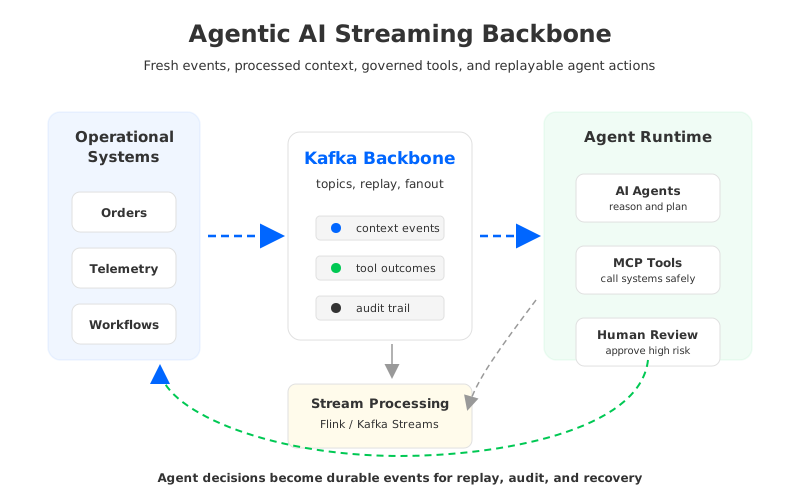
The easiest way to misunderstand agentic AI is to treat the agent as the center of the architecture. In production, the agent is usually the most visible component, not the most important one. The hard part is building the environment around it: fresh context, reliable tools, bounded permissions, audit trails, fallback paths, and enough event history to debug decisions after they happen.
Kafka is useful because it gives that environment a durable timeline. According to the Apache Kafka documentation, events are organized into topics, producers publish events, consumers subscribe to them, and topics can have many producers and many subscribers. That decoupling matters for agents because the source of truth should not depend on one agent session. A fraud signal, inventory update, payment event, support ticket, or deployment alert can be consumed by several systems: dashboards, stream processors, feature pipelines, rule engines, and agent runtimes.
The most practical agent inputs tend to be operational streams, not polished BI tables:
- Change events from core systems. Orders, account changes, payments, bookings, and device state updates provide the agent with facts that reflect the business as it moves.
- Telemetry streams. Logs, metrics, traces, and incident events let an operations agent reason over live failure symptoms instead of waiting for someone to paste dashboard screenshots into a chat.
- User and workflow events. Clickstream, support, CRM, and workflow events show intent, friction, and state transitions across a process.
- Tool-result events. When agents call tools, the results themselves can be published as events for audit, downstream enrichment, and human review.
- Policy and approval events. Guardrails are easier to govern when approvals, denials, overrides, and escalations are durable records rather than private state inside an agent framework.
That list explains why "give the LLM access to the database" is too narrow. Databases hold state. Streams describe how state changed, who reacted, what was attempted, and what happened next. For agents, that event history is a memory substrate, a coordination layer, and a control record.
2Where Kafka Fits With MCP, Tools, and Event-Driven AI
MCP is often discussed as if it competes with Kafka. That framing is not very useful. The Model Context Protocol documentation describes MCP as an open-source standard for connecting AI applications to external systems, with concepts such as tools, resources, prompts, and JSON-RPC based client-server communication. Kafka is not a tool registry. It is a streaming backbone. The two meet when an agent needs to consume real-time context, trigger work, or leave behind an auditable trail.
Think of the stack as three layers. MCP tells the AI application what it can call and how those capabilities are described. Kafka moves and stores the events that represent business activity and agent activity. Stream processing systems such as Flink turn raw event streams into derived context: risk scores, materialized views, session windows, anomaly alerts, customer state, feature updates, and routing decisions.
| Layer | Primary job | Agentic AI example | What to govern |
|---|---|---|---|
| MCP and tool interfaces | Expose callable capabilities and resources | Query an incident system, open a ticket, fetch a customer profile | Tool permissions, prompt injection risk, consent, rate limits |
| Kafka event streams | Capture durable real-time facts and action records | Subscribe to payment failures, publish tool-call outcomes, replay events for evaluation | Topic ACLs, schema quality, retention, replay controls |
| Flink or stream processing | Transform streams into stateful context | Build fraud windows, alert on deployment anomalies, enrich events before agent use | State correctness, event time, checkpointing, output contracts |
| Agent runtime | Plan, reason, call tools, escalate | Decide whether to notify an operator, request approval, or run a remediation step | Human-in-the-loop policy, auditability, bounded autonomy |
This separation keeps the agent from becoming an integration dumping ground. If every input is retrieved synchronously at prompt time, latency and failure handling become unpredictable. If every derived signal is rebuilt by the agent, inference cost rises and decisions become harder to reproduce. A streaming layer lets deterministic systems do deterministic work, while the agent handles the parts that benefit from reasoning, language, planning, and tool selection.
Apache Flink's project material is relevant here because Flink is designed for stateful computations over bounded and unbounded streams. In an agentic AI system, that means Flink can maintain operational state before the agent acts: "this user has three failed payments in five minutes," "this service error rate crossed a threshold after a deployment," or "this warehouse route changed while an order was in flight." The agent gets a compact, timely signal instead of raw noise.
3The Hidden Cost of AI Data Backbones
AI budget conversations usually start with models because model cost is visible. Every call has a price. Every GPU cluster has a purchase order. Kafka cost is less visible because it lives across compute, storage, network, operations, and over-provisioning. That makes it easier to ignore until agent workloads increase the number of producers, consumers, retained events, and replays.
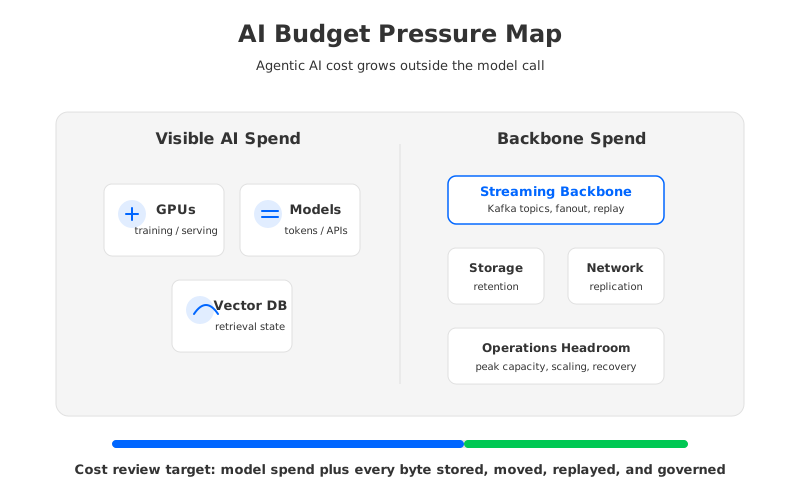
The cost pressure comes from several places at once. Traditional Kafka keeps durable log data on broker-owned storage and uses replication for durability and availability. In a cloud environment, that storage and replication model often translates into broker instances, block storage, cross-zone traffic, operational headroom, and capacity kept idle for peak traffic. The more events you retain for agent memory, simulation, evaluation, and audit, the more the storage model matters.
Agentic AI can amplify each cost driver:
- Higher fanout. The same stream may feed feature computation, vector indexing, monitoring, policy checks, evaluation pipelines, and multiple agent teams.
- Longer retention. Agents create demand for replayable history: not only what happened, but what the agent saw, decided, called, and returned.
- Burstier traffic. AI workflows can create spikes when agents investigate incidents, backfill context, or replay scenarios for testing.
- More derived streams. Each enrichment, classification, policy decision, and tool outcome can become another topic.
- More governance traffic. Audit and approval records are not optional when agents affect production systems, payments, customer communication, or operations.
None of this means Kafka is a bad fit. It means Kafka architecture matters more when AI turns event history into a first-class asset. A disk-bound cluster can still be the right answer for ultra-low-latency transactional paths with tight local performance requirements. But for high-volume context streams, telemetry, replay stores, and agent audit trails, the cost of storing and moving every byte through broker-attached disks deserves a separate design review.
4Diskless Kafka Architecture for AI Workloads
Diskless Kafka changes the question from "how many broker disks do we need?" to "which durable storage layer should own the log?" In AutoMQ, the Kafka-compatible compute layer remains familiar to applications, while durable stream data is offloaded through S3Stream to shared object storage with a write-ahead log path. AutoMQ documentation describes this as a shared storage architecture that makes brokers stateless, with object storage serving as the primary data repository and the WAL layer handling write efficiency and latency requirements.
That distinction matters for AI workloads because many agent data streams are large, replayable, and cost-sensitive. Telemetry, clickstream, tool-call logs, document-processing events, and enrichment outputs may not all require the same latency profile as a payment authorization path. They do require durable storage, predictable replay, elastic ingestion, and enough cost headroom that the AI team can afford to keep the data it needs.
AutoMQ is relevant here because it keeps Kafka protocol compatibility while changing the storage economics underneath. Existing Kafka clients, Kafka Connect pipelines, and many operational patterns can remain familiar, but broker-local persistent storage no longer defines the system. AutoMQ's public docs and customer material position the platform around stateless brokers, object-storage-backed durability, seconds-level elasticity, and BYOC deployment options where the data plane can run in the customer's cloud boundary. The open-source AutoMQ project is licensed under Apache 2.0, which is important for teams that want to inspect the implementation and avoid building agent infrastructure on a closed data backbone.
The production evidence is not abstract. Grab's public story describes a large real-time data streaming platform that improved efficiency after adopting AutoMQ, including partition reassignment moving from hours to under a minute. JD.com's customer story describes AutoMQ running at 40 GiB/s peak throughput during major e-commerce events, with storage footprint reduced by removing redundant broker-level replication on top of shared storage. LG U+ describes 2.2 billion daily log messages on AWS ECS with stateless Kafka brokers and compatibility with existing observability tools. Poizon describes 40 GiB/s observability peaks with elastic scaling and lower cost for high-volume telemetry. These are not agentic AI case studies, but they are highly relevant because agentic AI backbones inherit the same infrastructure pressures: volume, retention, elasticity, replay, and operating control.
There is still a trade-off. Object storage is excellent for elastic durability and cost-effective retention, but it is not the same as local NVMe in every latency scenario. AutoMQ addresses this with a WAL layer and different deployment modes, including lower-latency commercial options described in its architecture material. The design decision should be workload-specific, not ideological.
5Design Checklist for Agentic AI Teams
The right streaming backbone depends on the agent's role. A customer-support agent that watches CRM and ticket events has different needs from a trading agent, a robotics control loop, or a security remediation agent. The mistake is to choose one infrastructure pattern for every stream because all of them happen to feed AI.
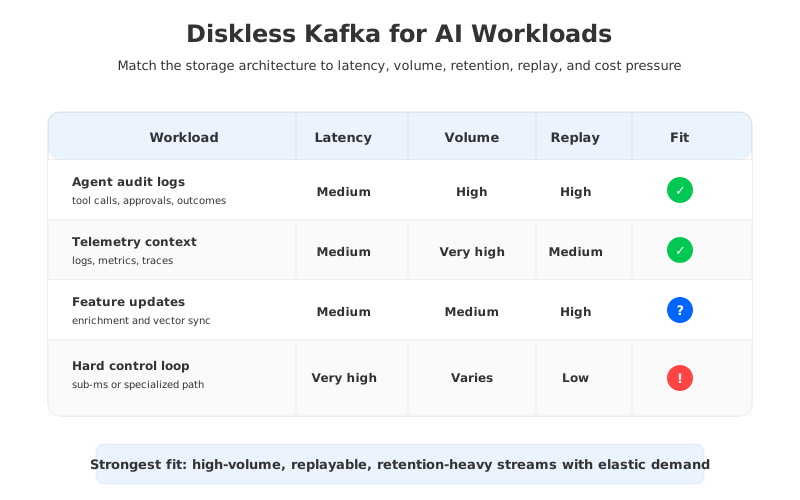
Start with latency, then widen the model. Latency is the first filter because some workloads cannot tolerate the write path or read path trade-offs of a cost-first architecture. After that, look at data volume, retention, replay frequency, fanout, and governance. The streams that produce the largest AI infrastructure bills are often not the lowest-latency streams. They are the ones that create continuous context and long-lived history.
Use this checklist before you add another agent to an existing Kafka estate:
- Classify streams by decision speed. Separate hard real-time actions, near-real-time operational decisions, batch enrichment, replay, and audit. Do not force observability history and customer-impacting control loops into the same latency budget.
- Count fanout explicitly. A topic that feeds one dashboard is different from a topic that feeds Flink, a vector indexer, a policy engine, several agents, and a replay evaluator.
- Model retention as an AI requirement. If agents need historical context, simulation data, or audit trails, retention belongs in the first cost estimate, not in an after-the-fact storage cleanup project.
- Keep deterministic processing outside the LLM. Use Flink, Kafka Streams, or other stream processors to precompute stable signals. Give the agent better context, not more raw noise.
- Publish agent actions as events. Tool calls, approvals, denials, escalations, and generated recommendations should be durable records. That makes audits, debugging, and replay possible.
- Choose deployment boundaries deliberately. For regulated data, BYOC or customer-controlled infrastructure may matter as much as Kafka compatibility.
- Test failure and replay paths. Agent systems fail in ways that normal dashboards do not: a bad prompt, a faulty tool, stale context, or an unsafe action. The backbone must support inspection and recovery.
The cost model should include cloud infrastructure, managed service fees, network transfer, storage, requests, operations, and the cost of not keeping enough data. AutoMQ's pricing calculator is useful as a directional comparison because it separates workload inputs such as throughput, retention, read fanout, requests, partitions, and availability-zone layout. Treat the savings estimate as conditional on your workload and region. The point is not that every AI stream saves the same percentage. The point is that object-storage-native Kafka can change which costs grow with each byte.
6When Traditional Kafka Still Makes Sense
A cost-efficient backbone should not become a blanket answer. Traditional Kafka remains a strong fit for teams that already run it well, have stable capacity, need specific operational guarantees, or have workloads where the dominant cost is not storage, replication, or elasticity. If your agent only consumes a small number of compacted state topics, the migration case may be weak. If the stream drives a latency-critical control path, benchmark the full end-to-end workflow before changing the storage architecture.
There is also an organizational factor. Agentic AI often arrives before platform governance catches up. A team may add tools, prompts, queues, indexes, and streaming topics faster than security and SRE teams can review them. In that environment, a Kafka-compatible backbone is valuable only if it comes with disciplined topic design, schema management, ACLs, observability, and operational ownership. Diskless architecture reduces a class of infrastructure cost and scaling problems; it does not remove the need for production engineering.
The stronger decision is usually a mixed one. Keep ultra-low-latency or highly specialized paths on the infrastructure that matches them. Move high-volume context, telemetry, replay, and audit streams toward a cost-efficient shared-storage backbone when the economics justify it. Use MCP for tool exposure, Kafka for event durability and routing, Flink for stateful signal generation, and agents for bounded reasoning and action.
7FAQ
7.1Is Kafka useful for AI agents?
Yes, when agents need fresh operational context, durable event history, replay, or coordination across systems. Kafka is not an agent framework, but it is a strong backbone for events that agents consume, produce, and audit.
7.2How does MCP relate to Kafka?
MCP standardizes how AI applications connect to external tools, resources, and prompts. Kafka handles event streams. In production, MCP can expose actions and data access to an agent, while Kafka carries the business events, derived signals, tool outcomes, and audit records around that agent.
7.3Do AI agents always need Flink?
No. Flink is useful when the system needs stateful stream processing, event-time logic, windows, joins, or derived operational signals before an agent acts. Smaller systems may use Kafka consumers or Kafka Streams. The principle is to keep deterministic transformations outside the LLM when possible.
7.4Why does streaming cost matter for agentic AI?
Agents increase demand for real-time context, fanout, retention, replay, and audit trails. Those requirements can expand Kafka storage, network, broker capacity, and operations cost. If the backbone is disk-bound and over-provisioned, infrastructure cost can limit how much context the AI system can afford to keep.
7.5Can diskless Kafka reduce AI infrastructure cost by 80%?
It can for some matching workloads, but it is not a universal number. AutoMQ publishes cost comparisons and a pricing calculator showing large savings under specific throughput, retention, fanout, and multi-AZ assumptions. Teams should run their own model with current cloud pricing, workload shape, and latency requirements.
7.6Where does AutoMQ fit in an agentic AI architecture?
AutoMQ fits as a Kafka-compatible streaming backbone for high-volume, replayable, cost-sensitive AI data streams such as telemetry, clickstream, tool-call logs, context updates, and audit trails. Its diskless shared-storage architecture is most relevant when elasticity, retention, and data-control boundaries matter.
7.7Should every Kafka workload for AI move to diskless Kafka?
No. Workloads with strict latency requirements, small scale, specialized storage needs, or already-optimized infrastructure may stay on traditional Kafka. A stronger architecture separates streams by latency, volume, retention, replay, and governance needs instead of treating all AI data as one category.
8Sources
- Apache Kafka documentation: Introduction
- Apache Flink: Applications
- Model Context Protocol: What is MCP?
- Model Context Protocol: Architecture overview
- Apache Kafka KIP-1318: Model Context Protocol Server for Apache Kafka
- AutoMQ overview
- AutoMQ architecture overview
- AutoMQ S3Stream shared streaming storage
- AutoMQ stateless broker documentation
- AutoMQ pricing calculator
- AutoMQ customer story: Grab
- AutoMQ customer story: JD.com
- AutoMQ customer story: LG U+
- AutoMQ customer story: Poizon


